


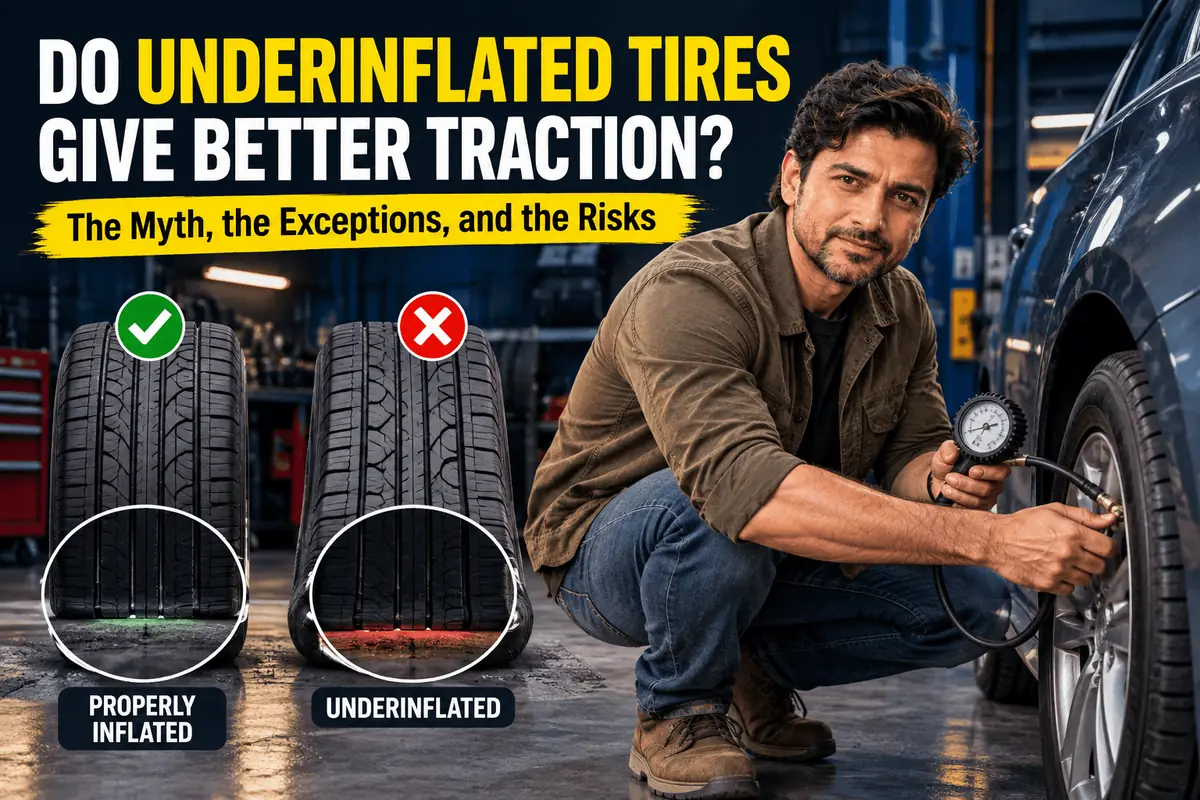
The logic sounds airtight. Let some air out, the tire flattens, more rubber touches the road and you get more grip. It is advice passed between drivers before every snowstorm and repeated at trailheads, and it contains just enough truth to keep it alive. Off-road drivers really do let air out of their tires, and it really does help them.
On pavement, though, the idea falls apart. A tire running below its recommended pressure does not grip a paved road better in the dry, the wet or the snow. It responds more slowly, stops worse in many conditions, builds dangerous heat and wears out faster. This guide explains why the myth fails on the street, where airing down legitimately helps and how to do it without destroying a tire or a wheel.
Table of Contents
Where the Myth Comes From
There is a real physical effect behind the belief. Lower pressure lets the tire deflect more under the vehicle’s weight, so the footprint gets longer. Off-road, on sand or loose dirt, that longer and softer footprint makes a dramatic difference. Drivers see it work at the beach or on a trail and assume the same principle applies everywhere.
The problem is that pavement is a completely different surface. A paved road is firm and does not need to be spread out over a larger area. What matters there is how evenly the tire’s load is distributed across its footprint, how well the tread channels water and how quickly the tire responds to steering and braking. Underinflation hurts all three.
Why Low Pressure Hurts Grip on Pavement
The Footprint Gets Bigger but Worse
Tire engineers design a tire’s construction and tread to work at a specific pressure range. At the right pressure, the load is spread fairly evenly across the width of the contact patch. When pressure drops, the center of the tread lifts slightly and the load shifts toward the shoulders. The footprint may grow in area, but the pressure across it becomes uneven, and the tread blocks no longer meet the road the way they were engineered to.
Sloppy Steering and Slower Responses
A soft tire has more sidewall flex. Turn the wheel and the sidewall twists before the tread follows, which makes steering feel vague and delayed. In an emergency lane change, that lag matters. The tire can also roll over onto its shoulder in hard cornering, reducing grip exactly when you need it most.
Wet Roads and Hydroplaning
Underinflation is particularly harmful in the rain. A soft tire’s tread grooves can partially close under load, and the uneven footprint does a poorer job of pushing water out from under the tire. The result is a higher risk of hydroplaning and reduced grip on wet pavement, the opposite of what drivers hoping for extra traction want.
Braking Suffers Too
Because the load is concentrated on the shoulders and the tread is not working as designed, a significantly underinflated tire can need more distance to stop, especially on wet roads. It also overheats more readily under repeated hard braking.
Snow and Ice: Still a No
Winter is when the myth gets the most use, and it is still wrong for ordinary road driving. Consumer Reports advises keeping tires at the vehicle manufacturer’s recommended pressure in all conditions, including snow. On a snowy road, a tire needs to bite through the snow and grip what lies beneath, and a soft, flattened tire does that job poorly while also compromising braking and handling.
Cold weather is already working against you. Tire pressure drops by roughly 1 psi for every 10 degrees Fahrenheit the temperature falls, so a car set up in mild fall weather can be several psi low by the first cold snap. Deliberately letting out more air compounds the problem. The real winter traction upgrade is a set of dedicated winter tires, properly inflated.
Where Airing Down Does Help
Off pavement, at low speeds, lower pressure becomes a legitimate tool. The longer, softer footprint spreads the vehicle’s weight over a larger area and lets the tread wrap around obstacles.
- Sand. This is where airing down makes the biggest difference. A softer tire floats on top of loose sand instead of digging in, which can be the difference between moving forward and getting stuck.
- Rocks. A flexible tire conforms to the shape of a rock, increasing the amount of tread in contact and reducing the chance of a sharp edge puncturing a tight, overinflated tire. The ride also becomes far more comfortable.
- Mud and loose trails. Moderate reductions improve grip on soft, uneven trail surfaces and smooth out washboard ruts.
- Deep, unplowed snow off-road. On trails, where the goal is flotation rather than biting through to pavement, airing down can help in the same way it does in sand.
Off-road equipment makers commonly suggest starting points like these for light trucks and SUVs on standard, non-beadlock wheels. Treat them as typical ranges, not targets, and adjust for your vehicle’s weight, tire size and tire construction.
| Terrain | Typical Aired-Down Range (Non-Beadlock Wheels) |
|---|---|
| General trail driving | About 18 to 25 psi |
| Mud | About 15 to 20 psi |
| Snow trails | About 15 to 20 psi |
| Sand | About 12 to 15 psi |
| Rocks | About 10 to 15 psi |
Beadlock wheels, which clamp the tire bead mechanically, allow even lower pressures. On ordinary wheels, air pressure is what holds the bead against the rim, and going too low risks pushing the bead off the wheel.
How to Air Down Safely
- Air down only at the start of off-road terrain, never on public roads you plan to drive at normal speeds.
- Use an accurate gauge or tire deflators so all four tires end up at the same pressure.
- Lower pressure gradually, starting conservatively and going lower only if the terrain demands it.
- Keep speeds low. Aired-down tires build heat quickly and are vulnerable to damage at higher speeds.
- Avoid sharp, high-speed turns that can roll the tire off the bead.
- Carry a compressor and reinflate to the vehicle’s recommended pressure before returning to pavement.
Light truck tires with stronger sidewalls tolerate airing down better than passenger tires, which are not built for it and are more likely to suffer sidewall damage.
What About Racing?
Race teams tune tire pressure carefully, and they may set cold pressures lower than street settings. That is not the same as underinflation. Race tires are built for track conditions, and teams set cold pressure knowing heat will raise it to a specific operating window. Engineers watch tire temperatures and wear and adjust pressure in small increments. Rally crews running loose gravel stages make similar adjustments for the surface. None of that translates to a street car on all-season tires, where the correct pressure is printed on the door jamb placard.
The Real Costs of Running Low
Even modest underinflation adds up, and severe underinflation is dangerous.
- Heat and tire failure. A soft tire flexes more with every revolution, which builds heat in the casing. Heat is the enemy of a tire’s internal structure and can lead to tread separation or a blowout, especially at highway speeds and with a full load.
- Higher crash risk. An NHTSA study found that vehicles with tires underinflated by more than 25 percent were three times more likely to be involved in a crash related to tire problems than vehicles with properly inflated tires.
- Faster, uneven wear. Underinflation wears the shoulders faster than the center, shortening tread life.
- Worse fuel economy. According to fueleconomy.gov, underinflated tires lower gas mileage by about 0.2% for every 1 psi drop in the average pressure of all four tires, while keeping tires properly inflated improves mileage by 0.6% on average and up to 3% in some cases.
If your tire pressure warning light comes on, treat it as a request to stop and check. Tire pressure monitoring systems typically warn when a tire is about 25 percent below the recommended pressure, which is already low enough to hurt handling and build heat.
How to Keep Pressure Right
The correct pressure for your vehicle is listed on the tire placard, usually on the driver’s door jamb, and in the owner’s manual. The number molded into the tire’s sidewall is the maximum pressure the tire can hold, not the recommended inflation for your car.
Check pressure at least once a month and before long trips, with the tires cold, meaning the car has been parked for a few hours or driven less than a mile. Use a quality gauge rather than trusting a glance at the tire, since a tire can lose a lot of air before it looks low. Recheck as temperatures fall in autumn and winter. Our guide to what happens when tire pressure is too low walks through the symptoms and long-term effects in more depth.
Modern tire technology has also made underinflation unnecessary for grip. Silica-enhanced tread compounds, dense siping and carefully engineered tread patterns deliver strong wet and winter traction when the tire is properly inflated. That is the condition every one of those features was engineered around.
Frequently Asked Questions
No. On pavement, low pressure produces an uneven footprint, more sidewall flex and slower steering responses, and it raises the risk of hydroplaning on wet roads. Properly inflated tires deliver better grip, braking and handling.
Not for normal road driving. Keep tires at the vehicle manufacturer’s recommended pressure, since a soft tire bites through snow poorly and compromises braking and handling. Cold weather already lowers pressure by roughly 1 psi per 10 degrees Fahrenheit, so check more often in winter.
At low speeds off pavement. Sand, rocks, mud and deep snow on trails all benefit from lower pressure, which lengthens the footprint and lets the tire conform to the surface. Reinflate before returning to the road.
On standard wheels, common ranges run from about 18 to 25 psi for general trails down to about 10 to 15 psi for rocks. Going lower risks unseating the bead unless you have beadlock wheels.
Fueleconomy.gov estimates that gas mileage drops by about 0.2% for every 1 psi drop in the average pressure of all four tires. Keeping tires properly inflated improves mileage by 0.6% on average and up to 3% in some cases.
It can be. Low pressure increases heat buildup, which can lead to tread separation or a blowout, and it degrades handling and braking. NHTSA research found that tires underinflated by more than 25 percent made a tire-related crash three times more likely.
The Verdict on Low Pressure and Grip
On pavement, underinflated tires do not give better traction. They distort the footprint, slow steering response, invite hydroplaning and build heat that can lead to failure, and that is true in snow as well as in dry and wet conditions. The pressure on your door jamb placard is the one that delivers the best balance of grip, braking, handling, tread life and fuel economy for your vehicle.
Airing down earns its place off-road, at low speeds, on sand, rocks, mud and snowy trails, where a longer and softer footprint helps a tire float and conform. Do it gradually, keep speeds low and carry a compressor so you can restore full pressure before you return to the road.
 Summarize this article with:














Leave a comment