


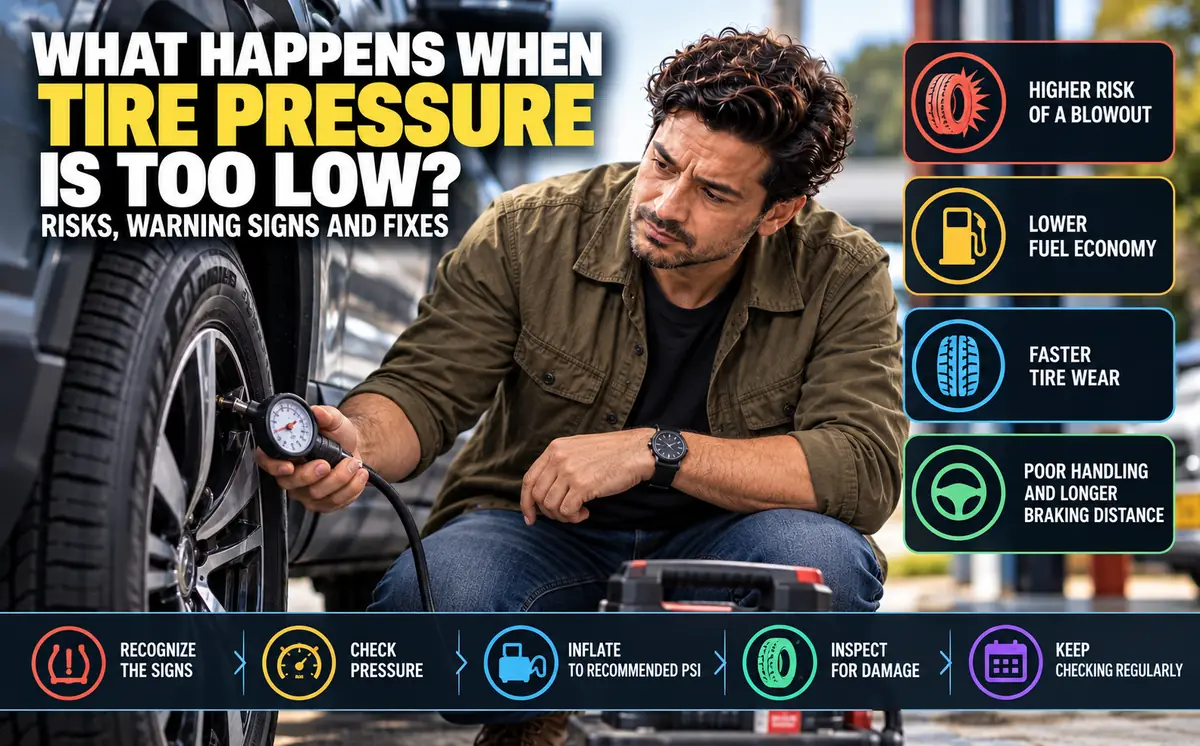
A tire that is a few psi low rarely looks any different from one that is properly inflated. The car still drives, the steering still works, and nothing seems urgent. That is exactly what makes underinflation so easy to ignore. Inside the tire, though, the sidewalls are flexing harder, heat is building, the tread is wearing on its edges, and the car is taking longer to stop.
Most drivers find out their pressure is low only when the warning light comes on, and by then the tire may have been running well under spec for weeks. This guide focuses on what low pressure does to the tire and the car, how to recognize it before the light appears, and what to do once you find a low tire. Our guide to finding the right tire pressure covers how to pick the correct number for your vehicle.
How this guide was put together: This guide is general information based on common manufacturer and industry guidance; your owner’s manual is the controlling source. Prices are typical ranges, not quotes. Checked on October 22, 2026.
Table of Contents
Why Air Pressure Matters So Much
A tire does not hold the car up on its own. The compressed air inside does most of the work, and the rubber, belts, and cords act as a container that keeps that air in the right shape. When pressure drops, the tire loses the internal support that keeps its sidewalls firm and its tread flat on the road.
The effects are gradual. A tire a couple of psi low behaves almost normally. As the shortfall grows, the sidewall bulges, the contact patch changes shape, and every problem described below gets worse. Pressure also falls on its own over time, so a tire that was set correctly months ago is probably not correct today.
Heat Buildup and Blowout Risk
Heat is the most serious consequence of low pressure. As a tire rolls, its sidewall flexes where it meets the road and straightens again as it leaves. That repeated flexing generates heat inside the rubber. At the correct pressure, the amount of flex is controlled and the heat stays within what the tire can shed.
An underinflated tire flexes much more with every revolution. At highway speed that happens hundreds of times a minute, and the extra flexing builds far more heat. Sustained high temperature weakens the bonds between the tire’s internal layers. The tread can separate from the casing, or the sidewall can fail, and that is how many highway blowouts begin.
Speed, load, and outside temperature all make it worse. A low tire on a fully loaded car during a summer road trip is close to the worst case. The damage can also be invisible from the outside: a tire that has been run very low may have internal damage even after it is reinflated.
A tire that has been driven a long way at very low pressure, or nearly flat, should be removed and inspected inside by a tire shop before it goes back into service. Reinflating it does not undo damage to the casing.
Shoulder Wear and Shorter Tire Life
The contact patch on a properly inflated tire is fairly flat and even across the tread. When pressure is low, the tire sags under the car’s weight, the shoulders carry more of the load, and the center of the tread presses less firmly on the road.
The result is shoulder wear: both outer edges wear down faster than the middle. Once the shoulders reach the wear bars, the tire needs replacing even if the center still has tread left. Uneven wear like this cuts into tread life and can also complicate a mileage warranty claim, since most warranties require correct inflation.
Longer Braking Distances
Underinflation changes the shape of the contact patch and lets the tread squirm and distort under heavy braking. The tire cannot use its full grip as effectively, so stopping distances grow. The difference is most noticeable on wet pavement, where the tire’s ability to clear water from under the tread already limits grip.
In an emergency stop, a few extra feet can decide whether you stop short of the car ahead or hit it. That is a strong reason to check pressure before long trips and at the start of rainy or winter weather.
Sluggish Steering and Hydroplaning
Vague Handling
Air pressure gives the sidewall much of its stiffness. When pressure is low, the sidewall becomes soft and the tire rolls over on its edge when you turn the wheel. Steering response feels delayed, the car leans and wallows more in corners, and quick avoidance maneuvers become less precise. If a rear tire is low, the back of the car can feel loose in a sudden lane change.
A car that pulls to one side on a straight road can also point to one low tire, since the softer tire has more drag and a slightly smaller rolling radius than its partner on the same axle.
Water Clearance
Tread grooves channel water out from under the tire. In an underinflated tire, the tread pattern deforms and the grooves partly close up, so the tire clears water less effectively. That lowers the speed at which the tire starts to ride up on a film of water and lose contact with the road. Low pressure combined with worn tread makes hydroplaning far more likely in heavy rain.
Lost Fuel Economy
A soft tire deforms more as it rolls, which raises rolling resistance. The engine has to work harder to keep the car moving at the same speed, and you pay for that at the pump.
The U.S. Department of Energy estimates that gas mileage drops by about 0.2% for every 1 psi drop in the average pressure of all four tires. A single psi is barely noticeable, but tires that are several psi low across the board, which is common when nobody checks them for a season, add up to a steady and avoidable cost on every fill-up.
Sidewall and Rim Damage
A properly inflated tire cushions the wheel when it hits a pothole or a sharp edge. An underinflated tire has less of that cushion, so a hard impact can pinch the sidewall between the road and the rim. That can cut or bruise the sidewall internally, leaving a bulge that shows up days later, and it can bend or crack the wheel.
Driving on a tire that is nearly flat does even more harm. The sidewall folds and rubs against itself, which can ruin the tire within a short distance, and the rim can contact the road. A sidewall bulge or a tire that has been driven flat should be replaced, since sidewall damage generally cannot be repaired.
Low pressure on an all-wheel-drive vehicle has one more consequence. A low tire has a smaller rolling diameter than the others, so it turns faster. Some AWD systems read that constant difference as slip, which puts extra strain on the drivetrain.
Consequences at a Glance
| Consequence | What Happens | What You Notice |
|---|---|---|
| Heat buildup | Excess sidewall flex raises internal temperature | Often nothing until the tire fails |
| Shoulder wear | Outer edges carry more load | Both edges worn smooth before the center |
| Longer braking | Distorted contact patch reduces usable grip | Car takes longer to stop, especially in rain |
| Sluggish steering | Soft sidewall rolls over in turns | Delayed response, more body lean |
| Hydroplaning | Tread grooves clear less water | Car feels light on wet highways |
| Fuel economy loss | Higher rolling resistance | More frequent fill-ups |
| Sidewall or rim damage | Less cushion against impacts | Bulges, bent wheels, cuts |
How the TPMS Warning Works
Passenger vehicles sold in the U.S. since the 2008 model year are required to have a tire pressure monitoring system. The warning light, a yellow horseshoe-shaped tire symbol with an exclamation point, comes on when one or more tires falls about 25% below the recommended cold pressure.
That threshold is a safety net, not a maintenance schedule. On a car with a 35 psi recommendation, the light may not come on until a tire is around 26 psi. By that point the tire is already wearing its shoulders, running hotter, and costing fuel. Treat the light as a sign that something is already wrong, and check pressure with a gauge before you ever see it.
A light that flashes for a minute or so at startup and then stays on usually indicates a fault in the system itself, such as a failed sensor, rather than a low tire. Sensors are battery powered and eventually wear out. Have a faulty system repaired, because it cannot warn you about a real problem while it is not working.
After you add air, the light usually goes out on its own once you have driven a short distance, but some vehicles need a manual reset. Your owner’s manual explains the procedure.
How to Tell a Tire Is Low
A gauge is the only reliable way to know. Tires can be 20% or more under pressure and still look normal, especially those with low-profile sidewalls. Still, several signs point to a low tire:
- The TPMS light is on. Check all four tires, plus the spare if your car monitors it.
- The steering feels heavy or slow. The car needs more effort to turn and responds lazily.
- The car pulls to one side. One low front tire often causes a steady pull toward that side.
- The sidewall bulges noticeably. Compare the tire with the others on the car. One that sits visibly flatter at the bottom is likely low.
- The ride feels mushy or the tire squeals in turns. Soft sidewalls lean more and protest at modest cornering speeds.
- The shoulders are wearing faster than the center. This is the long-term evidence of running low.
- Fuel economy has dropped without explanation. Low tires are one of the first things to check.
Pressure also falls with the weather, about 1 psi for every 10°F drop in outside temperature. A tire set correctly on a warm afternoon in late summer can be several psi low on the first cold morning of winter, which is why TPMS lights so often appear in the fall.
What to Do When a Tire Is Low
- Find a safe place to stop. If the light came on suddenly or a tire is visibly flat, slow down and pull over rather than continuing at highway speed.
- Check all four tires with a gauge. For an accurate reading, check cold, after the car has been parked for at least three hours or driven less than a mile. A warm tire reads higher than its true cold pressure.
- Inflate each tire to the pressure on the placard in the driver’s door jamb or in the owner’s manual. Do not inflate to the maximum pressure molded on the sidewall. That figure is the most the tire is rated to hold, not the pressure the car should run.
- Look for the cause. Inspect the tread for nails or screws and the sidewall for cuts or bulges. If one tire keeps losing air, have it checked for a puncture, a leaking valve stem, or corrosion where the tire seals against the wheel.
- Recheck in a day or two. A tire that drops again quickly has a leak that needs repair.
Build a Monthly Habit
Tires lose air slowly even without damage, roughly 1 to 2 psi a month, as air works its way through the rubber. Old valve stems and corroded wheel beads can add to the loss. Checking all four tires once a month and before long trips catches the gradual drop long before the TPMS light does. Keep a gauge in the glove box so you are not relying on a worn gauge at a gas station air pump.
Related Reading
- How to Get Water Out of Tires: Causes, Risks and the Proper Fix
- Do Underinflated Tires Give Better Traction? The Myth, the Exceptions and the Risks
Frequently Asked Questions
Only slowly and for a short distance to reach air or a shop. For most passenger vehicles, 20 psi is far below the recommended pressure, and driving at highway speed at that level builds heat quickly and raises the risk of a blowout. Add air as soon as possible and inspect the tire for the cause of the loss.
There is no single cutoff, because the risk grows steadily as pressure falls. The TPMS warning at about 25% below the recommended pressure is a good marker for a tire that needs attention right away. Any shortfall large enough to make the sidewall bulge visibly is already affecting braking, handling, and heat.
Usually, once the tires are inflated to the correct pressure and you have driven a short distance. Some vehicles require a reset through a button or the vehicle settings menu. If the light flashes at startup and then stays on, the system has a fault that needs repair.
It can. A low tire has a smaller rolling diameter than the others, so it turns faster. Some all-wheel-drive systems treat that constant speed difference as slip, which adds strain to the drivetrain over time. Keeping all four tires at the same correct pressure avoids the issue.
Slightly. Nitrogen seeps through tire rubber more slowly than oxygen, so tires filled with it tend to lose pressure a little more slowly. Ordinary air is already about 78% nitrogen, though, and regular pressure checks matter far more than which gas is in the tire.
Air contracts as it cools, so pressure falls about 1 psi for every 10°F drop in temperature. Tires that were correct in warm weather can drop enough to trigger the TPMS light on the first cold morning. Add air to the placard pressure, checking when the tires are cold.
If your placard says 35 psi, 31 psi is low enough to cost fuel and wear but the car will behave almost normally, while 27 psi is about 25% low, close to where the warning light comes on, so add air before driving far.
Keeping the Air Where It Belongs
Low tire pressure rarely announces itself until the damage is underway. It overheats the tire, wears the shoulders, lengthens stopping distances, dulls the steering, invites hydroplaning, wastes fuel, and leaves the sidewall and wheel exposed to impact damage. The TPMS light is a last warning rather than a first one. A gauge, a monthly check, and a few minutes at the air pump prevent nearly all of it, and they cost far less than a new tire or a roadside blowout.
Sources
Specs, warranty terms and prices were checked on October 22, 2026. Prices change often.
- NHTSA: Tires (tire safety, pressure and maintenance)
 Summarize this article with:















Leave a comment