


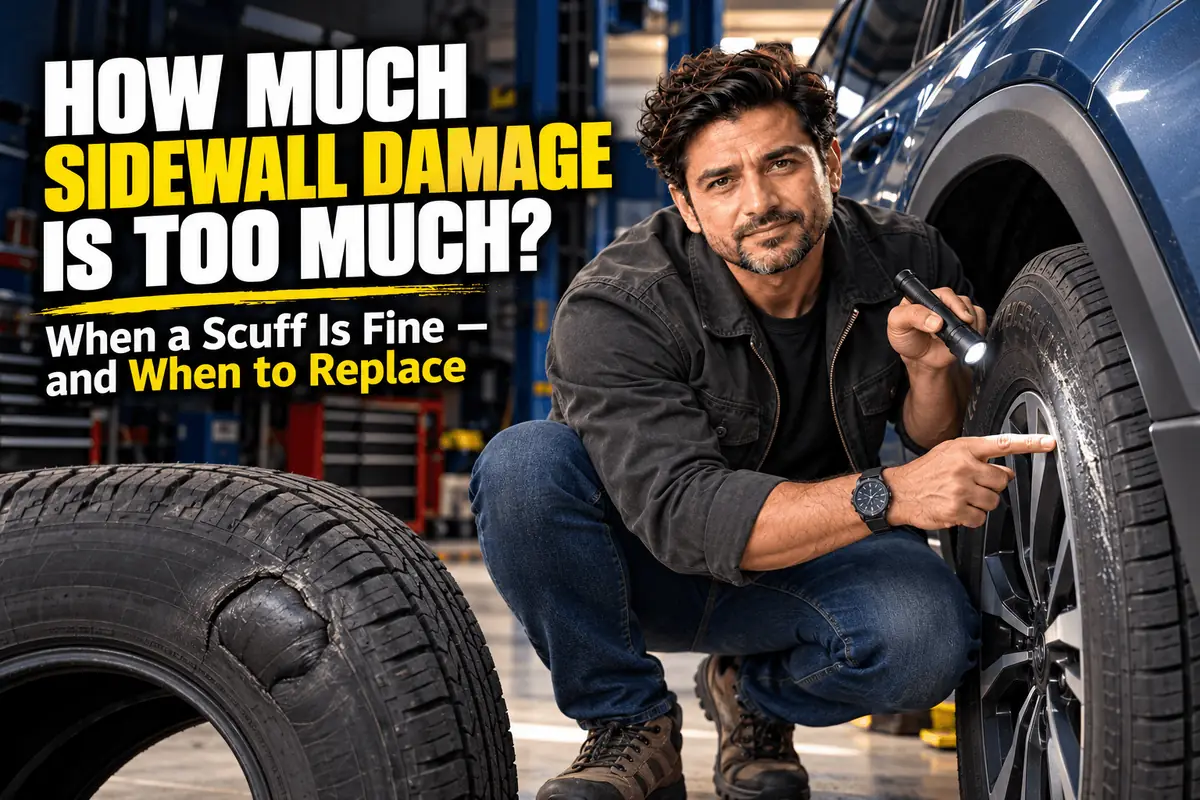
You scrape a curb while parallel parking, or you notice a pale gash on the side of a tire while loading groceries. The tire still holds air and the car drives normally. The question is whether that mark is just ugly or whether it is the kind of damage that ends a tire’s life. Getting the answer wrong in one direction costs you a tire you did not need to buy. Getting it wrong in the other direction can leave you on the shoulder with a blown tire.
The good news is that sidewall damage sorts into two fairly clear groups. Some marks only affect the protective outer rubber and can be left alone. Others reach the structure of the tire, and no shop should repair them. This guide explains where that line sits, how to inspect a damaged sidewall yourself, what changes with run-flat and low-profile tires, and whether you need to replace one tire or a pair.
Table of Contents
Why the Sidewall Gets Treated So Strictly
The tread area of a modern radial tire is reinforced by steel belts sitting on top of the body plies. The sidewall has no belts. Its strength comes from the body ply cords, usually polyester or another fabric, that run from bead to bead beneath a relatively thin layer of rubber. Those cords carry the load and hold the air pressure in shape.
The sidewall also flexes with every revolution. It bends as the tire rolls through the contact patch, it twists in corners and it absorbs the shock of every pothole. Any damage that weakens the cords in that zone gets worked thousands of times per mile, which is why a cut that looks small can grow into a failure. It also explains why the tire industry draws a hard line: punctures and cuts in the sidewall are not repaired.
Cosmetic or Replace: The Two Groups
Damage You Can Usually Leave Alone
Many tires have a raised protective rib or rim protector molded into the lower sidewall. Its job is to take curb contact so the rest of the sidewall does not. When that rib is scuffed, scraped or lightly gouged, the damage is often cosmetic.
- Light scuffs and curb rash confined to the protective rib or the outer surface rubber
- Shallow scrapes where the rubber is roughened but no cords, threads or fabric are visible
- Fine surface weather checking on a tire that is otherwise in good shape and not old
- Marks that do not leak air and do not change the shape of the sidewall
Cosmetic does not mean ignored. Mark the spot with chalk, take a photo and look at it again over the next few weeks to make sure it is not opening up.
Damage That Means Replacement
- Any cut or gouge that reaches the cords or shows fabric, threads or wire
- Any bulge, bubble or blister on the sidewall, regardless of size
- Any puncture through the sidewall, even a small nail hole
- Deep cracks that open up when the sidewall flexes or that show anything beneath the rubber
- Damage at or near the bead, where the tire seats against the wheel
- Impact breaks: a pinch from a pothole or curb that leaves a crease, dent, soft spot or distortion
- Cuts near the shoulder where the sidewall meets the tread
- Any sidewall damage that is leaking air
A bulge is a sign that cords inside the casing have already broken, and our guide to sidewall bubbles covers that problem in more detail. The short version is simple: a bulge is never cosmetic.
| Damage | What It Looks Like | Verdict |
|---|---|---|
| Curb rash on protective rib | Roughened or scraped rubber, no cords visible | Usually cosmetic, monitor |
| Shallow surface scuff | Rubber abraded but intact underneath | Usually cosmetic, monitor |
| Fine weather checking | Hairline surface cracks on a younger tire | Monitor, inspect as tire ages |
| Cut reaching cords | Fabric, threads or wire visible in the cut | Replace |
| Bulge or bubble | Outward blister on the sidewall | Replace |
| Sidewall puncture | Nail, screw or hole through the rubber | Replace |
| Deep cracking | Cracks that open when flexed or expose layers | Replace |
| Bead area damage | Cuts or tears where the tire meets the rim | Replace |
| Impact break | Crease, dent, soft spot or distortion after a hit | Replace |
Why a Sidewall Cannot Be Patched
Under industry guidance from the US Tire Manufacturers Association (USTMA), a passenger or light truck tire can be repaired only for punctures in the tread area, and only when the injury is about 1/4 in. in diameter or smaller. The proper repair requires removing the tire from the wheel, inspecting the inside and installing a combination patch and plug from within. Punctures in the shoulder or sidewall fall outside the repairable area, and so does any puncture larger than that limit.
That rules out the shortcuts. A plug pushed in from the outside does nothing to restore cords. Sealants, rubber cement, fillers and protective coatings can hide a cut, but they cannot rebuild what was cut. If a shop offers to patch a sidewall on your passenger car tire, take it somewhere else.
If a sidewall cut reaches the cords, the tire has lost part of its structure. Covering the cut does not put that structure back.
How to Inspect a Damaged Sidewall
A careful look takes about ten minutes per tire and tells you which group you are dealing with. It does not replace a professional inspection, but it helps you decide how urgent that inspection is.
- Park on level ground, set the parking brake and switch off the engine.
- Check the tire pressure first. A tire running low can show wrinkles and distortion that make damage look worse, or hide a slow leak from a cut.
- Clean the area with water and a soft brush or cloth. Road grime and brake dust easily hide a cut or the edge of a crack.
- Use good light. Daylight works, but a flashlight held at a low angle across the sidewall shows cuts, ridges and bulges far better than overhead light.
- Look at the inner sidewall too. Turn the steering wheel fully to each side to expose the front tires, and use a flashlight to check the inside of the rear tires. Impact damage often hits the inner side.
- Run your hand slowly around the full sidewall. A bulge, dip or soft spot is often easier to feel than to see.
- Gently check the depth of any cut with a fingernail. Do not pry it open with a screwdriver or other metal tool.
- Mark anything questionable with chalk and photograph it so you can compare later.
As a rule of thumb, if your fingernail catches and sinks into a cut rather than sliding over a roughened surface, or if you can see anything that looks like threads or fabric inside it, treat the tire as a replacement candidate and get it inspected before you drive on it at speed. A light scuff that your fingernail skims across is far less concerning. That is guidance for deciding what to do next, not a measured safety limit, so the final call belongs to a technician.
When to Get a Professional Opinion
Get a tire shop to look at the tire whenever you find a cut you cannot classify, any damage after a hard pothole or curb hit, a tire that keeps losing air or a vibration that appeared after an impact. A technician can dismount the tire and inspect the inner liner, which is where hidden damage from an impact or from driving underinflated often shows up first. Many tire retailers will check a tire for little or no charge.
Cracking, Weathering and Tire Age
Rubber ages with exposure to sunlight, ozone, heat and time. Early signs include fading from black to gray and a network of fine surface cracks, often called weather checking. Shallow checking on the surface rubber is common and does not by itself condemn a tire. Cracks that are deep enough to open when you squeeze the sidewall, that run together into larger splits or that reveal anything below the surface rubber are a different matter, and they put the tire in the replace group.
Age also changes how you read other damage. An older, hardened tire has less margin left, so a scrape you would monitor on a two-year-old tire deserves a closer look on an old one. Find the tire’s age from the last four digits of the DOT code on the sidewall, which give the week and year of manufacture. Many tire and vehicle manufacturers recommend regular professional inspection once a tire passes about five or six years old, even if the tread still looks healthy.
Run-Flat and Low-Profile Tires
Run-Flat Tires
Self-supporting run-flat tires use stiff, reinforced sidewalls that hold the car up for a limited distance after air loss. That stiffness works against you when inspecting damage. A run-flat can be driven on while badly underinflated without the driver noticing much, and the heat and flexing from that can damage the internal structure without leaving obvious marks on the outside. The same replace rules apply to cuts, bulges and punctures, and repair policies for run-flats are tighter still. Many manufacturers limit or prohibit repairs entirely, especially after a tire has been driven in run-flat mode, so check the tire maker’s policy and expect a shop to recommend replacement after any significant sidewall damage.
Low-Profile Tires
Low-profile tires have short sidewalls with less rubber and air between the wheel and the road. They are more prone to curb rash, and a pothole is more likely to pinch the sidewall against the rim hard enough to cause an impact break. Their wheels tend to take damage as well. After any hard hit on a low-profile tire, check the sidewall inside and out, and look at the rim lip for bends or cracks. A damaged wheel can cause slow leaks and vibration even after the tire is replaced.
Replacing One Tire or a Pair
Once a tire is condemned, the next question is how many new tires you need. The answer depends on how worn the others are and what drives the wheels.
| Situation | Usual Recommendation |
|---|---|
| Other tires are nearly new | Replace only the damaged tire, ideally with the same model and size |
| Other tire on the axle is well worn | Replace both tires on that axle to keep handling balanced |
| Replacing just two tires | Most shops install the newer pair on the rear axle |
| AWD vehicle with worn tires | Check the owner’s manual for tread-depth matching rules |
| AWD vehicle and a full set is too costly | Ask whether the shop can shave the new tire to match |
All-wheel-drive systems deserve extra care. Many are sensitive to differences in tire diameter, and a new tire next to three worn ones turns at a slightly different speed. Over time, that difference can strain the center differential or coupling. Vehicle makers often specify how closely tread depths must match, and some tire shops can shave a new tire down to the depth of the others, which can save you from buying a full set.
Preventing Sidewall Damage
- Check pressure monthly when the tires are cold, using the figure on the driver’s door jamb placard rather than the maximum on the sidewall.
- Approach curbs slowly and at a shallow angle when parking, and avoid climbing them.
- Slow down before potholes and broken pavement. Braking hard while over the hole loads the tire at the worst moment.
- Stay within your tires’ load rating, especially when towing or carrying heavy cargo.
- Inspect the sidewalls after any hard hit, since internal damage can take a day or two to show.
- Have the sidewalls checked at every rotation, when a technician can see the inner sides easily.
Frequently Asked Questions
Usually not. Light curb rash on the protective rib or outer rubber is usually cosmetic. It becomes a problem when the scrape turns into a cut that reaches the cords, when it sits near the bead or when the curb strike also caused a bulge or distortion. Clean the area, check it closely and get a shop opinion if you are unsure.
No. Industry repair guidance limits repairs to punctures in the tread area of about 1/4 in. or less, made with a patch and plug installed from inside the tire. Any puncture in the sidewall or shoulder means the tire should be replaced.
Those threads are the body ply cords or the fabric layer that gives the sidewall its strength. Once they are exposed, the tire has lost part of its structure and should be replaced. Avoid highway speeds and fit the spare if you can.
Fine surface checking is common and often only cosmetic. Cracks that open when the sidewall is flexed, that join into larger splits or that expose anything below the surface mean the rubber has deteriorated too far, and the tire should go.
If the damage is in the replace group, drive only as far as you must, at moderate speed, and fit the spare if one is available. Cosmetic scuffs are generally fine to drive on while you keep an eye on them. When you cannot tell which you have, treat it as serious until a technician says otherwise.
Not always. If the other tire on the axle is nearly new, replacing only the damaged one is usually acceptable. If it is well worn, replacing both keeps handling even, and AWD owners should follow the owner’s manual on tread-depth matching.
The Bottom Line on Sidewall Damage
The line between cosmetic and dangerous is clearer than it first looks. Scuffs and curb rash that stay on the protective rib or surface rubber, with no cords showing, are usually safe to monitor. Anything that reaches the cords, shows fabric, bulges, punctures the sidewall, cracks deeply, sits near the bead or follows a hard impact puts the tire in the replace group, and no reputable shop will patch it.
Do the careful inspection, use the fingernail check as a guide rather than a measurement, and let a technician make the final call when the damage is borderline. A replacement tire costs far less than the consequences of a sidewall letting go at highway speed.
 Summarize this article with:

















Leave a comment