


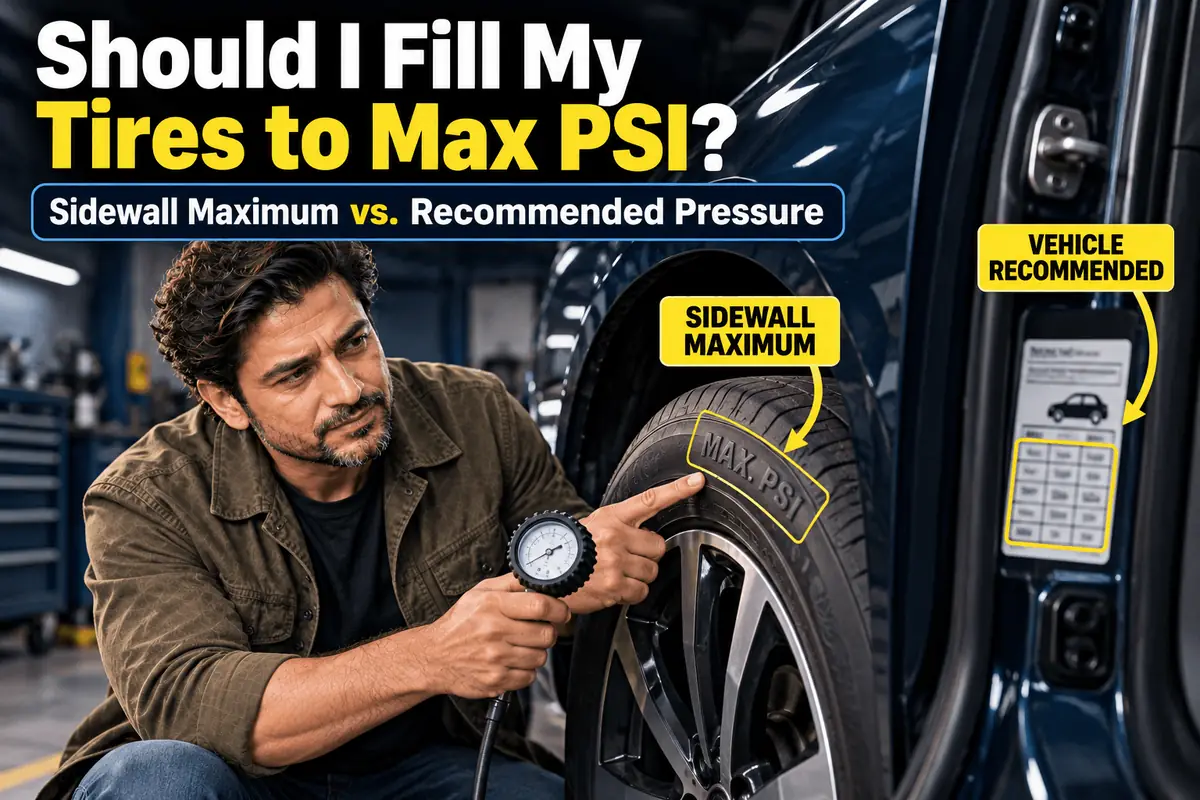
You crouch at the air pump, look at the sidewall and see “MAX PRESS 44 PSI” molded into the rubber. Then you open the driver’s door and find a sticker that says 35 psi. Two numbers, nine psi apart, and both seem official. Plenty of drivers split the difference or go with the bigger number on the theory that more air means better mileage and a safer tire.
For a typical car, SUV or light truck, the answer is no. The number on the sidewall is a ceiling, not a target. The pressure your tires should run is the one on the vehicle’s placard, set by the automaker for that specific vehicle. There are real exceptions, though, including trailer tires and some heavy-load situations, and the way heat changes your readings trips up a lot of people. Here is how to read the numbers and get pressure right.
How this guide was put together: This guide is general information based on common manufacturer and industry guidance; your owner’s manual is the controlling source. Prices are typical ranges, not quotes. Checked on October 22, 2026.
Table of Contents
Two Numbers, Two Different Jobs
The Sidewall Maximum
The pressure molded on the sidewall is the highest cold inflation pressure the tire is built to contain. Tire makers set it for the tire, with no knowledge of what vehicle it ends up on. It is a safety limit for the tire’s structure, not a recommendation for daily driving.
On many passenger tires, the maximum is well above the pressure needed to carry the tire’s full rated load. For example, a standard load P-metric tire reaches its maximum load capacity at 35 psi, and an extra load P-metric tire reaches it at 41 psi, yet the sidewall maximum on either may read 44 psi or 51 psi. That extra headroom exists so tire and vehicle manufacturers can tune pressure for handling, high-speed driving or rolling resistance when needed. It is not an invitation to fill to the top.
The Vehicle Placard
The pressure you should use is on the tire and loading information placard, usually on the driver’s door jamb, and in the owner’s manual. Some vehicles put it on the door edge, glove box door or fuel filler door. The automaker sets this number after weighing the vehicle’s weight, load capacity, handling, braking, ride comfort and fuel economy. It is a cold pressure, and it often differs between the front and rear axles.
Many placards list one pressure for normal use and loads up to the vehicle’s maximum. Some vehicles, particularly European models and trucks, list a second, higher pressure for full loads or sustained high speeds. If yours does, that higher figure is the one to use in those conditions.
| Number | Where You Find It | What It Means | Use It For |
|---|---|---|---|
| Placard pressure | Driver’s door jamb and owner’s manual | The automaker’s recommended cold pressure for your vehicle | Everyday inflation on passenger cars, SUVs and light trucks |
| Sidewall maximum | Molded on the tire | The highest cold pressure the tire is built to hold | A limit never to exceed; the target only in special cases such as many trailer tires |
| Load-specific pressure | Owner’s manual, some placards or load and inflation tables | A higher pressure for heavy loads or high speed | Towing, hauling or loaded highway trips when the manual calls for it |
Our guide to finding the right tire pressure walks through locating the placard and reading it on different types of vehicles.
What Happens When You Fill to Max PSI
Running a passenger tire at its sidewall maximum, perhaps 44 or 51 psi on a car that calls for 33 or 35, will not usually make it burst. The tire is built to hold that pressure. The trouble is how the car behaves.
Less Rubber on the Road
An overinflated tire becomes rounder and stiffer, and its contact patch shrinks and concentrates in the center of the tread. Less rubber touching the road means less grip, which shows up first in braking and on wet pavement, where a smaller, stiffer footprint has a harder time pushing water aside.
Faster Center Wear
With the load concentrated in the middle of the tread, the center wears faster than the shoulders. Run high pressure for long enough and you can wear out the center of a tire that still has plenty of tread at its edges.
A Harsher Ride and More Impact Risk
A tire is part of the suspension. At very high pressure, the sidewalls cannot flex to absorb bumps, so more of every pothole and expansion joint comes through to the cabin. A taut tire is also more vulnerable to impact damage from potholes and debris, because it cannot deform around them.
Small Gains That Are Not Worth It
Higher pressure does lower rolling resistance a little, and some drivers chase that for fuel economy. Steering can feel sharper too. Those gains are modest, and they come at the cost of grip, ride quality and even wear. The placard pressure already balances efficiency against safety for your vehicle.
The sidewall number tells you how much pressure the tire can hold. The door placard tells you how much your vehicle needs. Use the placard.
Underinflation Is the Bigger Danger
If filling to the maximum is the wrong move, running low is worse. An underinflated tire flexes too much, builds up heat and wears faster on its outer edges. That heat can break down the tire’s internal structure and lead to tread separation or a blowout, especially at highway speeds on hot days with a full load. Underinflation also lengthens stopping distances, dulls handling and raises fuel consumption.
That is why the goal is accuracy, not erring high or low. Keeping tires at the placard pressure avoids both sets of problems.
When Max PSI Is the Right Answer
There are situations where running at or near the sidewall maximum is correct.
Trailer Tires (ST)
Special Trailer tires, marked with an ST prefix, follow different rules. Their rated load capacity is tied to the maximum cold pressure molded on the sidewall, so the common recommendation from trailer and tire specialists is to inflate ST tires to that maximum, cold. Running them low reduces their load capacity and increases flexing and heat, which is a leading cause of trailer tire failures. ST tires are also speed rated to 65 mph unless the tire carries a different speed rating, which is worth keeping in mind on the interstate. Always follow the trailer’s placard and the tire maker’s guidance where they differ, and never exceed the pressure rating of the wheel.
Heavy Loads on Trucks and SUVs
Light truck (LT) tires carry more load as pressure rises, up to the maximum for their load range. If you tow or haul near the vehicle’s limits, the owner’s manual or placard may call for a higher pressure, sometimes close to the tire’s maximum, especially on the rear axle. Load and inflation tables from the tire manufacturer show exactly how much pressure a given load requires. Use them rather than guessing, and return to normal pressure when the load comes off.
When the Manual Says So
Some vehicles specify higher pressures for sustained high speed or full loads. The manual is the authority. What it does not do is tell you to use the sidewall maximum by default on a passenger car.
Hot vs. Cold Readings
Every recommended pressure, on the placard and on the sidewall, is a cold pressure. Cold means the tires have been parked for at least three hours or driven no more than a mile or so. Check first thing in the morning, before the sun or the road has warmed them, for the most accurate reading.
Temperature changes pressure noticeably. Tire pressure moves about 2% for every 10°F change in temperature, roughly 1 psi on a typical passenger tire. Driving also heats tires; pressure rises quickly at first and levels off after about 20 minutes on the road. A tire set to 35 psi cold can easily read several psi higher after a highway drive on a warm day.
That leads to two common mistakes:
- Letting air out of hot tires. If a tire reads 39 psi after a drive, it is probably fine. Bleed it down to 35 and it will be underinflated once it cools. Recheck it cold before changing anything.
- Filling to the maximum on a cold morning and forgetting about it. As the weather warms, pressure climbs further. Seasonal checks keep you at the placard number year-round, and our guide to whether 40 psi is good tire pressure explains when a figure like that is reasonable and when it is too high.
If you must add air when tires are warm, for example at a gas station mid-trip, set them a few psi above the cold target and recheck once they have cooled.
How to Check and Set Your Pressure
- Find the placard pressure for the front and rear tires.
- Check the tires cold with a reliable gauge. A digital or quality dial gauge is more consistent than many cheap pencil gauges, and gas station gauges vary.
- Add air in short bursts and recheck as you go.
- If a tire is over the target cold, press the valve core briefly to release air and recheck.
- Check all four tires and the spare, then replace the valve caps.
- Repeat at least once a month and before long trips or heavy hauling.
Your tire pressure monitoring system helps, but it is a warning light, not a gauge. Most systems alert only when a tire falls well below the recommended pressure, and indirect systems, which infer pressure from wheel speed, may not notice if all four tires lose air together. A monthly manual check still matters.
Frequently Asked Questions
For most passenger vehicles, yes. Filling to the sidewall maximum reduces the contact patch, cuts grip on wet roads, wears the center of the tread faster and makes the ride harsher. Use the pressure on the driver’s door placard instead, unless your owner’s manual calls for more in specific conditions.
It is the highest cold inflation pressure the tire is built to contain. Tire makers set it without reference to any particular vehicle, so it works as a safety ceiling rather than a recommended operating pressure.
It is a cold pressure. Pressure rises as tires warm from driving or sunlight, and a hot reading above the sidewall maximum is not necessarily a problem if the tire was set correctly when cold. Never bleed air from hot tires to reach a target.
The sticker reflects what your vehicle needs, balancing load, handling, braking, comfort and economy. The tire’s maximum includes extra headroom for special handling, high-speed or load requirements. A standard load passenger tire already reaches its full rated load at 35 psi.
Usually, yes. For most ST trailer tires, inflating to the maximum cold pressure on the sidewall is the common recommendation, because the tire’s full load rating depends on it. Follow the trailer placard and the tire maker’s guidance, and never exceed the wheel’s pressure rating.
Often, yes, but by the amount your owner’s manual, placard or the tire maker’s load and inflation table specifies, not automatically to the sidewall maximum. Go back to normal pressure once the load is off.
Slightly, because a firmer tire has less rolling resistance. The gain is small and comes with less grip, more center wear and a harsher ride. Keeping tires at the placard pressure captures most of the efficiency benefit without those trade-offs.
For a car whose placard says 35 psi, 40 psi set cold is too high, but a reading of 39 to 42 psi after a highway drive is normal because pressure rises as the tires heat up. Set pressure cold, to the door-jamb placard.
For passenger tires, yes, far above the typical 44 or 51 psi sidewall maximum. Some LT tires on loaded trucks are designed for pressures up to about 80 psi, so check the placard and never exceed the sidewall maximum.
Final Word: Treat Max PSI as a Limit
For nearly every car, crossover, SUV and pickup in normal use, the right pressure is the one on the door jamb, set cold. The sidewall maximum tells you what the tire can hold, not what your vehicle needs, and filling to it costs grip, ride quality and even tread wear for a tiny gain in efficiency.
The exceptions are specific: ST trailer tires, heavy towing or hauling when the manual calls for more, and vehicles that list higher pressures for full loads or high speed. Outside of those, check cold, fill to the placard and leave the sidewall number where it belongs, as a limit you never cross.
Sources
Specs, warranty terms and prices were checked on October 22, 2026. Prices change often.
- NHTSA: Tires (tire safety, pressure and maintenance)
 Summarize this article with:














Leave a comment