


It usually comes up at the worst moment. The spare in your trunk is flat or missing, a friend offers the one from their car, and you wonder whether a wheel is a wheel. Or you are browsing a salvage yard listing for a cheap donut and the seller swears it fits “most cars.” Both situations rest on the same question, and the answer is no: spare tires are not universal.
A spare has to match your vehicle at the hub, not just look roughly the right size. Bolt pattern, center bore, offset, lug nut fit, outer diameter and load rating all have to line up, and all-wheel-drive vehicles add another layer of caution. This guide walks through each of those measurements, explains how compact and full-size spares differ, and shows you how to confirm that a spare will fit before you are depending on it at the side of the road.
Table of Contents
Why One Spare Cannot Fit Every Car
Automakers choose a spare for each model the same way they choose its regular wheels. The wheel has to bolt onto that specific hub, center itself properly, clear that model’s brakes and suspension, and carry that vehicle’s weight. Two cars from the same brand, or even two trims of the same model, can differ on one or more of those points. A larger brake package on a sport trim, for example, may need more caliper clearance than the base model’s spare provides.
Compact spares from different vehicles can look nearly identical in a parts bin, but a wheel that misses on any single measurement either will not mount or will mount in a way that is unsafe to drive on.
The Measurements That Decide Spare Tire Compatibility
Bolt Pattern
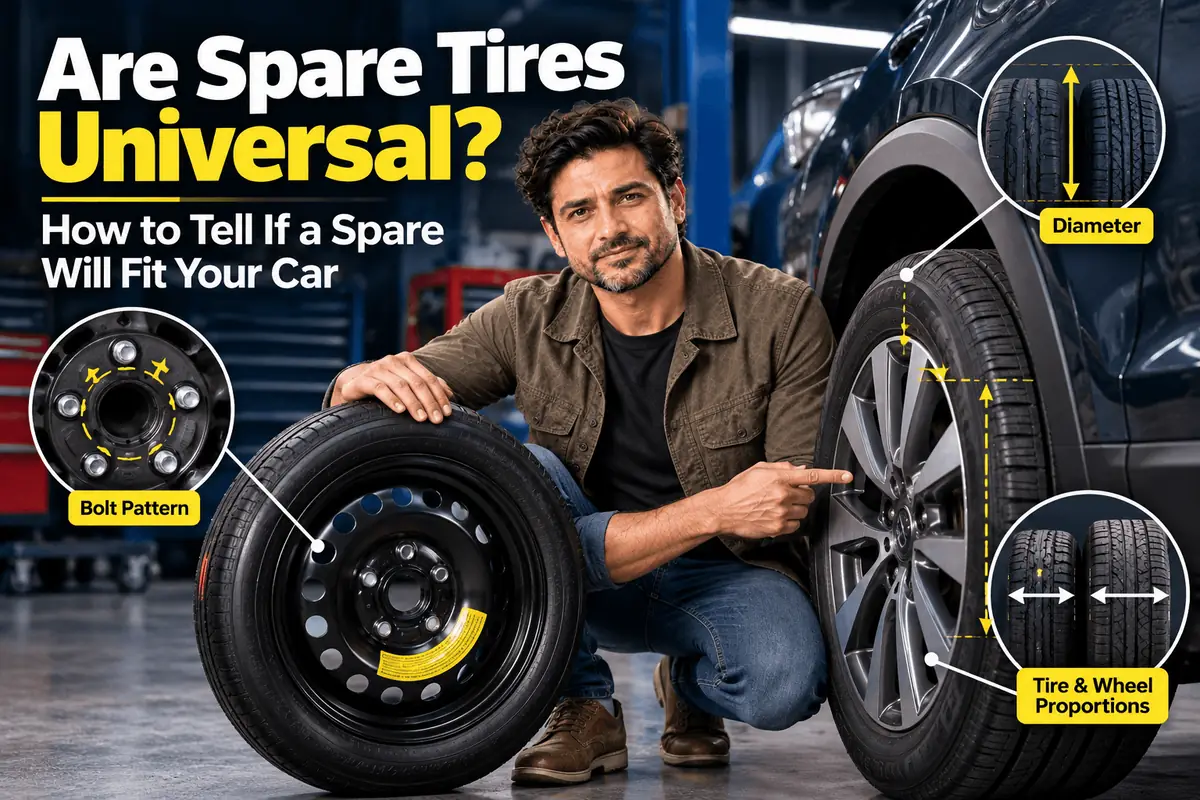
The bolt pattern, also called the lug pattern, describes how many studs the hub has and the diameter of the circle they sit on. It is written as two numbers, such as 5×114.3, meaning five lugs on a 114.3 mm circle. Many patterns look alike to the eye. A 5×114.3 wheel and a 5×115 wheel differ by less than a millimeter, close enough that someone might force the nuts on, yet far enough apart that the studs are stressed and the wheel never seats correctly. The pattern must match exactly.
Center Bore
The center bore is the large hole in the middle of the wheel that fits over the hub. Most modern cars are hub-centric, meaning the hub, not the lug nuts, carries the job of centering the wheel. If a spare’s bore is too small, it will not slide over the hub. If it is too large, the wheel can sit slightly off center and cause vibration unless the correct hub-centric ring is used.
Offset and Backspacing
Offset is the distance between the wheel’s mounting surface and its centerline. It determines how far inward or outward the wheel sits. The wrong offset can push the wheel into the brake caliper, the strut or the fender, or move it far enough out to change steering feel. A spare with the right bolt pattern but the wrong offset may bolt on and then rub or contact suspension parts as soon as the car moves.
Lug Size and Seat Type
The studs on your hub have a specific thread size, and the lug nuts that hold the spare must match it. The seat, the tapered or rounded surface where the nut meets the wheel, matters too. Common seats are conical, ball and flat. A nut with the wrong seat makes contact on a thin ring rather than its full surface and can loosen. Some vehicles with alloy wheels use one style of nut for the regular wheels and need a different one for a steel spare, so check that the correct nuts are in the car.
Tire Size and Outer Diameter
A spare should roll at close to the same outer diameter as the other three tires. Compact spares are narrower, but automakers size them so their diameter stays near that of the regular tires. A spare that is noticeably larger or smaller makes the wheel turn at a different speed than its partner on the same axle, which stresses the differential and can confuse traction and stability systems.
Load Rating and Inflation Pressure
The spare must be able to carry its share of your vehicle’s weight. A compact spare from a light sedan may not carry the load of a midsize SUV, even if the bolt pattern happens to match. Look at the load index on the sidewall and compare it with what your owner’s manual or door placard calls for. Compact spares typically run much higher pressure than regular tires, often around 60 psi, so follow the pressure molded on the spare’s sidewall or printed on your placard.
| Measurement | What It Controls | What Happens If It Is Wrong |
|---|---|---|
| Bolt pattern | Whether the wheel fits the studs | Wheel will not mount, or mounts under stress and never seats |
| Center bore | How the wheel centers on the hub | Will not fit over the hub, or runs off center and vibrates |
| Offset | Where the wheel sits in the wheel well | Contact with brakes, suspension or bodywork |
| Lug thread and seat | How securely the nuts clamp the wheel | Nuts loosen or damage studs |
| Outer diameter | Rolling speed relative to other tires | Strain on differentials, odd ABS or stability behavior |
| Load index | How much weight the spare can carry | Overloaded spare that can overheat or fail |
Donut vs. Full-Size Spares
The type of spare you carry changes how far it can take you and how the car behaves while it is mounted.
Compact Spares (Donuts)
A compact or temporary spare, often called a donut or space-saver, is smaller, lighter and narrower than a regular tire. It frees up cargo space and trims weight, which is why automakers fit them to so many cars. The trade-off is that it is a get-you-home tire. It has shallow tread, a narrow contact patch and a construction built for brief use.
Most compact spares carry a maximum speed of 50 mph, usually printed on the sidewall. Distance guidance varies by manufacturer, and you will commonly see limits in the range of 50 to 70 miles. Your owner’s manual has the figure for your car. Braking distances get longer, cornering grip drops and the car can feel less stable, especially in rain or snow, so drive gently and head straight to a tire shop. For more on living with one of these tires, see our donut spare tire guide.
Full-Size Spares
A full-size spare is the same size as your regular tires, though it is not always identical. Some vehicles carry a matching wheel and tire, while others carry a full-size tire on a plain steel wheel. Either way, a full-size spare lets you drive at normal speeds without a strict distance limit, and your speedometer stays accurate. The cost is weight and space, which is why you mostly find them on trucks, body-on-frame SUVs and some larger crossovers.
Even a full-size spare is not automatically a perfect match. An unused spare has deeper tread than worn tires, so its diameter is slightly larger, which can matter on AWD.
| Factor | Compact Spare (Donut) | Full-Size Spare |
|---|---|---|
| Typical speed limit | Usually 50 mph | Normal speeds |
| Distance | Short, commonly about 50 to 70 miles | Longer use possible |
| Handling and braking | Noticeably reduced | Close to normal |
| Storage space and weight | Small and light | Large and heavy |
| Typical pressure | Often around 60 psi | Same as your regular tires |
| Repairable if punctured | No, replace it | Same rules as any tire |
AWD and 4WD: Where a Mismatched Spare Can Cost You
All-wheel-drive systems connect the front and rear axles, and many of them expect all four tires to turn at very nearly the same speed. A compact spare, or even a fresh full-size spare paired with worn tires, makes one wheel rotate faster than the others. On a full-time AWD system, the center differential or coupling has to absorb that difference continuously, which generates heat and wear.
This is why many AWD owner’s manuals add instructions to spare tire use. Depending on the vehicle, the manual may tell you which axle the compact spare can go on, ask you to disable the AWD system with a fuse, set a stricter distance limit or tell you to avoid the spare altogether in certain conditions. Those instructions are specific to each drivetrain, so read the section on spare tires in your own manual rather than relying on a general rule. The same thinking applies when choosing a used spare: a tire that is the wrong diameter can do more harm on an AWD vehicle than it would on a front-wheel-drive car.
On an AWD vehicle, the spare tire section of your owner’s manual is not optional reading. A few miles on the wrong spare can be far cheaper than a damaged center differential, and a few hundred miles can be far more expensive.
How to Check Whether a Spare Will Fit
If you are buying a spare, borrowing one or just confirming that the one in your car is correct, work through these steps.
- Find your vehicle’s specifications. The tire and loading information placard on the driver’s door jamb lists tire size and pressure for the regular tires, and usually the spare too. Your owner’s manual adds load and spare-specific guidance.
- Read the spare’s sidewall. Note the size, the load index, the maximum speed and the inflation pressure, and compare them with your placard and manual.
- Confirm the bolt pattern and center bore. Many wheels have specifications stamped or cast on the back. If not, a tire shop or parts counter can look up your vehicle’s pattern and bore and measure the spare.
- Check the offset. It is often stamped on the wheel as “ET” followed by a number in millimeters. Compare it with your vehicle’s original wheels or spare.
- Match the lug nuts. Make sure you have nuts with the right thread and seat for the spare wheel, and that a lug wrench and jack are in the car.
- Test fit at home. Mount the spare in your driveway, torque the nuts to the specified value and spin the wheel by hand to confirm it clears the brakes and suspension. It is far easier to find a problem here than on a highway shoulder.
- When in doubt, ask. A tire retailer or dealer parts department can look up the correct spare by year, make, model and trim.
Keeping Your Spare Ready
A correct spare does you no good if it is flat or deteriorated when you need it. Check its pressure at least once a month along with your other tires, as NHTSA recommends, and do it when the tires are cold. Spares are easy to forget, and they slowly lose pressure like any other tire.
Inspect the spare when you check the others. Look for cracks in the sidewall, bulges, cuts and dry-rotted rubber. Check tread depth on a full-size spare with a gauge or the penny test: place a penny upside down in a groove, and if you can see the top of Lincoln’s head, the tread is down to 2/32 of an inch and the tire needs replacing.
Age matters even on a spare that has never touched the road. The last four digits of the DOT code on the sidewall give the week and year the tire was made, so a code of 0318 means the third week of 2018. NHTSA notes that some vehicle and tire manufacturers recommend replacing tires that are six to 10 years old regardless of tread, and a spare that has spent years in a hot trunk or under a truck bed deserves that scrutiny. If you have a matching full-size spare, working it into your rotation keeps its age and wear in line with the rest of the set, as long as your owner’s manual permits a five-tire rotation.
When Your Car Has No Spare
Many newer vehicles skip the spare to save weight and space. Some use run-flat tires, which support the car for a limited distance after losing air; Bridgestone, for example, says its DriveGuard run-flats can travel up to 50 miles at up to 50 mph after a puncture. Others carry a repair kit with sealant and a 12-volt compressor, which can seal many tread punctures but cannot fix a sidewall cut or blowout. If you want a spare on such a car, you can often buy the correct compact spare and jack for your model, as long as there is room to store it and it meets every measurement above.
Related Reading
Frequently Asked Questions
Only if it matches your vehicle’s bolt pattern, center bore, offset, lug nut thread and seat, approximate outer diameter and load rating. That sometimes happens between closely related models, but it cannot be assumed from the size of the tire or the number of lug holes. Verify each measurement before mounting it.
No. Compact spares follow the same fit rules as any other wheel. They come in many bolt patterns, bore sizes, offsets and load ratings, and a donut from one vehicle can be completely wrong for another even if the two look the same.
Most compact spares are limited to 50 mph, and the limit is usually printed on the sidewall. Distance guidance commonly falls around 50 to 70 miles, but your owner’s manual gives the figure for your vehicle. Treat it as a way to reach a tire shop, not as a tire to keep driving on.
Usually yes, for short distances, but many AWD manuals add conditions such as which axle to use, a reduced distance or disabling the AWD system. Because the smaller spare turns faster than the other tires, ignoring those instructions can overwork the center differential or coupling.
No. Compact spares should be replaced, not patched, if they are punctured or damaged. A full-size spare follows the same repair rules as your other tires, so a small tread puncture may be repairable while sidewall damage is not.
Check that the bolt pattern, center bore, offset, lug nut fit, overall diameter and load rating all match your vehicle. A spare has to match at the hub, not just look roughly the right size.
The Bottom Line on Spare Tire Fit
Spare tires are not universal, and the fit comes down to measurements you can check: bolt pattern, center bore, offset, lug nut thread and seat, outer diameter and load rating. Get one wrong and the spare either will not mount or will mount badly enough to damage your car or fail on the road. AWD owners have one more step, because a spare that turns at a different speed puts strain on the drivetrain, and the owner’s manual spells out how to use it safely.
The practical move is to verify your spare now, while nothing is wrong. Read its sidewall, check its pressure and age, confirm you have the right lug nuts and jack, and mount it once at home. If you are buying a replacement, buy by year, make, model and trim, and let a tire shop confirm the details. Ten minutes in the driveway is the difference between a quick change and a long wait for a tow.
 Summarize this article with:
















Leave a comment