



On paper, the decision looks obvious. “Summer” sounds like a tire for beach weekends and heat waves, and “all-season” sounds like the worry-free answer for every month of the year. Both names are misleading.
A summer tire is often the best rain tire you can buy, right up until the temperature drops. An all-season tire is closer to a three-season tire that runs out of answers in heavy snow. Choose the wrong one and you can add car lengths to your stopping distance, wear out a set of tires in a fraction of the expected time, or find yourself spinning in a frozen parking lot.
How this guide was put together: This comparison is based on general tire-industry specifications and typical warranty practices; tread life ranges are typical figures, not test results. Checked on October 22, 2026.
This guide explains what really separates the two categories, why temperature matters more than snow, how each performs on dry, wet, and wintry roads, and which drivers should choose which.
Table of Contents
At a Glance
| Factor | Summer Tires | All-Season Tires |
|---|---|---|
| Ideal temperatures | Above 45°F (7°C) | Roughly 100°F down to about 20°F |
| Dry grip and handling | Excellent; sharp steering response | Good; softer, less immediate feel |
| Warm wet roads | Excellent | Good |
| Cold rain and sleet | Poor | Better |
| Snow and ice | Unsafe | Acceptable in light snow only |
| Typical tread life | 20,000 to 30,000 miles | 50,000 to 80,000 miles |
| Mileage warranty | Usually none | Common |
| Best for | Performance cars, warm climates, two-set owners | Daily drivers, mild climates, one-set convenience |
It Starts With the Rubber
A tire is a highly engineered composite, and its behavior depends heavily on temperature. That is the key to understanding these two categories.
Summer Tires: The Specialist
Think of a summer tire like a stick of chewing gum. When it is warm, it is soft, pliable, and remarkably sticky. Summer tires use a specialized compound that stays soft and grippy at high speeds and in warm weather, giving it the ability to key into the tiny texture of the road surface.
Look at the tread and you will see large, solid blocks of rubber. That maximizes the contact patch, the area of rubber actually touching the road. Wide circumferential grooves pump water out from under the tire, but there are very few sipes, the small slits that help in snow. Everything about the design aims at maximum friction on dry and wet pavement when it is warmer than 45°F (7°C).
All-Season Tires: The Generalist
An all-season tire is more like a sturdy leather hiking boot. Manufacturers blend in more silica and synthetic polymers to create a tougher, more durable compound that resists wear. Crucially, it stays reasonably flexible as temperatures approach freezing, so it avoids turning into a hockey puck on a cold morning.
The tread is busier, with hundreds of small sipes. As the tire rolls, those sipes open slightly and create biting edges that help in light snow and slush. The goal is acceptable performance across a wide range of conditions, from hot asphalt to cold rain and light snow, combined with long tread life.
The 45°F Rule: Temperature Is the Real Deciding Factor
If there is one point to take away from this comparison, it is this: temperature matters more than snow. Many drivers assume summer tires are fine until the first snowflake falls. They are not.
Why Summer Tires Fall Off a Cliff
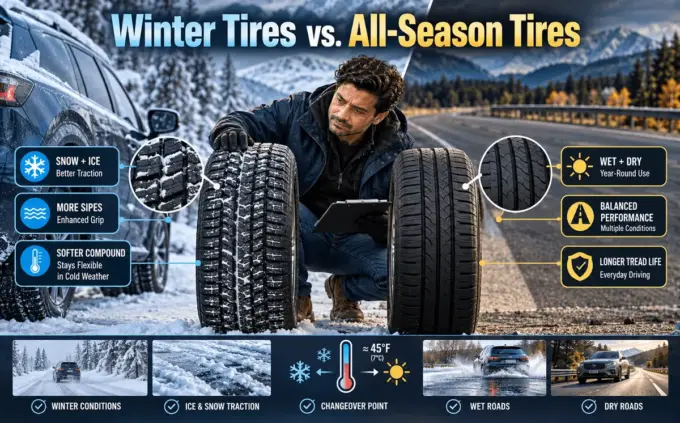
Below about 45°F (7°C), a summer tire’s compound starts to harden. It loses the ability to grip the microscopic texture of the road and begins to behave more like hard plastic sliding over concrete. Even on a perfectly dry road, a summer tire at 30°F (-1°C) will need significantly more distance to stop than an all-season tire. On a patch of ice, it offers almost no grip at all.
Cold can also cause lasting harm. Driving summer tires in freezing temperatures risks compound cracking, damage that can permanently ruin the tire.
Where All-Season Tires Fit
All-season tires are formulated to bridge that gap. They perform reliably from roughly 100°F down to about 20°F. Below that, they have limits of their own. In extreme cold, dedicated winter tires, which remain soft even at -30°F, are the safe choice.
The rule of thumb: If daytime temperatures regularly sit below 45°F (7°C) for weeks at a time, summer tires should come off the car, whether or not it snows.
Head-to-Head Performance
Dry Roads: Summer Tires, Clearly
In warm, dry weather, this contest is not close. Summer tires have stiffer sidewalls and larger tread blocks, which translate into sharper steering response. Turn the wheel and the car reacts immediately. All-season tires, with their flexible sipes and more mobile tread blocks, feel numb or slightly delayed by comparison.
Braking tells the same story. In warm conditions, a premium summer tire such as the Michelin Pilot Sport 4S generally stops shorter than a premium all-season tire, though the margin varies by test, size and temperature. That margin can be the difference between a close call and a rear-end collision.
Wet Roads: Summer Tires, With a Big Condition
This one surprises many drivers: summer tires are frequently the better rain tire. Their wide, straight grooves are extremely efficient at evacuating water and resisting hydroplaning, and their sticky compound grips wet pavement nearly as well as dry. In warm rain, a summer tire will out-brake and out-corner an all-season tire.
The condition is temperature. In a cold, sleety November rain below 45°F, the summer compound stiffens and the all-season tire takes the lead.
Snow and Ice: All-Season Tires, but Only Just
Summer tires are unusable in winter conditions. They spin helplessly in even a light dusting of snow, and braking distances can increase by as much as 300%. All-season tires are acceptable in light snow; their sipes pack with snow, and snow-on-snow friction is surprisingly grippy. In deep snow or on ice, though, they are far behind dedicated winter tires.
If you need real winter capability from a single set of tires, read on to the all-weather section below, or see our full comparison of winter tires and all-season tires.
Tread Life and Running Costs
Performance is only part of the equation. Over the life of a set of tires, all-season tires usually come out well ahead on cost.
How Long They Last
Soft, sticky rubber wears quickly, much like a pencil eraser. Summer tires typically last 20,000 to 30,000 miles, and most do not come with a mileage warranty. All-season tires typically last 50,000 to 80,000 miles, thanks to a harder compound engineered to resist abrasion. In practical terms, a summer tire often delivers roughly half the life of a comparable all-season tire.
Fuel Economy
Many all-season tires use low-rolling-resistance technology, which reduces the energy needed to keep the tire rolling. Compared with sticky summer tires, that can improve fuel economy by about 1% to 3%. Over the life of a set of tires, those savings can cover the cost of installation.
Whichever category you choose, uneven wear will shorten its life. Our guide to reading tire wear patterns explains how to catch alignment problems before they ruin a set.
Where All-Weather Tires Fit In
A third category complicates the debate. All-weather tires combine all-season durability with a compound and tread that qualify for the Three-Peak Mountain Snowflake (3PMSF) symbol, the certification for severe-snow service. Standard all-season tires, by contrast, generally carry only an M+S (Mud and Snow) marking.
For drivers in cities such as Denver, Chicago, or Boston who want to run one set of tires all year, an all-weather tire such as the Michelin CrossClimate2 or Nokian WR G4 is a better choice than a standard all-season tire. Our all-season versus all-weather comparison covers that decision in depth.
Which Should You Buy?
The answer comes down to three things: where you live, what you drive, and whether you are willing to swap tires twice a year.
Choose Summer Tires If…
- You drive a performance car. Putting all-season tires on a BMW M3, Porsche 911, or Ford Mustang GT is like lacing hiking boots onto a sprinter. You give away much of what the car was engineered to do.
- You live in the Sun Belt. In Florida, Southern California, or Arizona, where temperatures rarely drop below freezing, summer tires can deliver excellent grip and safety for most or all of the year.
- You already own a winter set. Running summer tires from spring through fall and winter tires through the cold months is the gold standard for both performance and safety. Our tire storage guide explains how to keep the off-season set in good shape.
Choose All-Season Tires If…
- You drive a daily commuter. For a Toyota Camry, Honda CR-V, or family minivan, the longevity and comfort of an all-season tire make the most sense.
- You want to set it and forget it. If you have nowhere to store a second set and no interest in booking swaps twice a year, all-season tires keep things simple.
- Your seasons are mild. In regions such as the Carolinas or the Pacific Northwest, where it rains often and gets chilly but rarely snows heavily, all-season tires fit the conditions well.
Pros and Cons
Summer Tires
Pros
- Best-in-class dry grip and steering response
- Shorter dry braking distances
- Excellent in warm rain, with strong hydroplaning resistance
Cons
- Grip drops sharply below 45°F (7°C)
- Unsafe on snow and ice
- Short tread life, usually without a mileage warranty
- Can suffer compound cracking if used in freezing weather
All-Season Tires
Pros
- Long tread life, often 50,000 to 80,000 miles
- Usable year-round in mild climates
- Often more fuel-efficient
- Comfortable and quiet on most vehicles
Cons
- Less precise handling than summer tires
- Longer dry and warm-weather wet stopping distances
- Only adequate in light snow; weak in deep snow and on ice
Related Reading
Frequently Asked Questions
It is not recommended. Below about 45°F (7°C), the summer compound hardens, stopping distances grow significantly, and the tire risks compound cracking, which can permanently ruin it.
Yes. Their soft, sticky compound abrades faster against the road. Expect roughly half the tread life of a comparable all-season tire, typically 20,000 to 30,000 miles.
Yes. Most SUVs and crossovers leave the factory on all-season tires, which handle the extra weight well while providing a comfortable, quiet ride.
Check the sidewall. All-season tires almost always carry an “M+S” marking; summer tires do not. The tread is another clue: large, solid blocks usually mean a summer tire, while hundreds of small sipes suggest an all-season tire.
In warm rain, often yes. Their wide grooves and sticky compound provide excellent wet grip and hydroplaning resistance. In cold rain below 45°F, an all-season tire is the better performer.
Two sets: summer tires for the warm months and dedicated winter tires for the cold months. If you can only run one set, choose based on your coldest regular conditions, not your warmest.
Yes. All-season tires work from roughly 100°F down to about 20°F, so summer heat is within their range. They give up some steering precision and warm-weather braking to summer tires but last longer and ride quietly.
Grip drops sharply below 45°F, they are unsafe on snow and ice, and they have short tread life, usually without a mileage warranty. They can also suffer compound cracking if used in freezing weather.
The Verdict
No tire is perfect. Every design trades grip against tread life, comfort, and weather capability. Summer tires give up longevity and cold-weather ability in exchange for maximum grip and safety when it is warm. All-season tires give up some of that peak grip for convenience, long life, and versatility when temperatures fall.
If you can afford it and have room to store them, the two-set approach of summer plus winter tires is the safest way to drive year-round. If you can only run one set, be honest about your weather. Do not let a summer tire catch you on a frozen bridge, and do not expect an all-season tire to stop on a dime in a heat wave.
Before you buy, check the placard on the driver’s door jamb to confirm the correct tire size and load rating. Our guide to tire sizes explains what those numbers mean.
Sources
Specs, warranty terms and prices were checked on October 22, 2026. Prices change often.
- NHTSA: Tires (tire safety, ratings and maintenance)
- eCFR: 49 CFR 575.104 (UTQG treadwear grading)
 Summarize this article with:















Leave a comment