


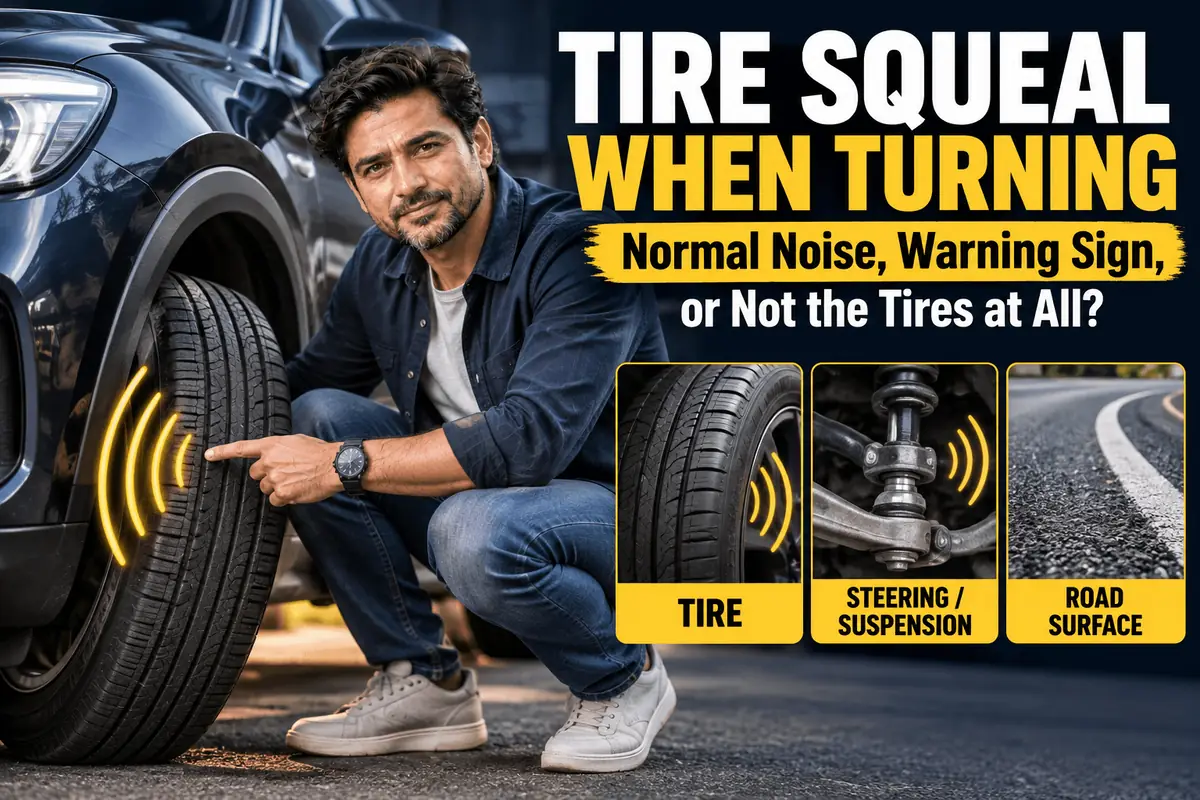
You swing into a parking garage, crank the wheel toward an open space and the car lets out a long, embarrassing squeal. Or maybe it happens on an ordinary right turn at a stop sign, at a speed where nothing should be making noise. Either way, the question is the same: is that sound harmless, or is the car trying to tell you something?
The answer depends on when the noise happens and what it actually sounds like. Some tire squeal is simply physics doing its job. Some points to low pressure, alignment problems or worn parts. And a surprising amount of “tire squeal” does not come from the tires at all but from belts, power steering, suspension joints or brakes. This guide sorts through all three groups and explains how to tell them apart.
Table of Contents
Why Tires Squeal in the First Place
When you turn, the tires have to push the car sideways as well as forward. To do that, the tread twists and slips slightly against the pavement, a small amount of slip that every turning tire experiences. Push the tire hard enough and that slip becomes a rapid cycle of grabbing and releasing. The rubber vibrates at a high frequency, and you hear it as a squeal.
The sound alone does not mean the tire has lost grip. What matters is whether the squeal happens in situations where you would expect the tires to be working that hard.
When Tire Squeal Is Normal
Hard Cornering
Take a highway ramp or a sharp turn with real enthusiasm and the tires will eventually protest. That is normal behavior, and it is also a warning that you are near the limit of grip. If the squeal only appears when you are clearly driving hard, the tires are doing their job. Slow down a little, especially on wet roads, where the margin shrinks.
Parking Garages and Painted Floors
The parking garage squeal is the most common harmless example. Garage floors are often smooth sealed concrete or coated with epoxy paint, and painted lines on any surface behave similarly. These surfaces have very little texture. At low speed with the steering near full lock, the tires scrub across that slick finish and squeal loudly, and the enclosed concrete space amplifies the sound. If the same turn on normal asphalt is quiet, there is nothing to fix.
Tires also scrub naturally at full lock, because the inside and outside front wheels follow circles of different sizes and no steering geometry is perfect at every angle. A faint chirp in a tight U-turn is usually just that.
New Tires
A fresh set of tires can squeal more easily for the first few hundred miles. New tread carries a slick surface layer from the manufacturing process, and the full-depth tread blocks flex more than worn ones. The noise typically fades as the tires scuff in.
When Squealing Points to a Problem
If the tires squeal at ordinary speeds on ordinary turns, something is making them work harder than they should.
Underinflation
Low pressure is the first thing to check because it is the most common cause and the easiest fix. An underinflated tire has a soft, floppy sidewall. In a turn, the tire rolls over onto its shoulder and the contact patch distorts, so the tread scrubs instead of rolling cleanly. You may also notice vague steering and wear on both outer edges of the tread.
Check all four tires when they are cold, before driving, using the pressure listed on the placard on the driver’s door jamb rather than the maximum figure on the sidewall.
Wheel Alignment
Alignment problems force the tires to scrub sideways even while you drive straight, and turns make it worse. Toe is the angle most likely to cause squealing: if the front of the tires points too far in or out, the tread is dragged across the pavement as it rolls. Camber and caster problems contribute less directly but still change how the tire meets the road.
Telltale signs include a car that pulls to one side, a steering wheel that sits off center when driving straight and feathered wear, where the tread ribs feel smooth when you slide your hand across them one way and sharp the other way. A hard hit on a pothole or curb is a common trigger.
Ackermann Problems on Modified Vehicles
Ackermann geometry is the steering design that turns the inside front wheel more sharply than the outside one, since the inside wheel follows a tighter circle. Factory geometry gets this close enough for normal use. Lowering or lifting a vehicle, fitting aftermarket steering arms or knuckles or running much wider wheels and tires can upset that relationship. The front tires then fight each other in tight turns, scrubbing and squealing at parking-lot speeds and wearing the shoulders faster. If the squeal started after suspension modifications, a shop experienced with that type of vehicle should look at the steering geometry, not just the standard alignment numbers.
Worn Tires
Tires near the end of their tread life squeal more easily and grip less, especially in the wet. Check tread depth with a gauge or look for the wear bars molded across the main grooves. At 2/32 inch, the bars are flush with the tread and the tire is legally worn out in most states, and many drivers replace sooner, around 4/32 inch, for better wet-weather grip.
Worn Suspension Parts
Worn shocks and struts let the body roll and the wheels bounce through a turn, so the tire loses consistent contact and scrubs as weight shifts. Worn control arm bushings, tie rod ends and ball joints let the wheel’s alignment shift under cornering loads, even if the static alignment checked out fine. Irregular wear such as cupping, a pattern of scooped dips around the tread, often points to this kind of problem. Our guide to tire cupping explains how to read that wear and trace it back to the suspension.
Noises That Sound Like Tire Squeal but Aren’t
Plenty of turning noises get blamed on the tires when the real culprit is elsewhere. A useful first test: tire squeal depends on the car moving and the tires scrubbing. If the noise happens with the car parked and you turn the steering wheel, or if it changes with engine speed, the tires are not the cause.
| Noise | What It Sounds Like and When | Likely Cause | How Urgent |
|---|---|---|---|
| Whine or groan | Rises as you turn the wheel, loudest near full lock, even when parked | Low power steering fluid or a failing pump | Check fluid soon; low fluid can damage the pump |
| Sharp squeal from under the hood | Loud screech at full lock or on startup, may rise with engine revs | Slipping serpentine belt, often from a worn belt or tensioner | Fix promptly; the belt drives vital accessories |
| Creak or groan | Low-speed creaking over bumps or while turning, like an old door | Dry or worn ball joints, bushings or strut mounts | Inspect soon; a failed ball joint is dangerous |
| High-pitched metallic squeal | Squeal while driving that often stops when you press the brake, may appear in turns | Brake pad wear indicator touching the rotor | Replace pads soon to avoid rotor damage |
| Rhythmic clicking | Clicks or pops when turning sharply while accelerating | Worn outer CV joint, usually after a torn boot | Repair soon; a failed CV joint can leave you stranded |
Power Steering Whine
On cars with hydraulic power steering, a whining or groaning noise that grows as you turn the wheel usually means the fluid is low or the pump is wearing out. The pump works hardest near full lock, so that is where the noise peaks, and it happens even with the car standing still. Check the fluid level on the reservoir dipstick or markings with the engine off. If it is low, top it up with the fluid your owner’s manual specifies, then look for leaks at the hoses, the pump and the steering rack, because fluid only disappears when it leaks out. Cars with electric power steering have no fluid, so this cause does not apply to them.
Slipping Serpentine Belt
On engines where the power steering pump is belt driven, turning to full lock puts a heavy load on the belt. A glazed, cracked or loose belt, or a weak tensioner, slips under that load and lets out a sharp squeal from the engine bay. The giveaway is that the noise comes from the front of the car under the hood and often happens when parked. With the engine off, inspect the belt for cracks, shiny glazed sides or fraying, and check that the tensioner holds firm tension. The belt also drives the alternator and often the water pump, so replace a worn one before it fails.
Ball Joints and Bushings
Dry or worn ball joints and rubber bushings tend to creak, groan or squeak rather than squeal, usually at low speed, over speed bumps or when turning in a driveway. Worn strut mounts can also pop or creak when you turn the wheel. Bounce each corner of the car by hand while listening; a creak that follows the motion points to the suspension. A clunk over bumps, loose steering or uneven tire wear alongside the noise raises the urgency. A worn ball joint that separates can cause loss of steering control, so get creaking front suspension inspected promptly.
Brake Pad Wear Indicators
Many brake pads carry a small metal tab that rubs the rotor when the pad gets thin, producing a high-pitched squeal by design. Because the brake assembly flexes slightly in a turn, the indicator can touch the rotor and squeal mainly in corners at first. The classic clue is a squeal that appears while driving and changes or disappears when you press the brake pedal. Have the brakes inspected; replacing pads at this point is far cheaper than replacing rotors after the pads wear through to metal.
CV Joint Clicking
On front-wheel-drive and all-wheel-drive vehicles, the outer constant velocity joints let the front wheels steer while transmitting power. When the protective rubber boot tears, grease escapes, dirt gets in and the joint wears. The result is a rhythmic clicking or popping when you turn sharply and accelerate, such as pulling out of a parking space. Look behind the front wheels for a torn boot and grease slung around the inside of the wheel. Repair usually means replacing the axle shaft, and it should not be left until the joint fails.
How to Diagnose Your Turning Noise
Work through these questions in order. They will narrow the cause quickly.
- Does it happen with the car parked when you turn the steering wheel? If so, suspect power steering, the serpentine belt or suspension mounts, not the tires.
- Does it change with engine speed? A noise that rises when you rev the engine in park points to the belt or power steering pump.
- Does it only happen on smooth garage floors or painted surfaces? That is normal surface scrub.
- Are the tires new? Give them a few hundred miles to scuff in.
- What do the gauge and the tread say? Check cold pressures against the door placard, then look for edge wear, feathering, cupping or tread near the wear bars.
- Does the car pull, or is the steering wheel off center? That points to alignment.
- Does it stop when you brake? Suspect the pad wear indicators.
- Is it clicking under acceleration in tight turns? Look at the CV joints.
- Is it a creak or groan over bumps? Have the suspension joints and bushings inspected.
When to See a Mechanic
You can fix low tire pressure and low power steering fluid yourself, and you can learn a lot from a visual check. Book a professional inspection when any of these apply:
- Squealing at normal speeds on normal turns that correct tire pressure does not cure
- Pulling, an off-center steering wheel or uneven tire wear
- Squealing that started after suspension work, lowering or lifting
- Clicking, clunking or creaking from the front suspension
- A brake squeal that changes when you press the pedal
- Power steering fluid that keeps dropping, or a belt that looks cracked or glazed
- Vibration, wandering or instability alongside the noise
A good shop can check alignment on a rack, inspect the suspension for play with the car lifted and road-test it to pinpoint where the noise starts.
Frequently Asked Questions
It is normal during hard cornering, in parking garages with smooth sealed or painted floors and for the first few hundred miles on new tires. Squealing at ordinary speeds on ordinary roads is not normal and usually points to low pressure, alignment problems or worn parts.
At full steering lock, the front tires scrub as they turn on different-sized arcs. On slick sealed concrete or painted surfaces that scrub becomes an audible squeal. If the car is quiet on regular asphalt, this is harmless. If it happens everywhere, check tire pressure and alignment, and consider steering geometry if the vehicle has been lowered or lifted.
Yes. An underinflated tire rolls onto its shoulder in a turn, distorting the contact patch so the tread scrubs instead of rolling cleanly. Checking and correcting cold tire pressure is the first step whenever squealing appears.
Yes, toe misalignment in particular drags the tread sideways as it rolls, and turning makes the scrubbing worse. Look for pulling, an off-center steering wheel and feathered tread wear as supporting signs.
Park the car with the engine running and turn the steering wheel from lock to lock. Tires make no noise when the car is not moving, so a whine or squeal in that test points to power steering or the serpentine belt.
That pattern usually points to the brake pad wear indicators. The metal tab touches the rotor as the brake assembly flexes in a turn, and pressing the pedal changes the contact. Have the brake pads inspected and replaced soon.
The Verdict on Squealing Turns
A squeal in a parking garage, on painted lines, during a spirited turn or from brand-new tires is usually nothing to worry about. A squeal on everyday turns at everyday speeds is different: start with a tire pressure check, then look for alignment problems, worn tread and tired suspension parts. Modified vehicles add steering geometry to that list.
Before blaming the tires, make sure they are really making the noise. A whine that shows up with the car parked, a screech from under the hood, a creak over bumps, a squeal that stops when you brake or a click in tight turns all point elsewhere. Matching the sound to the situation saves you from buying tires that were never the problem, and it catches the repairs that really matter before they get expensive.
 Summarize this article with:


















Leave a comment