


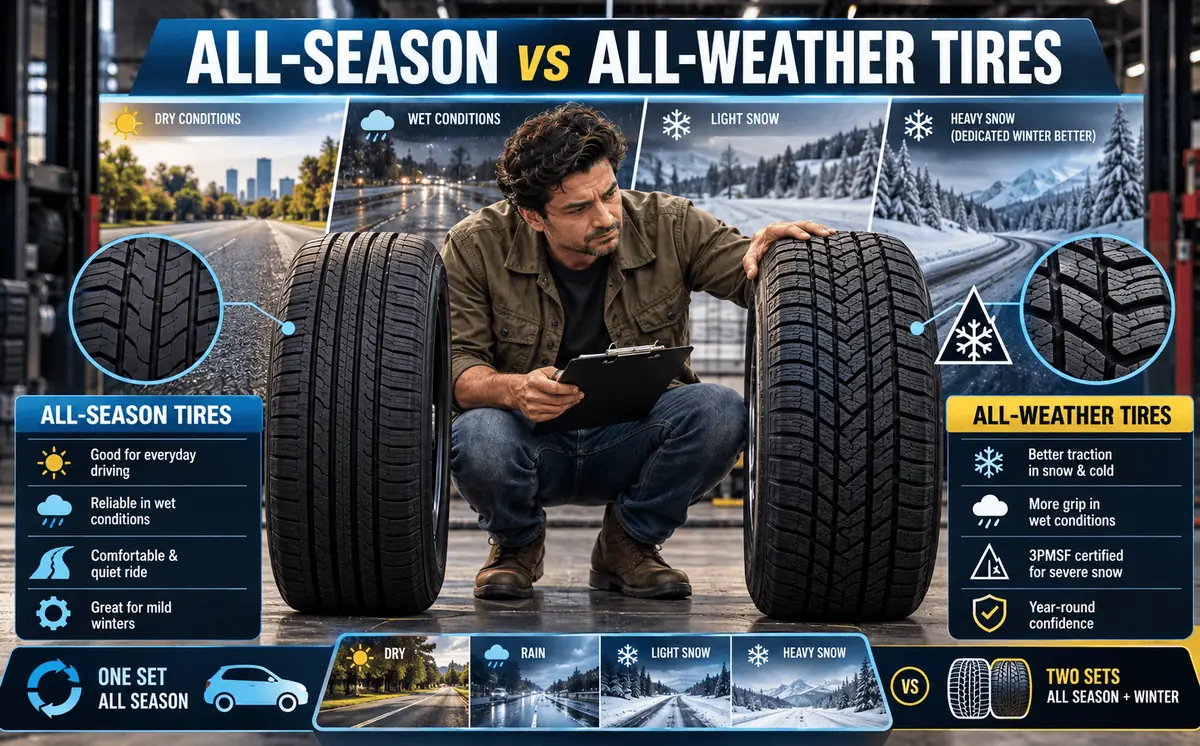
The names sound almost interchangeable, and plenty of tire shoppers assume “all-season” and “all-weather” are two marketing labels for the same product. They are not. An all-season tire is a fair-weather generalist that tolerates a light dusting of snow. An all-weather tire is a year-round tire with genuine winter credentials, built to keep working when the temperature falls and the roads turn white.
That difference matters most to drivers who live somewhere in the middle: places where winter is real but not relentless, where a few snowstorms a year are likely, and where swapping between two sets of tires feels like more hassle than it is worth. For those drivers, the choice between these two categories decides how much grip they have on the worst mornings of the year, and how much they pay in tread life and cost the rest of the time.
This guide breaks down how the two categories differ in construction, how they behave on dry, wet, and snowy roads, what they cost to own, and which drivers should choose each one.
Table of Contents
The Short Answer
If your winters bring little more than cold rain and the occasional light snowfall, a good all-season tire is the more economical choice. It typically lasts longer, rides more quietly, and costs less up front. If you regularly see snow, slush, and icy mornings but still want to run one set of tires all year, an all-weather tire is the smarter buy. Neither category replaces a dedicated winter tire in places with heavy snowfall or sustained deep cold.
| Factor | All-Season Tires | All-Weather Tires |
|---|---|---|
| Best climate | Mild to moderate winters, occasional light snow | Regular winter weather with snow, slush, and ice |
| Winter marking | Usually M+S (Mud and Snow) | 3PMSF (Three-Peak Mountain Snowflake) |
| Snow and ice grip | Adequate in light snow; weak on packed snow and ice | Clearly better on snow and ice |
| Tread life | Generally longer | Generally shorter |
| Ride and noise | Typically quieter and smoother | Can be slightly louder and firmer |
| Upfront price | Lower | Higher |
| Seasonal swaps needed | Not in mild climates | No, in most climates short of severe winter |
Two Symbols Tell You Most of the Story
The fastest way to tell these categories apart is to read the sidewall. Most all-season tires carry an M+S (Mud and Snow) marking. That designation relates to the tread geometry, not to any measured performance in snow, so it promises very little about how the tire will behave on a slick winter road.
All-weather tires carry the Three-Peak Mountain Snowflake (3PMSF) symbol, a mountain silhouette with a snowflake inside it. That mark means the tire has met a specific performance requirement in snow testing, the same certification dedicated winter tires carry. It is the clearest single sign that a tire has real cold-weather ability rather than simply looking the part.
Quick check: M+S alone means “all-season.” M+S plus the 3PMSF snowflake usually means “all-weather.” If you are shopping for winter capability, look for the snowflake.
What Makes an All-Season Tire Tick
All-season tires, sometimes called “no-season” tires, aim to be competent in dry, wet, and lightly snowy conditions without excelling in any one of them. Their tread combines circumferential grooves that run around the tire, lateral grooves that cut across it, and sipes, the thin slits in each tread block that create extra biting edges.
That layout moves water out of the contact patch effectively in ordinary rain, resists hydroplaning, and gives the tire a little purchase in light snow. The rubber compound stays pliable across a broad temperature range, but it begins to stiffen in very cold weather. Once that happens, the tire has less ability to conform to the road surface, and traction drops.
That is the core limitation. All-season tires can handle a dusting of snow or an occasional winter commute, but they are not built for deep snow, packed snow, or ice. For drivers in moderate climates who never see those conditions, the trade-off is barely noticeable. For drivers who do, it is the difference between confidence and white knuckles.
What Makes an All-Weather Tire Different
All-weather tires sit between all-season and dedicated winter tires. They are meant to stay on the car all year, but their tread and compound borrow heavily from winter-tire thinking.
- More aggressive tread. Deeper grooves and a denser network of sipes create more biting edges for snow and ice and help clear slush and water from the contact patch.
- Cold-tolerant compound. All-weather tires use rubber formulated to stay pliable as temperatures fall, often with a higher silica content. That flexibility lets the tread keep gripping frozen surfaces when an all-season compound would begin to harden.
- Winter certification. The 3PMSF symbol confirms the tire has met the severe-snow performance standard.
The result is a tire that handles light-to-moderate winter conditions far better than an all-season tire while still being practical in summer. What it does not do is match a dedicated winter tire in heavy snowfall or extreme cold. In those regions, winter tires remain the safest choice.
Well-known examples in this category include the Michelin CrossClimate2 and the Nokian WR G4, both popular with drivers who want one set of tires to cover every month of the year.
How They Compare on the Road
Snow and Ice: The Deciding Category
This is where the two categories separate most clearly. An all-season tire manages light snow, but its performance falls off sharply on packed snow or ice. The tread and compound simply are not set up for it, and braking, cornering, and acceleration all suffer.
An all-weather tire keeps working. Its deeper grooves and extra sipes bite into snow, and its more flexible compound maintains contact with frozen surfaces. In real winter weather, that translates into shorter stopping distances, more predictable cornering, and less chance of sliding through an intersection. If winter performance is the reason you are reading this article, the all-weather tire is the answer, with the caveat that a true winter tire is still better in severe conditions.
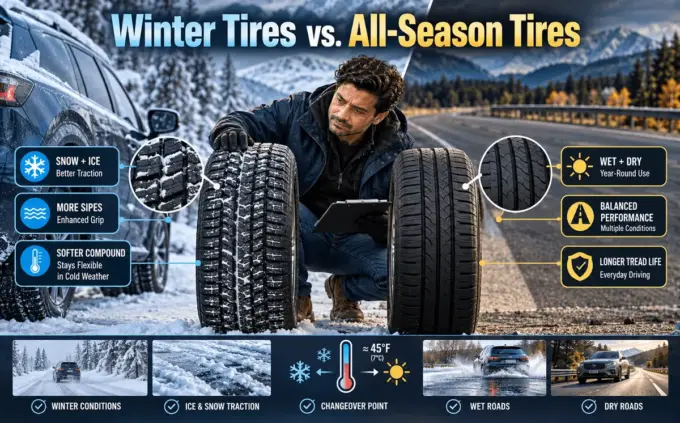
For a deeper look at that last step up, see our comparison of winter tires and all-season tires.
Wet Roads
All-weather tires generally hold an advantage in the rain, especially when it is cold. Their deeper grooves and more extensive siping channel water away from the contact patch efficiently, and their more pliable compound conforms to wet pavement better than the firmer rubber found in some all-season tires. That combination helps with hydroplaning resistance and stopping distances.
All-season tires remain perfectly competent in everyday rain. Where they can fall behind is in heavy standing water at highway speed, or in cold, sleety rain when their compound has started to firm up. As always, tread depth matters as much as category: a worn tire of either type gives up much of its wet grip.
Dry Pavement
On dry roads, both categories deliver dependable traction and cornering stability for normal daily driving. The gap here is narrower than in winter and depends heavily on the specific model. Some modern all-weather tires feel sharp and composed on dry pavement, while their softer, cold-oriented rubber can feel a touch less precise on a hot summer day than a well-sorted all-season tire. For most drivers commuting and running errands, neither will feel lacking.
Ride Comfort and Road Noise
All-season tires usually have the edge in refinement. Their tread patterns are less aggressive and tuned for a balance of grip and comfort, which tends to produce a smoother, quieter ride. All-weather tires prioritize traction, and their bolder tread blocks can generate more road noise and a slightly firmer feel.
That difference varies from tire to tire and car to car. Suspension tuning, tire pressure, and road surface all influence what you hear and feel from the driver’s seat, so a quiet all-weather tire on a well-insulated sedan may be more pleasant than a coarse all-season tire on a lighter hatchback.
Tread Life and Durability
This is where all-season tires earn their keep. Their shallower, less aggressive tread and firmer compound wear slowly, particularly on dry roads where most driving happens. All-weather tires trade some of that longevity for grip: deeper, more open tread blocks and softer rubber tend to wear faster, especially when the tire spends long summers on hot, dry pavement.
Actual tread life always depends on driving habits, vehicle weight, alignment, rotation, and road conditions. But as a general rule, drivers who rarely encounter real winter weather will get more miles for their money from an all-season tire.
Fuel Efficiency
Fuel economy differences between the categories are smaller than the differences between individual models. A low-rolling-resistance all-season tire will usually be more efficient than a grippier all-weather tire, but some all-weather designs are quite efficient too. If fuel economy is a top priority, compare the specific tires you are considering rather than assuming one category always wins. Vehicle weight, driving style, and ambient temperature will also shape your results.
Cost and Long-Term Value
All-weather tires generally cost more up front than comparable all-season tires, which reflects their more advanced compounds and tread designs. All-season tires are the budget-friendly pick for drivers who do not face serious winter weather.
Value, though, is about more than sticker price. Consider what each choice saves or costs you over a few years:
- All-weather tires can replace two sets of tires. For drivers who would otherwise buy winter tires, an all-weather set avoids a second set of tires, seasonal mounting, and off-season storage.
- All-season tires usually last longer. If you would never buy winter tires anyway, the longer tread life of an all-season tire stretches your money further.
- Winter safety has its own value. Drivers who face recurring snow and ice may decide that better grip on the worst days of the year is worth the higher upfront price and shorter tread life.
The right answer depends on where you live, how much winter you actually see, and whether you would ever consider a dedicated winter set.
Which Should You Buy?
Choose All-Season Tires If…
- You live where winters are mild and snow or ice is rare.
- Ride comfort and a quiet cabin rank high on your list.
- You want the longest tread life and the lowest upfront cost.
- You drive mostly on paved roads and can stay home on the rare bad-weather day.
Choose All-Weather Tires If…
- You regularly encounter snow, slush, or icy mornings but do not want to swap tires twice a year.
- You lack the space, time, or budget for a dedicated winter set.
- Winter safety is a higher priority for you than maximum tread life or the quietest possible ride.
- You live in a region with changeable weather, where a cold snap can arrive with little warning.
Choose Dedicated Winter Tires If…
- You live where heavy snowfall, long stretches of sub-freezing temperatures, or icy roads are routine.
- You are willing to manage a seasonal swap in exchange for the best possible cold-weather grip.
If you are still weighing whether a dedicated winter set is necessary, our guide to winter tires versus all-season tires walks through that decision in detail.
All-Season vs. All-Weather: Pros and Cons
All-Season Tires
Pros
- Typically longer tread life
- Lower purchase price
- Smoother, quieter ride in most applications
- Dependable in dry and everyday wet conditions
Cons
- Limited traction on packed snow and ice
- Compound stiffens in very cold weather
- Usually lacks the 3PMSF severe-snow rating
All-Weather Tires
Pros
- Much better grip on snow and ice than all-season tires
- Carries the 3PMSF severe-snow symbol
- Strong wet-road performance, especially in cold rain
- One set can cover the full year in many climates
Cons
- Higher upfront cost
- Tread tends to wear faster, particularly in hot climates
- Can be noisier and slightly firmer
- Still not a substitute for winter tires in severe winters
Frequently Asked Questions
No. All-season tires are tuned for dry, wet, and light snow conditions and usually carry only an M+S marking. All-weather tires use more aggressive tread and cold-tolerant rubber, and they carry the 3PMSF symbol, which indicates certified severe-snow performance.
Sometimes. In regions with occasional or moderate winter weather, an all-weather tire can do the job well enough that many drivers skip a dedicated winter set. In areas with heavy snowfall or extreme cold, a true winter tire still provides meaningfully better grip and remains the safer choice.
Generally, yes. Their deeper, more aggressive tread and softer compound tend to wear more quickly than an all-season tire, especially when driven mostly on warm, dry roads.
They can be. Their bolder tread blocks often produce a little more road noise and a slightly firmer ride. The difference depends on the specific tire and vehicle, so it is worth comparing individual models.
Look at the sidewall for the Three-Peak Mountain Snowflake symbol. Tires with only an M+S marking are typically standard all-season tires.
For drivers who see real winter weather but do not want to manage two sets of tires, usually yes. For drivers in mild climates, an all-season tire offers better tread life and value.
Yes. All-weather tires are built to stay on all year, and one set can cover the full year in many climates. The trade-offs are faster wear during long, hot summers and less grip than dedicated winter tires in heavy snow or extreme cold.
The Verdict
All-season tires remain the sensible default for drivers in mild climates. They last longer, cost less, and ride more quietly, and the conditions where they struggle are conditions those drivers rarely see.
All-weather tires are the better fit for anyone who faces regular snow, slush, and ice but wants to keep one set of tires on the car all year. They give up some tread life, some refinement, and some money at the register, and in return they deliver winter traction that an all-season tire simply cannot match.
The honest dividing line is your winter. If it is mostly cold rain, buy all-season tires. If it includes real snow, buy all-weather tires. If it is long, deep, and icy, put dedicated winter tires on the car for the cold months.
 Summarize this article with:














Leave a comment