


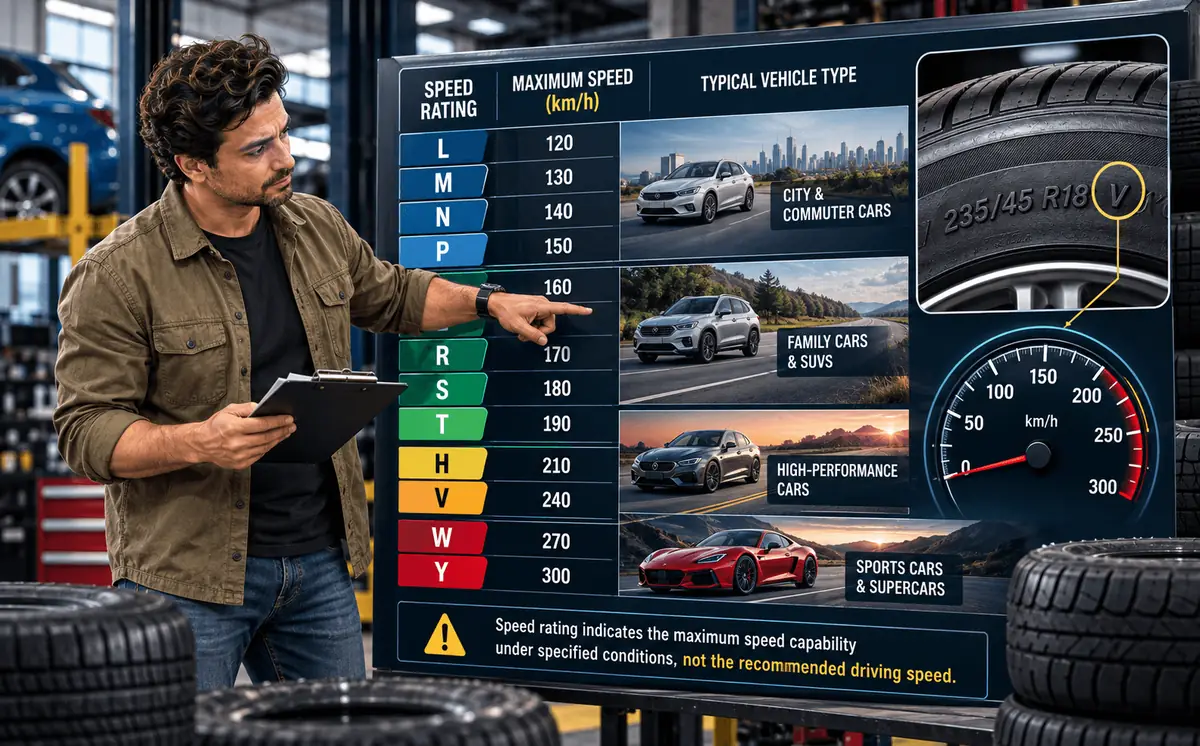
Ask most drivers what the “V” in 225/50R17 94V means and you’ll get a shrug. That single letter, the speed rating, is one of the most important specifications on a tire, and the number in front of it, the load index, is just as critical. Together they tell you how fast and how heavily a tire can safely work.
This guide includes a complete speed rating chart, explains the ratings you’ll actually encounter, and covers the load index, how to find the right ratings for your vehicle, and when it’s acceptable to deviate.
At a glance
The speed rating is a letter showing the maximum sustained speed a tire can handle.
Never go below the speed rating your vehicle manufacturer specifies.
The load index is a number showing the maximum weight each tire can carry.
Common everyday ratings: S (112 mph), T (118 mph), H (130 mph), V (149 mph).
Your door-jamb sticker and owner’s manual list the required ratings.
Table of Contents
What a Speed Rating Is
A speed rating is a standardized code indicating the maximum speed a tire can sustain while carrying its rated load. The key word is sustained: the rating describes a speed the tire can hold over time when properly inflated, not a momentary peak.
The system originated in Europe and is now used worldwide, with standards maintained by international bodies. Ratings come from standardized laboratory testing.
Why it matters: your vehicle manufacturer chose a specific rating for a reason. A lower-rated tire may not perform safely at highway speeds; it can overheat, deform, or fail. A higher rating is generally fine and often improves handling, though it typically costs more.
Reading the Code
In 225/50R17 94H:
- 225: section width in millimeters
- 50: aspect ratio (sidewall height as a percentage of width)
- R: radial construction
- 17: wheel diameter in inches
- 94: load index (maximum load per tire)
- H: speed rating (130 mph / 210 km/h)
The Complete Speed Rating Chart
| Symbol | Max Speed (mph) | Max Speed (km/h) | Typical Use |
|---|---|---|---|
| B | 31 | 50 | Specialty and off-road |
| C | 37 | 60 | Specialty heavy equipment |
| D | 40 | 65 | Farm and off-road equipment |
| E | 43 | 70 | Farm and off-road |
| F | 50 | 80 | Off-road, rare |
| G | 56 | 90 | Off-road |
| J | 62 | 100 | Off-road |
| K | 68 | 110 | Off-road |
| L | 75 | 120 | Off-road and some light truck |
| M | 81 | 130 | Temporary spares |
| N | 87 | 140 | Rare |
| P | 93 | 150 | Rare |
| Q | 99 | 160 | Winter and studded tires, mud-terrain |
| R | 106 | 170 | Light truck and commercial |
| S | 112 | 180 | Family sedans, light trucks |
| T | 118 | 190 | Family cars, minivans |
| U | 124 | 200 | Passenger cars, uncommon |
| H | 130 | 210 | Sport sedans, coupes, many crossovers |
| V | 149 | 240 | Sports sedans, performance cars |
| W | 168 | 270 | High-performance sports cars |
| Y | 186 | 300 | Ultra-high-performance |
| (Y) | Above 186 | Above 300 | Exotic and supercar tires |
| Z / ZR | Above 149 | Above 240 | High-performance (legacy designation) |
Note that H sits out of alphabetical order, between U and V. Speed symbols and maximum speeds match Tire Rack’s speed rating table (checked October 21, 2026).
The Ratings You’ll Actually Meet
Q: 99 mph (160 km/h)
Q is most often seen on dedicated winter tires and many mud-terrain tires. The lower ceiling isn’t a sign of low quality; the soft compounds that grip ice and the heavy lugs that claw through mud can’t sustain high speeds safely. For winter driving, where conditions demand modest speeds anyway, a Q-rated winter tire is entirely appropriate. Our Q vs S comparison explains more, and our Q vs T guide covers the next step up.
S: 112 mph (180 km/h)
Common on family sedans, minivans, and light trucks, S-rated tires are more than adequate for U.S. highways and balance durability and ride comfort without a premium price. See H vs S, S vs T and R vs S for comparisons.
T: 118 mph (190 km/h)
T is one of the most common ratings in the U.S. passenger market, found on many minivans, family sedans, and commuter cars. T-rated touring tires are well-rounded and often more affordable than H or V equivalents. See H vs T and V vs T.
H: 130 mph (210 km/h)
H is a sweet spot for many drivers. It offers ample margin for highway driving and often stiffer sidewalls and better cornering response than S or T. Many sport-tuned sedans and crossovers come with H-rated tires. See V vs H.
V: 149 mph (240 km/h)
V marks the start of true performance territory, common on sports sedans, hot hatches, and entry-level performance cars. The stiffer construction sharpens steering and dry handling, with a slightly firmer ride and sometimes shorter tread life. See V vs W and V vs Y.
W: 168 mph (270 km/h)
W-rated tires are for serious performance vehicles. Sustaining 168 mph requires advanced compounds, reinforced internal structures, and precise manufacturing for heat dissipation and structural integrity. They’re overkill for most drivers but worthwhile for high-powered sports cars and owners who track their cars. See W vs Y.
Y and (Y): 186 mph and Beyond
Y-rated tires are for exotic and ultra-high-performance vehicles. The parenthesized (Y) designation indicates the tire is approved for speeds above 186 mph. They’re unnecessary for nearly all drivers.
What About Z?
Z was once the top rating, introduced before W and Y existed. Today a “ZR” in the size (for example, 225/45ZR17) simply indicates capability above 149 mph; the service description at the end, such as 94W or 94Y, states the exact rating. Our Z vs W guide explains how to read a ZR size.
The Load Index: The Other Half of the Service Description
The load index is a numerical code for the maximum weight a single tire can support when properly inflated. It doesn’t state pounds directly; it references a standardized chart.
Example: a load index of 94 equals 1,477 lbs per tire. Across four tires, that’s 5,908 lbs of total capacity, which must cover the vehicle plus passengers and cargo.
Why It Matters as Much as Speed
A common mistake is buying a cheaper tire with a lower load index than specified, assuming it’s close enough. Over time, especially with a full vehicle or when towing, the tire runs beyond its capacity. That brings excess sidewall flex, heat buildup, and in the worst cases a blowout. Always match or exceed your OE load index.
Load Index Chart
| Index | Max Load (lbs) | Index | Max Load (lbs) | Index | Max Load (lbs) |
|---|---|---|---|---|---|
| 75 | 852 | 93 | 1,433 | 111 | 2,403 |
| 76 | 882 | 94 | 1,477 | 112 | 2,469 |
| 77 | 908 | 95 | 1,521 | 113 | 2,535 |
| 78 | 937 | 96 | 1,565 | 114 | 2,601 |
| 79 | 963 | 97 | 1,609 | 115 | 2,679 |
| 80 | 992 | 98 | 1,653 | 116 | 2,756 |
| 81 | 1,019 | 99 | 1,709 | 117 | 2,833 |
| 82 | 1,047 | 100 | 1,764 | 118 | 2,910 |
| 83 | 1,074 | 101 | 1,819 | 119 | 2,998 |
| 84 | 1,102 | 102 | 1,874 | 120 | 3,086 |
| 85 | 1,135 | 103 | 1,929 | 121 | 3,197 |
| 86 | 1,168 | 104 | 1,984 | 122 | 3,307 |
| 87 | 1,201 | 105 | 2,039 | 123 | 3,417 |
| 88 | 1,235 | 106 | 2,094 | 124 | 3,527 |
| 89 | 1,279 | 107 | 2,149 | 125 | 3,638 |
| 90 | 1,323 | 108 | 2,205 | 126 | 3,748 |
| 91 | 1,356 | 109 | 2,271 | ||
| 92 | 1,389 | 110 | 2,337 |
Example: a tire marked 107Y can carry up to 2,149 lbs per tire and is rated for a sustained 186 mph. For light-truck tires, the load range letter (C, D, E and so on) matters too; see our tire load range chart.
Typical Ratings by Vehicle Category
| Vehicle Category | Common Speed Rating | Common Load Index | Example Tire Lines |
|---|---|---|---|
| Economy and compact cars | S, T | 82–91 | Michelin Energy Saver, Bridgestone Ecopia |
| Family sedans and minivans | T, H | 88–96 | Michelin Defender, Continental TrueContact |
| SUVs and crossovers | H, V | 100–112 | Goodyear Assurance, Pirelli Scorpion Verde |
| Light trucks and full-size pickups | R, S, T | 110–120 | Michelin LTX, BFGoodrich All-Terrain T/A |
| Sports cars and performance sedans | V, W | 91–106 | Michelin Pilot Sport, Goodyear Eagle F1 |
| Ultra-high-performance and exotic | W, Y, (Y) | 95–112 | Pirelli P Zero, Continental SportContact 7 |
| Winter and snow tires | Q, S, T | 88–100 | Michelin X-Ice Snow, Bridgestone Blizzak WS90 |
| Temporary spare | M | 80–90 | Compact OE spares |
These are typical patterns; your vehicle’s specific requirements always govern.
Finding the Right Ratings for Your Vehicle
1. Door-jamb sticker. Open the driver’s door and look for the white or yellow placard on the frame. It lists the OE tire size with load index and speed rating. This is the most reliable reference.
2. Owner’s manual. The tires and wheels section lists required specifications, including the minimum speed rating.
3. Current tires. If the tires haven’t been changed from the factory specification, the last characters of the size code (for example, the “97H” in 225/55R17 97H) show the ratings.
Can You Use a Different Speed Rating?
Going Higher: Generally Fine
If your vehicle calls for H and you choose V, that’s typically fine. A higher rating usually brings stiffer sidewalls, better heat resistance, and sharper handling. Expect a slightly firmer ride and a higher price.
Going Lower: Not Recommended
Fitting a lower speed rating than specified is a safety compromise. Lower-rated tires have less robust construction that may not handle the dynamic loads of emergency maneuvers at highway speeds, even if you never approach the rated speed.
The Load Index: Never Lower
Never fit a lower load index than specified. An under-rated tire can fail under full load, hard braking, or hard cornering. Going higher on load index is fine and can mean a sturdier tire.
Speed Ratings and Seasonal Tires
Dedicated winter tires often carry lower speed ratings than summer or all-season tires. That’s expected: the soft compounds that grip snow and ice below about 45°F can’t sustain the same speeds. Switching from H- or V-rated summer tires to Q- or S-rated winter tires is accepted practice. Just respect the lower limit, which winter road conditions usually enforce anyway.
The Same System Worldwide
The speed rating and load index systems are identical worldwide. They’re standardized by international bodies, so a 94H tire in the U.S. is the same as a 94H tire in the U.K. or Europe.
Frequently Asked Questions
T (118 mph) and H (130 mph). Family sedans and minivans frequently use T; sportier sedans and crossovers often use H.
Not necessarily. Higher-rated tires often prioritize handling over comfort and may wear faster. Match the rating to your vehicle and driving.
Heat builds beyond what the tire is designed to handle. Sustained driving above the rating risks tread separation, blowout and loss of control.
Ideally, yes. If you must mix temporarily, follow the vehicle manufacturer’s guidance, typically placing the higher-rated pair on the rear axle to reduce oversteer risk, and observe the lowest rating’s limit.
It’s a code for the maximum weight per tire. A 94 equals 1,477 lbs and a 107 equals 2,149 lbs. Always match or exceed the OE load index.
Yes. It’s common and accepted for dedicated winter tires. Drive within their limit during the season.
Z is the older designation for above 149 mph. W (168 mph) and Y (186 mph) state the exact rating; look for them in the service description when you see ZR in the size.
They are speed ratings. H means the tire can sustain up to 130 mph and V up to 149 mph. H is common on sport sedans, coupes and many crossovers, while V shows up on SUVs, crossovers and sportier cars.
T is the higher rating: T tires are rated for 118 mph versus 112 mph for S. Both are common on family cars, minivans and light trucks, so use at least the rating your vehicle specifies.
The Bottom Line
Speed ratings and load indexes aren’t marketing numbers. They’re engineering standards that separate a tire performing as designed from one that fails when you need it most.
For everyday U.S. driving, an H-rated tire is a sweet spot for many drivers, with a solid margin above highway speeds, responsive handling, and reasonable prices, provided your vehicle doesn’t call for something higher. Performance car owners should match the V, W, or Y their manufacturer specified. Truck owners and anyone who hauls should pay as much attention to the load index as to the speed rating.
When in doubt, check the door-jamb sticker. Our tire buying and maintenance guide covers every other specification you need before buying your next set.
 Summarize this article with:












Leave a comment