


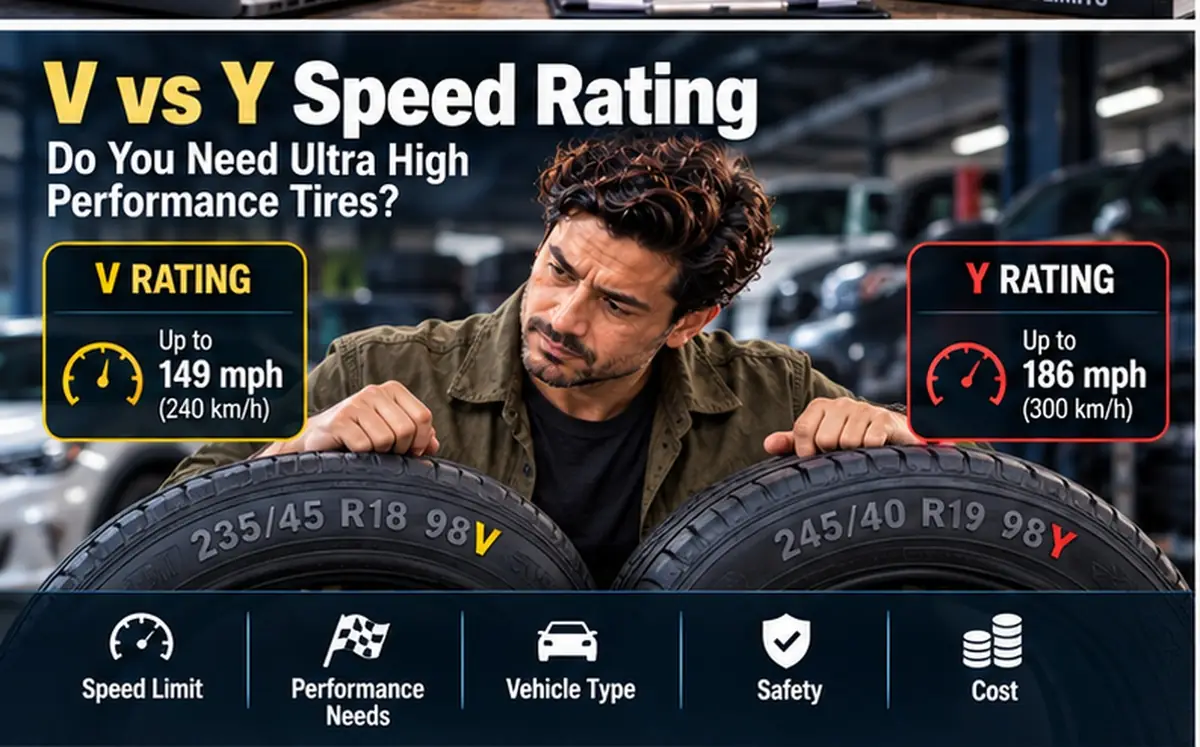
Stepping from a V-rated tire to a Y-rated one raises the certified speed from 149 mph to 186 mph. Nobody needs either number on a public road in the US. So the real choice behind V vs Y is not about top speed. It comes down to whether the stiffer construction and stickier compound that usually come with a Y rating are worth the extra cost, the firmer ride and the shorter tread life for the car you drive and the way you drive it.
For some owners the decision is made for them: if the car came from the factory on Y-rated tires, that is the minimum. For everyone else, the question is whether a Y-rated upgrade earns its keep or whether a V-rated tire already delivers everything the car can use. This guide breaks down what each rating represents, who needs which, and where the trade-offs show up in daily driving.
Table of Contents
Two Ceilings, Two Categories
| Detail | V Rating | Y Rating |
|---|---|---|
| Maximum speed | 149 mph (240 km/h) | 186 mph (300 km/h) |
| Typical category | Performance touring, performance all-season, sport tires | Ultra-high-performance summer tires |
| Typical vehicles | Sport sedans, sporty crossovers, entry performance cars | High-performance sports cars, exotics, supercars |
| Ride comfort | Usually more compliant | Usually firmer |
| Tread life | Generally longer | Generally shorter |
| Price | Lower | Higher |
These ratings sit near the top of the scale, with W (168 mph) between them. A Y in parentheses, written as (Y), goes one step further: it means the tire is rated above 186 mph, and the tire maker states the actual limit. Our tire speed rating chart lists every symbol from Q through Y.
What the Letter Certifies
Speed ratings come from controlled laboratory testing. The tire runs on a drum at its rated load and correct inflation through increasing speed steps, and the symbol reflects the highest step it sustains. The rating is not an invitation to drive that fast, and it describes a new tire under ideal conditions. Underinflation, overloading, repairs, impact damage, wear and age all reduce what a tire can actually handle, no matter what letter it carries.
What Changes Between V and Y
Speed is the official difference. The practical differences come from how tire makers build tires that can survive higher speeds and the heat they generate.
Construction and Compound
Higher speed ratings generally call for a stiffer construction with reinforced belts and firmer sidewalls, along with a tread compound that keeps its grip and stability at elevated temperatures. Y-rated tires tend to push these qualities further than V-rated tires, with stickier rubber and tread patterns biased toward dry grip, lateral stability and steering precision.
The result on the road is often sharper turn-in, more grip at the limit and a more connected steering feel. That stickier compound affects behavior at ordinary speeds too, which is why some enthusiasts choose Y-rated tires on cars that don’t require them.
Comfort and Noise
That same stiffness tends to transmit more of the road. Y-rated ultra-high-performance tires typically ride more firmly over broken pavement and can be louder on coarse highway surfaces. V-rated performance touring and all-season tires generally leave more room for compliance and refinement, which many daily drivers value more than a few extra percent of cornering grip.
Tread Life and Warranties
Soft, sticky compounds wear faster. Y-rated tires usually deliver shorter tread life than V-rated alternatives, and many come with short treadwear warranties or none at all. V-rated performance all-season and touring tires are more likely to carry meaningful mileage coverage. These are general tendencies, and individual tire models vary, so always compare the specific tires you’re considering.
Cost and Efficiency
Y-rated tires typically cost more to buy, and their shorter tread life means you replace them sooner, so the gap in cost of ownership is wider than the sticker difference suggests. Stickier compounds can also increase rolling resistance slightly, which may nudge fuel economy or EV range down a little compared with an efficiency-minded V-rated tire.
The extra 37 mph of certified capability is the smallest part of what separates V from Y. The parts you’ll notice every day are ride quality, tread life and price.
Which Vehicles Call for Which
Where V Fits
V is the standard rating for a wide band of sporty everyday vehicles: sport sedans, sport-trim crossovers, entry-level performance cars and many luxury sedans. It is the natural home of performance touring and performance all-season tires, which combine responsive handling with year-round usability. For drivers who want a car that feels alert on a back road but still rides comfortably on the commute, V-rated tires are hard to beat.
Where Y Fits
Y-rated tires are typical of ultra-high-performance applications: high-powered sports cars, performance variants of luxury sedans and coupes, exotics and supercars. These vehicles were developed on Y-rated rubber, and their suspension tuning, stability control calibration and braking performance assume that level of grip and high-speed stability. Max-performance summer tires such as the Michelin Pilot Sport 4S are common choices in this category.
Some drivers also choose Y-rated tires for frequent track days or autocross. If you regularly drive near the limit on a closed course, the heat tolerance and grip of an ultra-high-performance tire matter far more than they do on the street.
Replacing Y-Rated Tires With V-Rated Ones
If your car originally came with Y-rated tires, replace them with Y-rated tires. The general rule is that replacements should equal or exceed the original speed rating, and on high-performance vehicles that rule carries extra weight. The vehicle’s chassis tuning, ABS and stability control were developed around the original tires, and a lower-rated tire with a softer construction can change how the car responds in an emergency maneuver.
Some insurers and vehicle warranties may also question a lower-rated tire if a claim involves the tires, although this depends on the specific policy.
There is one widely accepted exception: winter tires. Ultra-high-performance cars often have approved winter tire fitments with lower ratings, such as H or V, and the owner’s manual usually spells this out along with any speed restriction while they’re fitted.
Upgrading From V to Y
Going up from V to Y is acceptable from a speed standpoint, since a Y-rated tire exceeds V capability. Whether it is worthwhile depends on the car and the driver.
On a sharp-handling sports car or hot sedan that you enjoy driving hard, a Y-rated tire can make the car feel more precise and grippy even at legal speeds. On a typical family sedan or crossover that came on V-rated tires, the improvement is hard to feel in everyday driving, while the firmer ride, shorter tread life and higher price are easy to notice. Many owners in this position are better served by a quality V-rated performance touring or performance all-season tire.
Season Matters as Much as Speed
Many Y-rated tires are summer tires. Their compounds need warmth to work, and in near-freezing temperatures they lose grip dramatically, to the point where a V-rated all-season tire can be the safer choice on a cold morning. Summer compounds can also be damaged if handled or driven in very cold conditions. If your car spends the winter in a cold climate, plan for a second set of winter tires or choose an all-season design, rather than relying on speed rating to tell you how a tire will behave.
Mixing V and Y Tires
A matched set of four tires is always the goal. If you have to combine V and Y tires temporarily, the vehicle’s top speed is limited to the V rating, the lowest on the car. Where ratings are mixed by axle, the higher-rated pair generally goes on the rear to help maintain stability, but follow the tire maker’s and vehicle maker’s guidance. This matters especially on performance cars with staggered fitments or all-wheel drive, where the manufacturer may specify exact tires front and rear.
Frequently Asked Questions
Yes. A Y-rated tire exceeds the V specification. The question is whether you want the trade-offs that usually come with it: a firmer ride, shorter tread life, higher cost and, in many cases, a summer-only compound.
It isn’t recommended for your regular tires. Replacements should equal or exceed the original rating, and high-performance cars are tuned around the grip and stability of their original tires. Approved winter tires are the usual exception, so check your owner’s manual for the specific allowance.
A speed symbol shown as (Y) means the tire is rated for speeds above 186 mph. The tire maker states the actual maximum speed for that tire. You’ll typically find it on tires fitted to the fastest exotic and supercar models.
They can, slightly. Stickier compounds often have higher rolling resistance than efficiency-oriented V-rated tires, which can trim fuel economy or EV range a little. The size of the effect depends on the specific tires.
Yes. A V-rated tire in good condition, properly inflated and within its load rating, has a large margin above any legal US highway speed. V-rated performance touring and all-season tires are among the most versatile choices for sporty everyday cars.
It is best not to. If you must, your top speed is limited to the V rating, and the higher-rated pair generally goes on the rear. On performance cars with staggered or all-wheel-drive setups, follow the manufacturer’s tire specifications closely and restore a matched set as soon as possible.
Y is the higher rating: Y tires are rated for 186 mph and W for 168 mph. Both are ultra-high-performance ratings, so match or exceed what your vehicle specifies.
Making the Call: V or Y
Start with your door jamb placard. If your car came on Y-rated tires, stay with Y for your primary set, because the car was engineered around that level of grip and stability. If it came on V-rated tires, a good V-rated tire already gives you more speed capability than you will ever use, along with a more comfortable ride, longer tread life and a lower cost of ownership.
Upgrading to Y makes sense when you drive a car that rewards extra grip and you value precision over comfort and longevity, or when you spend time on track. For most daily drivers, even keen ones, the money is better spent on a top-quality V-rated tire suited to your climate.
 Summarize this article with:
















Leave a comment