


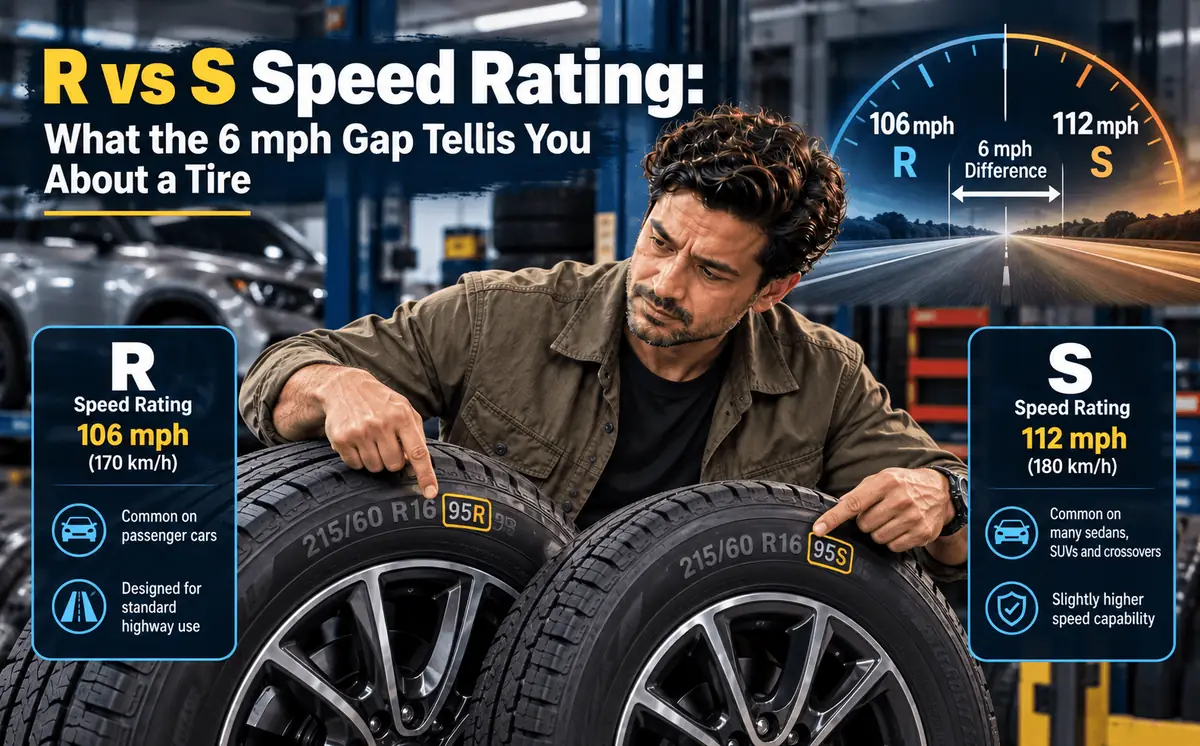
R and S sit next to each other on the speed rating scale, and only 6 mph separates them. So why does the letter matter when you’re replacing tires? Because R and S usually point to two different kinds of tire. An R most often appears on a heavy-duty light truck or off-road tire, while an S is far more likely to show up on a minivan, family sedan or touring all-season. The decision you face is rarely about top speed. It is about whether the tire you’re looking at was built for your vehicle’s job.
That matters most in two situations: when a truck owner considers swapping heavy-duty LT tires for something more road-focused, and when a car or crossover owner sees a cheaper R-rated option in a size that originally came with S. This guide covers what each rating means, where each one belongs, how load capacity fits into the picture, and when changing from one letter to the other makes sense.
Table of Contents
The Ratings at a Glance
| Detail | R Rating | S Rating |
|---|---|---|
| Maximum speed | 106 mph (170 km/h) | 112 mph (180 km/h) |
| Most common tire types | Heavy-duty LT, some all-terrain and mud-terrain | Touring and all-season passenger tires, some LT tires |
| Typical vehicles | Work trucks, heavy-duty pickups, off-road builds | Family sedans, minivans, crossovers, light trucks |
| Usual priority | Load capacity and toughness | Comfort, tread life and everyday versatility |
| Next step up | S | T |
Both ratings comfortably exceed any posted speed limit in the US, where the highest is 85 mph on one Texas toll road. The letter tells you more about construction and purpose than about how fast you can legally drive.
How a Tire Earns Its Letter
Speed ratings come from laboratory testing. A tire is mounted on a test drum, loaded to its rated load at proper inflation, and run through a series of increasing speed steps. The speed symbol reflects the highest step the tire completes. An R-rated tire has been validated to 106 mph under those conditions, and an S-rated tire to 112 mph.
Two caveats apply to every rating:
- It is not a driving recommendation. The rating describes what a new tire withstood in a controlled test, not a speed you should aim for on the road.
- Real-world capability shrinks. Underinflation, overloading, repairs, impact damage, wear and age all erode a tire’s ability to cope with heat and speed. A worn, underinflated R-rated tire on a loaded truck has much less reserve than its sidewall suggests.
Our tire speed rating chart lists every symbol if you want to see where R and S sit on the full scale.
Where R-Rated Tires Make Sense
R is common on heavy-duty LT tires and on many all-terrain and mud-terrain tires in LT sizes. Popular all-terrain models such as the BFGoodrich All-Terrain T/A KO2 carry an R in many of their LT sizes. These tires spend their engineering budget on carcass strength, puncture resistance, load capacity and traction on loose surfaces.
That focus shows up in how they behave. Heavy-duty LT construction typically handles a full bed or a trailer with composure, resists sidewall damage on gravel and rocks, and tolerates the abuse of work use. In return, these tires can feel heavier and less precise on pavement than a passenger tire, and aggressive tread designs often add noise. For a truck that works for a living or spends weekends off the pavement, that is an easy trade.
Who R Fits
- Owners of heavy-duty and work-oriented pickups that originally came with R-rated LT tires
- Drivers who tow or haul regularly and need high load ranges
- Off-road builds running all-terrain or mud-terrain tires in LT sizes
Where S-Rated Tires Make Sense
S is one of the standard ratings for everyday passenger vehicles. You’ll find it on family sedans, minivans and crossovers, typically in touring and all-season designs, and on some light truck tires. Many value-oriented and comfort-focused all-season tires use S ratings in common sizes.
These tires aim for a broad, livable balance: a comfortable ride, steady highway manners, year-round traction and long tread life. S-rated touring and all-season tires frequently come with mileage warranties, which makes them attractive for commuters and families who want predictable ownership costs.
Who S Fits
- Drivers of family sedans, minivans and crossovers whose placard specifies S or lower
- Highway commuters who want a comfortable, quiet, long-wearing tire
- Light truck owners who mostly drive on pavement and don’t need a heavy-duty LT tire
The Load Index Is Half the Story
The speed symbol always sits next to a load index, and the two only make sense together. In 215/65R16 98S, 98 is the load index and S is the speed symbol. In an LT size, you’ll often see a dual load index, such as LT265/70R17 121/118R, where the first figure applies to single fitment and the second to dual rear wheels.
The speed rating is valid only at or below the tire’s rated load and at proper inflation. Overload a tire and it generates more heat than its rating assumes, even at modest speeds. That is why load index matters so much for truck owners. Many R-rated LT tires carry high load indexes and heavy load ranges precisely because carrying weight is their primary purpose.
When you compare an R-rated LT tire with an S-rated passenger tire in a similar size, check the load index and load range first. A higher speed letter does not make up for a tire that can’t carry your truck’s load.
Swapping Between R and S
Moving Up From R to S
From a speed standpoint, replacing R-rated tires with S-rated ones is acceptable, since an S tire meets or exceeds an R tire’s speed capability. The question is whether the S-rated tire matches the rest of the specification. If your truck came with R-rated LT tires, a passenger-rated S tire may carry a lower load index and a lighter construction. It might ride more quietly, but it could fall short on load capacity and durability for towing or hauling. Confirm the load index, load range and inflation requirements against your vehicle’s placard before you switch.
Moving Down From S to R
Fitting R-rated tires to a vehicle that originally came with S-rated tires is generally not recommended for year-round use. The vehicle maker chose the original rating as part of the handling, braking and load package. Going below it reduces your margin for heat, and on a passenger car it often means installing a tire built for a different kind of vehicle altogether.
There is also a paperwork angle. Some insurers and vehicle warranties may scrutinize tires rated below the original specification if a claim involves the tires. Policies vary, so check if you’re considering it.
The main exception is winter tires. Many owner’s manuals allow lower speed ratings, such as Q, S, T or H, for dedicated winter tires, as long as you observe any speed limit the manual sets while they’re on.
What Changes as Ratings Climb
As you move up the scale from R and S toward T, H, V and beyond, tires generally use stiffer construction and stickier compounds. That tends to bring sharper steering and more grip, but also a firmer ride and shorter tread life, and many higher-rated performance tires skip the long treadwear warranties common on touring tires. It is a tendency rather than a rule, since individual models vary widely.
Between R and S, the difference in feel comes less from the letter and more from the tire category. A heavy LT all-terrain tire and a passenger touring tire behave very differently on the highway, whatever their speed symbols say. Judge the tire by its type, construction and load rating as well as its letter.
Mixing R and S on One Vehicle
A matched set of four tires with the same speed rating is the ideal. If you have to mix ratings, for example after a single tire fails and an exact match isn’t available, keep these points in mind:
- Your vehicle’s top speed is limited to the rating of the lowest-rated tire installed.
- The higher-rated pair usually goes on the rear axle to help preserve stability, but follow the tire maker’s and vehicle maker’s guidance, particularly on all-wheel-drive vehicles.
- Treat a mixed setup as temporary and restore a matched set when you can.
Finding Your Vehicle’s Rating
The tire placard on the driver’s door jamb and the tire section of your owner’s manual list the original size, load index and speed rating. Those are your baseline. Your current tires can serve as a reference if they match the original specification, but don’t assume a previous owner or shop installed the right ones.
Frequently Asked Questions
Neither is better in the abstract. S has a higher speed ceiling and is the more common choice for passenger cars, minivans and crossovers. R is typical of heavy-duty LT and off-road tires where load capacity and toughness matter more than top speed. The right one is whichever matches your vehicle’s specification and use.
Usually, yes, as far as speed is concerned. Just make sure the new tire’s load index and load range meet or exceed your vehicle’s requirement. Swapping an R-rated LT tire for an S-rated passenger tire can reduce load capacity, which matters if you tow or haul.
Yes, at legal speeds, with proper inflation and within their load rating. Their 106 mph rating is well above any US speed limit. The practical differences on the highway come from the tire type, since heavy-duty LT and all-terrain tires tend to feel less precise and louder than passenger touring tires.
Not directly. Treadwear warranties depend on the specific tire model and category. That said, S-rated touring and all-season tires often carry long mileage warranties, while many heavy-duty LT and mud-terrain tires offer shorter coverage or none.
It is best to avoid mixing. If you must, the lowest-rated tire limits your top speed, and the higher-rated pair generally goes on the rear. Follow your tire and vehicle maker’s instructions and return to a matched set as soon as you can.
Check the tire placard on the driver’s door jamb and the tire section of your owner’s manual. Both list the original tire size with its load index and speed rating.
The Verdict on R vs S
If you drive a family sedan, minivan or crossover, S is a natural fit: it delivers the comfort, tread life and highway composure these vehicles need, and it comes in an enormous range of all-season and touring designs. Don’t drop to R on a vehicle that came with S just because a tire is cheaper or available.
If you drive a work truck, tow regularly or run an off-road build, R-rated LT tires make complete sense. Their real advantage is load capacity and toughness, not speed, and the 6 mph difference will never limit you on public roads. Whichever way you go, read the load index as carefully as the speed letter, because on a truck it is often the number that matters most.
 Summarize this article with:

















Leave a comment