


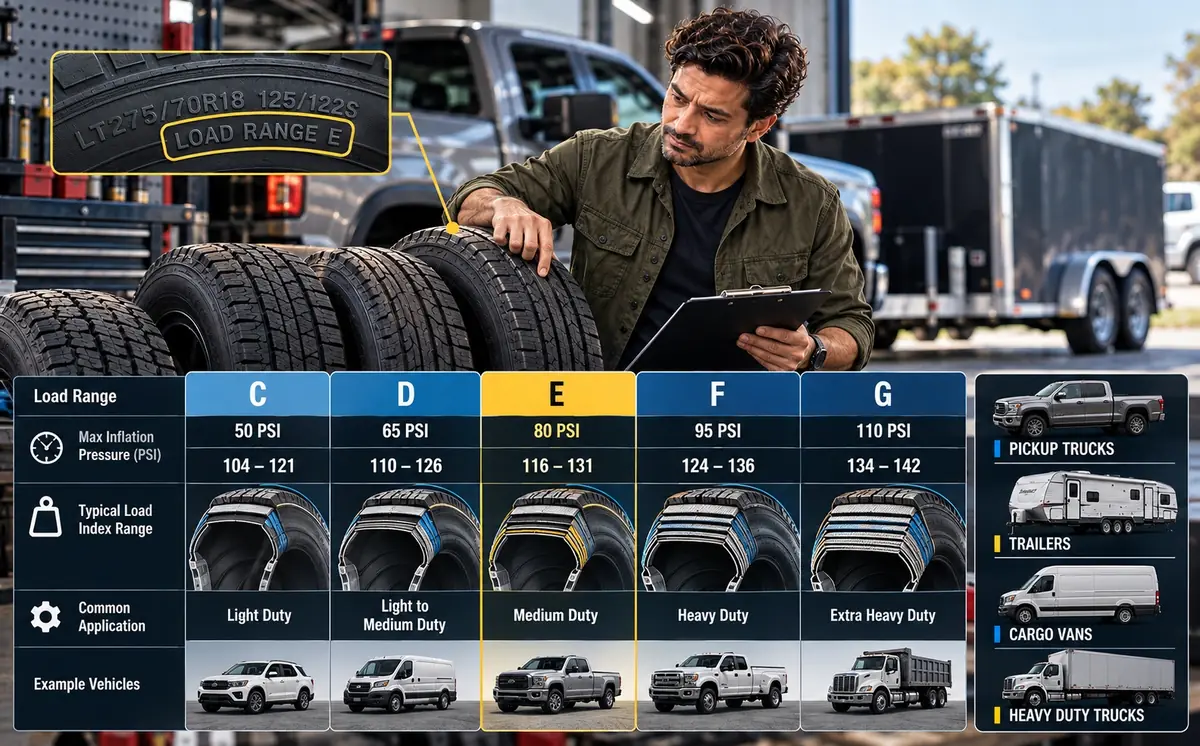
A loaded pickup running tires meant for a passenger car is an accident waiting to happen. The tires may look fine, hold air, and drive normally around town, then fail on a hot interstate with a full bed and a trailer behind. The problem isn’t the brand or the tread. It’s the load range.
Load range tells you how much weight a tire is built to carry at its rated inflation pressure. Get it right and your tires carry the load with margin to spare. Get it wrong and you’re relying on rubber that was never engineered for the job.
Quick answer
Load range is shown as a letter (SL, XL, C, D, E, F, G) or a ply rating number.
Most cars and crossovers need Standard Load (SL) or Extra Load (XL).
Trucks, full-size vans, and vehicles that tow or haul heavily usually need C, D, or E.
F and G are commercial, severe-duty ranges that most private owners will never need.
Table of Contents
What Load Range Actually Measures
Load range is not simply your vehicle’s weight divided by four. It describes the maximum load a single tire can carry at its maximum rated inflation pressure, which is a function of how strongly the tire is built.
The system was developed by the Tire and Rim Association and replaced the older ply rating approach common through the 1970s. Back then a 6-ply tire literally had six layers of rubber-coated fabric. Modern tires use fewer, stronger plies, so a Load Range C tire may contain just two physical plies yet perform like the old six-ply design. The ply number lives on as a legacy equivalent, not a layer count.
The practical question load range answers: can these tires carry a fully loaded truck bed and a trailer’s tongue weight at highway speed, in summer heat, mile after mile?
The Load Range Chart
| Load Range | Ply Rating Equivalent | Typical Max PSI | Typical Use |
|---|---|---|---|
| SL (Standard Load) | 4-ply | 35–44 | Passenger cars, light crossovers |
| XL (Extra Load) | 4-ply, reinforced | 41–51 | Heavier SUVs, performance cars, loaded passenger vehicles |
| C1 | 6-ply | 50 | Light trucks, cargo vans |
| C2 | 6-ply | 60 | Light trucks, higher-pressure variant |
| D | 8-ply | 65 | Heavier hauling, some vans and trucks |
| E | 10-ply | 80 | Three-quarter-ton and one-ton trucks, heavy towing |
| F | 12-ply | 95 | Commercial and severe-duty use |
| G | 14-ply | 110 | Heavy commercial use |
P-metric passenger tires are almost always SL or XL. If a size begins with “LT,” as in LT265/70R17, it’s a light truck tire and carries a lettered load range such as C, D, or E.
Standard Load vs Extra Load
Standard Load is the baseline for passenger vehicles. These tires typically operate at up to 35 PSI, or up to 44 PSI in some sizes, with a load index appropriate for a typical car. Most sedans, coupes, hatchbacks, and smaller crossovers roll on SL tires.
Extra Load, sometimes stamped “Reinforced” (RF) on European tires, uses stiffer construction rated for higher pressures, up to 51 PSI in some sizes. At maximum inflation, an XL tire carries meaningfully more than the same-size SL tire.
XL isn’t automatically better. On a vehicle engineered for SL, running XL tires at high pressure tends to produce a harsher, less compliant ride with no practical benefit. XL makes sense when:
- The door placard calls for it, which is common on heavier SUVs and crossovers
- The vehicle regularly carries a full load of passengers plus luggage
- Some performance applications benefit from the stiffer sidewall
- European vehicles frequently specify XL/RF as standard
In general, the SL version of a tire absorbs road texture a little better at the same pressure, while the XL version holds up better under a fully loaded family road trip. Match what your door placard specifies. If it says XL, run XL. If it says SL, there’s no reason to change unless your use has changed.
Light Truck Load Ranges: When Do You Need Them?
Load Range C (6-Ply)
Load Range C is the entry to light truck territory. It’s found on:
- Half-ton pickups that see moderate hauling or towing
- Full-size cargo vans
- Trailers
- Some overlanding and off-road builds where puncture resistance matters
At 50 to 60 PSI maximum, C-range tires carry substantially more than SL or XL tires. The trade-off is a firmer ride when empty, especially if owners leave the pressure high all the time. If you tow near your half-ton’s maximum rated capacity, LT tires of at least Load Range C are a sensible minimum; check your vehicle’s towing documentation, which often specifies tire requirements. Our 6-ply vs 8-ply and 6-ply vs 10-ply comparisons explore the next steps up.
Load Range D (8-Ply)
Load Range D is less common than C or E in many current sizes but still appears on some older three-quarter-ton trucks, certain heavy-duty vans, and specialty equipment. In many popular light truck sizes, major manufacturers offer C and E and skip D entirely. Our 8-ply vs 10-ply guide covers how D compares with E.
Load Range E (10-Ply)
Load Range E is the standard for serious truck work. If you drive a three-quarter-ton or one-ton pickup and do meaningful towing or hauling, E is almost certainly what your vehicle specification calls for.
Consider a three-quarter-ton diesel pulling a 12,000-lb fifth-wheel camper. Anything lighter than Load Range E on that combination would be reckless, because a lighter tire isn’t rated to carry the vehicle weight plus the trailer’s pin weight at highway speed. A highway or commercial all-season tire in a size like LT265/70R17 Load Range E is the appropriate choice.
The hard truth: if your truck doesn’t need Load Range E, its empty ride can feel punishing. Some owners swap to P-metric or XL tires for a more comfortable commute, but if you tow or haul regularly, that swap carries real safety implications. Know your use. Our comparisons of 10-ply vs 12-ply and 10-ply vs 14-ply tires cover the heavier ranges.
Load Range F (12-Ply)
Load Range F marks the transition from consumer to commercial territory. Rated for 95 PSI, it’s rarely seen on privately owned pickups used for personal transport. Legitimate reasons to consider it include:
- Severe-duty one-ton trucks in commercial or agricultural use, hauling grain, equipment, or livestock on rough roads daily
- Heavy flatbed and gooseneck work, where operators running near the GVWR of a one-ton dually want extra margin
- Upfitted or commercially modified dually rear axles
- Class 3 to 5 medium-duty trucks, such as box and utility trucks, which often use F-range tires from the factory
Commercial lines such as the Goodyear G614 RST and Michelin XPS Rib are examples of this category.
For most drivers researching Load Range F, the better question is whether a quality Load Range E tire already covers the job. For the overwhelming majority of heavy towing and hauling on one-ton pickups, it does.
One caution: running 95 PSI on a pickup that wasn’t engineered for it can stress wheels, hubs, and bearings beyond their design range. Consult the vehicle manufacturer or a commercial tire specialist before switching. Our 12-ply vs 14-ply guide compares F and G.
Reading Load Range on the Sidewall
Consider LT265/70R17 121/118S Load Range E:
- LT: light truck
- 265: width in millimeters
- 70: aspect ratio
- R: radial
- 17: wheel diameter in inches
- 121/118: load index for single and dual fitment; 121 equals about 3,197 lbs per tire in single use
- S: speed rating, up to 112 mph
- Load Range E: 80 PSI maximum, 10-ply rated
Sometimes the letter is spelled out (“LOAD RANGE E”); sometimes you’ll see “MAX LOAD … 80 PSI” and “10 PR” instead. Passenger tires are simpler: 235/55R18 100H XL, with XL or SL near the size. No marking implies SL.
Load Range vs Load Index
People mix these up constantly.
- Load range is the construction category and maximum pressure, shown as a letter.
- Load index is the number that gives the exact maximum weight for that tire at its rated pressure.
| Load Index | Max Load (lbs) |
|---|---|
| 85 | 1,135 |
| 90 | 1,323 |
| 95 | 1,521 |
| 100 | 1,764 |
| 105 | 2,039 |
| 110 | 2,337 |
| 115 | 2,679 |
| 121 | 3,197 |
| 126 | 3,748 |
You need both a suitable load range and a sufficient load index. A tire can be Load Range E yet carry a lower load index than your vehicle needs in an unusual size combination. Always check both against your placard. Our load index chart has the full table.
What Load Range Do You Need?
Passenger Cars and Small Crossovers
SL, or XL if the placard specifies it. Most mainstream sedans and light crossovers use SL tires from the factory. Stick with that unless you have a specific reason.
Mid-Size and Full-Size SUVs
SL or XL per the placard, occasionally Load Range C. Three-row SUVs that regularly carry seven passengers and cargo often specify XL. Some full-size SUVs in maximum-tow configurations come with LT C-range tires.
Half-Ton Pickups
SL/XL for light use; C or D for regular towing or hauling near capacity. Modern half-tons can tow a great deal, and at those loads LT tires of at least Load Range C are appropriate. For commuting with occasional light hauling, the P-metric SL or XL tires many come with are fine.
Heavy-Duty Pickups
Load Range E minimum for towing and hauling. These trucks exist to work, and their factory specifications almost universally call for LT Load Range E. Consider F only for a one-ton dually in genuine commercial or agricultural service running near its GVWR. For personal use, even demanding personal use, E is the right answer.
Cargo and Sprinter-Type Vans
C minimum, D for consistently heavy loads. Professional vans carrying tools, equipment, and products should run at least Load Range C.
Ply vs Ply: Comparing Load Ranges Side by Side
Few shoppers weigh all seven load ranges at once. The real decision is usually between two neighbors: the rating on the truck now and the one a step above it. Here’s how the common matchups compare.
| Matchup | Load Ranges | What You Gain | What You Give Up | Choose the Higher Rating If |
|---|---|---|---|---|
| 4-ply vs 10-ply | SL/XL vs E | Roughly double the capacity, far tougher sidewalls | Comfort, quietness, fuel economy | 10-ply only for towing or heavy hauling |
| 6-ply vs 8-ply | C vs D | More capacity and puncture resistance | A firmer ride, higher price | D for regular towing or rough roads |
| 6-ply vs 10-ply | C vs E | A big jump in load and cut resistance | Comfort, a little fuel economy | E for heavy-duty pickups and large trailers |
| 8-ply vs 10-ply | D vs E | About 3,042 vs 2,205 lbs per tire in a typical size | Often 1–2 mpg, more road noise | E for heavy towing and fifth-wheels |
| 10-ply vs 12-ply | E vs F | More capacity, longer tread life under load | Ride, noise, size availability | F for trucks near GVWR most days |
| 10-ply vs 14-ply | E vs G | Commercial-grade capacity at 110 PSI | A harsh unloaded ride, fuel economy | G only for commercial duty |
| 12-ply vs 14-ply | F vs G | About 4,080 vs 3,750 lbs in one common size | Ride, fuel economy, off-road flex | G for sustained maximum loads |
| 14-ply vs 16-ply | G vs H | The highest capacity, up to 125 PSI | Cost, limited sizes, ride | H for commercial trucks and heavy trailers |
4-Ply vs 10-Ply
This is the widest gap people ask about, and it’s rarely a real choice. A 4-ply (SL or XL) tire typically carries about 1,000–1,800 lbs depending on size, while a 10-ply Load Range E tire often handles more than 3,000. The 4-ply rides quieter, rolls easier, and costs less. The 10-ply shrugs off punctures and impacts far better. If your vehicle didn’t come on LT tires and you don’t tow, the 10-ply mostly buys you a stiffer ride.
6-Ply vs 8-Ply (Load Range C vs D)
Load Range C covers light trucks, smaller SUVs, and utility trailers at roughly 1,500–2,500 lbs per tire. Load Range D moves into the 2,500–4,000 lb range depending on size, with stiffer sidewalls that help on gravel and under a loaded bed. C rides softer and costs less. Pick D if you tow regularly or spend time on rough roads, and stay with C if the truck mostly commutes.
6-Ply vs 10-Ply (Load Range C vs E)
Skipping D and going straight from C to E makes sense when the work is clearly heavy-duty: a three-quarter-ton pickup, a large travel trailer, or off-road driving where sidewall cuts are a real risk. The trade is a firmer ride and slightly lower fuel economy. For light trucks and vans carrying moderate weight, C stays the more comfortable and economical choice.
8-Ply vs 10-Ply (Load Range D vs E)
This is the most common decision truck owners face. In a typical size, a Load Range D tire is rated around 2,205 lbs at 65 PSI, while Load Range E reaches about 3,042 lbs at 80 PSI, a four-tire difference of more than 3,300 lbs. E tires usually cost 1–2 mpg and add some road noise. Half-tons that tow now and then do fine on D. Heavy towing and fifth-wheel campers call for E.
10-Ply vs 12-Ply (Load Range E vs F)
Load Range F starts where most personal trucks stop needing more. It adds capacity, thicker sidewalls, and usually longer tread life under constant heavy use, but it rides firmer when empty, makes more noise, and isn’t stocked in every size. If your truck spends most days near its GVWR, F earns its price. If it’s loaded only part of the time, a quality E tire is usually the better fit.
10-Ply vs 14-Ply (Load Range E vs G)
Load Range G runs up to 110 PSI and belongs on commercial trucks and dually work rigs. On a pickup used for personal towing, it delivers a harsh unloaded ride and a noticeable fuel penalty without a meaningful safety gain over E. Shortlist G only when the door placard or the job itself demands it.
12-Ply vs 14-Ply (Load Range F vs G)
In one common heavy-duty size, F is rated around 3,750 lbs per tire and G around 4,080. G gives the longest tread life and the most stability under sustained maximum loads. F keeps a more tolerable ride, a smaller fuel penalty, and better flex off-road. F suits three-quarter-ton trucks and RV towing, while G suits trucks that run at their GVWR every working day.
14-Ply vs 16-Ply (Load Range G vs H)
Load Range H tops the scale with a typical 125 PSI maximum, against 110 PSI for G. That extra capacity matters for commercial trucks, equipment trailers, and fleet vehicles. Anywhere else, H adds cost, narrows your size choices, and stiffens the ride further. If you’re unsure whether you need H, you almost certainly don’t, and the vehicle’s placard will settle it.
Can You Inflate Your Way to a Higher Load Range?
No. Pressure and load range are not interchangeable.
You can’t run an SL tire at 50 PSI and expect it to carry a C-range load. SL tires aren’t built to operate safely at that pressure; their carcass, bead, and sidewall construction differ fundamentally from a C-range tire.
The reverse mistake is just as dangerous: running a Load Range E tire at passenger-car pressures, say 30 to 35 PSI, while carrying a heavy load leaves it under-inflated for that load. The sidewall flexes excessively, heat builds, and blowout risk rises, even though the tire looks normal. When you change load ranges, recalibrate your pressure expectations entirely using the tire maker’s load and inflation tables.
Load Range and Ride Quality
Stiffer tires carry more, and that comes at a price: Load Range C, D, E, and F tires ride noticeably firmer than SL or XL tires, especially when the vehicle isn’t loaded. Higher ratings mean less sidewall flex, less compliance over bumps, and more road noise. F-range tires at 95 PSI ride like the commercial equipment they are.
Compare a half-ton on LT Load Range E tires with the same truck on P-metric XL tires in a similar size: the P-metric tires are noticeably smoother and quieter around town, while the LT tires feel planted and stable at highway speed with a full bed.
Match your load range to your actual use, not your aspirational one. A half-ton used only for commuting and hardware-store runs can legitimately run SL or XL tires for better comfort and fuel economy. One that regularly tows a boat or camper should step up to a C-range LT tire without hesitation.
Frequently Asked Questions
Usually, yes, from a structural standpoint. Expect a firmer ride, higher cost, and the need for higher pressures to reach the rated load. Check your owner’s manual first, especially on newer vehicles with sophisticated suspension tuning.
For a truck that regularly hauls or tows heavy loads, yes. For a daily driver or lightly used pickup, E’s stiffness and cost are unnecessary.
That the tire’s capacity matches an old 10-ply bias construction, achieved with fewer, stronger layers.
Not inherently. Tread life depends mainly on the compound, reflected in the UTQG treadwear grade, not the load range.
Check the door placard or owner’s manual. Many tire retailers’ websites also flag XL requirements when you search by vehicle.
No. Different load ranges have different pressures and sidewall stiffness, which creates imbalanced handling in corners and emergency maneuvers. Run four matching tires.
E is the stronger rating. Load Range E (10-ply) is the standard for serious towing and hauling with three-quarter- and one-ton pickups, while D (8-ply) is less common. If your truck doesn’t need E, its firmer empty ride can feel harsh, so match what your vehicle calls for.
The Bottom Line
Load range rarely gets attention, yet it may be the most safety-critical specification you choose, especially for trucks and SUVs that do real work. Check your door placard, be honest about how you actually use your vehicle, and choose a load range and load index that match both. If you tow or haul regularly, step up. If you don’t, there’s no need to make your daily drive harsher with truck-spec tires.
 Summarize this article with:


















Leave a comment