


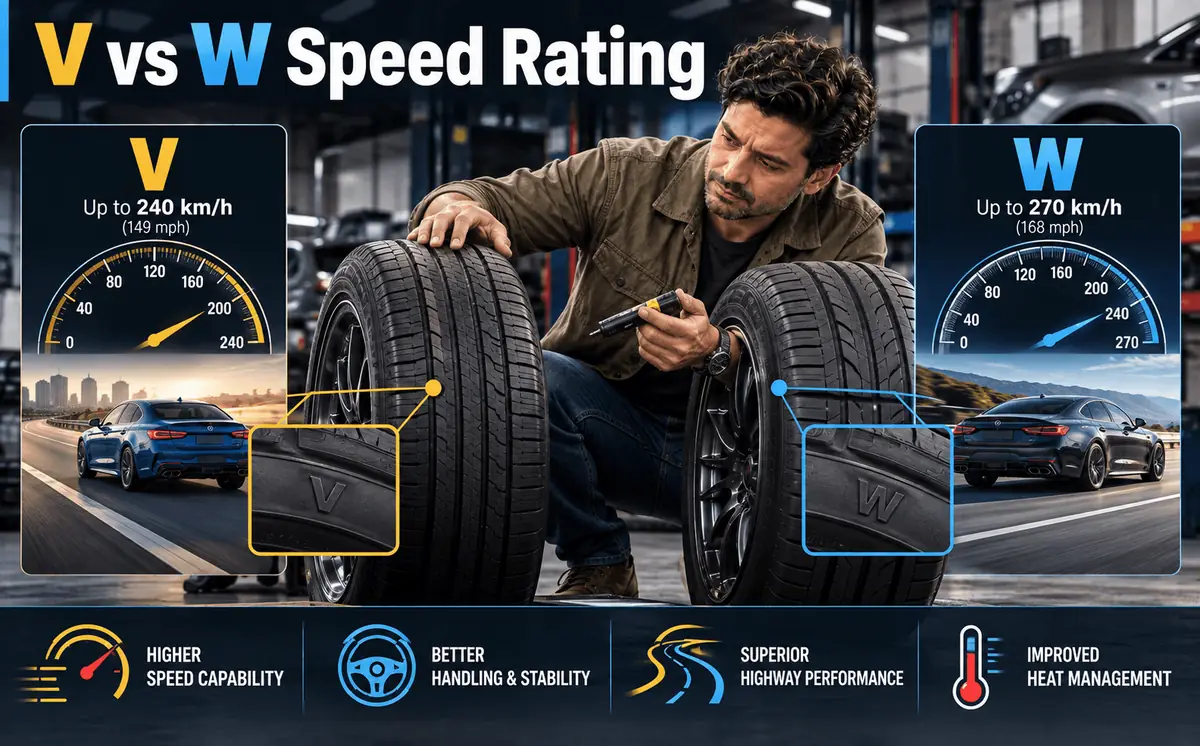
You own a performance car, perhaps a German sport sedan, an American muscle car, or a hot hatch, and it left the factory on W-rated tires. Now it’s time for a new set. A premium W-rated max-performance tire costs a lot. A capable V-rated sport touring tire costs a couple of hundred dollars less for the set. Do you really need a tire rated for 168 mph?
The V vs W decision is one of the most interesting in the tire world because it marks the line between a fast daily driver and a dedicated performance car. The 19-mph difference in rated speed changes how a car feels everywhere, even in a parking lot.
How this guide was put together: This guide is based on published speed rating standards and typical warranty ranges. The cost-per-mile example uses illustrative prices, not a specific pair of tires. Checked on October 22, 2026.
Key takeaways
V-rated (149 mph): the sport touring standard. Great for spirited daily driving and comfortable enough for long trips.
W-rated (168 mph): the entry to max performance. Stiffer sidewalls deliver sharper steering and higher cornering limits, usually at the expense of comfort and tread life.
The rule: upgrading from V to W is a safe way to sharpen handling. Downgrading from W to V is accepted for winter tires but not recommended for summer performance driving on a car that specifies W.
Table of Contents
The Ratings
- V: approved for speeds up to 149 mph (240 km/h). Once among the highest ratings available, it is now the standard for modern sport touring tires.
- W: approved for speeds up to 168 mph (270 km/h). Introduced as cars broke the 150-mph barrier, it often appears in the “ZR” family, as in 245/40ZR19 98W.
What’s Different Inside
To earn a W rating, a tire must survive sustained running at 168 mph in standardized testing. That requires physical reinforcement:
- Cap plies: W-rated tires typically use a full nylon or aramid spirally wound cap ply over the steel belts to restrain centrifugal growth. V-rated tires may use a less dense overlay or different materials.
- Apex stiffeners: the rubber filler above the bead is typically taller and stiffer in a W-rated tire, reducing sidewall deflection in hard cornering.
- Compound: W-rated compounds are engineered to manage heat at sustained high speed.
How V and W Feel on the Road
If you’ve compared H and V tires, you know H leans toward comfort and V toward sport. W takes sport a step closer to track-ready.
Steering Response
- V-rated: make a rapid steering input at highway speed and there’s a brief, progressive delay as the sidewall flexes and takes a set before the car turns.
- W-rated: response is almost immediate. The stiff sidewall transmits your input to the road with little lag, making the car feel lighter and more agile.
Ride Quality
- V-rated: firm but compliant, rounding off the sharp edges of potholes.
- W-rated: busy. You feel the texture of the asphalt. On a daily commute over badly maintained roads, that can be tiring.
Cornering
- V-rated: as cornering forces build, you can feel the tire start to roll onto its sidewall, a progressive warning that you’re approaching the limit.
- W-rated: stays flatter with a higher grip limit, but often has a sharper breakaway. When it lets go, it can do so more abruptly than a forgiving V-rated tire.
Braking
W-rated max-performance tires often stop shorter on dry pavement because their stiffer tread blocks resist squirming under heavy braking, preserving the contact patch. Exact results depend heavily on the specific models compared, so check independent test data when braking distance is your priority.
Highway Noise
V-rated sport touring tires are generally quieter. W-rated tires can produce a noticeable hum, particularly on concrete, though they often track straighter over grooves and ruts.
Track Days: Is V-Rated Enough?
Track days and high-performance driving events typically require only that tires be in good condition, but on track the demands are severe: repeated hard braking from high speed and sustained high cornering loads.
- V-rated: after a few laps, sidewall flex generates substantial heat. The rubber can turn greasy and lose grip, and pushed too hard, tread blocks may chunk.
- W-rated: built to manage this kind of heat cycling better, offering more consistent laps before fading.
If you plan to track your car, choose W or higher, or a dedicated track-oriented tire.
Wet Weather and Winter
Higher ratings aren’t better at everything.
- Hydroplaning: many W-rated performance tires use wide circumferential grooves and large shoulder blocks designed to evacuate water at speed, which can give them good hydroplaning resistance.
- Cold and snow: V-rated sport touring and all-season tires often use more siping and compounds that stay flexible in the cold. Many W-rated summer tires use compounds that harden significantly below about 45°F (7°C) and are not suitable for snow or ice. In freezing conditions, a V-rated all-season tire is almost always the safer choice than a W-rated summer tire.
Always check whether a tire is an all-season or a summer design, not just its speed rating.
Don’t Mix V and W Tires
Mixing V and W tires front to rear creates a handling imbalance: the axle with the stiffer, grippier tires responds faster and holds harder than the other, which can produce unpredictable behavior at the limit. On all-wheel-drive cars, differences in rolling circumference can also stress the drivetrain.
Match all four tires. If you buy two new W-rated tires, plan to replace the other two as soon as possible.
Is W Worth the Money?
Consider an illustrative comparison in a common sport sedan size, 245/40R19:
- V-rated sport touring tire: about $210 each, often with a UTQG treadwear grade in the 500 to 700 range and a 50,000-mile warranty
- W-rated max-performance tire: about $265 each, often with a UTQG treadwear grade around 200 to 340 and a 30,000-mile warranty or none
The set difference is about $220 up front. Spread over expected life, the V-rated set costs roughly $0.017 per mile and the W-rated set roughly $0.035 per mile. In other words, running W-rated max-performance tires can cost more than twice as much per mile, because you’re paying for stickier rubber and stiffer construction that wear faster.
The Modified Car
Consider a hot hatch that came on H- or V-rated all-season tires and has since been tuned for significantly more power. The stock tires may struggle to put that power down, spinning through the lower gears. A W-rated performance tire’s grippier compound can make better use of the added power and improve acceleration. If you substantially increase power, your tires should keep up.
When Downgrading from W to V Makes Sense
Manufacturers recommend against downgrading below the specified rating. In practice, there are situations where a V-rated tire is a reasonable choice:
- Winter tires: yes. Dropping to V, H, or even lower for dedicated winter tires is accepted and smart. You want a flexible carcass and cold-weather compound, not a stiff summer tire.
- Pothole-plagued roads: maybe. A slightly softer V-rated sidewall may reduce wheel damage, at the cost of handling precision. Check with your vehicle manufacturer or tire professional first.
- Gentle, comfort-focused driving: consider carefully. A quality V-rated touring tire will ride quieter, last longer, and cost less. But the vehicle’s handling will change, and you should never use it for track driving. Follow your manufacturer’s guidance and confirm the choice with a tire professional.
When to Upgrade from V to W
If your car came with V-rated tires and you enjoy driving, moving to a W-rated performance tire is one of the most noticeable handling upgrades available. It transforms steering feel more than many bolt-on modifications.
Why a W Tire Says “ZR”
You’ll often see sizes like 245/45ZR18 100W:
- ZR: indicates the tire is rated above 149 mph.
- W: the specific rating, 168 mph.
ZR is a legacy marking that adds nothing beyond the W. A tire marked “R” and one marked “ZR” are compatible as long as their service descriptions (for example, 98W) match. Our speed rating chart explains the full system.
Tires Worth Considering
V-Rated Sport Touring
- Continental ExtremeContact DWS06 Plus: a rare blend of high grip and good tread life.
- Michelin Pilot Sport All Season 4 (V-rated in some sizes): composed and confident.
- Yokohama Avid Ascend GT: focused on quiet comfort.
W- and Y-Rated Max Performance
- Michelin Pilot Sport 4S: a benchmark for street performance.
- Bridgestone Potenza Sport: strong dry grip with a stiff ride.
- Pirelli P Zero: a long-standing original-equipment choice on high-end performance cars.
- Firestone Firehawk Indy 500: a budget-friendly performance option.
Frequently Asked Questions
Usually, yes. Max-performance W-rated tires often last roughly 20,000 to 30,000 miles, compared with around 50,000 for many V-rated sport touring tires.
No. W is rated to 168 mph. For higher speeds you need a Y-rated (186 mph) or (Y)-rated (above 186 mph) tire.
Many summer performance tires, often W-rated, should not be driven in near-freezing temperatures, and their compounds can crack if driven in extreme cold. This is a property of the summer compound rather than the speed rating, but the two often go together. Check whether a tire is all-season or summer.
It’s not recommended. Two W-rated tires from different brands can handle quite differently. Match brand and model.
Yes. ZR in the size indicates capability above 149 mph; W in the service description gives the exact limit of 168 mph.
The Verdict
V vs W is a question of need versus want.
You need a V-rated tire for safe, reliable, spirited daily driving, and it’s the comfortable, cost-effective choice for cars that specify V.
You want a W-rated tire for sharper steering, higher cornering limits, and track-day durability, and you should run one if your manufacturer specifies W.
For performance cars like muscle cars and sport sedans built for hard driving, W is the right choice. For comfortable cruisers that don’t require it, a quality V-rated tire delivers a smoother, quieter, longer-lasting experience. Not sure what fits your wheels? Our tire size calculator guide can help.
Sources
Specs, warranty terms and prices were checked on October 22, 2026. Prices change often.
- NHTSA: Tires (tire ratings and safety information)
- Tires-Easy: Michelin Pilot Sport 4S (example of a 30,000-mile max-performance warranty)
 Summarize this article with:












Leave a comment