


Most drivers can tell you their tire size. Far fewer can tell you how much weight each of those tires is built to carry. Yet load capacity is one of the most safety-critical numbers on the sidewall. Exceed it and a tire runs hot, wears quickly, handles poorly, and in the worst case fails without warning.
The confusion starts with terminology. Shoppers hear “ply rating,” “load range,” and “load index” used almost interchangeably, and the old ply numbers no longer mean what they once did. This guide untangles all three, shows you where to find each one, and explains how inflation pressure and vehicle weight decide whether a tire is truly up to the job.
Table of Contents
Why Load Capacity Matters
Every vehicle has a Gross Vehicle Weight Rating (GVWR): the maximum it can safely weigh with passengers, cargo, and fluids on board. The tires carry every pound of that weight, and each one must be able to handle its share.
Get it wrong and three things suffer:
- Safety. An overloaded tire flexes excessively and builds heat, which can damage its structure and lead to a blowout and loss of control.
- Performance. Correctly loaded tires deliver the handling, braking, and ride the vehicle was engineered for. Overloaded tires feel vague and stop poorly.
- Longevity. Loads beyond a tire’s design limit accelerate tread wear and break down the internal structure, shortening its life.
From Literal Plies to Modern Ratings
Where the Term Came From
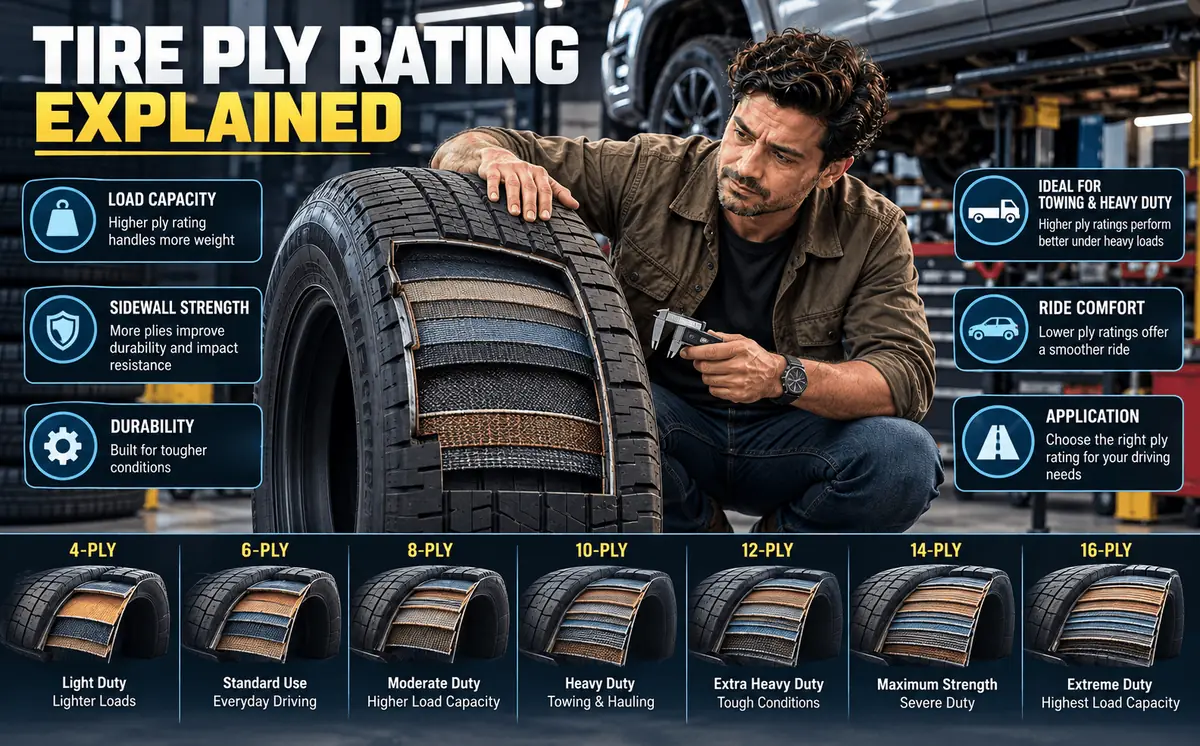
Early tires were built from multiple layers of rubber-coated fabric cord, often cotton or rayon, laid at opposing angles in bias-ply (cross-ply) construction. Those layers were the plies. A tire with an 8-ply rating literally contained eight layers, and more layers meant more load capacity.
Why the Term Survives
Modern radial tires use far stronger materials, such as polyester, nylon, steel, and aramid, so they achieve the same strength with far fewer layers. A radial tire marked “10-ply rated” typically has only two or three actual body plies. The number now describes strength equivalence: the tire can carry the load that a 10-ply bias tire once could.
So “ply rating” has become a legacy label. It still appears on many sidewalls, but the industry’s real language for load is the load range and the load index.
Load Range and Load Index: The Modern Language of Load
Load Range: The Strength Category
The load range is a letter (or abbreviation) that classifies a tire’s construction strength and maximum inflation pressure.
- Standard Load (SL): the baseline for passenger car tires.
- Extra Load (XL) or Reinforced (RF): passenger tires built to carry more than an SL tire of the same size, at higher inflation pressure.
- Light truck letters (C, D, E, F, G and beyond): LT tires use letters, each step representing more strength and capacity. A Load Range E tire is much stronger than a Load Range C tire.
| Load Range | Ply Rating Equivalent | Typical Max Pressure |
|---|---|---|
| C | 6-ply | 50 PSI |
| D | 8-ply | 65 PSI |
| E | 10-ply | 80 PSI |
| F | 12-ply | 95 PSI |
| G | 14-ply | 110 PSI |
The pairing never changes: a 6-ply rating is always Load Range C, 8-ply is always D, and 10-ply is always E. You will often see both on the sidewall, as in “Load Range E (10 Ply Rating).” Our guide to tire load ranges covers every category in more depth.
Load Index: The Exact Number
The load index is the two- or three-digit number that follows the tire size. It corresponds to the maximum weight a single tire can carry when inflated to its specified pressure, and it is the most precise measure of capacity. A higher number means more capacity: a load index of 104 carries far more than a 91.
Remember that the figure applies to one tire. The vehicle’s total weight is shared across all four.
How They Work Together
The load range tells you the tire’s general toughness and pressure category. The load index tells you exactly how much it carries. An XL passenger tire will have a higher load index than an SL tire of the same size, and a Load Range E LT tire will have a higher load index than a Load Range C tire of the same nominal size.
When you need to know exact capacity, for towing for example, go by the load index. In a size such as LT265/70R17 121E, the “121” tells you the precise per-tire limit.
Where to Find Your Load Information
On the Sidewall
Take a passenger tire marked P235/55R17 98V:
- P235/55R17 is the size: P for passenger, 235 mm section width, 55 aspect ratio, R for radial, 17-inch rim.
- 98 is the load index.
- V is the speed rating, a separate specification indicating the maximum sustained speed.
- MAX PRESS 51 PSI (printed elsewhere on the sidewall) is the most pressure the tire can hold, not the pressure you should run.
- Load range appears on LT tires as “Load Range E” or within the service description, and on passenger tires as “XL” or “Extra Load” near the size.
On the Door Placard
The vehicle manufacturer’s tire placard, usually on the driver’s door jamb and sometimes inside the fuel door or glove box, is the definitive reference. It lists:
- Recommended cold inflation pressure
- The vehicle’s GVWR
- The original-equipment tire size
- The minimum load index and speed rating for replacements
In the Owner’s Manual
The manual repeats the placard data and often adds guidance for towing or special uses. When there’s a conflict between general tire information and the vehicle maker’s requirements, the vehicle maker wins.
Load Index Reference Chart
The table below shows maximum load per tire for common load index values.
| Index | Load (lbs) | Index | Load (lbs) | Index | Load (lbs) |
|---|---|---|---|---|---|
| 75 | 853 | 92 | 1,389 | 109 | 2,271 |
| 78 | 937 | 94 | 1,477 | 110 | 2,337 |
| 80 | 992 | 96 | 1,565 | 112 | 2,469 |
| 82 | 1,047 | 98 | 1,653 | 115 | 2,679 |
| 84 | 1,102 | 100 | 1,764 | 118 | 2,910 |
| 86 | 1,168 | 102 | 1,874 | 120 | 3,086 |
| 88 | 1,235 | 104 | 1,984 | 121 | 3,197 |
| 90 | 1,323 | 106 | 2,094 | 123 | 3,417 |
| 91 | 1,356 | 108 | 2,205 | 126 | 3,748 |
LT tires often show two load index numbers separated by a slash, such as 121/118. The first applies when the tire is mounted singly; the second applies in a dual-wheel setup, where each tire carries slightly less.
Using the Chart
1. Find the load index on your tire’s sidewall.
2. Look up the corresponding weight in the chart.
3. For LT tires, confirm the load range and use the single or dual figure as appropriate.
4. Make sure the capacity meets or exceeds what your door placard or owner’s manual requires.
Inflation Pressure: The Other Half of Load Capacity
A tire’s rated load assumes the correct pressure. The air inside is what supports the weight, holding the sidewalls and tread in shape and spreading the load evenly. Without enough pressure, even a tire with an adequate load rating cannot carry its designed weight safely.
Under-Inflation
Under-inflation is one of the most common and dangerous mistakes. A soft tire flexes excessively under load, and that flexing generates heat that degrades the rubber and internal components. The result is accelerated wear and a much higher risk of sudden failure. An under-inflated tire’s effective capacity drops sharply, and handling and braking suffer with it.
Maximum PSI vs Recommended PSI
- Maximum pressure on the sidewall is the most air the tire can safely hold. It is set by the tire maker based on construction and is not an everyday driving pressure.
- Recommended pressure on the door placard is set by the vehicle maker for your vehicle and tire size. It balances comfort, handling, load capacity, and wear.
Inflate to the vehicle manufacturer’s recommendation. Heavy-duty LT tires are the main exception: for towing and hauling, their pressure is often adjusted according to load using the tire maker’s load and inflation tables.
Matching Load Ratings to Your Vehicle
Everyday Passenger Vehicles
For most cars, minivans, and crossovers, match the original-equipment load specification on the placard. That ensures the tires suit the loads the vehicle typically carries. Never install tires with a lower load capacity than the manufacturer specified.
RVs, Trailers, Commercial Vehicles, and Off-Road Rigs
- RVs and trailers often call for ST (Special Trailer) tires, built with stiffer sidewalls to handle sustained heavy loads and resist sway. Follow the RV or trailer manufacturer’s load and inflation specifications.
- Commercial trucks and vans carry substantial weight and typically require high load ranges such as E, F, G, or higher with correspondingly high load indexes. Overloading invites damage, crashes, and potential penalties.
- Off-road vehicles may not always carry extreme weight, but rough terrain is punishing. LT tires with higher load ratings and robust construction add durability and puncture resistance on top of capacity.
How Size Affects Capacity
Larger tires, with more overall diameter, more section width, or both, generally have the potential to carry more weight. A bigger tire holds more air at a given pressure, creating a larger air spring, and manufacturers often build larger sizes with stronger reinforcement. A 235/55R17 tire, for example, has inherently different capacity from a 185/65R14. When changing sizes, make sure the new tire meets or exceeds the original load index. Our tire size explainer covers the details.
What Overloading Does
Blowouts and Loss of Control
Excess weight stresses a tire’s internal structure beyond its limits and drives up heat, weakening rubber and cords until the tire fails suddenly, through rapid air loss or tread separation. At speed, or in a corner, that can mean a complete loss of control.
Faster, Uneven Wear
Overloading makes the rubber wear much faster than intended and often unevenly, with cupping or rapid breakdown of tread blocks. You end up replacing tires early.
Poorer Handling and Economy
Overstressed sidewalls make the ride harsher, steering less precise, and braking distances longer. Deformed, overloaded tires also roll with more resistance, cutting fuel economy.
Frequently Asked Questions
No. Ply rating is now a measure of strength equivalence. Old tires used weak cotton cord and needed ten layers for that strength; a modern Load Range E tire usually has two or three body plies made of much stronger materials.
They describe the same specification in two naming systems. A 6-ply rating is Load Range C, 8-ply is D, and 10-ply is E.
The load index. The load range is a broad category indicating toughness and maximum pressure; the load index gives the exact per-tire weight limit. When towing, always check the load index.
Usually, yes. Heavy-duty tires have thicker, stiffer sidewalls designed for higher pressures. On a light-duty truck or SUV that rarely carries much weight, Load Range E tires can feel noticeably harsh.
Generally not. Sedans, minivans, and compact crossovers use P-metric or Euro-metric tires in SL or XL form, roughly equivalent to the old 4-ply rating. Heavy-duty LT tires on a car are usually unnecessary, costly, and hard on ride comfort.
Near the size on the sidewall. Look for “Load Range E,” “LRE,” or “10 P.R.”
The Bottom Line
Ply rating is a historical term; load range and load index are what matter today. The load range tells you how tough a tire is and how much pressure it can hold. The load index tells you exactly how much weight it can carry.
Use your door placard and owner’s manual as the starting point, choose tires whose load index meets or exceeds the requirement, and keep them inflated correctly so they can actually deliver that capacity. Do that, and your tires will carry your vehicle, your passengers, and your cargo safely for their full service life.
 Summarize this article with:

















Leave a comment