


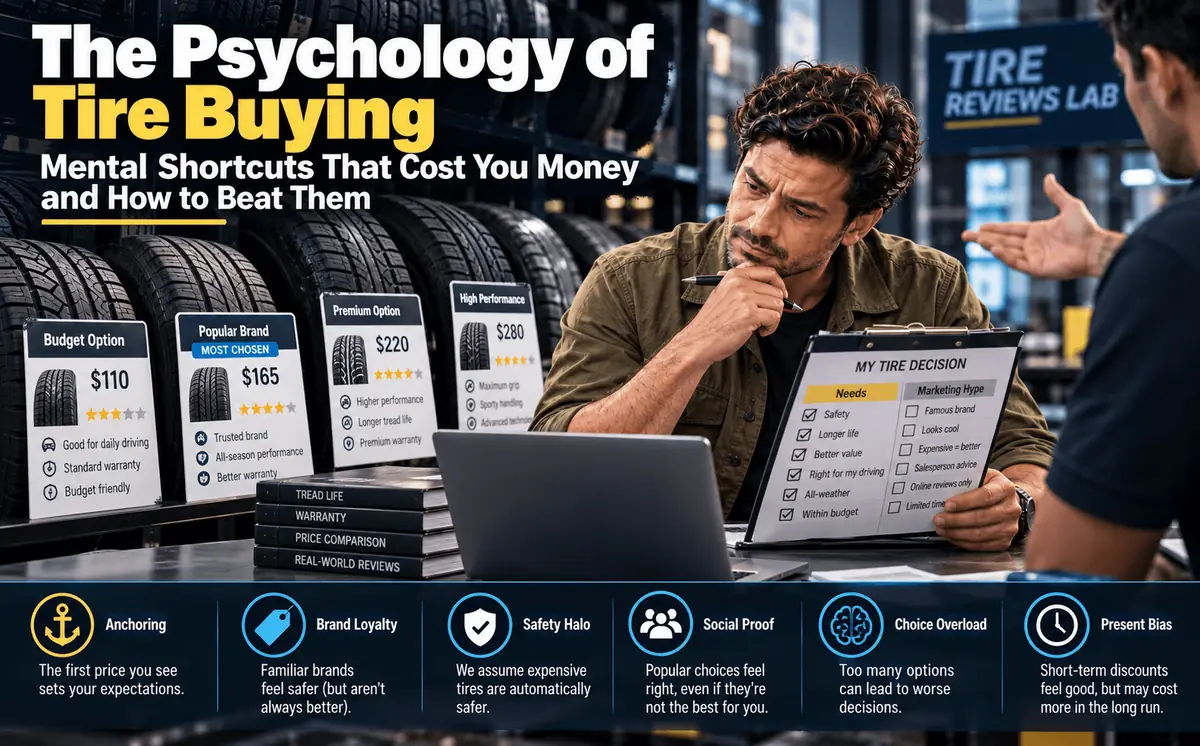
Most drivers put more thought into picking a streaming show than into choosing the only four parts of the car that touch the road. Then the moment arrives: a wall of tires at the shop, or 200 search results on a retail site, a service advisor waiting for an answer, and a price that seems to change every time someone opens their mouth. Under that pressure, people grab the brand they bought last time, take whatever the salesperson suggests, or put the whole decision off for another few months.
None of that makes you a bad shopper. It makes you human. Tire purchases are shaped by predictable mental shortcuts that have nothing to do with tread depth or wet braking, and once you recognize them, you can stop them from spending your money. Below are the biases that steer tire decisions most often, followed by a practical framework for choosing on the facts.
How this guide was put together: This guide draws on well-documented consumer-psychology concepts and simple cost-per-mile arithmetic, with sources listed at the end. Prices in the examples are illustrative.
Table of Contents
Why Tire Buying Triggers Bad Decisions
Tires combine almost every condition that makes people decide poorly. The purchase is infrequent, so few drivers build expertise. Models look nearly identical, so the real differences hide in specifications. The stakes feel high, because tires govern braking, hydroplaning resistance and cornering grip. And the sale often happens in a hurry, with the car already on a lift.
When a decision is unfamiliar, technical and emotionally loaded, the brain reaches for shortcuts that push buyers toward the most familiar, most heavily marketed or most convenient option rather than the best one for their car.
| Mental Shortcut | How It Shows Up at the Tire Shop | The Countermove |
|---|---|---|
| Price anchoring | The first price quoted becomes your yardstick | Set your own price range before you shop |
| Brand loyalty | You default to the logo you know | Compare at least one brand you have never bought |
| Choice overload | Dozens of options lead to “just pick something” | Filter to a shortlist of five to eight tires |
| Salesperson authority | The advisor’s pick becomes your pick | Arrive with a specific tire, size and price in mind |
| Present bias | Worn tires stay on “one more season” | Measure tread depth and set a replacement trigger |
| Social proof | Star ratings outweigh fitment and test data | Use reviews only as a tiebreaker |
Anchoring: The First Price Sets the Rules
Picture a shopper who walks in expecting to spend about $150 per tire. The advisor opens with a premium all-season at $340 each, then mentions a second option at $210. Suddenly $210 feels like a relief, even though it blows past the original budget by $60 a tire, or $240 for the set.
That is anchoring. The first number you encounter becomes the reference point for every number that follows, and later prices get judged against it rather than on their own merits. Tire retail is full of anchors: premium models at eye level, crossed-out “original” prices, an online listing at $289 tagged “Was $379.” Your brain does the subtraction and decides you are getting a deal before you read a single specification.
The fix is to bring your own anchor. Before you visit a shop or open a retailer’s site, look up the typical price range for the tire category you need in your exact size, whether that is a touring all-season, a performance summer tire or an all-terrain. Check two or three sellers. When you already know what a fair price looks like, the retailer’s opening number loses most of its pull.
Brand Loyalty and the Comfort of the Familiar
Plenty of drivers replace their tires with the same brand that came on the car, or the same brand they bought last time. Sometimes that is a smart, informed choice. Often it is simple familiarity doing the work.
People prefer things they have seen many times, and tire companies spend heavily on motorsport sponsorships, consistent branding and original-equipment deals to make sure you see their logos. At the counter, one brand feels safe and the unfamiliar one beside it feels like a gamble, even when the lesser-known tire matches it on the specs that matter.
Loyalty gets stickier with time. Drivers keep returning to a brand even after a set that wore unevenly or a price well above competitors, partly because switching means admitting earlier purchases might not have been ideal. Meanwhile, product lines get replaced, brands change hands, and a model that led its class years ago may have been overtaken since.
Treat every tire purchase as a fresh decision. Start from your current vehicle and driving needs, then deliberately add at least one brand you have never owned to your shortlist and compare independent test results side by side. Money spent on past tires is gone no matter what you buy today, so it should carry no weight in the choice.
The Safety Halo and Loss Aversion
Fear is a reasonable motivator when buying tires, but it often steers buyers toward the tire that feels safest rather than the one that measures safest. Major premium brands carry a safety halo built from decades of marketing and partnerships with luxury automakers. The reassurance of buying one is worth something, but it carries a price premium, and it can blind shoppers to strong alternatives. Reputable mid-tier brands such as Kumho and Falken sell well-regarded all-season tires at lower prices, and some large manufacturers sell budget lines of their own; Fuzion, for example, belongs to Bridgestone.
Loss aversion sharpens the effect. People feel potential losses more intensely than equivalent gains, so the imagined regret of “cheaping out” on safety looms larger than the real savings of a well-tested mid-range tire. Premium tires can absolutely be the right answer, particularly for demanding wet or winter use. The goal is to make sure you are paying for measurable performance rather than for the feeling. Our comparison of budget, mid-range, and premium tires breaks down where the extra money tends to buy real gains and where it mostly buys the name.
Choice Overload and Decision Fatigue
A single category search on a large retail site can return dozens of all-season options in one size, and the filters introduce terms like speed ratings (W versus Y, for example) and load index that send many buyers back to the owner’s manual. Faced with that much choice, people stop comparing and start coping: they sort by “best seller,” click the retailer’s “best value” badge, or call the shop and say, “Just put on whatever you recommend.”
Those outcomes are not always bad, but they come from exhaustion rather than evaluation. After hours of spec sheets and reviews, the add-to-cart button on the top result looks attractive simply because it ends the process.
Cut the field before you start comparing. Decide on three non-negotiables: the tire category, a budget ceiling and a minimum acceptable treadwear expectation or warranty. Apply those filters first, narrow the list to five to eight tires, and ignore everything else. You do not need to evaluate 80 tires. You need to evaluate the handful that fit.
Then separate the research from the purchase. Do the comparing on a calm day, ideally the day before you buy, and arrive at the shop or checkout with the exact make, model and size already chosen. The transaction should be execution, not research.
Salesperson Authority and the Upsell
A busy Saturday, a fast-talking service advisor, a car already up on the lift: the shop environment nudges you to hand the decision to the person behind the counter. Advisors often know a great deal, but they may also work under sales targets, commissions or inventory pressure, so their pick and your best interest will not always line up.
The upsell is where this matters most. Road hazard protection, nitrogen inflation, TPMS service packages and rotation bundles each look small next to the price of four tires, which is exactly why they add up. A string of modest add-ons can push the final bill well past what you planned to spend.
Some extras earn their keep. A road hazard plan can make sense on pothole-heavy city streets, construction zones or gravel, but rarely pays for a low-mileage driver on smooth highways. Judge each add-on with two questions: how likely am I to use this, and what would the service cost out of pocket if I needed it without the plan? If a plan costs $60 and the most likely claim is a $30 puncture repair, the math is poor no matter how vivid the fear of a blown tire on a dark highway feels.
Before agreeing to any add-on, ask for its price per tire and exactly what it covers. A plan you cannot describe in one sentence is a plan you should not buy on the spot.
Present Bias: Why Worn Tires Stay On Too Long
Not every bad tire decision happens at the store. Many happen in the driveway, when a driver notices shallow tread and decides it can wait.
Present bias is the tendency to favor what feels good now over what pays off later. A set of tires is a large, immediate expense, while the risk of worn tread feels vague and distant. So replacement slides from this month to next month to after the holidays. The danger is real: as tread wears down, the tire’s ability to channel water away falls off, raising hydroplaning risk and lengthening wet stopping distances well before the tread reaches the legal limit of 2/32 inch in most states. Many tire professionals recommend replacing tires around 4/32 inch if you drive regularly in rain, and earlier still for snow.
Beat present bias by turning a vague worry into a concrete rule. Buy an inexpensive tread depth gauge, check every month or two, and decide in advance the depth at which you will replace your tires. When the number hits, you buy, without reopening the debate.
Social Proof and the Pull of Star Ratings
A tire with thousands of reviews averaging 4.6 stars feels like a safe bet. People look to others to confirm their choices, and a crowd of satisfied buyers reassures in a way a controlled braking test often does not.
The reassurance is only partly earned. Reviews can be manipulated, many are written before wear or noise issues appear, and a reviewer’s vehicle and climate may look nothing like yours. Large pools of verified owner reviews can be useful, but star ratings should never be the first filter.
Recency bias works alongside social proof. A driver whose last tires wore quickly may obsess over treadwear even if the real culprit was underinflation or poor alignment, and one scary winter commute can lead someone to overpay for snow traction while driving mostly on dry roads.
Use reviews as a tiebreaker between tires that already meet your size, load and speed requirements. Favor reviewers with vehicles and climates like yours, and look for patterns rather than single dramatic stories.
A Practical Framework for Choosing Tires
The shortcuts above share one weakness: they all thrive when you shop without a plan. A simple framework gives your decision structure before emotion, marketing or fatigue can take over.
- Start with your climate. Mild, dry regions suit all-season or summer tires; regular heavy rain puts wet traction near the top of the list; real snow and ice call for winter tires or, in milder winter areas, an all-weather tire carrying the three-peak mountain snowflake symbol.
- Profile your driving. Write down your annual mileage, your highway versus city split, any towing or off-road use, and whether comfort, quietness or sharp handling matters most. If your last tires disappointed, note whether alignment or inflation could have been the cause.
- Confirm the fitment requirements. Match the size, load index and speed rating listed on your vehicle’s door placard or in the owner’s manual. No review or bargain overrides this step.
- Set a budget range. Base it on your own price research, not on the first quote you hear.
- Compare cost per mile, not sticker price. Divide the tire’s price by its expected tread life.
- Read the UTQG grades. Use treadwear, traction and temperature grades as a starting point for comparing tires within the same brand, then confirm with independent test results.
Cost per mile often reverses the sticker-price ranking. A $200 tire with a 65,000-mile treadwear warranty works out to about 0.31 cents per mile, while a $150 tire with a 40,000-mile warranty comes to about 0.38 cents per mile. The cheaper tire costs more to run.
| Example | Price per Tire | Treadwear Warranty | Cost per Mile |
|---|---|---|---|
| Tire A | $150 | 40,000 miles | About $0.0038 |
| Tire B | $200 | 65,000 miles | About $0.0031 |
Treadwear warranties are estimates, not promises, so treat cost per mile as a comparison tool rather than a forecast. UTQG grades have limits too: manufacturers assign their own treadwear grades from a standardized test, so a 500 from one brand is not directly comparable to a 500 from another, and no grade is a pass-or-fail safety certification. Paired with independent testing, these numbers still beat a logo or a star count.
Frequently Asked Questions
Shop environments combine time pressure, technical jargon and a trusted-looking expert, which makes handing over the decision feel like the easy path. Doing your research on a separate day and arriving with a specific tire, size and target price in mind keeps you in control while still letting you ask the advisor useful questions.
No. Price reflects marketing budgets, original-equipment deals and retail markup as well as engineering, so it is an imperfect signal of performance. Some mid-range tires perform very well in independent wet-braking tests, while some premium models disappoint. Judge safety by test results and the tire’s suitability for your climate rather than by price alone.
Loyalty is fine when it comes from tires that keep performing well for your needs. It becomes a problem when it replaces comparison. Each time you buy, include at least one alternative brand on your shortlist and check current test data, since product lines and competitive standings change over time.
Set three filters before you browse: tire category, maximum budget and minimum expected tread life. Narrow the list to five to eight options that meet those requirements and fit your vehicle, then compare only those. A smaller field makes careful comparison possible.
Replace tires before tread reaches 2/32 inch, the legal minimum in most states, and consider replacing around 4/32 inch if you often drive in rain. Visible cords, bulges, cracks or uneven wear are reasons to act right away. Choosing your replacement depth in advance removes the temptation to keep stretching it.
The Smarter Way to Shop for Tires
Anchoring, brand loyalty, choice overload, salesperson authority, present bias and social proof are not character flaws. They are normal features of a brain built to decide quickly, and tire buying punishes exactly that kind of speed, which is why these shortcuts so often lead to overspending, underbuying or waiting too long.
The fix requires a little intentional friction: research before you shop, set your own price anchor, shortlist before you compare, separate the decision from the transaction, and let climate, driving habits, fitment requirements, cost per mile and independent data make the call. Your tires stop the car, hold it through corners and clear water in a storm. They deserve a decision made on purpose.
Sources
Specs, warranty terms and prices were checked on October 22, 2026. Prices change often.
- TireReviewsLab: Tire warranties explained (how treadwear warranties are prorated)
- 49 CFR 575.104 (Cornell LII) (how UTQG treadwear grades are assigned)
 Summarize this article with:















Leave a comment