


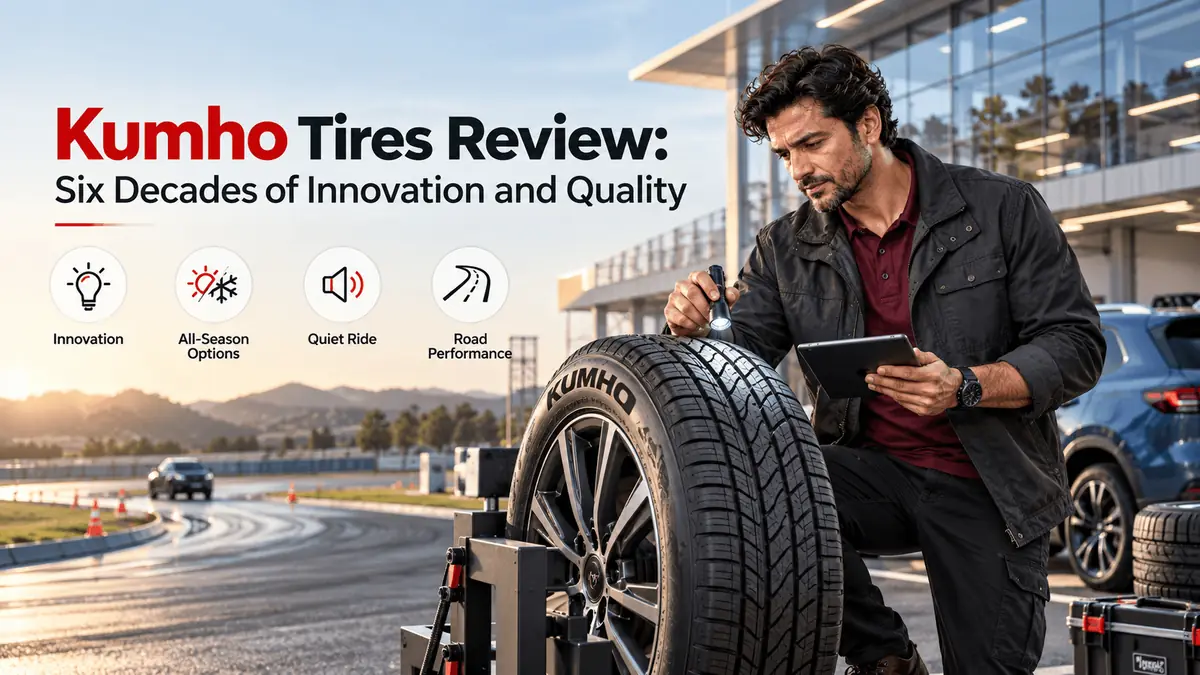
Kumho isn’t trying to out-Michelin Michelin. The South Korean tiremaker has built its reputation among American drivers on a simpler pitch: solid, well-rounded performance at a price that consistently undercuts the major brands. That strategy has made Kumho one of the more popular “value with substance” names in the US market, but it also means the buying decision isn’t as simple as grabbing the cheapest tire on the shelf.
Kumho’s catalog spans everything from track-capable ultra-high-performance summer tires to mud-terrain truck tires and studdable winter models. Whether Kumho is the right brand for your car depends heavily on what you drive, where you drive it, and how long you expect to keep the tires mounted. Here’s what matters most before you buy.
How this review was put together: We have not road-tested Kumho tires. This review is based on company information, published specs and warranty terms, with sources listed at the end. Checked on October 22, 2026.
Table of Contents
At a Glance
| Category | Summary |
|---|---|
| Best for | Budget-conscious commuters, families, and drivers who want capable all-around performance without paying premium-brand prices |
| Main strengths | Strong value, competitive dry/wet grip on top performance models, comfortable and quiet ride, wide model range |
| Main limitations | Shorter treadwear warranties than premium rivals; we could not verify real-world tread life |
| Price position | Mid-range to budget — generally well below Michelin, Bridgestone, and Continental equivalents |
| Where to buy | Tire Rack, Discount Tire, Walmart, Costco, Sam’s Club, and authorized Kumho dealers nationwide |
A Six-Decade Climb From Samyang Tire to Global Manufacturer
Kumho’s history stretches back to 1960, when the company was founded as Samyang Tire during South Korea’s early push to build a domestic automotive industry. As the country industrialized and demand for reliable tires grew, Samyang quickly established itself as one of the country’s leading manufacturers. The company was renamed Kumho Tires in 1981, and through the 1970s and 1980s it kept investing in research and development, becoming one of the first South Korean tiremakers to produce radial tires — a shift that delivered meaningfully better performance and fuel efficiency than the bias-ply construction common at the time.
Kumho is headquartered in Gwangju, South Korea, and has been controlled by China’s Doublestar since Doublestar bought a 45% stake in 2018. It runs plants in South Korea, China, Vietnam, and Macon, Georgia, supplying tires for passenger cars, SUVs, light trucks, commercial vehicles, and motorsports applications. Kumho backs that manufacturing base with dedicated R&D centers in both South Korea and the US, and it uses motorsports competition as a testing ground for new compounds and constructions before they reach retail shelves.
The Kumho Lineup: Five Categories, One Value-Focused Philosophy
Kumho organizes its tires around five core groups, each aimed at a different type of driver rather than a one-size-fits-all approach.
Passenger car tires prioritize a comfortable ride, dependable treadwear, and all-season versatility for sedans, coupes, and compact cars. The Ecowing ES31 and Solus TA11 represent this segment well.
Light truck and SUV tires are built to handle the added weight and load demands of trucks, SUVs, and crossovers, with the Road Venture APT KL51 and Crugen HT51 as popular picks.
Performance tires target sports cars and performance sedans where grip, cornering response, and high-speed stability matter most. The Ecsta PS91 and Ecsta PS31 are Kumho’s flagship names here.
All-terrain and mud-terrain tires are built for off-road use, with aggressive tread patterns and reinforced construction. The Road Venture AT51 and Road Venture MT51 lead this category.
Winter tires focus on braking, traction, and handling on snow and ice, using specialized compounds and tread patterns. The WinterCraft WP71 and WinterCraft Ice WS31 anchor Kumho’s cold-weather lineup.
Kumho also produces specialty tires for commercial vehicles, trailers, and recreational vehicles, rounding out a lineup that covers nearly every category a typical US household or small fleet would need. A full breakdown of individual passenger and light truck models, organized by tire type, appears in the reference table at the end of this article.
On the Road: Grip, Handling, and Ride Comfort
Kumho builds its tread compounds and siping patterns to keep a strong, consistent contact patch with the pavement, which is the foundation of both cornering ability and responsive steering. In dry conditions, that translates into precise turn-in and confident grip through corners, helped by stiffer tread blocks and a contact patch tuned to limit understeer and oversteer.
Wet-weather performance follows a similar formula. Strategically placed grooves and sipes move water out from under the tread quickly, which reduces the risk of hydroplaning and helps keep braking distances and directional stability consistent even in heavy rain. For a driver who splits time between dry highway commutes and sudden downpours, that combination matters more than peak dry grip alone — it’s the difference between a tire that behaves predictably in a surprise storm and one that doesn’t.
Ride comfort gets equal attention. Kumho tunes sidewall construction to absorb road imperfections rather than transmit them into the cabin, and several product lines add sound-dampening layers within the tire’s internal structure to cut down on road noise. That matters most for anyone who spends long stretches on imperfect highways.
Tread Life: How Long Do Kumho Tires Really Last?
Kumho leans on advanced rubber compounds and tread geometry to stretch tread life, and many models carry treadwear warranties that promise a set number of miles before the tread wears down to the legal limit. Warranty length varies by model, so check the listing for the tire you want; we don’t quote owner mileage figures we can’t verify.
That durability shows up most clearly in Kumho’s all-season and touring lines, where silica-enhanced compounds and tread patterns designed to promote even wear help the tire hold its tread depth for longer. The practical payoff for a buyer is straightforward: fewer trips to the tire shop and more predictable handling as the tire ages, provided the vehicle gets regular rotations and proper alignment.
Off the Pavement: All-Terrain and Mud-Terrain Options
For truck and SUV owners who leave the pavement occasionally — or often — Kumho’s Road Venture AT51 uses an aggressive tread pattern with deep grooves and reinforced shoulder lugs to grip mud, dirt, and rocky surfaces, backed by cut-and-chip resistant compounds that hold up against sharp debris.
For more serious off-roading, the Road Venture MT51 steps up with a mud-scooping tread design, larger tread blocks, and reinforced sidewalls built to shrug off punctures and impacts in the roughest terrain. Both models have earned solid reputations among off-road enthusiasts who want genuine trail capability without stepping up to a specialty off-road brand.
Winter Traction: Snow and Ice Performance
Kumho’s winter lineup uses tread compounds engineered to stay pliable in freezing temperatures, paired with directional patterns dense with biting edges and sipes that bite into snow and interlock with ice. Several Kumho winter tires carry the severe snow service rating, meaning they’ve met the industry’s established benchmark for snow traction rather than simply claiming winter capability.
Drivers in regions with heavy, persistent snow and ice have the option of studdable Kumho winter tires, which accept metal studs for extra grip on hard-packed snow and glare ice; the tread’s groove layout and stud spacing are tuned specifically to make the most of those studs. For milder winter climates, Kumho’s non-studdable winter models still deliver dependable braking and handling on snow and slush without the trade-offs studs bring on dry pavement.
Fuel Efficiency: Kumho’s Low Rolling Resistance Models
Kumho has invested specifically in low rolling resistance tires aimed at improving highway fuel economy. The Ecowing ES31 uses a silica-based compound that Kumho says reduces heat buildup and deformation as the tire rolls, which lowers rolling resistance and, in turn, eases the load on the engine.
The Ecowing LE Sport takes a different angle on the same idea, pairing low rolling resistance construction with a sportier tread pattern aimed at drivers who want efficiency without giving up driving feel. For anyone who spends significant time commuting, that combination is worth paying attention to: lower rolling resistance can translate into real savings at the pump over the life of the tire, particularly for drivers logging heavy highway miles.
Pricing and Value
Value is arguably Kumho’s strongest selling point. The brand isn’t the cheapest name in the tire aisle, but its price-to-performance ratio regularly beats out pricier premium-brand alternatives, and that holds across the lineup — from performance tires for sports cars to durable all-season tires for family sedans. Kumho also runs frequent promotions and rebates, which can meaningfully stretch a tire budget for shoppers willing to watch for a sale.
Warranty Coverage and Peace of Mind
Kumho backs most of its lineup with treadlife warranties tied to specific mileage figures, plus coverage for defects in materials and workmanship. Road hazard protection and trial periods depend on the model and retailer, so check the exact terms before buying.
What Owners Say: Real-World Feedback
We have not compiled verified owner feedback across Kumho’s whole lineup, and review scores vary widely by model. Read the reviews for the specific tire and size you are considering.
Where to Buy Kumho Tires
Kumho tires are widely stocked at major retailers, including Tire Rack, Discount Tire, Walmart, Costco, and Sam’s Club, both in physical stores and online. Beyond those chains, Kumho maintains an extensive network of authorized dealers and installers across the country that specialize in the brand and can help match a model to a specific vehicle and driving need, along with professional mounting and balancing. Shoppers who prefer buying online can browse the full lineup, compare models, and arrange installation at a nearby authorized shop through retailers like Tire Rack and Discount Tire.
Kumho vs. Premium Brands: How Does It Stack Up?
Positioned against premium tiremakers like Michelin, Bridgestone, and Continental, Kumho reads as a mid-range brand that trades a bit of ultimate capability for a meaningfully lower price. It rarely claims the very top spot in grip, handling precision, or tread life, but it consistently delivers more capable all-around performance than its price point would suggest.
At the upper end of Kumho’s range, the Ecsta PS91 is Kumho’s max-performance summer tire, aimed at the same buyers as top-tier rivals. Kumho also sells studless winter tires for cold-climate drivers who want a lower price than the premium brands.
Where the gap widens is in treadwear warranty length and outright grip at the extreme limits of performance — areas where premium brands still hold an edge. But for drivers who want a sporty, responsive tire without premium pricing, that trade-off is often an easy one to accept. Kumho’s coverage across vehicle segments, from compact cars through SUVs and light trucks, is broad enough for the overwhelming majority of mainstream drivers, even if it doesn’t reach as far into the ultra-premium tier as, say, Michelin’s Pilot lineup.
Buying Guide: Who Should Choose Kumho?
Kumho makes the most sense for daily commuting, highway driving, and moderate climates that don’t see extreme weather extremes. It’s a sensible pick for sedans, minivans, crossovers, and smaller SUVs where dependable, affordable performance matters more than chasing the outer edge of grip or the longest possible tread warranty.
Drivers who prioritize cost savings over absolute best-in-class performance or maximum tread life are the clearest fit for the brand. Kumho strikes a deliberate balance between price and quality, which makes it a practical option for budget-minded individuals and families rather than drivers chasing a specific performance benchmark.
Pros and Cons
Pros
- Noticeably lower price than premium-brand equivalents, often without a proportional drop in performance
- The Ecsta PS91 gives drivers a max-performance option below premium-brand prices
- Comfortable, well-controlled ride with tread and construction tuned to keep road noise down
- Broad lineup covering passenger cars, SUVs, light trucks, performance driving, all-terrain use, and winter conditions
- Treadlife, road hazard, and satisfaction guarantees back most of the lineup
Cons
- Treadwear warranties generally trail what premium brands offer
- Few verified figures on real-world tread life
- Ultimate grip at the outer limits of performance still favors flagship brands like Michelin and Continental
- The lineup doesn’t extend as far into the ultra-premium tier as brands like Michelin’s Pilot series
Full Kumho Passenger and Light Truck/SUV Tire Lineup
For reference, here is Kumho’s full passenger and light truck/SUV tire lineup, grouped by category.
| Category | Models |
|---|---|
| Extreme Performance Summer | Ecsta V730 |
| Max Performance Summer | Ecsta PS91; Ecsta Sport S |
| Ultra High Performance Summer | Ecsta PS31; Ecsta Sport |
| Ultra High Performance All-Season | Ecsta PA51; Ecsta Sport A/S; Ecsta 4X II KU22 |
| High Performance All-Season | Ecsta PA31; Ecsta AST |
| Grand Touring All-Season | Ecsta LX Platinum; Majesty 9 Solus TA91; Majesty 9 Solus TA91 EV; Majesty Solus; Majesty X Solus; Solus 4S HA32; Solus KH16; Solus KH25; Solus TA31; Solus TA31 EV; Solus TA31+; Solus TA51; Solus TA51a; Solus TA71 |
| Standard Touring All-Season | Solus TA11 |
| Racetrack & Autocross Only | Ecsta V700 |
| Streetable Track & Competition | Ecsta V720 ACR |
| Temporary/Compact Spare | Spare Tire T121; Spare Tire T131 |
| Street/Sport Truck All-Season | Ecsta STX KL12 |
| Crossover/SUV Touring All-Season | Crugen EV HP71; Crugen EV HP71 SUV; Crugen HP71; Crugen HP71 EV; Crugen Premium; Crugen Premium KL33; Solus 4S SUV HA32; Solus KL21 |
| Highway All-Season | Crugen HT51; Road Venture APT KL51 |
| On-Road All-Terrain | Road Venture AT51; Road Venture AT52 |
| Rugged All-Terrain | Road Venture RT |
| Off-Road Maximum Traction | Road Venture MT KL71; Road Venture MT51; Road Venture MT71 |
Related Reading
Frequently Asked Questions
Yes, within the context of a mid-range, value-focused brand. Kumho tires generally deliver dependable all-season performance, decent treadwear, and a comfortable ride. They don’t match the absolute top-tier grip or longevity of premium brands like Michelin or Continental, but they consistently outperform their price point.
It varies by model. Use the treadwear warranty on the specific tire as a guide; results vary with driving habits, alignment, and road conditions.
Yes, if you choose a winter model. Kumho’s dedicated winter tires, including the WinterCraft lineup, perform well in snow and ice, with several models carrying the severe snow service rating and studdable options available for the harshest climates. For all-season use in milder winter conditions, Kumho’s all-season models offer reasonable traction but aren’t a substitute for a dedicated winter tire where snowfall is heavy.
No. Kumho sits in the mid-range rather than the bottom of the market. It’s priced well below premium brands like Michelin and Bridgestone, but it isn’t the cheapest tire available either — the appeal is the balance between price and performance rather than rock-bottom cost.
The Solus TA11 and similar Grand Touring All-Season models are built specifically around comfort, quiet operation, and dependable treadwear, making them a strong fit for daily commuters. Drivers who want a fuel-efficiency edge should look at the Ecowing ES31.
Kumho generally trails premium brands in treadwear warranty length and outright grip at the extreme limits of performance, and its top performance models, like the Ecsta PS91, are aimed at the same buyers. The primary advantage Kumho offers is price: capable performance at a noticeably lower cost.
Kumho tires are sold through major retailers including Tire Rack, Discount Tire, Walmart, Costco, and Sam’s Club, as well as through a nationwide network of authorized Kumho dealers and installers.
Goodyear, if you want top-tier grip and longer treadwear warranties. Kumho is a mid-range brand that trades a bit of ultimate capability for a meaningfully lower price, and it often outperforms its price point in everyday driving.
Hankook generally sits a step higher, with everyday performance close to Michelin and Continental at 20 to 30 percent less. Kumho is the more price-focused of the two Korean brands, so it suits drivers who want solid all-around tires for less.
Final Verdict
Kumho has built a genuinely useful niche: a tire brand that delivers capable, well-rounded performance without premium-brand pricing. The lineup covers nearly every mainstream driving need, from efficient commuter tires to sporty ultra-high-performance models and serious winter options, and the ride comfort, wet-weather grip, and value proposition all hold up well against the asking price.
The trade-offs are real but limited: treadwear warranties don’t stretch as far as the premium brands, and we could not verify real-world tread life. Drivers chasing the absolute longest tread life or the last percentage point of grip at the performance limit will still find more capability at Michelin, Bridgestone, or Continental — at a corresponding price.
For everyone else — commuters, families, and budget-conscious drivers who want a dependable, comfortable tire without paying a premium-brand markup — Kumho is an easy brand to recommend. As the company continues investing in tread compounds and construction to close the gap with the industry’s biggest names, that value proposition only looks likely to get stronger.
Sources
Specs, warranty terms and prices were checked on October 22, 2026. Prices change often.
- Wikipedia: Kumho Tire (ownership, headquarters, plants)
- Manufacturing.net: Kumho Georgia plant expansion (US plant)
 Summarize this article with:















Leave a comment