


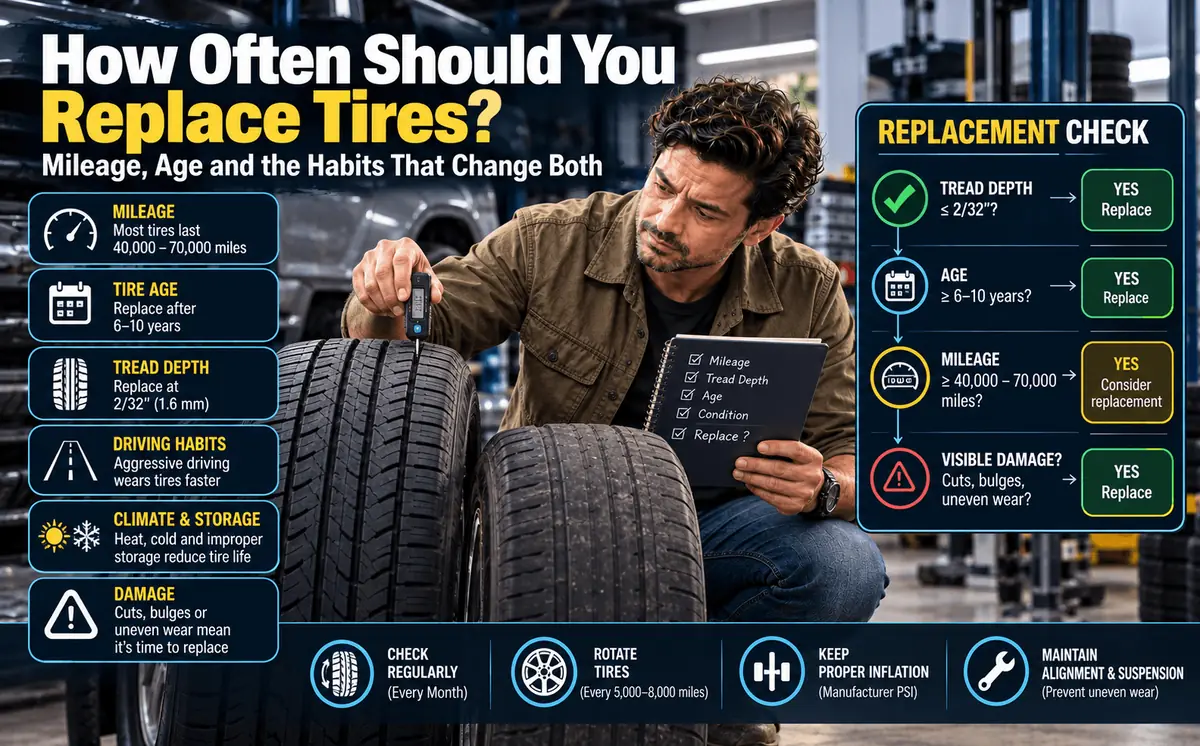
Ask a tire shop how often you should replace your tires and you will usually get an unsatisfying answer: it depends. That is true, but it does not help you budget for a new set, decide whether the tires on a used car are still trustworthy, or figure out why your last set gave up 20,000 miles early. What you really need is a usable timeline, plus a clear sense of what moves it in either direction.
Tires reach the end of their life in two ways. Most wear out, meaning the tread gets too shallow to grip a wet road. Some age out first, meaning the rubber hardens and weakens even though plenty of tread remains. This guide covers both clocks: typical tread life by tire category, what a treadwear warranty can tell you, the age limits automakers and tire makers use, and the driving, maintenance, and vehicle factors that speed everything up.
How this guide was put together: This guide draws on published treadwear warranty patterns and tire-age guidance from automakers and tire industry associations, with sources listed at the end. Mileage ranges are typical figures, not guarantees. Checked on October 22, 2026.
Table of Contents
The Short Answer: Two Clocks Running at Once
For a typical passenger car or crossover on all-season tires, a set lasts somewhere in the range of 40,000 to 60,000 miles. Drivers covering the national average of roughly 12,000 to 15,000 miles a year will therefore replace tires every three to five years. Long-wearing touring tires on a gently driven sedan can go past 80,000 miles, while performance tires on a sporty car may be finished in half the mileage of a touring set.
Age sets the outer boundary no matter how few miles you drive. Many automakers advise replacing tires at about six years old. Tire manufacturers typically call for a professional inspection every year once a tire reaches five years, and treat 10 years from the date of manufacture as the absolute limit, even for a tire that looks almost new.
Whichever clock runs out first is the one that matters. A high-mileage commuter will wear through tread long before age becomes a factor. A weekend car, a low-mileage retiree’s sedan, or a spare that has never touched the road will hit the age limit first.
Typical Tread Life by Tire Category
The type of tire on your car has more influence on replacement frequency than almost anything else. Softer, stickier compounds grip better and wear faster. Harder compounds with deep tread and long-wear engineering give up some grip to last longer.
The ranges below are broad and assume reasonable maintenance. Your own results can land outside them in either direction.
| Tire Category | Typical Tread Life | Treadwear Warranty Pattern |
|---|---|---|
| Standard and grand touring all-season | 50,000 to 80,000+ miles | Commonly 60,000 to 80,000 miles |
| Highway all-season (SUV and light truck) | 50,000 to 80,000 miles | Commonly 60,000 to 80,000 miles |
| High-performance and UHP all-season | 35,000 to 50,000 miles | Often 40,000 to 50,000 miles |
| Summer and max-performance | 20,000 to 35,000 miles | Often low or none |
| All-terrain | 40,000 to 60,000 miles | Often 50,000 to 60,000 miles |
| Mud-terrain | 30,000 to 50,000 miles | Frequently none |
| Winter (used only in winter) | Several seasons | Often none |
Two categories deserve a closer look. Summer and max-performance tires trade tread life for dry and wet grip, so a driver who buys them for a sports sedan should expect to replace them far more often than a neighbor on touring tires. Winter tires are measured in seasons rather than miles. Their soft compound and deep, heavily siped tread wear quickly on warm, dry pavement, which is why they belong on the car only during cold months.
Using a Treadwear Warranty as a Guide
The mileage warranty printed on a tire’s marketing material is one of the better clues to how long a particular model will last, because the manufacturer has a financial stake in that number. A tire with an 80,000-mile warranty is built with a longer-wearing compound than one with a 40,000-mile warranty, and the gap usually shows up in the real world.
Treat that number as a ceiling, not a promise. Warranty mileage assumes correct inflation, regular rotation, proper alignment, and normal driving. Claims are prorated, so if a tire wears out at 60,000 miles on an 80,000-mile warranty, you typically receive a credit for the unused share toward a replacement, not a free tire. Most manufacturers also require proof of rotation at the specified interval, so keep your service receipts.
Many performance, winter, and mud-terrain tires carry a short warranty or none at all. That does not mean they are poorly built. It reflects how much their life depends on how hard they are driven and in what conditions.
The Age Limit and How to Read the DOT Date
Rubber ages whether the car moves or not. Oxygen, heat, sunlight, and ozone gradually break down the compounds that keep a tire flexible. As that happens, the rubber hardens, grip falls off, and fine cracks start to appear in the sidewall and between the tread blocks. Internal components can also weaken in ways you cannot see from the outside, which is why an old tire with deep tread can still fail suddenly.
The guidance from the industry lines up into a simple plan:
- At around six years, many automakers recommend replacing tires regardless of tread.
- From five years on, have a tire professional inspect the tires at least once a year.
- At 10 years from manufacture, replace the tire no matter how it looks, and include the spare.
You find a tire’s age in the DOT code on the sidewall. The code begins with the letters DOT, and the last four digits are the date of manufacture. The first two digits give the week and the last two give the year, so a tire stamped 2719 was built in the 27th week of 2019. The full code is sometimes molded on only one side of the tire, so check the inboard sidewall if you cannot find it on the outside. A three-digit date means the tire was made before 2000 and is long overdue for replacement.
Check the date code when buying tires, too. A new tire that has sat in a warehouse for a year or two is not unsafe, but you should know its age before you start counting toward the limit.
What Wears Tires Out Faster
Two drivers can buy the same tire on the same day and replace them years apart. These are the factors that make the difference.
Driving Style
Hard launches, late and heavy braking, and fast cornering all scrub rubber off the tread. Aggressive drivers can take a large bite out of a tire’s expected life, and the effect is greatest on soft performance compounds. Smooth inputs and anticipating stops are the cheapest way to make a set last.
Inflation Pressure
Underinflation is the most common reason tires wear out early. A soft tire flexes more, runs hotter, and wears both shoulders. Too much air does the opposite, concentrating wear in the center of the tread. Tires lose air slowly through the rubber, roughly 1 psi a month, and pressure also drops about 1 psi for every 10°F fall in outside temperature. Check pressure monthly with the tires cold and set it to the figure on the driver’s door jamb placard, not the maximum molded into the sidewall.
Alignment and Rotation
A car that is out of alignment drags its tires slightly sideways with every revolution, grinding one edge or feathering the tread across its width. A pothole or curb strike can knock alignment out in an instant. Rotation tackles a different problem: the tires at each corner of the car do different jobs and wear at different rates. On a front-wheel-drive car, the fronts steer, brake, and put down power, so they wear much faster than the rears. Rotating every 5,000 to 7,500 miles, or as your owner’s manual specifies, evens out that wear so all four tires reach the end together.
Climate and Roads
Heat speeds up both tread wear and rubber aging, which is why tires in the Sun Belt often show sidewall cracking sooner than tires in cooler states. Constant sun exposure adds to the damage. Rough pavement, gravel roads, and pothole-heavy commutes chew through tread faster than smooth highway miles, and they increase the odds of impact damage that ends a tire’s life early.
Load
Regularly carrying heavy loads or towing near your vehicle’s limit puts more stress on the tires and shortens their life. Exceeding the tire’s load rating is worse still, because it generates heat that weakens the casing.
Electric Vehicle Weight and Torque
Electric vehicles are hard on tires for two reasons. Battery packs make them significantly heavier than comparable gas cars, and electric motors deliver full torque instantly, which scrubs the tread every time the driver accelerates briskly. Many EV owners find their original tires wear out sooner than they expected. Tires built for EVs use compounds and constructions that handle the extra weight and torque, and gentle use of the accelerator pays off more on an EV than on almost any other vehicle.
Seasonal Sets Change the Math
Drivers who switch between winter tires and all-season or summer tires effectively split their annual mileage across two sets. Each set wears more slowly, so both last more calendar years than a single year-round set would.
That has a side effect. Because seasonal sets rack up miles slowly, the age limit is more likely to arrive before the tread wears out, particularly for low-mileage drivers. Winter tires in particular lose some of their cold-weather grip as the compound hardens with age, even when tread depth still looks healthy. Check the date codes on both sets every time you swap.
Storage also matters. Keep off-season tires clean, in a cool, dry, dark place away from electric motors and other ozone sources. Tires stored in a hot garage or in direct sunlight age faster.
Tread Depth Still Has the Final Say
Mileage and age tell you when to start paying closer attention. Tread depth tells you when a tire is finished. New passenger tires typically start with around 10/32 to 11/32 inch of tread.
At 2/32 inch, a tire has reached the legal minimum in most states and must be replaced. Wet-road grip and resistance to hydroplaning fall off well before that point, so many drivers plan replacement at 4/32 inch, especially in rainy regions or ahead of winter. Every tire has small raised wear bars molded into its grooves at 2/32 inch, and a penny inserted head-first into a groove shows the same limit: if you can see the top of Lincoln’s head, the tire is done. Our guide to the signs you need new tires covers the tread tests and the other warning signs in more detail.
Replacing Two Tires or Four
Replacing all four tires at once keeps grip balanced front to rear and side to side, and it is the best option for handling and braking. Some all-wheel-drive vehicles have strict limits on how much tread depth can differ between tires, because mismatched diameters strain the drivetrain, so check your owner’s manual before replacing fewer than four.
If you do replace only two, put the new tires on the rear axle, even on a front-wheel-drive car. Deeper tread at the rear resists hydroplaning and keeps the back of the car from sliding out in a wet curve, which is far harder for an ordinary driver to correct than a front-end skid.
Related Reading
Frequently Asked Questions
Most all-season tires on cars and crossovers last roughly 40,000 to 60,000 miles. Long-wearing touring tires can exceed 80,000 miles, while summer and max-performance tires may need replacing at 20,000 to 35,000 miles. Driving style, maintenance, and vehicle type move those numbers considerably.
Not necessarily. Many automakers recommend replacing tires at about six years, and tire manufacturers advise annual professional inspections from five years onward. If a six-year-old tire shows sidewall cracking, hardening, or any other damage, replace it. If it passes inspection, it can stay in service, but no tire should be used beyond 10 years from its date of manufacture.
Look for the DOT code on the sidewall. The last four digits are the build date, with the first two showing the week and the last two showing the year. A code ending in 3523 means the tire was made in the 35th week of 2023. If the code is not on the outer sidewall, check the inboard side.
They often do. Electric vehicles are heavier than comparable gas models and deliver instant torque, both of which scrub tread faster. EV-specific tires help, as do correct inflation, regular rotation, and smooth acceleration.
It is a useful comparison tool, because a manufacturer will not put a long warranty on a tire that wears quickly. The real-world number will often come in below the warranty, and claims are prorated and usually require proof of regular rotation and correct inflation.
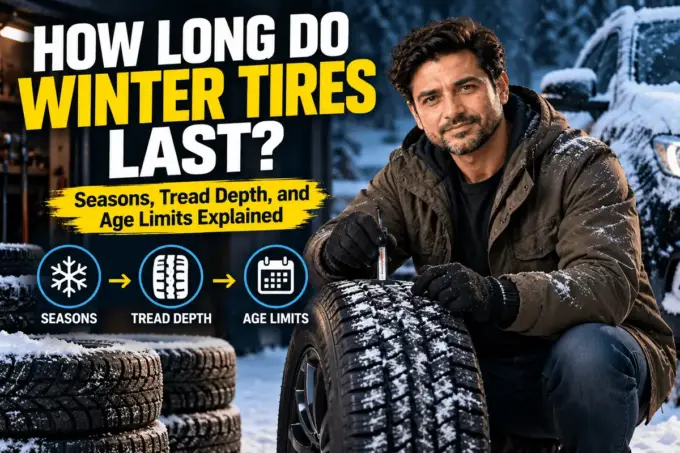
Winter tires wear quickly if driven on warm pavement, but used only during cold months they typically last several seasons. Because they accumulate miles slowly, age can catch up with them before the tread does, so check their date codes when you put them on each year.
It is normal. Most all-season tires on cars and crossovers last roughly 40,000 to 60,000 miles, and many touring tires last longer, so 40,000 miles is at the low end of typical.
Check tread depth and age. A tire must be replaced at 2/32 inch, when the tread is flush with the wear bars or a penny shows all of Lincoln’s head; many drivers replace at 4/32 inch for rain or winter, and many automakers advise replacing tires at about six years old.
Whenever the tread or age limit arrives: for most all-season tires that is roughly every 40,000 to 60,000 miles, and never later than 10 years from manufacture. Replacing all four at once keeps grip balanced and matters most on all-wheel-drive vehicles.
Planning Your Next Set
There is no single replacement interval that fits every driver, but there is a reliable way to know where you stand. Use typical mileage for your tire category, and the treadwear warranty if your tires have one, to estimate when the next set will be due. Read the date codes so you know when the age clock will run out, and remember that around six years and 10 years are the two numbers that matter. Then protect your tires in between with monthly pressure checks, rotation on schedule, and an alignment after any hard hit. The tires will tell you when they are finished through their tread depth, and with good habits that day will come later than you might expect.
Sources
Specs, warranty terms and prices were checked on October 22, 2026. Prices change often.
- Tire Rack: How old are your tires? (automaker 6-year and industry 10-year guidance)
- Tire Review: Decoding NHTSA’s tire aging report (NHTSA research on tire aging)
- Tire Rack: BFGoodrich Advantage Control (example of a 65,000/75,000-mile tiered warranty)
- Modern Tire Dealer: Goodyear Assurance MaxLife 2 (example of an 85,000-mile warranty)
 Summarize this article with:
















Leave a comment