


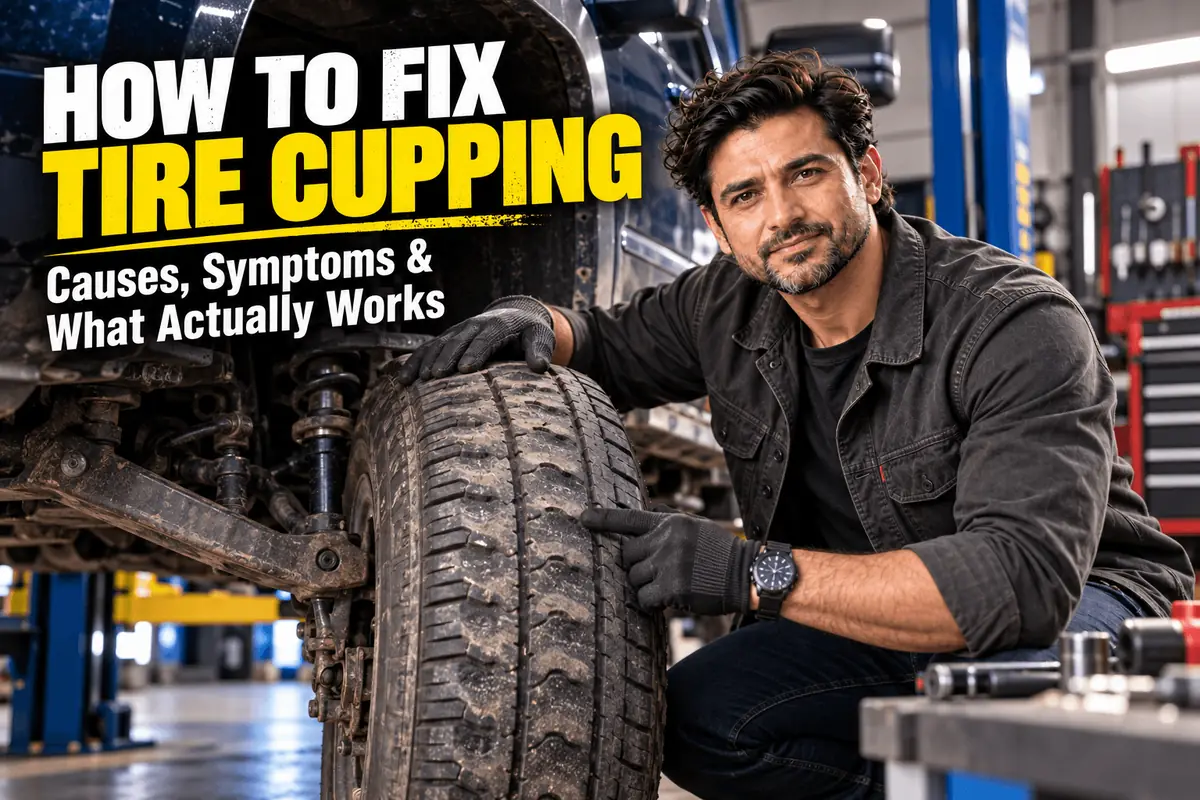
The noise starts as a faint hum that you blame on the road surface. A few thousand miles later it is a rhythmic roar that rises and falls with speed, and someone suggests a bad wheel bearing. Then a technician runs a hand across the tread and finds a series of shallow dips around the tire. That pattern is cupping, and it is one of the most misdiagnosed tire problems on the road.
The harder truth is that a cupped tire cannot be repaired back to smooth. What you can fix is the cause, and that matters more than the tire itself, because new tires on the same worn suspension will cup again. This guide explains what cupping is, how it differs from other irregular wear, what causes it, how to confirm it and the realistic options for dealing with tires that already have it.
Table of Contents
What Tire Cupping Looks Like
Cupping, also called scalloping, is a pattern of uneven wear around the circumference of the tread. Instead of wearing evenly, the tire develops a series of scooped-out patches with higher areas between them. The dips may repeat at fairly regular intervals or appear in scattered patches, and they often show up first on one shoulder.
Each low spot forms where the tire has been bouncing and slapping down on the road rather than rolling smoothly. With every bounce, that patch of tread scrubs against the pavement a little harder than the rest. Over thousands of miles, the scrubbed patches wear lower and the pattern becomes visible and audible.
Cupping, Feathering and Heel-Toe Wear Compared
Three kinds of irregular wear get confused constantly, and each points to a different cause.
| Wear Pattern | What You See and Feel | Typical Causes |
|---|---|---|
| Cupping or scalloping | Scooped dips and high spots around the circumference of the tread | Worn shocks or struts, imbalance, worn suspension parts, bent wheels |
| Feathering | Tread ribs worn at an angle across the tire, smooth one way and sharp the other when you slide a hand sideways | Incorrect toe alignment |
| Heel-toe wear | Individual tread blocks worn higher on one edge than the other, like a sawtooth, felt as you slide a hand around the tire | Underinflation, skipped rotation, free-rolling axle position |
Feathering runs across the tread, while cupping and heel-toe wear run around it. The difference between those last two is scale: heel-toe wear happens block by block, while cupping forms larger dips spanning several blocks.
What Causes Tire Cupping
Worn Shocks and Struts
Worn dampers are the leading cause. Shock absorbers and struts control how quickly the wheel moves up and down. When they wear out, the spring is left uncontrolled, and the tire bounces after every bump instead of settling back onto the road. Each bounce scrubs a patch of tread, and the pattern builds from there.
Wheel and Tire Imbalance
An out-of-balance assembly hops slightly with every revolution, which produces the same repeated slapping. Imbalance and worn dampers often appear together, and a weak damper makes the effects of imbalance much worse.
Alignment Problems
Incorrect alignment angles make the tire scrub as it rolls. Misalignment alone more often causes feathering or shoulder wear, but combined with weak suspension it contributes to cupping.
Worn Suspension and Steering Parts
Loose ball joints, tired control arm bushings, worn tie rod ends and loose wheel bearings let the wheel move in ways it should not. That play allows the tire to wander and bounce even when the shocks are healthy.
Bent Wheels and Runout
A wheel bent by a pothole or curb, or a tire with excessive runout, does not roll as a true circle. The high spot thumps the road on every revolution and can start a cupping pattern.
Underinflation and Skipped Rotation
An underinflated tire has a softer, less stable footprint that is more prone to irregular wear. Skipping rotation leaves each tire in the same position for too long, so any irregular wear keeps building in one place. Tires on a free-rolling axle, such as the rear of many front-wheel-drive cars, are especially prone to developing irregular wear when they are never moved.
Symptoms: The Noise That Fools People
The classic sign of cupping is a rhythmic roar, hum or whirring growl that rises in pitch and volume with speed. Many drivers and even some technicians mistake it for a failing wheel bearing, which makes a similar sound. A few clues help separate them.
- Cupping noise often changes with the road surface and tends to follow the tire if it is moved to another corner of the car.
- Wheel bearing noise usually changes when the car turns or shifts weight to one side, and it stays at the same corner regardless of tire position.
- Vibration through the steering wheel, seat or floor often accompanies cupping, especially at highway speeds.
- Visible wear in the form of uneven tread around the circumference confirms the diagnosis.
How to Feel for Cupping
- Park on level ground, set the parking brake and turn the steering wheel fully to one side to expose the front tread.
- Place your flat palm on the tread near one shoulder.
- Slide your hand slowly around the circumference of the tire, following the tread.
- Feel for a wavy pattern of dips and high spots. Cupped tread feels like a gentle washboard.
- Repeat near the center and on the other shoulder, then check every tire, including the rears.
Measuring tread depth at several points around the tire with a gauge can confirm what your hand finds, since cupped areas read lower than the spots beside them.
Can You Fix Tire Cupping?
Not in the sense of making a cupped tire like new. The rubber in those dips is gone, and nothing puts it back. The fix is to stop the cause, then manage the tire you have.
Step 1: Find the Cause
Start with a professional inspection. A technician will check the shocks and struts for leaks and poor damping, inspect ball joints, bushings, tie rods and wheel bearings for play, measure alignment and check each wheel and tire for balance and runout. A road force balancer can detect tire and wheel uniformity problems that a standard balance misses. A quick check you can do at home is the bounce test: push down hard on each corner of the car and release. If the body keeps bouncing rather than settling almost immediately, the dampers are likely worn.
Step 2: Repair the Suspension, Then Balance and Align
Replace worn shocks or struts, normally in pairs across an axle, along with any loose or worn suspension and steering parts. Then have the wheels balanced and the alignment set to specification. Skipping this step and buying new tires simply resets the clock on the next set of cupped tires.
Step 3: Rotate and Monitor
Once the cause is corrected, rotate the tires on the pattern your owner’s manual specifies. Moving a mildly cupped tire to a different position, where it rolls in a different direction or under different loads, can help the high spots wear down. Mild cupping often quiets down noticeably over the following few thousand miles. Keep checking with your hand at each rotation to see whether the pattern is fading or holding steady.
Tire Truing and Shaving
Some shops offer truing, which shaves the tread on a machine to remove high spots and restore a round profile. It can reduce noise and vibration on a tire with mild cupping and plenty of tread, but it removes usable rubber and shortens tread life, and relatively few shops still offer it. It is not a cure for deep cupping, and it does nothing about the cause.
When Replacement Is the Answer
Severe cupping means replacement. If the dips are deep enough to see easily, the noise is loud even after suspension repairs, vibration persists after balancing or the tire is close to the end of its tread life anyway, a new tire is the practical choice. If you replace only two tires, most shops put the new pair on the rear axle for stability. AWD owners should follow the owner’s manual on tread-depth matching across all four tires. Tire warranties usually exclude cupping, since it is treated as a vehicle condition rather than a tire defect.
Fix the suspension before you buy tires. New tires on worn shocks are often cupped again within a few thousand miles.
Is It Safe to Drive on Cupped Tires?
Mild cupping is mostly a noise and comfort problem, but it should not be ignored. Cupped tread has a less consistent contact patch, which can reduce grip on wet roads. More important, the worn shocks or struts behind most cupping reduce how well the tires stay planted during hard braking and emergency maneuvers. Severe cupping, combined with vibration and worn suspension, makes the car less predictable. Get it inspected promptly.
Preventing Tire Cupping
- Rotate your tires every 5,000 to 7,500 miles, or on the schedule in your owner’s manual. Our article on what happens if you don’t rotate your tires explains why skipped rotations lead to irregular wear like this.
- Check tire pressure monthly when the tires are cold, using the placard on the driver’s door jamb.
- Have the tires balanced when they are installed, and again if a new vibration appears.
- Get an alignment check after a hard pothole or curb hit, or if the car pulls or the steering wheel sits off center.
- Have shocks and struts inspected as mileage builds, and watch for fluid leaks, excessive bouncing or nose-diving under braking.
- Run your hand over the tread at every rotation to catch irregular wear early.
Related Reading
Frequently Asked Questions
Rotation alone will not fix it. Once the cause has been corrected, rotating a mildly cupped tire to a new position can help even out the high spots and reduce noise, but if worn shocks or imbalance remain, the cupping will continue on every tire.
Both produce a speed-related roar or hum. Bearing noise usually changes when you turn or load one side of the car and stays at one corner. Cupping noise often follows the tire when it is moved and can be felt as dips when you run your hand around the tread.
Worn shocks and struts are the most common cause, because they let the tire bounce instead of staying planted. Imbalance, worn suspension or steering parts, bent wheels, alignment problems, underinflation and skipped rotation also contribute.
Mildly cupped tires can quiet down after the cause is fixed and the tires are rotated, as the high spots gradually wear closer to the low ones. Deeply cupped tires will not recover and need to be replaced.
Partly. Truing shaves the tread to remove high spots and can help a mildly cupped tire with plenty of tread left. It costs tread life, few shops offer it and it does not address the underlying cause.
Usually not. Tire makers generally treat cupping as a result of vehicle conditions such as worn suspension or imbalance rather than a manufacturing defect. Check your warranty terms if you believe the tire itself was at fault.
Mild cupping is mostly a noise and comfort problem, but it should not be ignored. Cupped tread can reduce wet grip, and the worn shocks or struts behind most cupping make hard braking and emergency maneuvers less predictable, so get it inspected promptly.
The Takeaway on Cupped Tires
Tire cupping is a symptom, and treating it starts under the car rather than at the tire rack. Worn shocks and struts are the usual culprit, with imbalance, worn suspension and steering parts, bent wheels, alignment, low pressure and skipped rotation playing supporting roles. Fix those first, then balance, align and rotate.
After that, the tire tells you what to do. Mild cupping often fades and quiets with rotation, while severe cupping means new tires. If you are chasing a speed-related roar that a new wheel bearing did not cure, run your hand around the tread before replacing anything else.
 Summarize this article with:















Leave a comment