


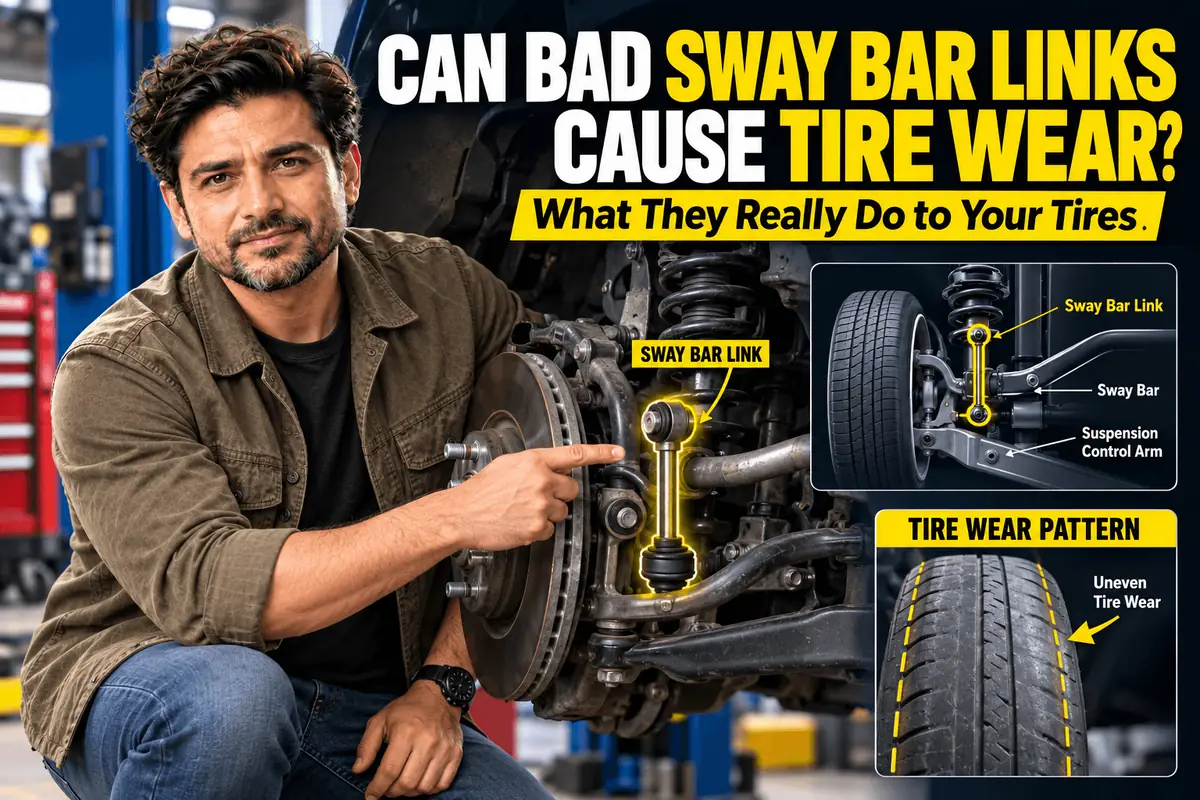
A clunk from the front end every time you hit a pothole is enough to make anyone nervous. When the shop says the sway bar links are worn and you notice your tires look a little rough on the edges, it is natural to connect the two. Some repair advice goes further and blames bad links for cupping, feathering and alignment problems all at once.
The real picture is more modest. Worn sway bar links are a real handling and noise problem, and they can contribute to some shoulder wear through extra body roll. But they do not hold your alignment, and they are rarely the main reason a tire wears out early. This guide explains what sway bar links do, how to recognize failing ones, what they can and cannot do to your tires, which parts are more likely culprits and what replacement typically costs.
How this guide was put together: This guide is general information based on common manufacturer and industry guidance; your owner’s manual is the controlling source. Prices are typical ranges, not quotes. Checked on October 22, 2026.
Table of Contents
What Sway Bar Links Do
The sway bar, also called a stabilizer bar or anti-roll bar, is a steel bar that runs across the vehicle and connects the left and right suspension. It works as a torsion spring. When the car leans in a turn, the outside suspension compresses while the inside extends, and the bar twists to resist that difference. The result is less body lean in corners and a flatter, more stable feel during lane changes.
Sway bar links, often called end links, are the short connectors between each end of the bar and the suspension, usually at the lower control arm or strut. Most have a small ball joint or rubber bushing at each end so the suspension can move freely while the link still transmits the bar’s twisting force. They are small, cheap parts, but without them the sway bar is disconnected from the wheels and stops doing its job.
That is the key point for tire wear. The sway bar only works when one side of the suspension moves differently from the other, mostly in corners and over uneven bumps. Driving straight down a smooth highway, the bar does very little. Sway bar links also do not locate the wheel or set camber, caster or toe. Those angles are controlled by the control arms, ball joints, tie rods and strut mounts.
Symptoms of Bad Sway Bar Links
End links usually fail at their ball joints or bushings. The joint wears, the boot tears and lets in dirt and water, or the link bends after a hard hit. The signs tend to show up in this order:
- Clunking or rattling over bumps. A metallic knock from one corner when driving over potholes, speed bumps or broken pavement is the classic symptom. It is often loudest at low speed over uneven surfaces.
- More body roll. The car leans further in corners and on highway ramps than it used to.
- Vague or loose handling. Steering feels less precise in turns and lane changes, and the car may feel less settled at speed.
- Unstable feel in quick maneuvers. Sudden lane changes or evasive moves feel sloppier, because the bar is no longer controlling lean.
A completely broken link can leave the bar flopping around, sometimes rattling against other parts. That is when the handling change becomes obvious.
Do Bad Sway Bar Links Cause Tire Wear?
They can contribute to it, but mostly indirectly, and the effect is usually small compared with other suspension faults.
When links are worn or broken, the sway bar cannot control body roll as well. More lean in turns shifts more of the car’s weight onto the outer tires, and especially onto their outside shoulders. Over many miles of cornering, that can add to wear on the shoulders of the tread. Moog, a major suspension parts maker, lists uneven tire wear among the symptoms of bad links for this reason.
What worn links generally do not do is change your alignment. Because they do not locate the wheel, a loose end link will not knock your toe or camber out of specification in the way a worn tie rod end or ball joint can. That matters, because toe and camber errors are behind most of the dramatic tire wear patterns people blame on suspension problems:
- Feathering, where tread ribs feel smooth one way and sharp the other, is almost always a toe problem. Our guide to feathered tires covers how to identify it and correct it.
- Cupping, the scalloped dips around the tread, usually traces to worn shocks or struts, imbalance or loose suspension parts that let the wheel bounce.
- Wear on one edge across the whole circumference usually points to camber or toe being out of specification.
If your tires show any of these patterns, worn sway bar links may be part of a tired suspension, but they are unlikely to be the root cause. Replacing the links alone will quiet the clunk and tighten up the handling. It probably will not stop the wear.
If a shop blames worn sway bar links alone for heavily cupped or feathered tires, ask what else they checked. Shocks, tie rods, ball joints and the alignment deserve a look first.
Sway Bar Links Versus the Usual Tire-Wear Suspects
Sway bar links rank low on the list of suspension parts that wear tires. Here is how they compare.
| Component | What It Does | Typical Effect on Tires |
|---|---|---|
| Sway bar links | Connect the anti-roll bar to the suspension to limit body lean | Mild and indirect: extra shoulder loading in corners |
| Tie rod ends | Connect the steering to the wheels and set toe | Strong: worn ends let toe wander, causing feathering and rapid edge wear |
| Ball joints | Pivot points that locate the wheel | Strong: play changes camber and toe, causing edge wear and sometimes cupping |
| Control arm bushings | Hold the control arms in position | Moderate to strong: worn bushings let alignment shift under braking and cornering |
| Shocks and struts | Damp wheel motion over bumps | Strong: worn units let tires bounce, the leading cause of cupping |
| Wheel alignment | The camber, caster and toe settings themselves | Strong: misalignment is the most common cause of uneven wear |
A sensible approach is to treat clunking and body roll as a sway bar link problem, and treat abnormal tire wear as an alignment and suspension problem until proven otherwise. Both can exist at once, especially on older, high-mileage vehicles.
How to Inspect Sway Bar Links
You can do a basic check at home with the vehicle safely supported.
Visual Check
Look at each link from under the car, following the sway bar from the middle of the vehicle out to where it connects near each wheel. Look for:
- Torn or missing rubber boots on the ball joints.
- Cracked, squashed or missing bushings.
- A bent link, often from a curb or pothole strike.
- Loose or missing nuts at either end.
- Heavy rust, particularly where the link meets the joint.
Hands-On Check
- Raise the vehicle and support it on jack stands so the suspension is loaded, or on drive-on ramps. On many vehicles, links bind when one wheel hangs free, which makes them hard to check.
- Grab each link and try to move it up and down and side to side.
- Grab the sway bar near each end and push it up and down while watching the link joints.
- Listen and feel for clunking, free play or a joint that moves without the link moving with it.
A good link moves the bar with no knocking or slop. Any visible play at the joints means the link is worn. A road test over a few speed bumps or a rough patch, with the windows down, can help you hear which corner the clunk comes from. Note that the bounce test, where you push down on each corner of the car, mainly checks your shocks and struts, not the sway bar links.
Replacing Sway Bar Links
End link replacement is one of the easier suspension jobs. On many vehicles, it is a matter of removing a nut at each end, swapping the link and torquing the new one to specification. Rusted fasteners are the most common complication, and many links need a wrench on the stud to keep it from spinning while you remove the nut. Links are usually replaced in pairs on the same axle so both sides behave the same.
Because the links do not set alignment, replacing them alone does not normally require a wheel alignment. If other parts such as tie rods, ball joints or control arms are being replaced at the same time, an alignment afterward is a good idea.
What Replacement Costs
Prices vary with vehicle, link design and local labor rates, so treat these as rough guides rather than quotes:
- Parts: Aftermarket end links commonly run roughly $20 to $100 per pair, with front links on larger vehicles toward the top of that range.
- Labor: Usually around half an hour to an hour and a half per pair at shop labor rates.
- Total at a shop: Published estimates generally land between about $85 and $300 per axle.
If the shop finds worn sway bar bushings, the rubber mounts that hold the bar to the frame, replacing them at the same visit adds relatively little in parts. Polyurethane upgrades last longer than rubber but need proper greasing to avoid squeaks.
When Your Tires Need Replacement
Fixing a suspension problem will not restore tread that is already worn unevenly. Replace your tires when:
- Tread reaches 2/32 inch, the legal minimum in most states, or the tread wear bars sit flush with the tread. Many drivers replace sooner for better wet traction.
- One shoulder has worn much lower than the rest of the tread.
- Cupping is deep enough to cause persistent noise or vibration after suspension repairs.
- You see cuts, cracks or bulges in the sidewall or tread.
When you put new tires on, fix the suspension and alignment first. Otherwise, the new set will start wearing the same way.
Frequently Asked Questions
They can contribute to some shoulder wear by allowing more body roll, which puts more load on the outside edges of the tires in corners. The effect is usually mild. Severe uneven wear usually traces to alignment, tie rods, ball joints, bushings or shocks.
Not in the usual sense. End links connect the sway bar to the suspension but do not locate the wheel, so they do not set camber or toe. Worn links can make the car feel loose, but they rarely move your alignment out of specification.
Usually a clunk, knock or rattle from one corner when driving over bumps, potholes or rough pavement, often most noticeable at low speeds.
Short term, worn links are rarely an emergency, but they reduce stability in turns and emergency maneuvers. A broken link can let the bar move freely. Have them replaced soon, especially if the car leans noticeably more than it used to.
Usually not, because the links do not affect alignment angles. If other steering or suspension parts are being replaced at the same time, or if your tires already show uneven wear, an alignment check is worthwhile.
There is no fixed interval. Lifespan depends on driving conditions, road quality and link design. Rough roads, potholes and heavy loads shorten their life, so checking them during routine tire rotations or other service is a good habit.
The Verdict on Sway Bar Links and Tire Wear
Worn sway bar links deserve attention for the clunking, extra body roll and loose handling they cause, and replacing them is one of the cheaper suspension repairs you can make. Their effect on tires is real but modest, limited mostly to extra shoulder loading when the car leans in corners.
If your tires are wearing unevenly, look beyond the end links. Feathering, cupping and one-sided wear usually lead back to alignment, tie rods, ball joints, control arm bushings or tired shocks. Fix the links to restore a tight, quiet front end, then have the alignment and the rest of the suspension checked before you trust a new set of tires to the same car.
Sources
Specs, warranty terms and prices were checked on October 22, 2026. Prices change often.
- NHTSA: Tires (tire safety and maintenance)
 Summarize this article with:















Leave a comment