


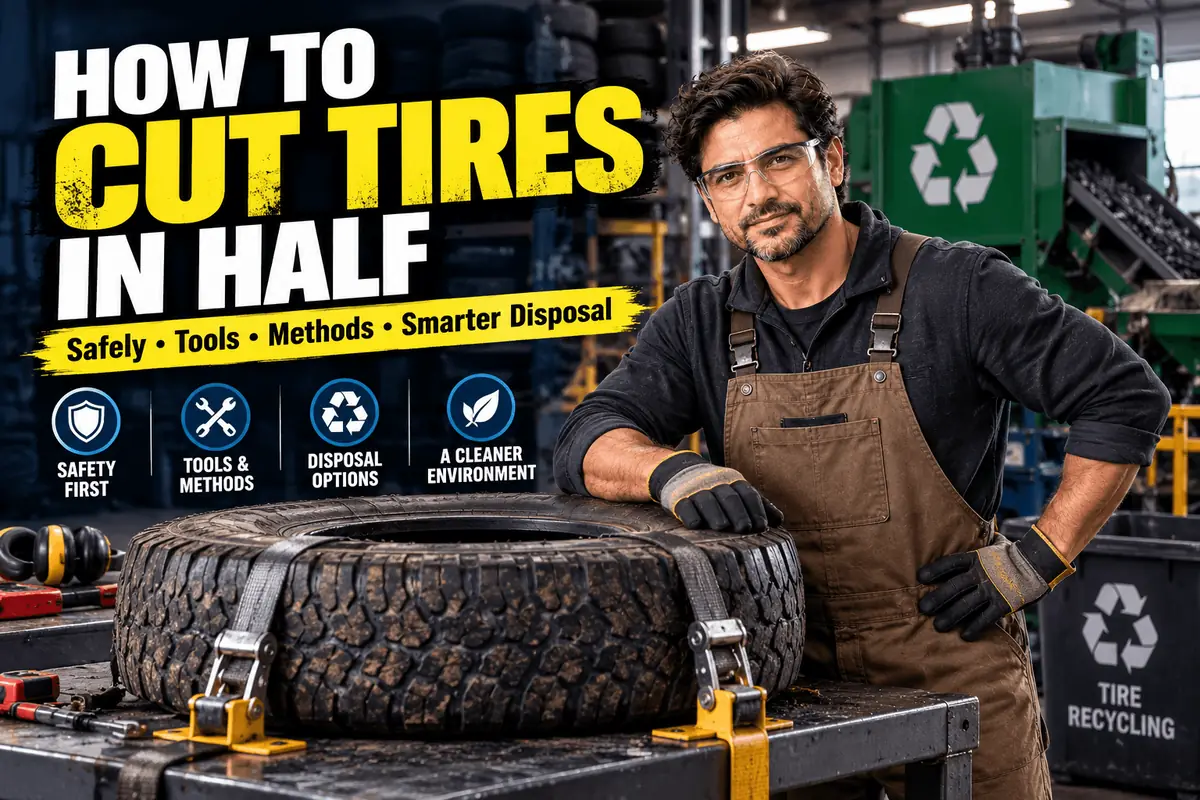
An old tire looks like soft rubber until you try to cut it. Somewhere under the tread sits a layer of steel belts, and inside each bead is a bundle of steel wire strong enough to hold the tire on the wheel at highway speed. Plenty of people start this job with a kitchen knife or a utility blade, get an inch in and realize they need a very different plan.
Whether you want a planter, a garden border, a playground project or just less bulk in the trash, the job is doable with the right tools and a healthy respect for what you are cutting through. This guide covers the safety basics, which tools work on which parts of the tire, step-by-step methods for two common cuts and the disposal routes that may make cutting unnecessary.
Table of Contents
Why People Cut Tires in Half
Most tire cutting falls into a handful of categories. Gardeners turn tires into raised planters and bed edging. Playground and backyard builders use tire halves for borders, steps, sandbox edges and obstacle courses. Crafters make everything from boot trays to wall planters and pet beds. Others simply want to reduce the volume of a few worn-out tires before disposal, and some landfills and transfer stations accept tires only after they have been cut or shredded.
The cut you choose depends on the goal. A slice around the middle of the tread produces two rings, each with one sidewall and a lip of tread, which suits planters and bowls. A cut straight across the tire at two opposite points produces two U-shaped halves, which work well for edging, troughs and arches.
Safety First: Read This Before You Pick Up a Tool
Never cut a tire that is still mounted on a wheel or holding any air. Have a tire shop dismount it first, and cut only a loose, fully deflated tire.
A tire mounted on a rim stores energy, and cutting into a pressurized casing can release it violently. Even a loose tire fights back: the rubber pinches blades, the steel wire springs out when it is severed and cut edges bristle with sharp wire ends.
Gear up before you start:
- Eye protection: safety glasses at minimum, with a full face shield when using an angle grinder
- Cut-resistant work gloves: severed belt wire is sharp enough to slice skin
- Long sleeves and long pants: to protect against wire ends, sparks and flying debris
- Hearing protection: grinders and saws are loud, and cutting steel adds to the noise
- A dust mask or respirator: cutting and grinding rubber throws off fine particles
Power tools add heat. Steel belts and bead wire throw sparks under a grinder, and friction can make the rubber smoke. If you see smoke, stop and let things cool, because burning rubber produces fumes you should not breathe and can ignite. Work outdoors, keep the area clear of anything flammable, and keep a fire extinguisher or hose within reach. Secure the tire so it cannot roll or spring, and keep both hands on the tool.
What You Are Cutting Through
Knowing the anatomy of a tire tells you where each tool will struggle.
- Tread rubber: thick but cuttable with most tools
- Steel belts: two or more layers of steel cord under the tread of a typical radial tire, which stop knives and wear out ordinary saw blades
- Sidewalls: rubber over fabric body plies, with no steel belts in passenger radials
- Bead: a hoop of high-strength steel wire at the inner edge of each sidewall, the toughest part of the tire to cut
Bias-ply tires, common on older vehicles, some trailers and certain specialty tires, use fabric plies and often lack steel belts. They are much easier to cut, though their beads still contain steel wire.
Choosing the Right Tools
| Tool | Best For | Strengths | Drawbacks |
|---|---|---|---|
| Utility knife | Bias or older tires, sidewalls | Cheap, quiet, no sparks | Useless against steel belts, slow, slip risk |
| Reciprocating saw | Tread and steel belts | Fast, controllable, no sparks from rubber | Blades bind and wear quickly |
| Angle grinder with cut-off wheel | Steel belts and bead wire | Cuts steel easily | Sparks, heat, smoke risk, kickback |
| Hacksaw or bolt cutters | Bead wire | Precise, no power needed | Slow, hard work on thick beads |
Utility Knife
A sharp utility knife works only on bias or older tires and on some sidewalls. It will not get through steel belts. The technique is scoring, not slicing: lubricate the line with soapy water, draw the blade along it in repeated shallow passes and flex the rubber to open the cut as you go. Change blades often, always cut away from your body and keep your free hand well clear of the blade’s path.
Reciprocating Saw
For most radial tires, a reciprocating saw is the main tool. Fit a metal-cutting or bi-metal blade, since an ordinary wood blade will be destroyed by the steel belts. Expect to go through more than one blade. A spray of soapy water on the cut line reduces binding, and a slow, steady stroke works better than forcing the saw.
Angle Grinder
An angle grinder with a thin cut-off wheel goes through belts and bead wire quickly, but it creates the most hazards. It throws sparks, heats the rubber and can kick if the wheel catches. Use the guard, wear a face shield, work in short bursts and let the rubber cool when it starts to smoke.
Tools for the Bead
The bead wire is where many projects stall. A hacksaw with a fine metal-cutting blade, a pair of heavy bolt cutters or a grinder will get through it. Cut the surrounding rubber away first so the tool can reach the wire bundle directly.
Preparing the Tire
- Confirm the tire is off the wheel and fully deflated.
- Wash it with water and a stiff brush. Pick stones out of the tread grooves, since grit and pebbles dull blades and can fly out during cutting.
- Let the outside dry so marking lines show clearly.
- Mark the cut line with chalk or a paint marker. Measure from the edge of the tread at several points around the tire and connect the marks for an even line.
- Secure the tire with wooden blocks, clamps or ratchet straps on a sturdy surface so it cannot roll or shift.
- Drill a pilot hole on the line if you are using a reciprocating saw, which gives the blade an easy entry point.
Method 1: Cutting Around the Tread for Two Rings
This cut runs around the full circumference through the middle of the tread. It goes through steel belts the entire way but never touches the beads, so a reciprocating saw does most of the work.
- Mark a line around the center of the tread, measuring from one shoulder at regular intervals.
- Lay the tire on its side, or stand it upright in a cradle of blocks, depending on which gives you better access.
- Drill a pilot hole on the line and insert the reciprocating saw blade.
- Cut along the line in sections of several inches, keeping the blade square to the tread.
- Rotate the tire to bring the next section within easy reach, rather than stretching to follow the line.
- Push a wedge or a block of wood into the cut behind the blade if the rubber starts closing on it, and spray soapy water when the blade drags.
- Pause regularly to let the blade cool, and change it when cutting slows noticeably.
- Finish the last section carefully, since the two rings separate suddenly once the cut closes.
- Trim or grind off protruding belt wire along both cut edges.
Method 2: Cutting Across the Tire for Two U-Shaped Halves
This cut slices across the tire at two opposite points. Each cut crosses the tread, the steel belts, both sidewalls and both beads, so it takes more tool changes but less total cutting distance.
- Mark two lines straight across the tire at opposite points, running from bead to bead over the tread.
- Stand the tire upright and secure it so the first line is accessible.
- Cut across the tread and steel belts with the reciprocating saw or angle grinder.
- Continue down each sidewall toward the bead with the saw, or score the sidewall rubber with a lubricated utility knife if the tire allows it.
- Cut the rubber away from the bead wire on each side so the steel bundle is exposed.
- Sever the bead wire with a hacksaw, bolt cutters or the grinder. Hold the tire firmly, as the casing can spring open when the bead lets go.
- Rotate the tire and repeat steps 3 through 6 on the second line.
- Separate the two halves and remove any loose wire from the cut faces.
Solving Common Problems
- Blade binding: the rubber closes behind the blade. Wedge the cut open, spray soapy water and cut in shorter strokes.
- Smoking rubber: the tool is running hot. Stop, let the tire and blade cool and resume at a slower pace.
- Wandering cuts: the line drifts on the curved tread. Re-mark the line, rotate the tire more often and correct gradually rather than all at once.
- Sharp edges: belt wire sticks out of every cut face. Snip ends flush with side cutters, grind them down or file them before anyone handles the pieces, especially for playground use.
A Caution on Planters for Food Crops
Tire planters are popular, but whether they belong in a vegetable garden is a fair question. Tire rubber contains zinc and other compounds that can leach into soil over time, especially as the rubber breaks down in sun and heat. Research has not settled how much reaches plants in a typical garden, and opinions among gardening experts vary. Many gardeners play it safe by using tire planters only for flowers and ornamentals, or by lining them with a barrier before adding soil for edibles. Your local cooperative extension office is a good place to ask about current recommendations.
When Cutting Isn’t Worth It: Disposal Options
If your goal is simply getting rid of old tires, cutting them up yourself may be the hardest way to do it.
- Tire retailers: when you buy new tires, the shop usually takes the old ones for a small disposal fee per tire. Many will also accept old tires for a fee even if you are not buying.
- Local recycling programs: many cities and counties run scrap tire collection days or accept tires at transfer stations, sometimes for a modest charge.
- State scrap tire rules: most states regulate how scrap tires are stored, transported and disposed of. Some limit how many you can haul without a permit, and many ban whole tires from landfills. Check your state environmental agency for the rules where you live.
Dumping tires on roadsides, vacant lots or private land is illegal and can bring heavy fines. Abandoned tires collect rainwater that breeds mosquitoes, and tire piles are a serious fire hazard.
Frequently Asked Questions
For most steel-belted radial tires, a reciprocating saw with a metal-cutting or bi-metal blade does the bulk of the work. An angle grinder with a cut-off wheel is faster through steel but produces sparks and heat, and a hacksaw or bolt cutters handle the bead wire.
Only bias-ply or older tires and some sidewalls. A knife cannot get through the steel belts of a modern radial. On tires where it works, score the rubber in repeated passes with soapy water as a lubricant rather than trying to slice through in one stroke.
The bead is a bundle of high-strength steel wire that anchors the tire to the wheel. It is built to resist enormous force, so it takes a metal-cutting tool. Cut the rubber away first, then use a hacksaw, bolt cutters or a grinder on the exposed wire.
No. Never cut a tire that is mounted or holding any air. Have a tire shop dismount it, and work only on a loose, fully deflated tire.
The question is not settled. Tire rubber contains zinc and other compounds that may leach into soil as it ages, so many gardeners reserve tire planters for ornamentals or line them before planting edibles. Check with your local extension office for guidance.
Leave them with a tire retailer when you buy new ones, paying the small disposal fee, or use a local scrap tire collection program. Follow your state’s scrap tire rules, and never dump tires illegally.
The Final Word on Cutting Tires
Cutting a tire in half is a manageable weekend job once you accept what is inside it. A reciprocating saw with a metal-cutting blade handles the tread and steel belts, a grinder or hacksaw takes care of the bead wire, and a utility knife earns its place only on bias tires and some sidewalls. Choose the ring cut for planters and bowls, or the cross cut for U-shaped halves.
Treat the safety steps as part of the job, not an extra: dismounted and deflated tires only, eye and hand protection, and an eye on heat and smoke. If all you want is to be rid of the tires, a retailer’s disposal fee or a local recycling program will usually save you the effort and the risk.
 Summarize this article with:
















Leave a comment