


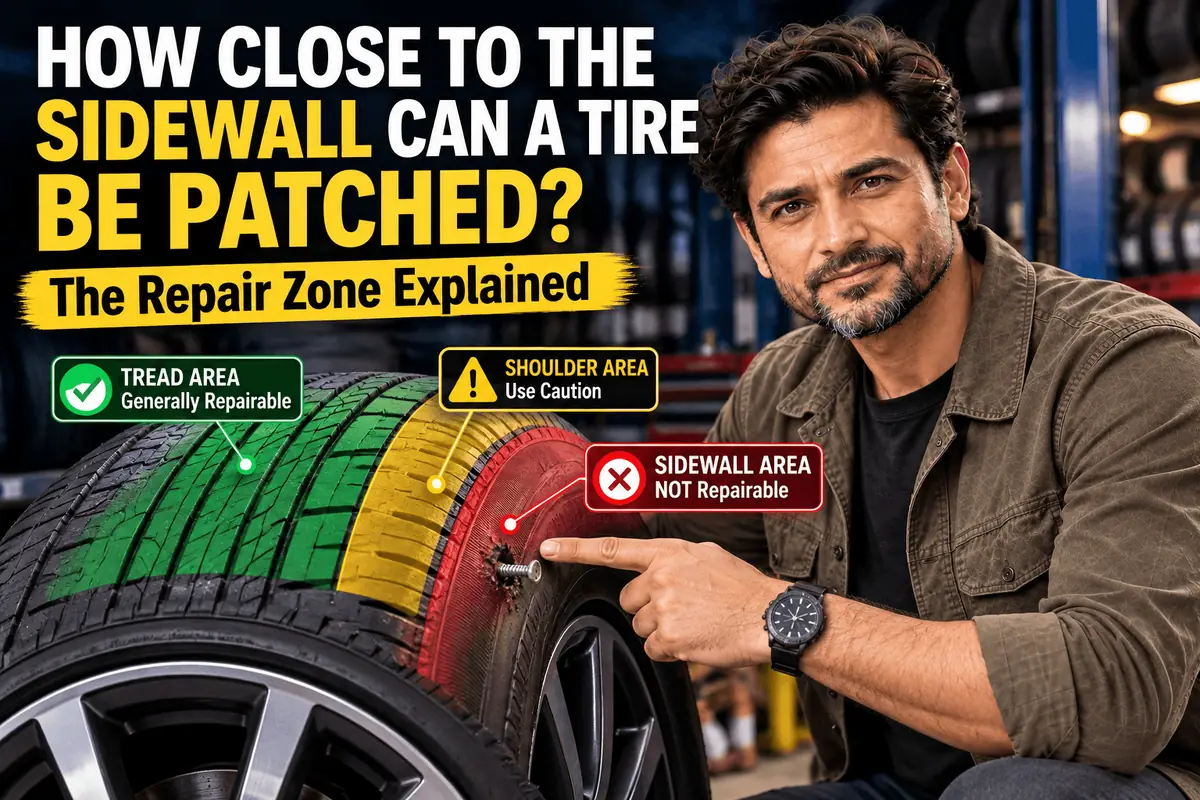
You find a screw in the tread, the tire is losing a few psi a day, and it looks like a cheap fix. Then the shop pulls the wheel, points to where the screw went in and tells you the tire has to be replaced. The hole is tiny and the tread looks fine, so the verdict can feel like an upsell.
Usually it is not. Whether a tire can be patched depends far more on where the puncture sits than on how small it looks, and the closer it gets to the sidewall, the faster the answer turns to no. This guide explains the industry repair standard, the distance rule of thumb shops use, why the shoulder is off-limits and what your options are when a repair is refused.
Table of Contents
The Short Answer: The Tread Only
The U.S. Tire Manufacturers Association (USTMA), the trade group formerly known as the Rubber Manufacturers Association, sets the repair guidelines most American shops follow. Its rules for passenger and light truck tires are blunt:
- Repairs are limited to the tread area.
- No repairs are allowed where the damage extends into the shoulder or belt edge, or where the injury runs at an angle into the shoulder.
- Sidewall damage cannot be repaired.
- The puncture can be no larger than 1/4 inch (6 mm) in diameter.
- Repairs cannot overlap one another.
- A plug alone is not an acceptable repair. The tire must come off the wheel, be inspected inside and be fixed with a plug to fill the injury plus a patch to seal the inner liner.
So the real answer to “how close to the sidewall” is that a repair never goes into the sidewall, and it should not go into the shoulder either. The question shops really answer is where the tread ends and the shoulder begins on your particular tire.
The Distance Rule of Thumb
Because the boundary between tread and shoulder is not marked on the tire, shops use a working rule. The figure you will hear most often is that a puncture should sit at least 1/2 inch in from the edge of the tread to be considered repairable. Many shops and some tire makers prefer a wider margin, and a buffer of around 1 inch is common practice at careful shops.
Treat any single number as a guideline rather than a universal law. Tire makers publish their own repair policies, tread widths and shoulder shapes vary from one design to the next, and a performance tire with a square, wide shoulder is not built like a rounded touring tire. If the tire maker’s guidance is stricter than the shop’s habit, the stricter rule wins.
It also helps to know what the measurement means. The distance is taken across the face of the tread, from the edge of the usable tread inward, not from the vertical sidewall you see when you stand beside the car.
| Where the Puncture Is | Typical Outcome | Reason |
|---|---|---|
| Center of the tread, under 1/4 inch | Usually repairable with a plug-patch | Belts support the repair under load |
| Tread, but close to the shoulder edge | Often refused, depending on the shop and tire maker | Inside the commonly used safety margin |
| Shoulder, where the tread curves down | Not repairable | High-flex zone outside the repair area |
| Sidewall, inner or outer | Never repairable | Constant flexing and no belt support |
| Larger than 1/4 inch anywhere | Not repairable | Too much structural damage |
Angle Matters as Much as the Entry Point
A nail that enters straight down into the tread leaves a short, clean channel. One that goes in at a steep diagonal can travel under the tread and exit into the shoulder area even when the entry hole looks safely inboard. USTMA’s guidance specifically excludes injuries that extend at an angle into the shoulder, which is one reason a technician needs to see the inside of the tire before deciding.
Size Is Judged From the Inside
Rubber closes around a nail or screw and can make a sizable hole look like a pinprick. The only reliable way to judge the diameter is to remove the object, dismount the tire and measure from the inside. Small nails and screws commonly fall well under the 1/4-inch limit, while bolts, jagged metal and debris strikes often do not.
Why the Shoulder and Sidewall Flex
The repair zone follows the tire’s construction. Under the tread of a typical radial tire sit steel belts that keep the footprint flat and stiff. That belt package gives a patch a firm, stable base, and it limits how much the repaired area moves as the tire rolls.
Move outward and the picture changes. The shoulder is where the tread rolls over into the sidewall, and the steel belts end at its edge. Every time that section of the tire enters the contact patch, it bends, then straightens again as it leaves. That happens with every revolution, many hundreds of times per mile.
The sidewall works even harder. It carries much of the vehicle’s load through its body plies, and it bulges and recovers constantly to absorb bumps and allow the tire to grip. That flexing is part of how a tire rides and handles, but it is hostile to any repair. A patch bonded to a surface that keeps bending has to fight that motion with nothing rigid behind it. It may hold for a while, which is the dangerous part, because it can build false confidence before letting go at speed.
A repair that holds for a week near the shoulder is not proof it worked. The failure mode is a sudden loss of air at highway speed, not a slow leak you notice in the driveway.
Damage That Rules Out a Repair Anywhere
Location is the first question, but it is not the only one. Even a perfectly placed puncture can disqualify a tire.
Driving on It Flat
If you drove any meaningful distance on a tire that was flat or badly underinflated, the sidewalls flexed far beyond their normal range. That builds heat and can damage the inner liner and body cords in ways that do not show from outside. Technicians look for a worn, discolored or rubber-dusted inner liner as evidence. Once that damage is present, the location of the nail no longer matters.
Bulges, Cuts and Impact Breaks
A bubble or bulge on the sidewall means internal cords have broken and air is pushing against the outer rubber. That is a structural failure, not a puncture, and the tire should come off the car. Cuts that expose cords and impact damage from potholes also call for replacement. Our guide to how much sidewall damage is too much walks through those situations in detail.
Overlapping or Crowded Repairs
A tire can carry more than one repair, but the repairs cannot overlap. When two punctures sit close enough that their patches would touch, the tire is replaced. Some tire makers and shops also limit the total number of repairs they will accept on a single tire, so ask about the policy if your tire already has a patch.
Run-Flat Tires
Run-flat tires have reinforced sidewalls that let them keep rolling after losing pressure, typically for a limited distance at reduced speed, often cited as about 50 miles at up to 50 mph. Repair policies vary widely here. Some manufacturers allow tread-area repairs only if the tire was never driven underinflated, while others do not permit repairs at all. Check the tire maker’s guidance before you count on a patch.
Worn-Out Tread
There is little point repairing a tire that is already at the end of its life. If the tread is down to the wear bars, at 2/32 inch, the tire needs replacement regardless of the puncture.
Plug, Patch or Plug-Patch?
The type of repair matters as much as where it goes. Three approaches are common, and only one meets the industry standard.
| Repair Type | How It’s Done | Verdict |
|---|---|---|
| Plug only | Rubber string pushed in from outside, tire stays on the wheel | Temporary at best, no internal inspection |
| Patch only | Patch applied to the inner liner after dismounting | Seals the liner but leaves the channel unfilled |
| Plug-patch combination | Tire dismounted, inspected, injury filled and liner sealed | The accepted permanent repair |
A roadside plug can get you to a shop, but it is not a fix to keep driving on. It skips the inside inspection that catches hidden damage, and it does not seal the liner. Our tire patch vs plug comparison covers the trade-offs in more depth. When you drop the car off, ask directly whether the shop will dismount the tire and repair it from the inside with a combination unit.
How to Size Up Your Puncture Before the Shop
You cannot make the final call yourself, but you can set your expectations.
- Find the object and note where it sits across the width of the tread.
- Locate the tread edge, where the flat face of the tread starts to curve toward the sidewall.
- Estimate the distance inward from that edge. If the puncture sits within roughly an inch of it, be prepared for a replacement recommendation.
- Look at the angle. A screw standing straight up is a better sign than one lying at a sharp slant toward the shoulder.
- Check the sidewalls on both sides for bulges, cuts or cracks.
- Think about how far you drove after the tire lost pressure.
- Leave the nail in place until the shop removes it, and avoid driving on the tire if it is flat.
If the puncture is clearly in the center ribs, the object entered straight and the tire never ran flat, the odds of a repair are good.
When the Tire Can’t Be Repaired
A refused repair does not have to mean a rushed decision.
Ask to See the Damage
A good shop will show you where the puncture is relative to the tread edge, or show you the inner liner if heat damage is the issue. If the explanation does not make sense, a second opinion from another tire shop is reasonable. Just do not shop around for someone willing to patch a shoulder or sidewall.
Match the Replacement Properly
Replace the tire with the same size, load index and speed rating, ideally the same model. If your other tires are fairly new, a single replacement is usually fine on a two-wheel-drive vehicle. When only two tires are replaced, the new pair generally goes on the rear axle for stability.
Mind the All-Wheel-Drive Rules
All-wheel-drive vehicles can be sensitive to differences in tread depth between tires, because mismatched diameters make the drivetrain work against itself. Check the owner’s manual for the allowed difference. In some cases a shop can shave a new tire down to match the others, and in others you may need to replace more than one.
Check Your Coverage
Some retailers sell road hazard protection that covers punctures that cannot be repaired. If you bought it with the tire, it may cover a replacement. Tire manufacturer warranties generally do not cover road hazard damage on their own.
Use the Spare Sensibly in the Meantime
If you have to drive before the new tire arrives, use the spare and follow its speed and distance limits. A compact spare is for getting to the shop, not for daily driving.
Related Reading
Frequently Asked Questions
Not in the sidewall and not in the shoulder. USTMA limits repairs to the tread area and excludes any damage that extends into the shoulder or belt edge. A puncture close to the tread edge may still be refused, because most shops apply a safety margin of around 1/2 inch or more from the edge.
It is a commonly used guideline that a puncture should be at least 1/2 inch inward from the edge of the tread to be repairable. Some shops and tire makers require a wider margin, so treat it as a minimum rather than a guarantee.
USTMA caps passenger and light truck repairs at 1/4 inch (6 mm) in diameter. Anything larger, even in the center of the tread, means a new tire.
No. A plug alone is not an accepted permanent repair anywhere on the tire, and the shoulder is outside the repairable area regardless of the repair method. A plug can serve as a short-term way to reach a shop.
Yes, as long as each puncture meets the location and size rules and the repairs do not overlap. Some tire makers and shops cap the number of repairs per tire, so ask about the policy before assuming a second patch is allowed.
The most common reasons are that the tire was driven while flat and has internal heat damage, the hole is larger than 1/4 inch once measured from the inside, the object entered at an angle toward the shoulder or the tread is already worn out. Run-flat tires may also fall under stricter repair rules from the manufacturer.
The Bottom Line on Patching Near the Sidewall
A tire repair is only as good as the structure behind it. The tread area has steel belts to support a patch, while the shoulder and sidewall flex constantly and give a repair nothing solid to hold. That is why the industry draws a firm line at the tread, caps repairs at 1/4 inch and forbids overlapping patches, and why shops add a margin from the tread edge on top of that.
If your puncture sits squarely in the middle of the tread and the tire never ran flat, a proper plug-patch repair from the inside should restore it. If it sits near the shoulder, angles toward it or comes with a bulge or heat damage, replacement is the safe call. Ask to see the damage, insist on an inside repair when one is possible and do not let anyone talk you into a shoulder or sidewall patch.
 Summarize this article with:


















Leave a comment