


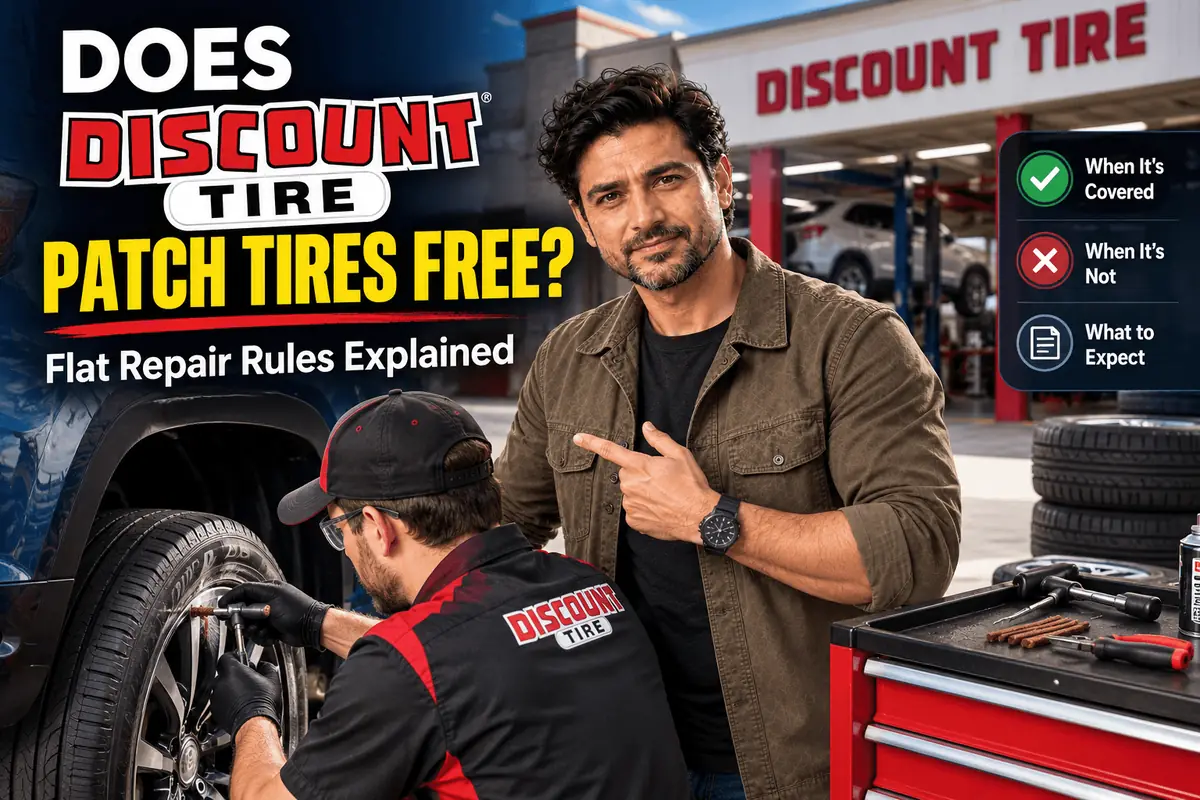
A nail in the tread rarely announces itself at a convenient moment. The tire pressure light comes on during the morning commute, you find a screw head glinting in the tread, and the question becomes simple: where can you get this fixed quickly, properly and without being talked into a new set of tires? For a lot of drivers the answer is the nearest Discount Tire, which also operates as America’s Tire in parts of the country.
The short answer is yes. Discount Tire repairs flat tires, and it does so for free when the damage is repairable, even if you bought the tire somewhere else. The longer answer is that “repairable” has a specific meaning, and knowing it before you pull in tells you whether you are leaving with your old tire or shopping for a new one. This guide covers the policy, the repair method, the limits that decide the outcome and how to look after a repaired tire.
Table of Contents
The Short Answer: Free Flat Repair at Every Location
Discount Tire advertises free flat tire repair at every store when the damage can be safely repaired under US Tire Manufacturers Association (USTMA) guidelines. The company states plainly that this applies even if you did not buy your tires from it. There is no flat fee for a standard puncture repair on a qualifying passenger car or light truck tire.
That puts Discount Tire in a different position from many shops, which typically charge somewhere in the range of a few dozen dollars for the same job. Our guide to tire patch costs breaks down what drivers usually pay elsewhere, but if a Discount Tire store is nearby, a qualifying repair costs nothing beyond the wait.
The company is one of the largest tire retailers in the United States. Bruce Halle founded it in Ann Arbor, Michigan, in 1960, and the privately held chain is now headquartered in Scottsdale, Arizona, with well over 1,000 stores across most of the country. That footprint is part of what makes the free repair policy useful: on a road trip, there is a good chance a store is within reach.
Flat repair is free at Discount Tire when the tire meets USTMA repair guidelines, regardless of where the tire was purchased.
What Discount Tire Can and Cannot Repair
Every free repair depends on one test: does the damage fall within USTMA’s limits? Discount Tire follows those industry rules, so the outcome is largely decided by the size, location and history of the damage rather than by a technician’s mood.
| Condition | Repairable? | Why It Matters |
|---|---|---|
| Single puncture up to 1/4 inch (6 mm) in the tread area | Yes | The tread is backed by steel belts and can support a proper repair |
| Puncture larger than 1/4 inch | No | A larger injury weakens the structure beyond what a repair can restore |
| Damage in the shoulder or sidewall | No | These areas flex constantly, and a repair will not hold safely |
| Puncture that would overlap a previous repair | No | USTMA does not allow repairs to overlap |
| Internal damage from driving on the flat | No | Running flat can crush and shred the inner structure |
| Tread worn to 2/32 inch or less | No | The tire is already at the replacement point |
Size and Location
The quarter-inch rule covers nails, screws and most road debris. Anything larger, or any cut or gash rather than a clean hole, usually ends the conversation. Location matters just as much. The repairable zone is the central tread area, and a puncture that sits in the shoulder, where the tread rolls into the sidewall, is treated the same as a sidewall puncture.
Damage From Running Flat
This is the condition drivers most often cause without realizing it. A tire that has been driven any real distance with little or no air can suffer damage to the inner liner and sidewall that is invisible from outside. A technician who dismounts the tire may find a ring of rubber dust or creased inner liner, and at that point the tire cannot be repaired no matter how small the original nail was. If you notice a flat, pulling over promptly gives you the best chance of a free fix.
Run-Flat Tires
Run-flat tires follow their manufacturer’s rules, and many makers restrict or prohibit repairs after the tire has been driven deflated. Expect replacement to be the more likely outcome with a run-flat, especially if you used its zero-pressure capability to get to the store.
Old Tires
Age is its own limit. Discount Tire recommends replacing tires at six years old regardless of tread depth, and it does not service tires that are 10 years or older. You can check the age by reading the last four digits of the DOT code on the sidewall: the first two are the week of manufacture and the last two are the year. A tire that is too old will not be repaired even if the puncture itself qualifies.
How the Repair Works
USTMA guidelines require a specific method, and it is not the quick plug some roadside kits and shops rely on.
- The technician removes the tire from the wheel so the inside can be inspected. A proper repair cannot be done with the tire still mounted.
- The inner liner is checked for hidden damage, including signs that the tire was driven flat.
- The injury is cleaned and prepared so the repair materials can bond.
- A rubber stem, or plug, fills the puncture path through the tread.
- A patch is applied to the inner liner to seal it from the inside.
- The tire is remounted, inflated to the correct pressure and checked for leaks.
The combination of a stem filling the hole and a patch sealing the liner is what makes this a permanent repair rather than a temporary one. A plug alone does not meet the standard because it leaves the inner liner unsealed and the inside of the tire uninspected. A patch alone does not meet it either, because the puncture channel stays open to moisture, which can reach the steel belts over time. Our tire patch vs plug comparison explains the difference in more detail.
Balancing is part of what drivers expect after a repair. Discount Tire includes complimentary balancing on tires purchased from it, while balancing on tires bought elsewhere is a paid service. If your repaired tire came from another retailer and develops a vibration afterward, that is worth knowing before you go back.
When Discount Tire Replaces Instead
If a tire falls outside the repair guidelines, the technician will explain why and recommend replacement options that fit the vehicle. Common reasons include a puncture too large or too close to the shoulder, sidewall cuts or bulges, an overlapping earlier repair, damage from running flat, tread at or near 2/32 inch, or a tire past the age limit.
Replacing a single tire raises its own questions. On an all-wheel-drive vehicle, a new tire next to three worn ones can create a tread-depth mismatch that some manufacturers do not allow, so the shop may recommend replacing more than one. When only two tires are replaced, the industry recommendation is to put the newer pair on the rear axle for stability, and Discount Tire follows that practice. If a new tire seems unnecessary, ask the technician to show you the damage and the measurement that rules out a repair.
Coverage on Tires Bought From Discount Tire
Customers who bought tires from Discount Tire may have an additional safety net. The company sells optional tire protection plans it calls Certificates, which can help when a tire suffers road hazard damage that cannot be repaired. Coverage terms depend on what you purchased, so check your invoice before assuming a replacement is covered. Manufacturer warranties are a separate matter with their own terms, so read the tire maker’s warranty booklet if a repaired tire later develops a problem.
Should You Patch It Yourself First?
Roadside plug kits and aerosol sealants have a place. They can get you off the shoulder and to a store. They are not a substitute for a proper repair, and they can create problems of their own.
- Plug kits seal the hole from outside without inspecting the inner liner. A plugged tire should be taken in for a proper dismount, inspection and patch-plug repair as soon as practical.
- Aerosol sealants coat the inside of the tire and can complicate the repair, since the residue must be cleaned out first. Tell the technician if you used one.
- The spare is often the best answer. Mounting the spare and bringing the punctured tire in avoids driving on it while it is low, which protects your chance of a free repair.
The free policy removes the main reason most drivers attempt a home repair, which is cost. If a Discount Tire is within a reasonable drive, a free repair to industry standards is a better outcome than a DIY plug.
How to Get the Most From a Free Repair
A few habits make the visit faster and the result better.
- Stop driving on a flat tire. Running even a short distance at very low pressure is the most common way a repairable puncture becomes a replacement.
- Leave the nail in. If the tire is still holding some air, the object often slows the leak and shows the technician exactly where the injury is.
- Go during off-peak hours. Weekday mornings are usually quieter than Saturdays, and repairs take longer when the bays are full.
- Ask what was found. If the answer is replacement, a good technician can show you the size, location or internal damage that made the call.
- Check pressure afterward. Recheck the repaired tire over the following days to confirm it is holding air.
Living With a Repaired Tire
A tire repaired to USTMA standards is meant to go back into normal service. There is no need to baby it, avoid highways or plan an early replacement purely because it was repaired. That said, a repaired tire deserves the same attention as the rest of the set.
- Check pressure monthly and before long trips, using the placard on the driver’s door jamb.
- Rotate on the schedule in your owner’s manual. A properly repaired tire can be rotated with the others.
- Inspect the tread and sidewalls for bulges, cuts or new nails when you check pressure.
- Remember that each tire can only be repaired so many times, because new repairs cannot overlap old ones.
One caution applies to speed ratings. Some tire manufacturers adjust or remove the speed rating of a tire after a repair, particularly on performance tires. If you drive a car with high-speed-rated tires, check the tire maker’s repair policy.
Related Reading
- Does Discount Tire Do Brakes? What It Services and Where to Go Instead
- Does Discount Tire Sell and Install Used Tires? What to Know First
Frequently Asked Questions
No, not for a standard repair. Discount Tire offers free flat tire repair at all locations when the damage is repairable under USTMA guidelines. Balancing may be an extra charge if the tire was bought elsewhere.
Yes. Discount Tire states that its free flat repair applies even if you did not buy your tires there. The tire must still meet the same repair limits as any other.
The puncture must be no larger than 1/4 inch (6 mm) in diameter and located in the tread area. Larger holes, cuts and anything in the shoulder or sidewall cannot be repaired.
It uses a combination repair: the tire is removed from the wheel, a rubber stem fills the puncture and a patch seals the inner liner. This is the method USTMA guidelines require, and it is considered a permanent repair.
The most common reasons are a puncture larger than 1/4 inch, damage in the shoulder or sidewall, internal damage from being driven flat, an overlapping earlier repair, tread worn to 2/32 inch or a tire that is 10 years old or older.
Timing depends on how busy the store is. The repair itself requires dismounting, inspecting, repairing and remounting the tire, so allow extra time during weekends and other peak periods.
A tire repaired to industry standards can return to normal service, including highway driving. Some manufacturers alter the speed rating of repaired tires, so owners of high-performance tires should check the tire maker’s policy.
The Bottom Line on Discount Tire Flat Repairs
Discount Tire patches tires, and for most drivers with a nail or screw in the tread, the repair costs nothing, whether or not the tire was bought there. The work follows USTMA rules: the tire comes off the wheel, the inside gets inspected and the injury is sealed with a stem and patch rather than a quick plug.
The limits are firm. Punctures larger than a quarter inch, damage outside the central tread, overlapping repairs, internal damage from running flat, worn-out tread and tires 10 years or older all lead to replacement. The best thing you can do is stop driving on a flat tire right away, because that single choice often decides whether you leave with a free repair or a new tire.
 Summarize this article with:
















Leave a comment