


You walk out to the car and one tire is sitting low, with a nail head glinting in the tread. The immediate question is practical: can this tire be fixed, and what will it cost? The good news is that a nail or screw in the tread is one of the most common and least expensive problems a tire can have. A proper repair usually costs far less than a new tire, and some shops do it for free.
The catch is that not every puncture can be repaired safely, and not every “repair” is done correctly. Prices also climb for trucks, low-profile performance tires and run-flats, and a few add-on charges can double a small bill. This guide covers typical tire patch costs, what drives the price up, how to pay less, what a DIY plug kit can and cannot do, and when replacement is the only safe answer.
How this guide was put together: This guide uses typical US repair prices from shop price lists and published guidance on repair methods, with sources listed at the end. Prices vary by shop and region; checked on October 22, 2026.
Table of Contents
Typical Tire Patch Costs at a Glance
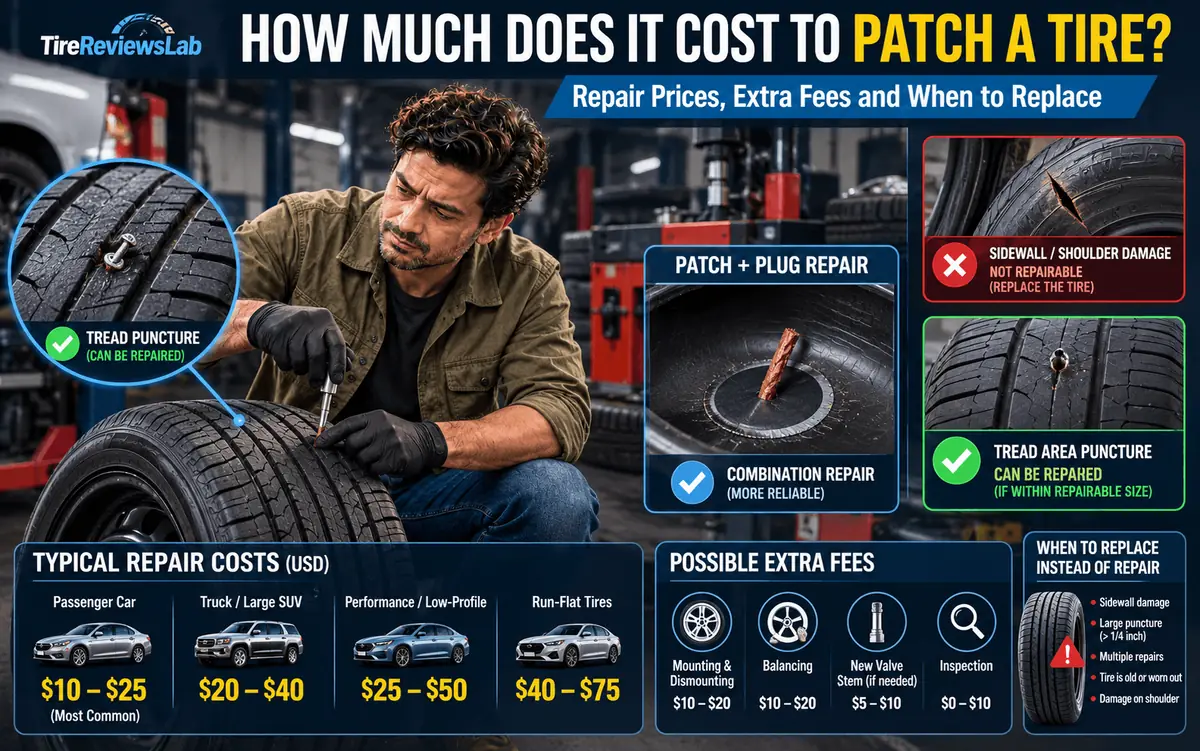
Prices vary by region, shop and vehicle, but these ranges reflect what most US drivers can expect for a standard tread puncture repair.
| Tire or Vehicle Type | Typical Repair Cost per Tire |
|---|---|
| Small passenger car tire | About $10 to $20 |
| Mid-size sedan or small SUV | About $15 to $25 |
| Truck, large SUV or van | About $25 to $35, sometimes more |
| Performance or low-profile tire | About $30 to $50 or more |
| Run-flat tire (where repair is permitted) | About $50 to $75 or more |
For a typical passenger car, a basic repair at a tire store or service chain commonly runs around $15 to $20. Dealership service departments tend to sit at the higher end, while many tire retailers repair punctures free of charge, especially on tires they sold.
What a Proper Tire Repair Involves
The word “patch” gets used loosely, and the difference matters for both price and safety.
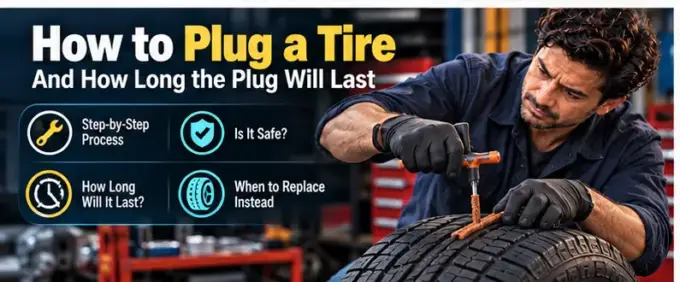
A plug is a strip of rubberized material pushed into the puncture from outside the tire. It can be installed without removing the tire from the wheel, which is why it is quick and cheap.
A patch is a rubber repair bonded to the inside of the tire over the injury. It seals the inner liner, which holds the air.
The repair method the tire industry recommends, including the US Tire Manufacturers Association and the Tire Industry Association, uses both: the tire is removed from the wheel, inspected inside and out, and repaired with a plug to fill the injury and a patch to seal the inner liner. Often this is a single combination unit, sometimes called a patch-plug or plug-patch. A plug alone or a patch alone is not considered a complete, permanent repair.
Removing the tire is not optional busywork. Driving even a short distance on a deflated tire can damage the inner sidewall in ways you cannot see from outside. Dismounting lets the technician spot that damage before declaring the tire safe.
A properly done repair restores the tire to service and lets you get the rest of its tread life, which is why it is worth paying a shop to do it right.
What Drives the Price Up
Labor and Shop Rates
Most of the cost is labor: dismounting the tire, finding the leak, preparing the inner surface, installing the repair, remounting, inflating and balancing. Shop labor rates vary widely by region, and urban shops usually charge more than rural ones. Many shops bundle the work into a flat repair fee rather than billing by the hour.
Tire and Wheel Type
Some tires simply take more time and care. Low-profile and stiff-sidewall performance tires are harder to mount and dismount without damage, and large or expensive alloy and chrome wheels require extra caution to avoid scratches. Truck and SUV tires are bigger and heavier, which adds time.
Run-Flat Tires
Run-flats are a special case. Many manufacturers prohibit repairing them, and others allow it only if the tire was not driven while deflated, because the reinforced sidewalls can be damaged internally without showing it. Where a repair is permitted, expect to pay more, and expect some shops to decline the job.
Materials
The repair unit itself is inexpensive, typically a few dollars at most, even for heavy-duty reinforced versions. Materials are rarely what makes a repair expensive.
Extra Charges to Watch For
The quoted repair price does not always cover everything. Ask about these before work starts.
- Wheel balancing: Once a tire is removed from the wheel, it should be rebalanced. Some shops include this; others charge roughly $10 to $20.
- Valve stem: A worn or damaged rubber valve stem may need replacing, usually around $10 to $15. TPMS sensor service parts on vehicles with tire pressure monitoring can cost more.
- Mounting and dismounting: If the repair price does not include it, a separate charge of roughly $10 to $20 is common.
- Nitrogen refill: If your tires were filled with nitrogen, some shops charge about $5 to $10 to refill the repaired tire. Regular air is perfectly acceptable if you prefer to skip it.
- Tire disposal: If the tire turns out to be unrepairable and you replace it, expect a small disposal fee of a few dollars.
- Sales tax: Some states tax repair labor and parts, others do not, so the final bill can vary by location.
Add-ons can push the total $20 to $50 above the basic repair price in some cases. A reputable shop will tell you about extra charges before doing the work.
How to Pay Less for a Tire Repair
- Go back to where you bought the tires. Many tire retailers repair punctures free for tires they sold, and some offer free flat repair to anyone.
- Check your road hazard coverage. If you bought a road hazard protection plan with your tires, repairs (and sometimes replacement) may already be covered.
- Look for coupons. National chains and local shops often run service promotions, and some offer discounts through email lists or loyalty programs.
- Use memberships. AAA and similar organizations offer discounts at participating repair shops.
- Compare quotes. A quick phone call to two or three shops can reveal a large price spread for the same job.
- Stay loyal. Regular customers often get small repairs at a discount or free.
DIY Plug Kits: What They Cost and What They Can Do
A basic tire plug kit costs about $5 to $15 and usually contains enough plugs for several repairs. Heavier-duty kits with better tools run about $15 to $40. That is less than a single shop repair in many cases, which makes a kit worth keeping in the trunk.
The important limitation is that an external plug is best treated as a temporary, emergency repair. It does not allow anyone to inspect the inside of the tire for damage, and it does not seal the inner liner the way a combination repair does. A plug can get you home or to a shop instead of waiting for a tow, which is valuable, but the tire should be inspected and properly repaired by a professional as soon as practical.
| Repair Option | Typical Cost | Best Use | Key Limitation |
|---|---|---|---|
| DIY external plug kit | About $5 to $40 for the kit | Roadside emergency to reach a shop | Temporary; no internal inspection |
| Shop combination repair (plug and patch) | About $10 to $25 for most passenger cars | Permanent repair of a qualifying tread puncture | Requires dismounting; costs more than a plug |
| Tire replacement | Price of a new tire plus mounting and balancing | Damage that cannot be safely repaired | Highest cost |
If you do plug a tire yourself, check its pressure frequently and avoid sustained high speeds until it has been inspected. Some tire manufacturers also state that a repaired tire no longer carries its original speed rating, so check your tire maker’s policy if you drive fast or tow.
When to Repair and When to Replace
A puncture can usually be repaired if:
- It is in the tread area, not the shoulder or sidewall
- It is no larger than 1/4 inch (about 6 mm) in diameter
- The tire was not driven far while flat and shows no internal damage
Replace the tire instead if:
- The puncture is larger than 1/4 inch
- The damage is in the sidewall or shoulder, which flexes too much for a repair to hold
- The tire shows internal damage, such as a crease or rubber dust inside from being driven flat
- A new puncture overlaps an existing repair
- The tire has other problems, such as bulges, cracks, cuts or exposed belts or cords
- The tread is worn to 2/32 inch or less, the legal minimum in most states
When the extent of the damage is uncertain, replacement is the safer choice. A repair costs very little, but it is not worth trusting a compromised tire at highway speed to save the price of a new one.
If you do need a new tire, keep the set matched. On all-wheel-drive vehicles in particular, a single new tire with much deeper tread than the others can strain the drivetrain, so check your owner’s manual and our guide to replacing one tire versus two or four.
Frequently Asked Questions
For most passenger cars, expect roughly $10 to $25 for a standard tread puncture repair. Trucks, performance tires and run-flats cost more, and many tire retailers repair punctures free, especially on tires they sold.
Not on its own. The industry-recommended repair combines a plug to fill the hole with a patch that seals the inside of the tire, installed after the tire is removed and inspected. An external plug is a useful emergency fix but should be followed by a proper repair.
No. The sidewall and shoulder flex constantly, and repairs in those areas are not considered safe. A tire with sidewall damage should be replaced.
There is no single universal number, but repairs must not overlap, and some tire manufacturers limit how many repairs a tire can have. If a new puncture is close to an old repair, the tire usually needs replacing.
A proper combination repair is permanent and should last for the remaining life of the tire. A DIY external plug should be treated as temporary until a shop inspects and repairs the tire properly.
Usually because the puncture was too large, too close to the sidewall, overlapped a previous repair, or the tire showed internal damage from being driven flat. Shops follow industry repair limits for safety and liability reasons, so a refusal is generally a sign the tire is not safe to keep using.
For the rest of the tire’s life. A proper combination plug-patch repair is permanent and should last for the remaining tread life, while an external DIY plug is only temporary until a shop repairs it.
A DIY plug kit is cheaper up front at about $5 to $40, but it is only temporary. A shop’s permanent plug-patch repair costs about $10 to $25 for most passenger cars, so the proper repair costs only slightly more.
Walmart values its flat repair at about $15, and Walmart+ members get free flat repair on qualified tires. Prices can vary by location, so check with your store.
Final Word on Tire Patch Costs
A puncture in the tread is usually a small expense. Most drivers pay roughly $10 to $25 for a proper repair on a passenger car, more for trucks, performance tires and run-flats, and often nothing at all at the shop where they bought the tires. Ask about balancing, valve stems and other add-ons up front so the final bill does not surprise you.
Insist on the right kind of repair: tire removed, inspected inside, and sealed with a combination plug and patch. Keep a plug kit in the trunk for emergencies, but treat it as a way to reach a shop, not a permanent fix. And if the damage is in the sidewall, too large, or hard to judge, replace the tire. Saving a few dollars on a repair is never worth trusting a tire that may not hold.
Sources
Specs, warranty terms and prices were checked on October 22, 2026. Prices change often.
- Les Schwab: Why a plug and patch combination is needed (repair method)
- Cooper Tire: Tire repair (which punctures can be repaired)
 Summarize this article with:















Leave a comment