


A used tire with deep tread looks like easy money. It holds air, the sidewalls look clean and the buyer only wants something cheap to get through inspection. The number that matters most is the one few people check: the four-digit date code on the sidewall. A tire can carry plenty of tread and still be old enough that its rubber has hardened and its internal bond has weakened.
Whether you run a used tire shop, sell a set from your garage or are about to buy one, the question is the same. How old is too old, what do the rules say, and what happens if an aged tire fails after it changes hands? This guide covers the date code, the age guidance from automakers and tire makers, the state laws that govern used tire sales and what to do with tires that should not go back on the road.
How this guide was put together: This guide summarizes rules for general information; it is not legal or insurance advice, and terms vary by state and provider. Checked on October 22, 2026.
Table of Contents
Why Age Matters Even With Good Tread
Tire rubber changes chemically over time, whether the tire is driven or not. Oxygen and ozone in the air slowly attack the compound, heat speeds the reaction and sunlight adds ultraviolet damage. The rubber loses elasticity and becomes brittle, and the bond between the rubber and the steel belts and fabric cords inside the tire can weaken.
Much of that deterioration is internal. A tire can show crisp tread blocks and only faint surface checking while its belts are closer to separating than the outside suggests. That is why age is treated as its own risk factor, separate from tread depth.
Several conditions speed aging:
- Heat and sun. Tires used or stored in hot, sunny climates age faster than those kept cool and shaded.
- Ozone exposure. Electric motors, furnaces, switches and sump pumps produce ozone, which cracks rubber.
- Underinflation. Running low builds heat and flexes the sidewalls harder, stressing the structure.
- Long periods of sitting. Tires on a vehicle that rarely moves, or a spare that never leaves its well, still age.
- Poor storage. Tires stacked in a hot shed or attic age faster than tires kept in a cool, dry, dark space.
How to Read a Tire’s Date Code
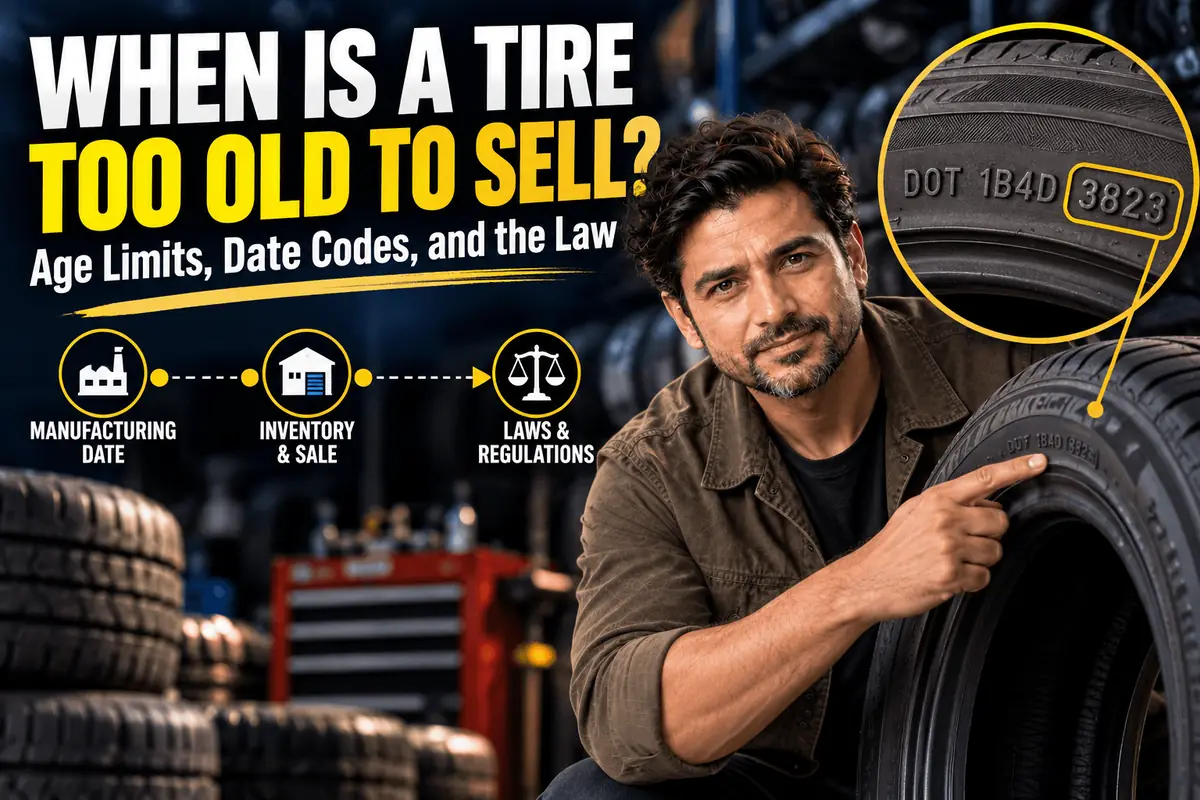
Every tire sold in the US carries a DOT Tire Identification Number, and its last digits show when the tire was built. NHTSA notes that the full number may appear on only one sidewall, so check both sides.
- Tires made since 2000 end in four digits. The first two are the week and the last two are the year. A code ending in 3215 means the 32nd week of 2015, and 0308 means the third week of 2008.
- Tires made before 2000 end in three digits: two for the week and one for the year within the decade. Any tire with a three-digit date code is now more than 25 years old and has no place on a road vehicle.
The age of a tire starts on its date of manufacture, not the day it was bought or mounted. A tire that sat in a warehouse for three years before installation is three years older than its owner may think.
If the DOT number is missing, ground off or unreadable, treat the tire as unsellable. Without it, nobody can verify the tire’s age or check it against a recall.
The 6-Year and 10-Year Guidance
There is no single federal expiration date for tires. Instead, buyers and sellers work from two benchmarks, and NHTSA summarizes them this way: some vehicle and tire manufacturers recommend replacing tires that are six to 10 years old, regardless of treadwear.
Automakers: Six Years
Several automakers take the conservative end of the range. Ford, Nissan and Mercedes-Benz tell owners to replace tires six years after their production date, regardless of remaining tread. Check your owner’s manual, because the automaker’s guidance for your specific vehicle is the one that applies.
Tire Makers: Inspect at Five, Retire at 10
Tire manufacturers generally set the outer limit at 10 years. Michelin recommends replacing tires 10 years after their date of manufacture, regardless of remaining tread depth or appearance, and says tires with five years of service should be inspected at least once a year by a trained professional. Bridgestone says an inspection is essential after five years and recommends that tires made 10 or more years earlier be taken out of service. Continental follows the same 10-year ceiling with annual inspections after the fifth year.
| Tire Age From Manufacture | Guidance | What It Means for a Used Sale |
|---|---|---|
| Under 5 years | No age-based restriction from major tire makers | Sell on condition: tread, damage, repairs |
| 5 to 6 years | Annual professional inspection advised | Inspect carefully and disclose the date |
| 6 to 10 years | Past several automakers’ replacement point | Hard to justify for highway use; full disclosure essential |
| 10 years or more | Tire makers advise removal from service | Do not sell for road use |
| Pre-2000 three-digit code | Far beyond every guideline | Recycle |
Taken together, the guidance points to a practical rule for sellers. A tire 10 years or older should not be sold for road use, full stop. A tire past six years is already beyond what several automakers allow on their own vehicles, which makes it a poor product to put on a stranger’s car, especially at highway speeds.
What State Laws Say About Used Tire Sales
No federal law bans the sale of old tires, and none of the state used tire laws below sets an age limit. What these states do is define an “unsafe used tire” by its condition and bar businesses from selling or installing one. Laws change, so always check your own state’s current rules.
New Jersey
New Jersey’s law, signed in 2017, prohibits the retail sale of a used tire that has:
- Tread depth of less than 1/16 inch in any groove
- Damage exposing the reinforcing plies
- Improper repairs, including sidewall repairs or punctures larger than 1/4 inch
- Evidence of temporary sealant use without a proper follow-up repair
- A defaced or missing identification number
- Signs of internal separation, such as bulges
Penalties run up to $500 for a first offense and from $500 to $1,000 for later offenses.
Ohio
Ohio’s law took effect July 1, 2019, and bars retailers from knowingly installing used tires with less than 2/32 inch of tread, damage exposing the reinforcing plies (including cuts, cracks, punctures or scrapes), damage not repaired to industry standards, or damage to the inner liner or signs of internal separation such as bulges or local areas of irregular tread wear.
California
California’s law, AB 949, signed in September 2019, bars automotive repair dealers from installing an unsafe used tire on a vehicle for highway use. Its list of unsafe conditions is the most detailed of the three. It includes tread worn to 2/32 inch or less, exposed plies, repairs in the shoulder or belt edge, sidewall or bead repairs, unrepaired or improperly repaired punctures, repairs larger than 1/4 inch, sealant use without a proper repair, inner liner or bead damage, signs of internal separation, and a defaced or removed DOT identification number.
What These Laws Mean for Age
Because the statutes focus on condition, an old tire can technically pass them while still being well past the manufacturer’s recommended service life. But age and condition overlap. Aged rubber develops the cracks that expose plies and the separations that show up as bulges, and in New Jersey and California a missing or defaced DOT number alone makes a tire unsafe. A seller who relies only on the letter of the law is ignoring the guidance the tire makers themselves publish.
Seller Liability: Why Age Still Matters Legally
Staying inside a state’s unsafe-tire definition does not end a seller’s exposure. If a tire fails and someone is hurt, the injured party can bring a civil claim arguing the seller was negligent, for example by selling a tire that was clearly past the age the manufacturer recommends or by failing to check it at all. The outcome depends on the facts and the state, so a business selling used tires in volume should talk to an attorney and an insurer about its specific risks.
Recalls add another layer. A tire that falls under a manufacturer recall should never be resold. Tire recalls are tied to specific ranges of identification numbers, which is one more reason a readable DOT code is non-negotiable.
Good practice protects both the buyer and the seller:
- Read and record the full DOT number and date code of every tire you sell.
- Check the identification number against recall listings.
- Inspect inside and out for cracks, bulges, exposed cords, bead damage and improper repairs.
- Measure tread depth in several grooves and confirm it clears your state’s minimum.
- Set a firm age cutoff, and never sell a tire 10 years or older for road use.
- Put the manufacture date on the receipt so the buyer knows exactly what they bought.
- Keep inspection records with photos for each tire sold.
Private sellers face the same physics, even if they face fewer statutes. If you sell a set of old tires online, state the date code plainly in the listing. A buyer who knows a tire’s age can make an informed choice, while a buyer who learns it after a failure has a grievance.
Signs a Tire Is Too Far Gone, Whatever the Date
Age is the first filter, not the only one. Reject any tire, regardless of date, that shows:
- Cracking in the sidewall or between tread blocks, especially cracks deep enough to suggest the rubber is splitting rather than just surface checking
- Bulges, bubbles or waves that point to internal separation
- Exposed cords, steel or fabric
- Irregular wear patches that suggest heat damage or separation
- A dull, faded, chalky surface that signals heavy sun and ozone exposure
- Damage to the bead area
- Repairs outside the tread area, or plugs without a proper patch
Spare tires deserve the same scrutiny. They rarely touch the road, but they age at the same rate, and a full-size spare pulled from under a truck has spent years exposed to heat and road spray.
Buying Used: Protect Yourself
If you are the buyer, the date code is your first check, not your last. Find it on the sidewall before you pay, and walk away from anything over 10 years old. Our guide to how much used tires sell for covers what a fair price looks like, but a bargain on an old tire is no bargain. For more on what aging does to a tire and how to judge the risk, see our guide to how safe old car tires are.
The same check applies to tires sold as new. A “new” tire can spend years in inventory before it reaches you. If you find that new tires you bought are already several years old, you have the right to ask the seller for fresher ones.
Storage: Slowing the Clock on Inventory
Sellers and owners who store tires can slow aging, though never stop it:
- Clean and fully dry tires before storage.
- Keep them in a cool, dry, climate-controlled space, out of direct sunlight.
- Keep them away from ozone sources such as electric motors, furnaces, switches and sump pumps.
- Store tires upright rather than stacked, on clean wood rather than bare ground.
- Keep them away from solvents, fuels and other petroleum products.
- Rotate stock on a first-in, first-out basis so older tires don’t sit at the back for years.
What to Do With Tires That Are Too Old
Once a tire is past its usable life, it should leave the road-use market for good.
Recycle it. Most tire retailers accept old tires for a disposal fee, and many communities hold tire collection events or accept them at recycling centers. Scrap tires are processed into products such as crumb rubber for playgrounds and athletic surfaces, rubber mulch and tire-derived fuel for industrial use.
Don’t move it to a trailer. It is tempting to send an aged car tire to a utility trailer or camper, but trailers carry heavy loads at highway speeds and often sit for long stretches, the very conditions that make old tires fail. Passenger tires also aren’t the correct fit for most trailers, which typically use dedicated trailer tires.
Repurpose it off the road. Old tires can become planters, swings or garden borders. Once a tire is used this way, it should never return to a vehicle.
Never dump it. Illegally dumped tires collect water, breed mosquitoes and create fire hazards, and most states regulate scrap tire disposal.
Related Reading
Frequently Asked Questions
No federal law sets an age limit, and the used tire laws in New Jersey, Ohio and California define unsafe tires by condition rather than age. Six years is a recommendation from several automakers, not a legal cutoff, but a tire that old deserves careful inspection and clear disclosure before any sale.
Find the DOT Tire Identification Number on the sidewall and read its last four digits. The first two are the week and the last two are the year, so 2518 means the 25th week of 2018. Check both sidewalls, since the full number may appear on only one side.
No. Michelin and Bridgestone both recommend taking tires out of service 10 years after their date of manufacture, regardless of tread depth. Selling one for road use goes against the manufacturers’ own guidance and exposes the seller to unnecessary risk.
Mostly not. The laws in New Jersey, Ohio and California are aimed at businesses: retail sellers in New Jersey, retailers that install tires in Ohio and automotive repair dealers in California. Private sellers still owe buyers honesty about what they are selling, and disclosing the date code is the simplest way to do that.
A spare is still a road tire that has to work in an emergency, often at highway speed. The same age guidance applies, and a tire 10 years or older should not be sold for any road use, including as a spare.
Take them to a tire retailer or recycling center that accepts scrap tires. Expect a small disposal fee in most areas. Never dump them, and don’t put them on a trailer or camper as a way to use up the remaining tread.
The Bottom Line on Selling Old Tires
The date code answers most of the question. Under five years, a used tire is judged on its condition. Between five and 10 years, it needs a careful inspection, and past six it is already outside what several automakers accept. At 10 years, the tire makers say it should leave service, and no responsible seller should put it back on the road.
State laws in New Jersey, Ohio and California set a floor based on tread, damage, repairs and a readable DOT number, not on age. Clearing that floor is the minimum. Reading the date, disclosing it, setting a firm cutoff and recycling what falls past it is what keeps buyers safe and keeps a seller’s name out of a courtroom.
Sources
Specs, warranty terms and prices were checked on October 22, 2026. Prices change often.
- NHTSA: Tires (tire safety and maintenance)
 Summarize this article with:

















Leave a comment