


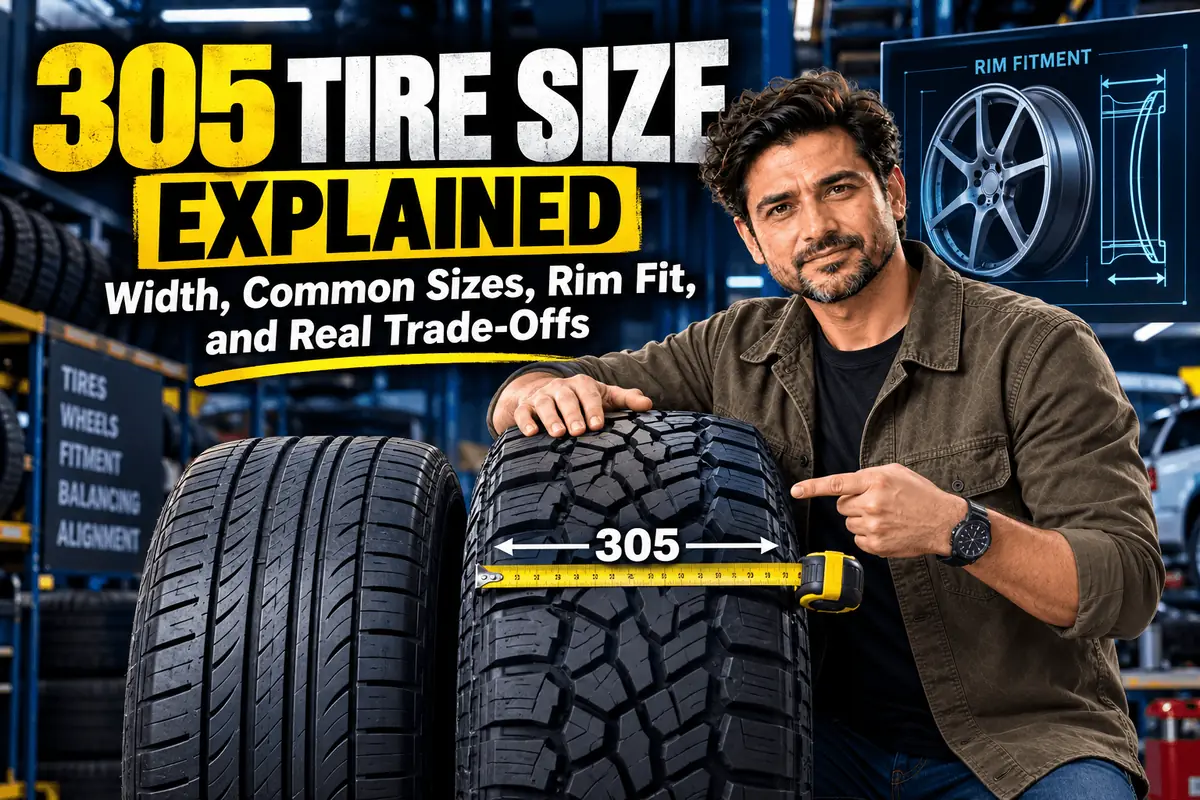
You have seen the number on a forum build thread, a tire quote or the rear of a sports car: 305. It sounds like a single size, but it is only the first piece of one. A 305 tire on a lifted pickup and a 305 tire on a mid-engine Corvette share a tread width and almost nothing else. One stands nearly 34 inches tall on a 17-inch wheel, the other is barely 27 inches tall on a 20-inch wheel with a sidewall you could cover with your palm.
That is why buying “305s” without understanding the rest of the size string leads to rubbing fenders, a wrong speedometer, a tire stretched over the wrong rim or a bigger bill than expected. This guide breaks down what 305 actually means, calculates the dimensions of the most common 305 sizes, lists the rim widths they need and explains who benefits from going this wide and what it costs in fitment, money and fuel.
Table of Contents
What the 305 in a Tire Size Means
In a metric size such as 305/55R20, the 305 is the section width: the distance from sidewall to sidewall, in millimeters, of a mounted and inflated tire. Divide 305 by 25.4 and you get 12.0 inches, which is why 305 tires are often described as 12-inch-wide tires. That figure is measured on a specific measuring rim, so the same tire mounted on a narrower or wider wheel will measure slightly differently, and the tread itself is always narrower than the section width.
The rest of the size string does the heavy lifting on everything else:
- Aspect ratio (the 55 in 305/55R20) is sidewall height as a percentage of section width. A 55-series 305 has a sidewall 55 percent of 305 mm, or about 6.6 inches.
- R means radial construction, which covers virtually every modern passenger and light truck tire.
- Rim diameter (the 20) is the wheel diameter in inches.
- LT in front of the size, as in LT305/55R20, marks a light truck tire with heavier construction and load ratings for towing and hauling.
If any of that notation is unfamiliar, our guide to reading tire sizes walks through the full sidewall code, including load index and speed rating.
How to Calculate a 305 Tire’s Diameter
The math takes about 30 seconds. Multiply 305 by the aspect ratio to get sidewall height in millimeters, divide by 25.4 to convert to inches, double it (there is a sidewall above and below the wheel), then add the rim diameter.
For 305/70R17: 305 × 0.70 = 213.5 mm, or 8.4 inches. Doubled, that is 16.8 inches. Add the 17-inch wheel and the tire stands about 33.8 inches tall. Multiply diameter by pi (3.1416) and you get circumference, roughly 106 inches, or how far the tire travels in one revolution.
Common 305 Sizes and Their Dimensions
These are some of the 305 sizes you are most likely to run into, with diameters calculated from the formula above. Rim width ranges are the commonly published minimum and maximum wheel widths for each size.
| Size | Sidewall Height | Diameter | Rim Width Range | Typical Use |
|---|---|---|---|---|
| 305/70R17 | 8.4 in | 33.8 in | 8.0 to 9.5 in | Off-road and lifted trucks, Jeeps |
| 305/55R20 | 6.6 in | 33.2 in | 8.5 to 10.0 in | Half-ton and heavy-duty pickups on 20-inch wheels |
| 305/45R22 | 5.4 in | 32.8 in | 9.5 to 11.0 in | Trucks and SUVs on large street wheels |
| 305/35R20 | 4.2 in | 28.4 in | 10.0 to 12.0 in | Rear axle of muscle and performance cars |
A few other sizes are worth knowing. A 305/70R16 works out to about 32.8 inches tall, a favorite for older trucks and Jeeps that run 16-inch wheels. A 305/30R20 is only about 27.2 inches tall, the kind of low, wide rear tire found on sports cars. And a 305/35R24 lands near 32.4 inches, so a huge wheel with a thin sidewall can end up close to the height of a much smaller truck wheel with a tall one.
Notice what the table shows: three of these sizes cluster around 33 inches tall despite riding on 17-, 20- and 22-inch wheels. The bigger the wheel, the thinner the sidewall needed to keep the same height. That matters because a 33-inch tire is a common target for truck owners who want a bigger look without major lift work, and you can reach it with several wheel choices.
Why Rim Width Changes With Aspect Ratio
The rim column follows a clear pattern. The tall 70-series 305 is happy on an 8.0- to 9.5-inch wheel, while the low-profile 35-series 305 wants 10.0 to 12.0 inches. A short, stiff sidewall has little room to flex, so it needs a wheel close to its own width to hold the right shape. A tall sidewall can bridge a narrower wheel without distorting.
Running a 305 outside its approved range is a real problem, not a cosmetic one. Too narrow a wheel pinches the bead and balloons the tread, which can make the center wear quickly and the steering feel vague. Too wide a wheel stretches the sidewall and exposes the rim lip to curbs. Many tire shops will refuse to mount a size outside its approved range, so check your wheel width before you order.
How a 305 Compares With Nearby Widths
Each 10 mm step in section width adds about 0.4 inch. That sounds trivial on paper, but the jump from a 285 to a 305 is 0.8 inch per tire, enough to change how the tire sits in the wheel well and whether it contacts a fender liner at full steering lock.
| Section Width | Approximate Width | Difference From 305 |
|---|---|---|
| 285 | 11.2 in | 0.8 in narrower |
| 295 | 11.6 in | 0.4 in narrower |
| 305 | 12.0 in | Baseline |
| 315 | 12.4 in | 0.4 in wider |
| 325 | 12.8 in | 0.8 in wider |
A 305 sits in a useful middle ground. It is noticeably wider than the 265 and 275 sizes many trucks wear from the factory, but it usually requires less modification than a 315 or 325, the widths you see on purpose-built off-road trucks. Keep in mind that width alone does not determine fit. A 305/70R17 and a 305/35R20 are equally wide and wildly different in height, and height is usually what causes rubbing on a truck.
Which Vehicles Use 305 Tires
Pickup Trucks, SUVs and Off-Road Builds
Trucks are the biggest market for 305 tires, mostly as an upgrade. Owners of half-ton and heavy-duty pickups often step up to sizes like 305/55R20 or 305/70R17 to fill the wheel wells and gain a wider, more aggressive stance. Jeeps, overland rigs and trail trucks use tall 305s for the added sidewall and footprint, typically in all-terrain, rugged-terrain or mud-terrain treads. In LT construction, these tires carry the load ratings needed for towing and hauling, which makes them a sensible choice for working trucks rather than only a styling move.
The Rear Axle of Performance Cars
On the performance side, 305 is a rear-tire size. Rear-drive sports cars and muscle cars use a staggered setup with narrower tires up front and wide tires at the back, where the extra footprint helps put power down out of corners. The C8 Corvette Stingray wears 305/30R20 rear tires, and the Camaro ZL1 runs 305/30R20 at the rear as well. These are low-profile, high-speed-rated summer tires, a completely different product from a 305 all-terrain truck tire.
Staggered cars come with one big limitation: with different sizes front and rear, the tires generally can only be rotated side to side, if at all. Rear tires on powerful cars often wear out well before the fronts.
Fitting 305 Tires on Your Vehicle
On a performance car that came with 305s, fitment is settled at the factory. On a truck where you are upsizing, it is the whole question. A tire that clears the fender while parked can still rub at full steering lock or when the suspension compresses over a bump.
The common ways to make room include:
- Leveling kits and suspension lifts. Raising the front or the whole vehicle adds clearance for taller tires.
- Body lifts. These raise the body on the frame, gaining space in the wheel wells without changing suspension geometry.
- Fender trimming or rolling. Removing or folding a small amount of material around the fender lip or liner clears tires that touch only at the extremes of travel.
- Wheel offset or spacers. Moving the tire outward can clear suspension parts, though it can push the tread toward the fender and increase stress on wheel bearings.
- Body mount chops. On some trucks, trimming the body mount area creates clearance for tires that rub at full lock.
Each modification has its own trade-offs, and the right combination depends heavily on the specific truck. Owner forums for your exact model are often the best place to learn which 305 sizes fit with a leveling kit and which need more.
Taller tires change your effective gearing and speedometer. A tire meaningfully taller than stock will make the speedometer read low, and many trucks need recalibration to correct it.
Popular 305 Tire Models
Because 305 is mostly a truck size, most of the familiar options are light truck tires. Models that commonly appear in 305 sizes include:
- Michelin Defender LTX M/S, a highway all-season tire for drivers who mostly stay on pavement and want a quiet, long-wearing ride.
- BFGoodrich All-Terrain T/A KO2, a long-running all-terrain choice with tough sidewalls for mixed pavement and trail use.
- Goodyear Wrangler DuraTrac, an aggressive all-terrain tire that leans further toward off-road traction.
- Toyo Open Country R/T, a rugged-terrain design that sits between all-terrain and mud-terrain tires.
- Nitto Trail Grappler M/T, a mud-terrain tire for owners who spend real time on rocks and mud.
Tire lineups and size offerings change, so confirm that the exact size, load range and model you want are available before committing to a wheel. For performance cars, 305 rear tires come mainly in max-performance summer and all-season performance lines.
The Trade-Offs of Going Wider
What You Gain
- Footprint and dry grip. A wider tire puts more rubber on the road, which helps traction on dry pavement, especially when putting power down.
- Stability and load capacity. Wide LT tires carry heavy loads well and help a truck feel planted when towing.
- Stance. For many truck owners, the look of a wide tire filling the wheel well is half the reason to buy one.
What You Give Up
- Cost. Wide sizes cost more than common sizes, and heavy-ply LT construction and aggressive tread add to the price. A performance 305 rear tire is often the priciest tire on the car.
- Fuel economy. A heavier, wider tire with more rolling resistance takes more energy to turn, and aggressive tread makes it worse. Expect some loss in mpg after upsizing a truck.
- Wear on other parts. Heavier tires add unsprung and rotating mass, which loads the suspension, steering and wheel bearings harder over time.
- Ride and noise. Stiff LT sidewalls and blocky treads ride firmer and hum louder than the highway tires many trucks wear from the factory.
- Deep snow. A wide footprint spreads weight over a larger area, which means less pressure biting into snow. Narrower tires often perform better in deep snow.
Caring for 305 Tires
Wide tires are expensive enough that maintenance pays for itself. Rotate them on the schedule in your owner’s manual; Discount Tire, for example, suggests every 6,000 to 8,000 miles for most vehicles, and aggressive off-road treads can benefit from more frequent rotation. Check pressures monthly using the vehicle placard, or the tire maker’s load and inflation tables if you have changed to an LT size, since an LT tire often needs different pressure than the original passenger tire. Never exceed the tire’s load rating, and get an alignment check after installing a lift or new tires.
Related Reading
Frequently Asked Questions
A 305 tire has a section width of 305 millimeters, or about 12.0 inches. The tread is narrower than that, and the measured width changes slightly with the width of the wheel it is mounted on.
A 305/70R17 is about 33.8 inches tall, a 305/55R20 about 33.2 inches, a 305/45R22 about 32.8 inches and a 305/35R20 only about 28.4 inches.
That also depends on the full size. Common published ranges run from 8.0 to 9.5 inches for a 305/70R17 up to 10.0 to 12.0 inches for a 305/35R20. Lower-profile sizes need wider wheels.
Some will, especially lower-profile 305s close to the stock diameter. Taller sizes around 33 to 34 inches frequently need a leveling kit, lift or trimming to avoid rubbing at full lock or under compression. Check what owners of your exact truck have fitted.
Usually, yes. Wider and heavier tires take more energy to roll, and aggressive all-terrain or mud-terrain treads add further losses. The size of the drop depends on the tire, the vehicle and how much larger the new tire is than stock.
Not always. Several 305 sizes, such as 305/70R17, 305/55R20 and 305/45R22, land close to 33 inches tall, but a 305/35R20 is closer to 28 inches. The 305 tells you width, not height.
The Verdict on 305 Tires
A 305 is a wide tire, about 12 inches across, and that is all the number says on its own. Whether it is the right tire depends on the rest of the size: a tall 305 on a truck is a stance and traction upgrade that brings fitment work and fuel costs, while a low 305 on the back of a sports car is a factory choice for putting power down.
If you are upsizing, start with the total diameter, confirm your wheel falls inside the approved rim range and research what fits your specific vehicle before you buy. Done that way, a 305 can deliver the grip and look you want without surprises at the fender line or the gas pump.
 Summarize this article with:


















Leave a comment