


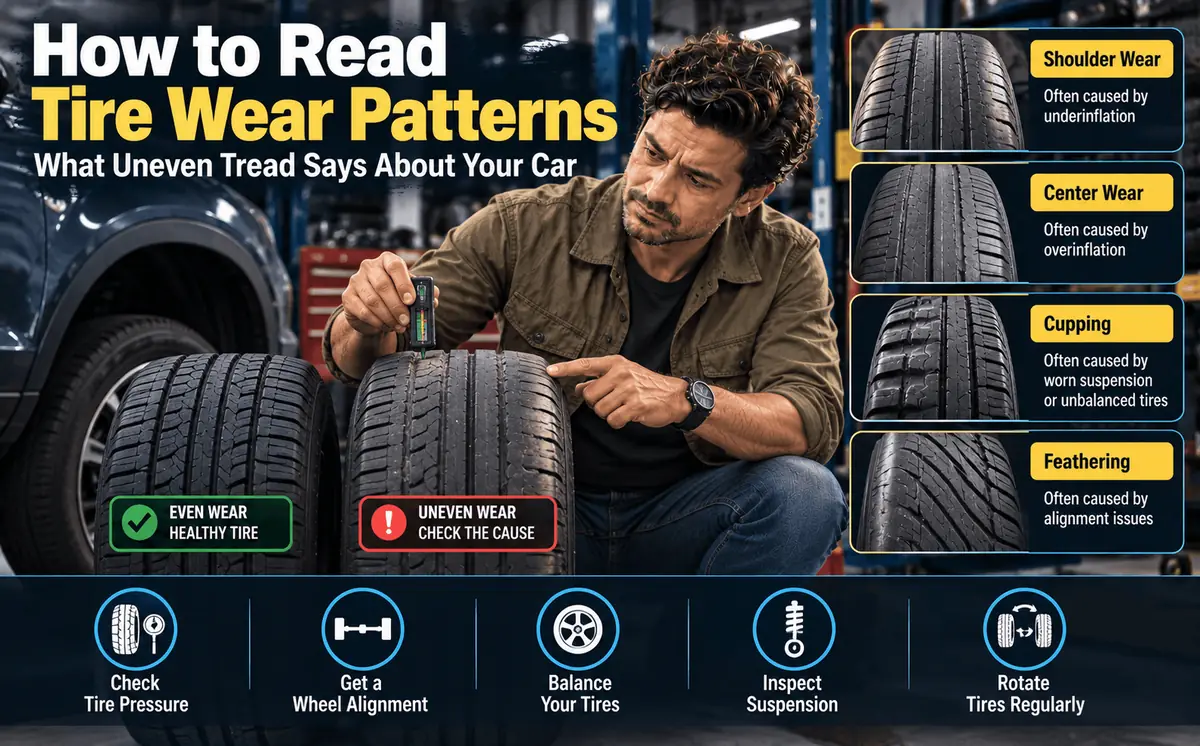
Most drivers only look closely at their tires when something has already gone wrong: a flat, a bulge, or a warning light on the dash. By then, the tread has often been recording a problem for thousands of miles. A tire that wears faster on one edge, in the middle, or in scooped patches is pointing straight at an inflation habit, an alignment angle, or a tired suspension part.
Learning to read those patterns lets you fix the cause before it destroys a set of tires. You do not need a lift or alignment equipment. A few minutes in the driveway, a coin, and your hand on the tread will tell you most of what you need to know, and this guide explains each common pattern, its cause, and the fix.
Table of Contents
Why Wear Patterns Matter
A tire that wears evenly across its width and around its circumference is a sign that pressure, alignment, and suspension are all doing their jobs. Uneven wear means at least one of those systems is out of spec. The tire will reach the end of its useful life early, sometimes far ahead of its mileage warranty, and a warranty claim is unlikely to succeed when the cause is low pressure or poor alignment.
Safety is the bigger issue. Worn shoulders reduce cornering grip, and a tire worn to the cords on one edge can fail without much warning. Catching a pattern early usually means a cheap fix: a pressure adjustment, an alignment, or a rotation.
The Common Tire Wear Patterns
Center Wear: Too Much Air
The strip down the middle of the tread is worn noticeably lower than the outer ribs. Slide your fingers across the tread and the center feels sunken.
Overinflation is the usual cause. Too much pressure makes the tread crown slightly, so the center carries a larger share of the load while the shoulders do less work. Drivers often cause it by filling to the maximum pressure molded on the sidewall. That figure is the most the tire is rated to hold, not the pressure your car should run. The correct number is on the placard in the driver’s door jamb or in the owner’s manual.
An overinflated tire also has a smaller contact patch, which hurts wet braking and makes the ride harsher, and it is more vulnerable to pothole damage. Set all four tires to the placard pressure, recheck monthly, and rotate if the center has already worn ahead of the shoulders.
Both Shoulders: Too Little Air
Both outer edges are worn down while the center still has good tread. This is the mirror image of center wear and one of the most common patterns on the road.
An underinflated tire sags under the car’s weight, so the shoulders carry the load and the middle of the tread lifts slightly away from the road. Tires lose air gradually through the rubber, roughly 1 psi a month, and pressure also falls about 1 psi for every 10°F drop in outside temperature. A tire set correctly in late summer can be well under spec by midwinter if nobody checks it.
Shoulder wear is more than a tread-life problem. An underinflated tire flexes more with every revolution and runs hotter, and low pressure is a leading cause of tire failure at highway speed. Inflate to the placard figure, rotate the tires, and look closely at both shoulders. If one shoulder is clearly worse than the other, an alignment problem may be layered on top of the pressure problem.
One Edge Only: Camber or Alignment
The inner or outer edge is worn far more than the opposite side. In severe cases one shoulder is down to the wear bars while the other still looks healthy.
This pattern usually points to camber, the inward or outward tilt of the tire when you look at the car from the front. Most cars run a small amount of negative camber, with the tops of the tires tilted slightly inward, for stability in corners. When a ball joint, control arm bushing, or strut wears out, or a hard curb strike bends something, camber can go well out of spec and grind away one edge. Excessive toe can also wear one edge, which is another reason to treat this as an alignment issue rather than a guess.
Get a four-wheel alignment and ask for the before-and-after printout. If the camber cannot be brought into spec, have the shop inspect bushings, ball joints, and strut mounts. Lifted or lowered vehicles may need aftermarket camber correction parts.
Feathering: Toe Misalignment
Each tread rib or block is worn at an angle, sharp on one side and rounded on the other. You will feel this more easily than you will see it. Run your hand across the tread from side to side: in one direction it feels smooth, and in the other it catches on sharp edges.
Feathering comes from incorrect toe, meaning the tires point slightly inward or outward instead of straight ahead. As the tire rolls, it scrubs sideways as well as forward, shaving rubber off one edge of every rib. The difference from camber wear is the location. Camber wear sits on one shoulder, while feathering shows up across the full width of the tread. A toe adjustment during a four-wheel alignment is usually one of the quicker corrections a shop can make.
Cupping or Scalloping: Shocks, Struts, or Imbalance
The tread has a series of dips and high spots around the circumference, as though someone scooped out patches of rubber. Run your palm slowly around the tire and it will feel wavy instead of smooth.
Cupping happens when the tire bounces instead of rolling smoothly. Worn shocks or struts are the most common cause, because they no longer control the wheel’s motion after a bump. Wheel imbalance can produce a similar pattern, usually less regular than the cupping caused by worn dampers. A simple check is the bounce test: push down hard on one corner of the car and let go. A healthy shock or strut lets it rebound once and settle. Repeated bouncing suggests worn dampers.
Cupped tires often produce a humming or droning noise that changes with speed and is easy to mistake for a wheel bearing. Replace worn shocks or struts before fitting new tires, or the new set will cup the same way. Cupping does not grind back out, so a badly cupped tire will stay noisy even after the cause is fixed. If imbalance is the suspect, our guide to driving on unbalanced tires explains the symptoms and the fix.
Flat Spots: Skids and Lockups
A flat spot is a localized patch where the tread is worn much lower than the surrounding area, usually across the full width. It typically comes from a hard skid with the wheels locked, as can happen on cars without antilock brakes or when an ABS system is not working properly. Repeated hard launches or brake lockups can produce the same result.
A badly flat-spotted tire causes a rhythmic thump or vibration and often cannot be corrected. Have the brakes and ABS checked if flat spots appear without an obvious panic stop. A tire parked for weeks can also develop a temporary flat spot, but that one fades after a few miles.
Heel-Toe Wear on Tread Blocks
On tires with large, separate tread blocks or lugs, each block can wear unevenly from front to back, leaving one edge higher than the other in a sawtooth profile around the circumference. Running your hand around the tire in one direction feels smooth, while the other direction catches.
Heel-toe wear is common on aggressive all-terrain, mud-terrain, and winter tires, because individual lugs flex and scrub as they enter and leave the contact patch. It is often worse on non-drive axles and is made worse by underinflation and infrequent rotation. Some of it is normal for this type of tread, but keeping pressure correct and rotating on schedule slows it down and reduces noise.
Diagonal Wipe on Rear Tires
A diagonal wipe shows up as worn patches running at an angle across the tread, repeating around the tire. It is most often found on the rear tires of front-wheel-drive vehicles, where the rear tires carry little load and are easily scrubbed by a rear toe setting that is out of spec.
Rotation neglect is part of the problem, because a rear tire left in one position for too long gives the pattern time to develop. A four-wheel alignment that includes the rear toe, followed by a rotation, is the usual fix. If wear does not fit neatly into any single pattern, treat it as a combination problem and start with an alignment check plus rotation rather than a rotation alone.
Quick-Reference Wear Pattern Table
| Wear Pattern | What You See or Feel | Likely Cause | First Step |
|---|---|---|---|
| Center wear | Middle worn, shoulders fine | Overinflation | Set pressure to placard |
| Both shoulders | Edges worn, center fine | Underinflation | Inflate to placard, rotate |
| One edge | Inner or outer shoulder worn | Camber or alignment | Four-wheel alignment |
| Feathering | Ribs sharp one way, smooth the other | Toe misalignment | Alignment with toe adjustment |
| Cupping or scalloping | Wavy dips around the tire | Worn shocks or struts, imbalance | Inspect suspension, balance wheels |
| Flat spots | Localized patch worn across tread | Skid or brake lockup | Check brakes and ABS |
| Heel-toe | Lugs worn higher on one edge | Lug flex, low pressure, no rotation | Correct pressure, rotate |
| Diagonal wipe | Angled worn patches, often rear | Rear toe, rotation neglect | Alignment, then rotate |
Checking Tread Depth
Every passenger tire has tread wear indicator bars molded into the main grooves at 2/32 inch. When the surrounding tread wears down level with these small raised bridges, the tire has reached 2/32 inch, the legal minimum in most states, and needs replacing.
You can check before the bars show with a coin:
- Penny test: Insert a penny into a groove with Lincoln’s head pointing down. If you can see the top of his head, the tread is at or below 2/32 inch.
- Quarter test: Insert a quarter the same way with Washington’s head pointing down. If you can see the top of his head, the tread is at or below 4/32 inch.
Many drivers plan replacement around 4/32 inch, because wet-road grip and resistance to hydroplaning fall off well before a tire reaches the legal minimum. For anyone driving in snow or heavy rain, the quarter test is the more useful warning.
Coins tell you whether you have crossed a threshold. A tread depth gauge costs only a few dollars and gives an actual reading, which is what you need to compare one shoulder with the other.
A Ten-Minute Driveway Inspection
- Check the tread depth with a gauge or coin at the inner shoulder, center, and outer shoulder of each tire. A difference of more than about 2/32 inch across one tire is worth investigating.
- Stand in front of the car and look at each front tire. Visible tilt at the top suggests a camber problem.
- Run your palm slowly around the tread of each tire, including the inner shoulder if you can reach it. Feel for waviness, sharp rib edges, and low spots.
- Look for damage: bulges, cuts, cracks in the shoulder, and exposed cords.
- Check pressure cold, after the car has sat for at least three hours or been driven less than a mile, and set each tire to the door placard figure.
When Wear Requires Immediate Action
Some findings mean the tire should come off the car right away. These include tread at or below 2/32 inch anywhere on the tire, exposed belts or cords, bulges or bubbles in the sidewall, cracking in the shoulder on a tire that has been run low, and missing chunks of tread.
Other patterns call for a shop visit soon rather than immediately: tread near 4/32 inch heading into winter, one-sided wear you can feel by hand, and cupping that is already making noise. Mild feathering or slight shoulder wear on tires with plenty of tread can wait for a scheduled alignment and rotation.
Rotation Prevents Most Problems
Many uneven wear patterns never get the chance to develop on tires that are rotated regularly. Every 5,000 to 7,500 miles is a common interval, though your owner’s manual has the final word. On front-wheel-drive cars, the front tires steer, brake, and transmit power, so they wear faster than the rears. Without rotation, you end up replacing tires two at a time and running mismatched tread depths front to rear.
Ultra-high-performance tires are especially sensitive to alignment, and wear patterns show up on them quickly. Touring all-season tires are more forgiving of small errors, which only means the damage builds more slowly.
Related Reading
Frequently Asked Questions
Mild feathering or early shoulder wear is usually safe to drive on while you schedule an alignment or pressure correction. Severe one-sided wear, deep cupping, tread at 2/32 inch anywhere on the tire, or any sidewall damage means the tire should be replaced before more highway driving.
Rotation slows further uneven wear and can even out remaining tread life across the set, but it cannot restore rubber that is already gone. Fix the cause first, whether that is pressure, alignment, or suspension, then rotate.
Once a month is a good habit, ideally at the same time you check tire pressure. Look again after any hard pothole or curb strike.
Yes. A tire can show one-sided camber wear and feathering at the same time, which usually means more than one alignment angle is out of spec. The alignment printout will show which settings need correcting.
Yes. An unbalanced wheel makes the tire hop slightly as it rolls, which can create cupping. Imbalance-related cupping is usually less regular than the pattern from worn shocks or struts, and balancing is inexpensive, so it is a sensible first check when vibration and irregular wear appear together.
They are small raised bridges molded across the bottom of the main tread grooves at 2/32 inch. When the tread is level with them, the tire has reached the legal minimum in most states and should be replaced.
Reading the Tread Before It Costs You
Tire wear patterns are among the cheapest diagnostic tools you have. Center wear and shoulder wear tell you to fix the pressure, one-sided wear and feathering point to alignment, cupping sends you to the shocks, struts, or balancer, and flat spots lead back to the brakes. Check your tires monthly, measure the tread across each one, and act on what you find. A pressure adjustment or an alignment costs far less than a set of tires worn out before their time, and far less than a tire that gives up at highway speed.
 Summarize this article with:

















Leave a comment