


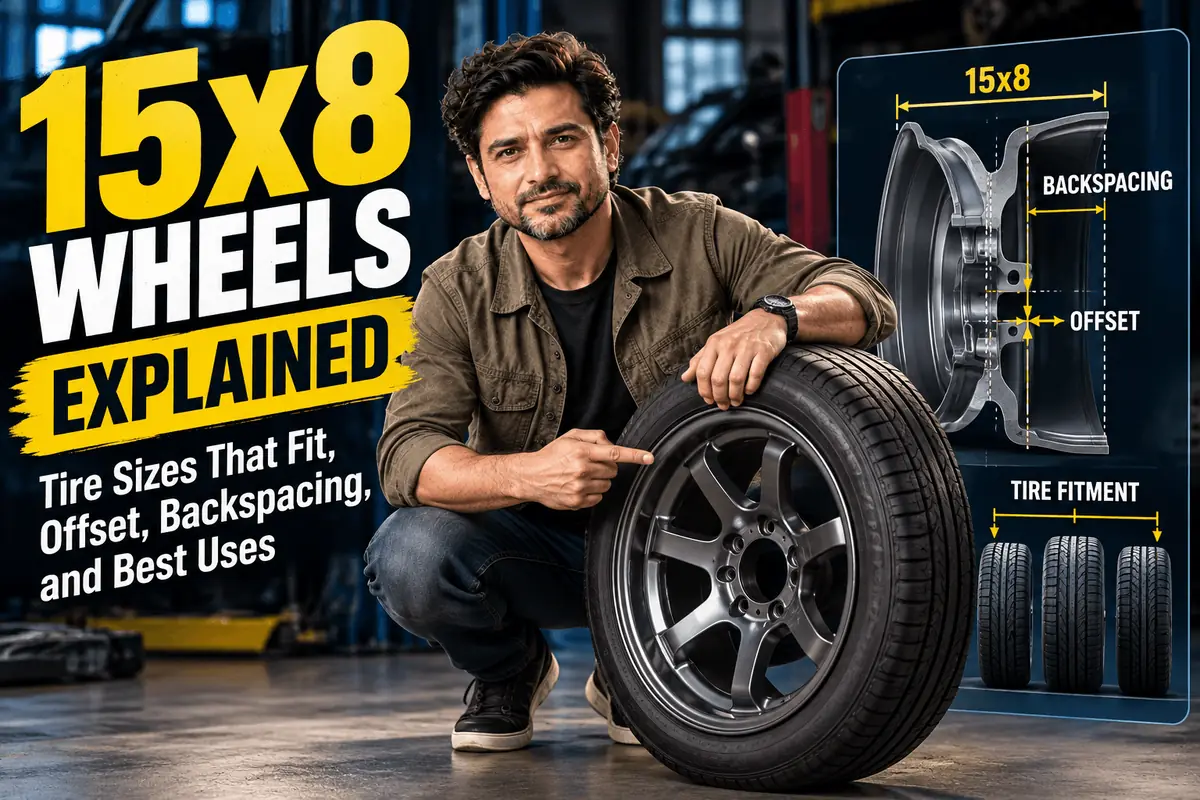
A 15×8 wheel shows up in a surprising number of places: under the rear fenders of a classic Camaro, on the hubs of an old square-body pickup, on a Jeep built for trails rather than pavement. The size is popular for a reason, but it also confuses a lot of buyers, starting with a basic misunderstanding. 15×8 describes a wheel, not a tire. It tells you the wheel is 15 inches in diameter and 8 inches wide, and it says nothing about which tire you should mount on it.
That is the real question most people are trying to answer. Which tire sizes are approved for an 8-inch-wide, 15-inch wheel, and will the whole package clear the fenders, brakes and suspension? This guide covers the common tire sizes that fit, explains offset and backspacing in plain terms and walks through where 15×8 wheels make the most sense.
Table of Contents
What 15×8 Means
The first number is the wheel’s diameter, measured at the bead seat where the tire seals, not across the outer lip. A 15-inch wheel takes a tire with “15” as the last number in its size, such as 235/75R15.
The second number is the wheel’s width, also measured between the bead seats rather than across the outer edges of the flanges. Because the flanges add material on each side, the total width of an 8-inch wheel is roughly 9 inches. That extra inch matters later, when you calculate backspacing and check clearance.
Tire sizes are written differently. A metric size like 275/60R15 gives the section width in millimeters (275), the sidewall height as a percentage of that width (60) and the wheel diameter (15). A flotation size like 31×10.50R15 is written in inches: 31 inches tall, 10.5 inches wide, for a 15-inch wheel. For a deeper look at reading these numbers and matching them to wheels, our wheel and tire setup guide covers the full process.
Tire Sizes That Fit a 15×8 Wheel
Every tire size has an approved rim width range set by industry standards. A tire mounted within that range seats properly, keeps its intended sidewall shape and handles as its maker intended. Outside that range, you risk poor bead seating, a pinched or overly stretched sidewall and vague handling.
The sizes below all include 8 inches within their approved range. Ranges and dimensions come from common industry sizing charts and can vary slightly by tire manufacturer, so confirm the exact spec for the tire you plan to buy.
| Tire Size | Approved Rim Width | Approx. Diameter | Approx. Section Width | Typical Use |
|---|---|---|---|---|
| 235/75R15 | 6.0 to 8.5 in | 28.9 in | 9.3 in | Older trucks, SUVs, trailers |
| 255/60R15 | 7.0 to 9.0 in | 27.1 in | 10.0 in | Muscle cars, street rods |
| 255/70R15 | 6.5 to 8.5 in | 29.1 in | 10.0 in | Trucks, SUVs |
| 265/75R15 | 7.0 to 9.0 in | 30.7 in | 10.4 in | Trucks, Jeeps, light off-road |
| 275/60R15 | 7.5 to 9.5 in | 28.0 in | 10.8 in | Muscle car rear wheels |
| 295/50R15 | 8.0 to 10.0 in | 26.6 in | 11.6 in | Wide rear setups, pro-street builds |
| 31×10.50R15 | 7.0 to 9.0 in | 31.0 in | 10.5 in | Jeeps, trucks, off-road |
Reading the Table
A few sizes deserve a closer look because of where 8 inches falls in their range.
235/75R15 sits near the top of its range on an 8-inch wheel. It fits, but the sidewall will look more squared off than it would on a 6- or 7-inch wheel. That is a perfectly good choice for a truck that wants a narrow, tall tire for snow or mud, but it will look a bit tucked in on a wide wheel.
255/60R15 and 275/60R15 are the classic muscle car pairing. An 8-inch wheel lands comfortably in the middle of the 255’s range, while the 275 is commonly listed with 8 inches as its measuring rim, the width at which its published dimensions are taken. Both sizes are still made in the BFGoodrich Radial T/A, the raised-white-letter tire that defined the look of 1970s performance cars. The 255/60R15 version carries a 102 load index, rated for 1,885 pounds, and the 275/60R15 carries a 107 load index, rated for 2,149 pounds.
295/50R15 puts 8 inches at the bottom of its range. It mounts legally, but the tire will bulge a bit at the sidewall. Builders chasing the widest possible rear tire on a 15-inch wheel often step up to a 10-inch wheel for this size.
31×10.50R15 is the go-to size for Jeeps and older trucks. It is approved for 7- to 9-inch wheels, so 8 inches is right in the middle. The BFGoodrich All-Terrain T/A KO2 is one example offered in this size, as an LT31x10.50R15 with a 109S load and speed rating and a Load Range C construction.
A 33×12.50R15 is a popular off-road size, but its approved rim width range starts at 8.5 inches. On a 15×8 wheel it sits below the minimum, so a 15×8.5 or wider wheel is the correct match.
Narrower Tires on a Wide Wheel
Going too narrow causes as many problems as going too wide. When a tire’s maximum approved width is below 8 inches, the wheel stretches the bead outward, the sidewall loses its support and the bead and wheel edge become more exposed to curb damage. If you are working with narrower wheels instead, our guide to whether a 235 tire fits a 6-inch wheel walks through the same logic from the other direction.
Offset and Backspacing on a 15×8 Wheel
Getting the tire size right is only half the job. The wheel also has to sit in the right place relative to the hub, and that position is described by offset and backspacing. Two 15×8 wheels with the same tire can fit completely differently because one tucks inward and the other pokes out past the fender.
Offset
Offset is the distance between the wheel’s mounting surface, where it bolts to the hub, and the wheel’s centerline. It is usually listed in millimeters.
- Zero offset means the mounting surface sits exactly on the centerline.
- Positive offset moves the mounting surface toward the outer face of the wheel, which pulls the wheel and tire inward toward the suspension. Most modern front-wheel-drive cars use positive offset.
- Negative offset moves the mounting surface toward the back of the wheel, which pushes the wheel and tire outward toward the fender. Lifted trucks and off-road builds often use negative offset for a wider stance.
Backspacing
Backspacing is the distance from the mounting surface to the inner edge of the wheel, measured in inches. It is the number many classic car and truck builders prefer, because it tells you directly how much room the wheel takes up on the inboard side, near springs, control arms and frame rails.
To measure it, lay the wheel face down, set a straightedge across the inner flange and measure straight down to the mounting pad.
Converting Between the Two
Offset and backspacing describe the same thing from different reference points, and one converts to the other with a simple formula:
Backspacing = ((wheel width + 1) ÷ 2) + offset in inches
The “+1” accounts for the flanges that make the real width of a wheel about an inch more than its nominal size. To convert offset from millimeters to inches, divide by 25.4.
| 15×8 Offset | Approx. Backspacing | Where the Wheel Sits |
|---|---|---|
| +12 mm | 4.97 in | Tucked further inward |
| 0 mm | 4.50 in | Centered on the mounting surface |
| -12 mm | 4.03 in | Pushed slightly outward |
| -19 mm | 3.75 in | Pushed further outward |
So a 15×8 wheel with zero offset has about 4.5 inches of backspacing. Each 6 mm of offset shifts the backspacing by roughly a quarter inch.
Why It Matters
Too much backspacing pushes the tire into the suspension, frame or inner wheel well. Too little pushes it out toward the fender lip, where it can rub over bumps or during turns, and it changes how the steering feels by moving the tire’s contact patch away from the suspension’s pivot point. Wheel spacers can add outward clearance, but they should be high-quality, hub-centric parts installed to the correct torque, and they are a workaround rather than a substitute for choosing the right wheel.
The safest approach is to measure your current setup before you buy anything. Note the existing wheel’s backspacing, measure the clearance between the tire and the closest suspension part and between the tire and the fender, then compare that to the new wheel and tire combination.
Where 15×8 Wheels Make the Most Sense
Classic Muscle Cars
The 15-inch wheel was the performance standard for decades, and a 15×8 on the rear axle is a common choice for American muscle cars from the 1960s and 1970s. A popular pattern pairs a 15×7 front wheel with a 15×8 rear, with a 255/60R15 or 275/60R15 tire out back. That staggered look keeps the period-correct proportions while putting more rubber where a rear-wheel-drive car needs it. Brake clearance is rarely a problem on original drum or early disc setups, but a modern big-brake upgrade may not fit inside a 15-inch wheel, so check before you commit.
Older Trucks and SUVs
Pickups and full-size SUVs from the same era often came on 15-inch wheels, and a 15×8 lets them run sizes like 235/75R15, 255/70R15 or 265/75R15 with a fuller sidewall than a narrower wheel allows. Tall sidewalls soften the ride and protect the wheel from rocks and potholes, which suits work trucks and daily-driven classics alike. If the truck hauls or tows, choose a light truck (LT) tire with a load rating that covers the vehicle’s real working weight.
Jeeps and Off-Road Builds
The 15×8 wheel and 31×10.50R15 tire are a classic pairing for older Jeeps and small trucks. The combination gives meaningful extra ground clearance over stock sizes while keeping the sidewall tall enough to air down on trails, where a lower pressure lets the tire wrap over rocks and spread out in sand. A wheel with negative offset, often around 3.75 inches of backspacing, pushes the tire outward for a wider, more stable stance and keeps it away from the leaf springs. Going larger than a 31-inch tire usually brings a lift, fender trimming and a wider wheel into the conversation.
Trade-Offs to Weigh
A 15×8 setup is not automatically an upgrade for every vehicle. A few compromises come with it:
- Tire selection is narrower than it used to be. Many modern performance tires are no longer made in 15-inch sizes, so 15×8 buyers often choose from classic-style street tires, all-terrains and mud-terrains rather than the newest ultra-high-performance models.
- Wider and taller tires can affect fuel economy and steering effort. A heavier tire with more rolling resistance takes more energy to turn.
- Speedometer readings change with total tire diameter. Moving from a 28-inch tire to a 31-inch tire means the speedometer will read low unless it is recalibrated.
- Clearance is never guaranteed. Fender lips, sway bars, steering stops and brake calipers all limit what fits, and those limits vary from vehicle to vehicle.
Pressure, Load and Maintenance
Inflation pressure for any tire on a 15×8 wheel starts with the vehicle’s door placard or owner’s manual for the original size. If you change size or switch from passenger to LT tires, the correct pressure may change, so ask the installer to check the load and inflation tables for the new tire. Never exceed the maximum pressure molded into the sidewall, and check pressure monthly with the tires cold.
Make sure the load index covers the vehicle’s weight, including passengers and cargo, and that the speed rating meets or exceeds what the vehicle needs. Rotate the tires on the schedule in your owner’s manual, have them balanced when mounted and get an alignment after any suspension change or hard impact. On a staggered muscle car setup, front-to-rear rotation isn’t possible, so rear tires usually wear out sooner and need replacing on their own schedule.
Frequently Asked Questions
No. 15×8 is a wheel size meaning a 15-inch diameter and an 8-inch width. Many different tire sizes fit a 15×8 wheel, including 235/75R15, 255/60R15, 275/60R15, 265/75R15 and 31×10.50R15.
No. The approved rim width range for a 33×12.50R15 starts at 8.5 inches, so an 8-inch wheel sits below the minimum. A 15×8.5 or wider wheel is the right match for that size.
About 4.5 inches. Using the formula of half the wheel width plus one inch, (8 + 1) ÷ 2 equals 4.5 inches, and zero offset adds nothing to that figure.
255/60R15 and 275/60R15 are the classic choices for rear wheels, with 8 inches falling well within both sizes’ approved ranges. The 275 gives a wider footprint and a more aggressive look, while the 255 is easier to fit under tight factory fenders.
Yes. The 31×10.50R15 is approved for wheels 7 to 9 inches wide, so an 8-inch wheel sits right in the middle of its range. It is one of the most common setups for older Jeeps and small trucks.
Negative offset moves the mounting surface toward the back of the wheel, so the wheel and tire sit further outward. That widens the stance and adds clearance from springs and suspension parts, but it moves the tire closer to the fender lip.
Final Word on 15×8 Wheels
A 15×8 wheel is one of the most versatile sizes in the classic car and truck world, but it only works when the tire, offset and vehicle all agree. Start with a tire size whose approved rim range includes 8 inches, such as 255/60R15 or 275/60R15 for a muscle car, 235/75R15 or 265/75R15 for an older truck and 31×10.50R15 for a Jeep. Then confirm the offset and backspacing will place that tire where it clears both the suspension and the fender.
If you get those pieces right, a 15×8 setup delivers exactly what owners want from it: period-correct looks on a classic, a fuller sidewall on a truck and a proven, capable package on the trail. If a size falls outside the approved range, like a 33×12.50R15, the better move is a wider wheel rather than forcing the fit.
 Summarize this article with:

















Leave a comment