


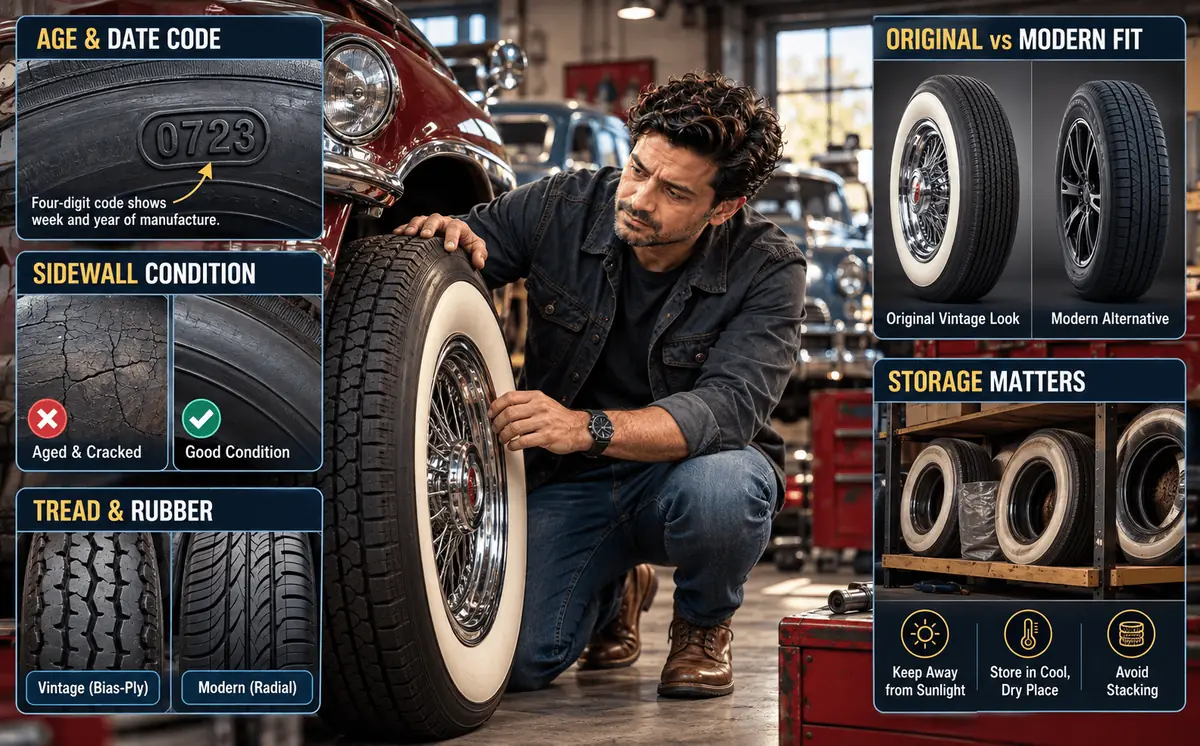
Vintage tires are not interchangeable with modern rubber. The sizing systems differ, speed and load ratings mean different things on older vehicles, the choice between bias-ply and radial is a genuine mechanical decision rather than a cosmetic one, and the wrong set can spoil a car’s handling, its looks, or both.
Whether you’re restoring a 1960s muscle car, maintaining a postwar pickup, or simply trying to understand why an old car drives so differently from a new one, this guide covers what you need to know: decoding vintage sizes, choosing construction, getting whitewalls right, finding suppliers, storing tires, and mounting them correctly.
The short version
Vintage cars use several sizing systems that don’t convert neatly to modern metric sizes.
Bias-ply looks period-correct; radial drives better. Pick one and use it on all four corners.
Verify speed and load ratings before driving at highway speed.
Whitewall width varies by era, and the details matter for authenticity.
Store tires away from ozone, sunlight, heat, and petroleum products, and treat anything older than six years with caution.
Table of Contents
Part 1: The Sizing Systems
The biggest cause of confusion is that there isn’t one vintage sizing system. There are several, used in overlapping eras.
The Numeric System (Roughly Pre-1965)
The oldest format uses two numbers, such as 6.00-16 or 7.50-14. The first number is the approximate section width in inches; the second is the wheel diameter in inches. A 6.00-16 tire is roughly 6 inches wide and fits a 16-inch wheel.
The word “approximate” does a lot of work. These designations were rough guides, and actual dimensions varied between manufacturers. Two tires labeled 6.50-16 from different suppliers can differ meaningfully in overall diameter, which affects speedometer accuracy, fender clearance, and stance.
The lesson: with numeric sizes, always check actual dimensions (section width, overall diameter, and loaded section height) before ordering, not just the nominal size.
The Alphabetical System (Roughly 1965–1970)
This system trips up the most people, because it looks almost modern but isn’t. Typical sizes read F70-14 or G78-15:
- The letter indicates load-carrying capacity relative to other sizes in the series. A is the smallest; N is the largest commonly found. An E-series tire carries less than an H-series tire at the same pressure.
- The middle number is the aspect ratio. A 70-series tire was relatively low-profile for its era; 78-series was the standard profile of the late 1960s.
- The last number is the rim diameter in inches.
So G78-15 describes a G-load, 78-series tire for a 15-inch rim, a fairly wide, normal-profile tire for a large American car of the period.
The section width isn’t stated directly, and it varied by manufacturer. As a rough guide:
| Letter | Approx. Section Width |
|---|---|
| E | 7.35 in |
| F | 7.75 in |
| G | 8.25 in |
| H | 8.55 in |
| J | 8.85 in |
| L | 9.00 in |
The Modern Metric System (Mid-1970s Onward)
From the mid-1970s, the familiar metric format took over, as in 225/70R15: section width in millimeters, aspect ratio, construction (R for radial, B or D for bias types), and rim diameter in inches. Many vehicles from the mid-1970s through the 1980s originally used metric sizes, and replacements are easy to find. Our tire size explainer covers the modern format.
Why This Matters
Swapping a G78-15 for a modern metric size without careful research can leave you with a tire that’s taller, wider, or a different diameter than original. On a late-1960s or early-1970s car, that can mean:
- Rubbing on the fender lip under compression or at full steering lock
- A speedometer reading several mph off
- A stance that looks wrong to anyone who knows the car
- Altered suspension geometry if the diameter change is large
The speedometer issue is especially common and easy to avoid: compare overall diameter before buying.
Part 2: Bias-Ply vs Radial
This is the decision with the biggest real-world impact on how a vintage vehicle drives, and it’s too often treated as purely cosmetic.
Bias-Ply Tires
In a bias-ply tire, the internal cords run diagonally across the tire at alternating angles, typically 30 to 40 degrees to the direction of travel, continuously from bead to bead. Sidewall and tread share the same structure. Virtually every tire made before the early 1970s was bias-ply.
In practice, bias-ply tires have stiff sidewalls, a tall, rounded profile, and a contact patch that changes shape as the tire heats and flexes. They communicate the road less crisply, tend to wander on highways, and deliver a floaty, somewhat disconnected ride. That classic 1960s “floating” feel owes a lot to bias-ply construction.
Radial Tires
In a radial tire, cords run straight across from bead to bead, perpendicular to the direction of travel, with a separate belt package, usually steel, stabilizing the tread. Sidewall and tread can flex independently. Radials offer lower rolling resistance, better fuel economy, a flatter and wider contact patch, sharper road feedback, and longer tread life. The industry shifted to radials during the 1970s, driven by fuel economy concerns and clear performance gains. Our radial vs bias-ply guide goes deeper.
Never Mix Them
Do not mix bias-ply and radial tires on the same vehicle. It isn’t a style preference; it’s a handling safety issue. The two constructions behave so differently that a vehicle with one type at each end can react unpredictably and asymmetrically in emergency maneuvers. Use the same construction on all four corners.
Authenticity vs Drivability
- Show-quality restorations: bias-ply is often the right call. Its tall, rounded profile is part of the period look, especially on 1950s and 1960s cars.
- Driver-quality restorations: a radial in period-appropriate sizing and tread design often makes more sense, with handling suited to modern traffic, better braking response, and longer life.
The major vintage-tire makers offer both options in most period sizes, including radial-construction tires molded to look like bias-ply originals.
Part 3: Speed Ratings and Load Capacity
Vintage Speed Ratings
Modern tires carry standardized speed rating letters such as H (130 mph) and V (149 mph). Many 1950s and 1960s tires carried no explicit speed rating at all; they were engineered around the performance of the vehicles they were fitted to. By the late 1960s and early 1970s, as performance cars grew faster, ratings appeared, but they weren’t standardized the way modern ones are.
If you drive a vintage vehicle at sustained highway speed, especially above 70 mph, verify the speed rating of the tire you’re buying. Bias-ply tires build heat differently from radials, and an underrated tire at sustained speed can fail. Reputable vintage suppliers will state speed and load ratings clearly; if one can’t, shop elsewhere. Many reproduction tires are rated for modern highway speeds, for example S (112 mph), but older styles may have lower limits.
Load Capacity on Vintage Trucks
Pre-metric trucks and heavy vehicles used load range designations, with higher letters indicating stronger construction and greater capacity. If your vintage pickup or work vehicle will carry real cargo, match or exceed the original load range. A tire that fits isn’t necessarily rated for your use. Our ply rating and load range guides explain the modern equivalents.
Part 4: Whitewalls and Stripes
Whitewalls are one of the most overlooked authenticity details, and they’re frequently wrong.
Width Matters
Whitewall width changed with the era, and an incorrect width looks as out of place to a knowledgeable eye as modern alloy wheels on a classic. As a rough guide for American cars:
- Before about 1955: wide whitewalls, often 3 to 4 inches
- Mid-1950s to early 1960s: narrower, often 2 to 2.5 inches
- Late 1960s: thin whitewalls, about 3/4 to 1 inch, standard on most cars
European vehicles followed their own conventions and often had no whitewall at all. For the correct width on your specific year, make, and model, consult period sales brochures; the AACA Library and Research Center holds brochures for many vehicles.
Red Lines and Raised White Letters
Many late-1960s muscle cars, particularly from Dodge and Plymouth, came with red-stripe tires rather than whitewalls. Raised white letters became common in the early 1970s; for cars of that era, whitewalls aren’t correct. Reproduction red-line and raised-white-letter tires are available from specialist suppliers.
Part 5: Where to Buy
- Coker Tire is the largest and best-known vintage tire supplier in North America, with extensive sizing for American vehicles from the 1940s through the 1980s and knowledgeable staff. Prices reflect correct sizing, correct appearance, and dependable support.
- Lucas Classic Tires covers many European fitments, particularly British cars such as MG, Triumph, and Austin-Healey.
- Universal Tire Company carries American and European sizes at competitive prices.
- Diamondback Classic Radials specializes in authentic wide- and narrow-whitewall tires for pre-1970 American vehicles, a strong choice when show-car appearance is the priority.
Don’t buy on price alone. A tire that’s the right size but wrong construction, speed rating, or appearance is an expensive mistake. Buy from people who know the product.
Part 6: Storage
Tire storage isn’t the same as tossing a spare set in the corner of the garage. Many enthusiasts learn this after ruining a set of rare new-old-stock (NOS) tires.
What Degrades Rubber
- Ozone: the biggest culprit. Even ambient ozone attacks rubber’s polymer chains, causing the surface cracking known as ozone cracking or dry rot. A tire can look fine from a few feet away while its structure is compromised.
- UV light: causes fading and surface oxidation on top of structural damage.
- Heat cycling: repeated warming and cooling accelerates ozone damage and draws plasticizers out of the rubber, leaving it brittle.
- Petroleum products: gasoline, oil, and solvents attack rubber aggressively.
How to Store Tires
- Avoid ozone sources. Electric motors, fluorescent lights, and frequently running air compressors all generate ozone.
- Keep them out of sunlight, including indirect window light over months.
- Store upright. Stacking flat for long periods deforms the structure; if you must stack, rotate the stack every few months.
- Bag them loosely in black plastic with as much air excluded as practical to limit ozone exposure without trapping moisture.
- Skip tire dressings. Many contain petroleum distillates that accelerate degradation. Store tires clean and dry.
The Six-Year Guideline
A widely observed rule of thumb: inspect any tire more than six years old carefully before trusting it at highway speed, however little it’s been used. Tires more than ten years old should generally be replaced even without visible damage, since internal aging can’t be assessed by eye.
The manufacture date is in the four-digit DOT code on the sidewall: week, then year. “2219” means the 22nd week of 2019. Always find this code on used vintage tires.
Part 7: Mounting and Balancing
Tube-Type vs Tubeless
Many tires for pre-1970 vehicles were tube-type, designed to hold air with an inner tube rather than sealing against the wheel. Running a tube-type tire without a tube is unsafe; it won’t seal properly and can fail without warning.
Check whether your tires are tube-type or tubeless and whether your wheels suit one or the other. Pre-1950s wire-spoke and riveted steel wheels usually aren’t airtight and need a tube plus a protective rim band. Split-rim wheels, common on 1940s and 1950s trucks, have their own specific safety requirements and should be serviced only by experienced technicians. Most modern reproduction tires are tubeless when mounted on suitable wheels, but confirm with your supplier.
Wheel Width
Each vintage tire has a compatible rim width range. A wheel that’s too wide or too narrow distorts the profile, alters handling, and can compromise the bead seal. Get the range from your supplier and match your wheels.
Balancing
Bias-ply tires can be hard to balance perfectly, because the manufacturing technology of their design era didn’t achieve modern uniformity. A slight shimmy at 55 mph that persists after repeated balancing may be inherent to the tire. Some owners use static (bubble) balancing, the standard practice of the era, which can be adequate for moderate-speed use; dynamic spin balancing remains the more common modern approach.
Choosing a Shop
Many chain-store technicians have never mounted a bias-ply tire or a tube-type wheel. An independent shop, a classic-car restoration shop, or a specialty tire dealer experienced with delicate whitewalls is far less likely to scratch rims or tear beads.
Take Your Time
Most vintage tire mistakes come from hurrying: ordering before verifying overall diameter, buying because the price is low, or trusting a tire because it looks fine. The information is available in period service manuals, marque-specific clubs and forums, supplier catalogs, and tire reference books. Confirm what your car originally used, make sure your purchase matches, and buy from specialists. Your car will look right and handle predictably.
Frequently Asked Questions
Most modern reproduction tires run tubeless, but pre-1950s wire-spoke or riveted steel wheels generally need a tube and rim band.
Not always. Be cautious. Look for a shop experienced with bias-ply tires, tube-type wheels, and whitewalls.
That’s tramlining, a normal trait of bias-ply construction, which tends to follow ruts and grooves. Switching to radials is the only real cure.
Not especially. A good scrub with a dedicated whitewall cleaner every few weeks during driving season keeps them bright.
Check the speed rating on the specific tire. Many reproductions are rated for highway speeds, such as S (112 mph), but some older styles have lower limits. Stay within the tire’s and the vehicle’s braking capabilities.
No. Use the same construction on all four corners.
The Bottom Line
Getting vintage tires right means understanding the sizing system your car used, choosing bias-ply for authenticity or radial for drivability, confirming speed and load ratings, matching period details such as whitewall width, and storing and mounting the tires with care. Do the research up front and your classic will look correct, drive predictably, and be a pleasure to own.
 Summarize this article with:

















Leave a comment