


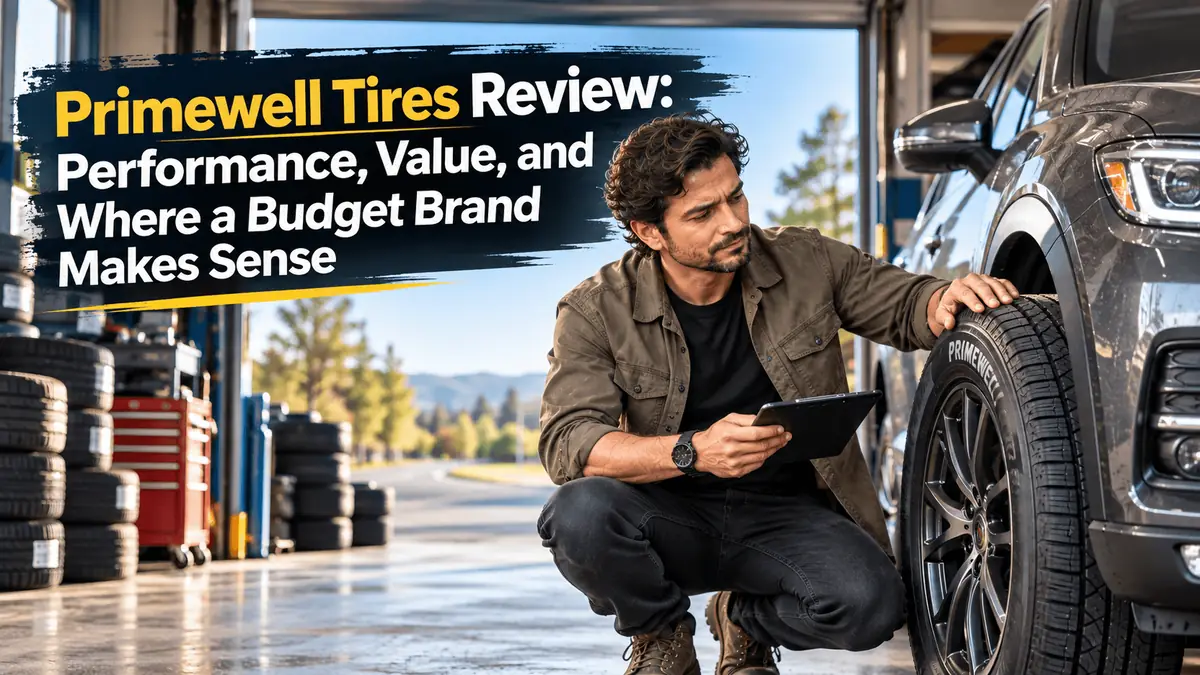
Primewell shows up on a lot of shortlists for one simple reason: the price. A budget-focused shopper cross-shopping a set of all-season or all-terrain tires will regularly find Primewell running well below what Michelin, Bridgestone, or even a mid-tier brand like Cooper charges for a comparable size. The harder question is what that lower price actually costs you in grip, comfort, and tread life — and whether Primewell is a smart trade-off or a tire you’ll regret buying twice as often. This review works through where Primewell tires come from, how the individual models in the lineup actually perform, and which ones make sense depending on your vehicle and budget.
Table of Contents
Who Makes Primewell Tires?
Primewell is a budget tire brand owned by Giti Tire, a Singapore-headquartered manufacturer that ranks among the largest tire producers in the world and builds tires for passenger cars, SUVs, and light trucks across multiple price tiers. That ownership matters more than the Primewell name alone suggests: it puts a large-scale manufacturer’s production capacity and quality-control processes behind a line of tires priced well below the mainstream brands most American drivers recognize.
How this review was put together: We have not road-tested Primewell tires. This review is based on published specifications, warranty terms and retailer listings, with sources listed at the end. Checked on October 22, 2026.
It’s fair to be skeptical of a budget brand manufactured overseas, and plenty of shoppers are the first time they come across Primewell. But manufacturing scale and a lower price tag aren’t automatically a sign of a corner-cutting product — Giti’s broader manufacturing footprint is part of what allows Primewell to compete on cost without disappearing entirely on performance.
The Primewell Lineup, Category by Category
Primewell’s catalog isn’t as deep as what you’d find from a brand like Goodyear or Continental, but it covers the categories that matter to most everyday drivers: touring all-season tires for sedans and crossovers, an ultra-high-performance option for drivers who want sharper handling, all-terrain and highway tires for trucks and SUVs, a dedicated light-truck and van model built for load-carrying duty, and a cold-weather option for drivers who need dedicated winter traction. The lineup leans heavily toward all-season and summer tread designs, which is where Primewell puts most of its engineering attention.
| Category | Model | Best For |
|---|---|---|
| Touring All-Season | PS890 Touring | Sedans and crossovers used for daily commuting |
| Ultra High Performance | PS850 | Drivers who want sharper steering and cornering grip |
| All-Terrain | Valera A/T | Trucks and SUVs that split time between pavement and trail |
| Highway All-Season | Valera H/T | SUVs and trucks used mostly on paved roads |
| Light Truck / Van | PV600 | Vans and light trucks that carry heavier loads |
| Passenger All-Season | Primewell All Season | Passenger cars and minivans |
| Winter | PW588 | Drivers who need dedicated snow and ice traction |
Model Spotlights: Which Primewell Tire Fits Your Vehicle?
Primewell PS890 Touring — The Default All-Season Pick
The PS890 is Primewell’s volume seller, and it’s built to be the tire most drivers never have to think about. Its tread compound and pattern favor confident traction over sportiness, and the design pays particular attention to wet-weather grip — deep grooves and a tread layout that resist hydroplaning give the PS890 shorter wet stopping distances and steadier highway composure than you’d expect from a tire in this price bracket. Dry traction and braking hold up well too, and the tire stays quiet and comfortable enough for daily commuting.
The trade-off shows up in longevity: the PS890 doesn’t carry the same generous treadwear coverage that touring tires from bigger brands typically offer, so drivers who put on heavy annual mileage should expect to replace a set sooner than they would with a longer-rated competitor.
Best for: commuters and family-car drivers who want dependable wet and dry traction at an entry-level price and don’t need a long treadwear warranty to be satisfied.
Primewell PS850 — A Cheaper Way Into Sharper Handling
For drivers who want more responsiveness than the PS890 offers, the PS850 leans into dry-weather performance with sharper steering response and stronger cornering grip. It won’t match a genuine ultra-high-performance tire from Michelin or Continental at the limit, but it delivers a noticeably more engaging drive than a standard touring tire, at a fraction of the cost.
Best for: drivers of sportier sedans and coupes who want a livelier feel without stepping up to premium UHP pricing.
Primewell Valera A/T — Built for Hardpack, Not Rock Crawling
The Valera A/T is Primewell’s all-terrain entry, and it earns its keep on hardpacked gravel and dirt roads rather than technical off-roading. It aims for a balance of dry, wet, and snow traction, with stable cornering for the price. The tread block design incorporates noise-reducing elements, though in practice the Valera A/T still generates noticeable drone at highway speed — a common trait among all-terrain tires generally, and one the tread design softens rather than eliminates.
It’s worth being clear about the limits here: this isn’t a mud-terrain tire, and drivers who need serious traction in deep mud or on rocky trails will find the Valera A/T out of its depth. Expect a heavier, less nimble feel on pavement than a comparable highway tire.
Best for: truck and SUV owners who spend real time on gravel and dirt roads but don’t need mud-terrain or rock-crawling capability.
Primewell Valera H/T — An Affordable Highway Tire for Trucks and SUVs
Where the Valera A/T is built for unpaved surfaces, the Valera H/T stays on pavement and focuses on comfort and value for truck and SUV owners who rarely leave the road. It handles wet weather confidently, rides smoothly over uneven pavement, and delivers dependable everyday traction and braking at a price well below comparable highway tires from bigger brands.
Steering feel is adequate for daily driving rather than sharp — drivers coming from a more performance-oriented tire may notice less feedback through the wheel — and this particular model doesn’t come with a treadwear warranty, which is worth factoring into the total cost of ownership. Highway noise is also noticeable at speed, which is typical for a tire in this segment but still worth setting expectations around before buying.
Best for: SUV and light-truck owners who want an affordable, comfortable highway tire and don’t need off-road capability or a treadwear warranty to feel confident in the purchase.
Primewell PV600 — Load-Focused Duty for Vans and Light Trucks
The PV600 is built around a narrower job than the rest of the lineup: hauling weight reliably. Reinforced construction gives it the support to handle heavier loads without feeling unstable at highway speed, and its resistance to wear helps offset its already modest price. Wet-road traction is solid, and the tire stays composed on the highway even when loaded.
Snow traction is the one category where the PV600 falls short — Primewell doesn’t position this as a cold-weather tire, and drivers in snowbelt regions running a PV600 through winter should plan on swapping to a dedicated winter tire rather than relying on it for ice or heavy snow.
Best for: van and light-truck owners who need dependable load-carrying capability and stay mostly out of serious winter weather.
Primewell All Season — The Passenger-Car Value Option
Aimed at passenger cars and minivans, the Primewell All Season tire uses a symmetric tread pattern built around zig-zag sipes and four circumferential grooves, a combination that channels water away from the contact patch effectively and helps prevent skidding in wet conditions. Larger shoulder blocks support handling and stability, while a variable-pitch tread pattern is tuned to keep road noise down — and in practice, the cabin stays commendably quiet for a tire at this price point.
Steering feedback is muted rather than sharp, which fits the tire’s mission as a comfort-and-value option rather than a driver’s tire, and tread life tracks close to the category average rather than standing out as a strength.
Best for: budget-conscious passenger-car and minivan owners who prioritize a quiet, stable ride over outright responsiveness.
Primewell PW588 — Dedicated Winter Traction
For drivers who need real cold-weather grip rather than an all-season compromise, the PW588 uses a deep tread pattern and a specialized winter compound built to stay pliable in freezing temperatures. That combination gives it meaningfully better traction on snow and ice than any of Primewell’s all-season models, making it the right seasonal swap for drivers in genuinely harsh winter climates.
Best for: snowbelt drivers who want dedicated winter traction without paying flagship winter-tire prices.
How Primewell Tires Perform Day to Day
Across the lineup, Primewell’s strongest and most consistent trait is wet-weather composure. Tread designs on the PS890, Valera A/T, and Primewell All Season all lean on grooves and siping specifically tuned to move water away from the contact patch, which is meant to shorten wet stopping distances and steady highway handling in rain — a genuinely useful trait for a brand competing mostly on price.
Dry grip and braking are solid rather than exceptional on the touring and passenger models, and noticeably sharper on the PS850 for drivers who want more responsiveness. Ride comfort and cabin quiet are a real strength on the passenger-oriented tires, thanks to tread designs specifically tuned to cut down on road noise — though that same noise-reduction engineering has less impact on the Valera A/T and Valera H/T, where the more aggressive tread and larger vehicle weight both work against a quiet cabin. Snow performance is where the lineup splits clearly: the Valera A/T and PW588 are built with winter traction in mind, while the PV600 explicitly isn’t, and drivers should choose a model based on that distinction rather than assuming any Primewell tire handles snow equally well.
Treadwear, Fuel Economy, and Getting the Most from a Set
Treadwear expectations vary widely by tire category across the industry, and Primewell’s lineup follows that same pattern rather than beating it. All-season passenger tires generally fall somewhere between 40,000 and 100,000 miles of expected tread life depending on the specific model and how aggressively it’s built for performance, while summer-oriented tires tend to wear faster — often closer to 20,000 miles — because of softer compounds built for grip rather than longevity. Real-world tread life also depends heavily on driving conditions: a tire run mostly on gravel or rough pavement will wear faster than its rated mileage suggests, regardless of brand.
Fuel economy is a smaller but real factor in total cost of ownership. Lower-rolling-resistance tread compounds can improve fuel efficiency by up to roughly 10% compared with less efficient designs, though that efficiency gain typically comes with some trade-off in outright grip. Keeping tires inflated to the manufacturer-recommended pressure is the simplest way to capture whatever efficiency a given tire is built to offer without sacrificing handling.
One buying tip worth knowing regardless of brand: check the DOT date code on the sidewall before purchasing, especially when shopping discount retailers or older inventory. A four-digit code such as “4015” indicates the tire was manufactured in the 40th week of 2015. Tires are generally considered past their usable life after about ten years regardless of tread depth or mileage, so confirming a recent manufacture date is a simple way to avoid buying old stock.
Maintenance habits matter as much as the tire itself. Primewell recommends rotating tires every 5,000 to 8,000 miles to promote even wear, and routine attention to inflation pressure and wheel alignment goes a long way toward getting a full set’s rated mileage rather than falling short of it. Over-inflation accelerates wear in the center of the tread and stiffens the ride, while under-inflation increases rolling resistance and wears the outer edges prematurely — both are avoidable with a monthly pressure check.
Warranty Coverage and Customer Support
Primewell backs many of its passenger and light-truck tires with a treadwear warranty (70,000 miles on the PS890 Touring’s non-staggered fitments, per SimpleTire) that covers a set number of miles or years, whichever comes first, with pro-rated replacement if a tire wears out before reaching its rated mileage. A separate materials-and-workmanship warranty covers manufacturing defects, and a tire that becomes unserviceable due to a covered defect is replaced free of charge, including mounting and balancing — though, as the model spotlights above make clear, not every Primewell tire carries the same warranty terms, so it’s worth confirming coverage on the specific model before buying.
Primewell maintains customer service channels by phone, email, and online support for warranty claims and general product questions. Filing a claim typically requires proof of purchase, the tire’s DOT code, and a description of the issue, after which the tire may need to go to an authorized dealer or service center for inspection before a replacement is approved.
Pricing and Value
Price is Primewell’s clearest selling point. Compared with premium brands, Primewell tires generally cost considerably less for a comparable size and category, though the gap varies by size, so compare prices for your fitment. That gap is large enough to matter for budget-conscious buyers, particularly those replacing tires on a vehicle they don’t plan to keep for the long haul or who are simply trying to keep transportation costs down.
The trade-off isn’t invisible — treadwear coverage and outright performance ceiling both trail what a premium brand offers — but Primewell doesn’t ask drivers to give up basic safety performance to get there. Wet traction and everyday dry handling remain genuinely competitive for the price, which is the more relevant comparison for anyone actually shopping this tier of the market rather than cross-shopping a flagship Michelin or Bridgestone.
Where to Buy Primewell Tires
Primewell tires are sold directly through the company’s website and carried by major online retailers including Tire Rack, Amazon, and DiscountTire.com, which makes comparing prices and sizes straightforward from home. In-store, national chains such as Pep Boys, NTB, and Discount Tire stock Primewell products, and independent tire shops and dealerships in many regions carry the brand as well. Most retailers offer professional installation — mounting, balancing, and alignment — either at the point of sale or through a separate service appointment, which is worth factoring into the total cost when comparing a Primewell set against a pricier alternative that might already include installation.
Primewell vs. Michelin, Goodyear, Bridgestone, and Other Established Brands
Primewell isn’t trying to out-engineer Michelin, Goodyear, or Bridgestone, and it doesn’t pretend otherwise. In day-to-day traction, handling, and braking, Primewell’s tires hold up reasonably well against those brands for ordinary driving conditions, even though the very top of the performance ceiling — extreme grip limits, the most demanding weather, sustained high-speed stability — still favors the premium names. Where Primewell actually competes is value: it consistently undercuts those brands on price without asking for a dramatic drop in everyday capability.
Against closer competitors like Cooper Tires and General Tire, the gap narrows further. Treadwear and overall durability land in a similar range across all three brands, and the deciding factor for most buyers comes down to specific model availability and price rather than a clear capability gap. Where Primewell falls behind is model variety: brands like Goodyear and Continental offer a deeper bench of specialized options, including a broader range of dedicated winter and off-road tires, than Primewell’s more compact catalog currently covers.
Primewell Tires: Pros and Cons
Pros
- Pricing that consistently runs 30 to 50 percent below premium-brand tires in comparable sizes and categories
- Strong wet-weather traction and hydroplaning resistance across the touring and passenger models
- A lineup broad enough to cover passenger cars, SUVs, light trucks, vans, and dedicated winter driving
- Backed by Giti Tire’s global manufacturing scale and quality-control processes
- Treadwear and materials warranties available on most models, with pro-rated replacement for premature wear
Cons
- Warranty coverage varies by model, and some — like the Valera H/T — carry no treadwear warranty at all
- Highway noise is noticeable on the all-terrain and highway-truck models
- Doesn’t match premium brands at the outright performance ceiling in extreme conditions
- A narrower model range than larger brands, with fewer specialized off-road and winter options
- Brand recognition and long-term reputation trail more established manufacturers
Which Primewell Tire Should You Buy?
- Daily commuters and family sedans: the PS890 Touring for balanced wet and dry performance at an entry-level price.
- Drivers who want sharper handling: the PS850 for more responsive steering and cornering grip without UHP pricing.
- Truck and SUV owners who use gravel or dirt roads regularly: the Valera A/T for hardpack traction and cornering stability.
- SUV and truck owners who stay on pavement: the Valera H/T for an affordable, comfortable highway tire.
- Van and light-truck owners hauling heavier loads: the PV600 for durable, load-focused construction.
- Budget-conscious passenger-car and minivan owners: the Primewell All Season for a quiet, stable ride.
- Snowbelt drivers: the PW588 for dedicated winter traction, or the Valera A/T if truck or SUV all-terrain capability is also needed.
Frequently Asked Questions
For budget-conscious drivers, yes. Primewell tires deliver solid wet and dry traction, a reasonably comfortable ride, and a lineup that covers passenger cars, SUVs, light trucks, and vans — all at a price well below premium competitors.
They’re not a bad option for everyday driving; handling and traction on both wet and dry roads are dependable for the price. Drivers focused on aggressive or high-performance driving are better served by a dedicated performance tire from a brand like Bridgestone or Michelin.
Primewell tires are manufactured by Giti Tire, a Singapore-headquartered company and one of the largest tire manufacturers in the world, producing tires for passenger cars, SUVs, and trucks across several brands and price points.
Tread life depends on the specific model and driving conditions, with all-season passenger tires generally landing in the industry-typical range and summer-oriented tires wearing faster. Regular rotation, correct inflation, and routine alignment checks all help a set reach its expected mileage.
Only some models are. The Valera A/T and the dedicated PW588 winter tire are built with snow and ice traction in mind, while models like the PV600 are not intended for winter use and should be paired with a dedicated winter tire in harsh climates.
A set of four Primewell all-season tires for a mid-size sedan typically runs $300 to $450, compared with $600 to $800 or more for a comparable set from a premium brand — a savings of roughly 30 to 50 percent.
Final Verdict: Are Primewell Tires Worth Buying?
Primewell earns its place as a value-tier option rather than a compromise dressed up as one. For budget-conscious drivers who want a dependable all-season tire, the PS890 Touring is a sensible choice, balancing wet and dry traction with a comfortable ride at a price that undercuts nearly every mainstream competitor. Drivers who want more responsiveness have an affordable path to it in the PS850, truck and SUV owners get genuine gravel-road capability from the Valera A/T, and anyone facing serious winter weather has a dedicated option in the PW588.
The trade-offs are real and worth going in with eyes open: warranty coverage isn’t consistent across the lineup, highway noise shows up on the more rugged models, and the outright performance ceiling still favors premium brands in extreme conditions. But for the driver actually shopping this price tier — someone weighing Primewell against other budget and mid-tier options rather than against a flagship Michelin — the combination of low cost, dependable everyday traction, and a lineup broad enough to cover most vehicle types makes Primewell a reasonable, honest value pick.
Sources
Specs, warranty terms and prices were checked on October 22, 2026. Prices change often.
- Priority Tire: Primewell tires (Giti sub-brand, model list)
- SimpleTire: Primewell PS890 Touring (70,000-mile warranty, made by Giti in Indonesia)
 Summarize this article with:













Leave a comment