


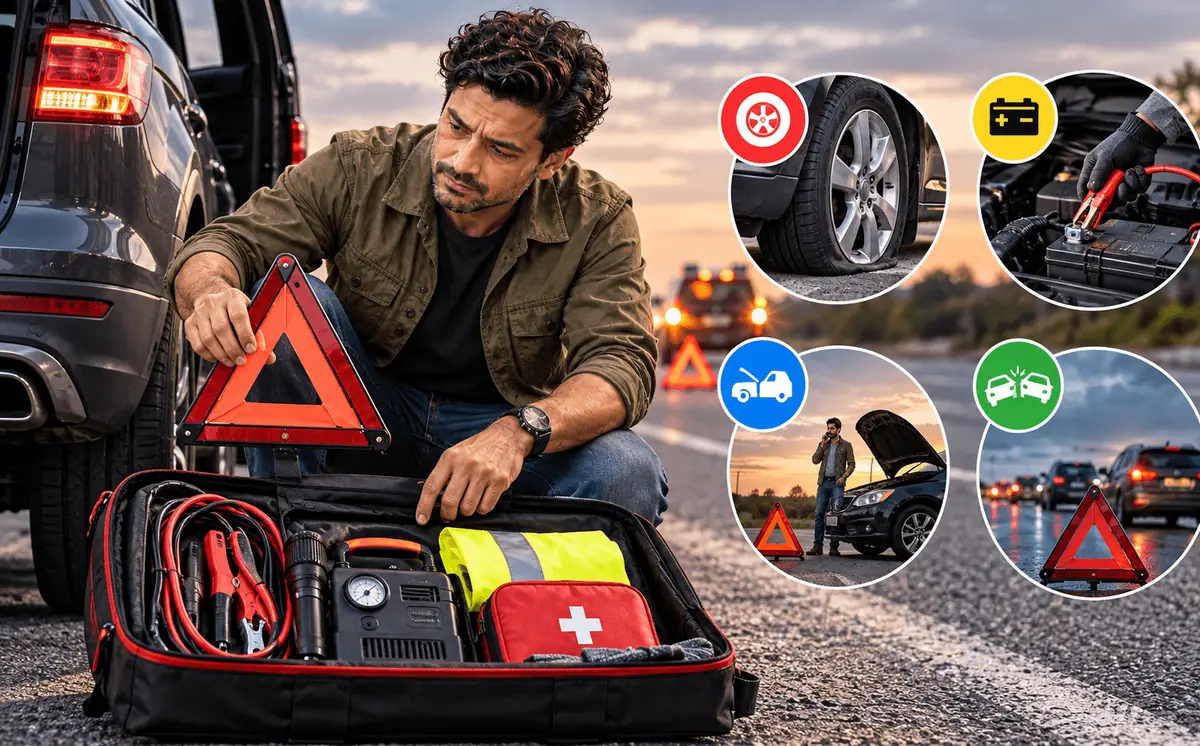
Most road emergencies arrive without warning: a tire goes flat on the highway, the car will not start in a dark parking lot, or a fender bender leaves you shaken on the shoulder. In those moments, the drivers who cope best are not necessarily the most mechanically skilled. They are the ones who prepared a little in advance and know the first few steps to take.
This guide covers the essentials: what to keep in the car, how to stay safe and visible, how to handle the most common problems, and when to stop and call for help. Treat it as a quick-reference plan you can read once and remember when it counts.
Table of Contents
Your First Three Moves in Any Roadside Emergency
- Get to safety. If the car can move, get it as far off the road as possible, ideally onto a wide shoulder, exit, or parking lot on a straight stretch where approaching drivers can see you.
- Make yourself visible. Turn on your hazard lights immediately, set the parking brake, and turn the front wheels away from traffic.
- Decide whether to stay in or get out. On a busy highway, staying inside with your seat belt fastened is often safest while you call for help. If you must get out, exit on the side away from traffic and move well away from the road, never standing directly in front of or behind the car.
Pack a Roadside Emergency Kit
A well-stocked kit turns many emergencies into minor delays.
| Item | Why You Need It |
|---|---|
| First aid kit | Treating minor injuries |
| Reflective triangles or road flares | Warning approaching traffic |
| High-visibility vest | Making you visible outside the car |
| Flashlight with spare batteries | Breakdowns rarely happen in good light |
| Jumper cables or a portable jump starter | Restarting a dead battery |
| Basic tools: pliers, adjustable wrench, screwdrivers, duct tape | Small roadside fixes |
| Inflated spare tire, jack, and lug wrench, or a tire inflator kit | Dealing with a flat |
| Portable tire inflator and pressure gauge | Topping up a low tire |
| Phone charger or power bank | Calling for help |
| Water and non-perishable snacks | Waiting for assistance |
| Blanket, gloves, and warm layers | Staying warm if stranded in cold weather |
| Rain poncho | Working in bad weather |
Add seasonal items as needed: an ice scraper, small shovel, and sand or cat litter in winter, and extra water, sunscreen, and a hat in summer. Our guides to winter car care and preventing breakdowns in summer heat cover seasonal kits in more detail.
Keep Emergency Numbers Handy
Save these in your phone and keep a written copy in the glove box in case your phone dies:
- 911 for injuries, fires, or dangerous situations
- Your roadside assistance provider, whether through your insurer, an auto club, your vehicle manufacturer, or a credit card
- Your insurance company’s claims line
- Local police or highway patrol non-emergency number
- A trusted mechanic and towing service
- A family member or friend who can help or pick you up
Which call comes first? For injuries, fire, a dangerous location, or a crash, call 911 first. For a flat, dead battery, lockout, or a car that simply will not run, call roadside assistance.
How to Handle a Flat Tire
If you feel the car pull to one side or hear a rhythmic thumping, hold the wheel firmly, ease off the gas without braking hard, and drive slowly to a safe spot. Then:
- Turn on your hazards, set the parking brake, and place triangles or flares behind the car.
- Chock the wheel diagonally opposite the flat if you have wheel chocks.
- Get out the spare, jack, and lug wrench.
- Loosen the lug nuts while the tire is still on the ground, turning counterclockwise just enough to break them free.
- Position the jack at the reinforced lift point shown in your owner’s manual and raise the car until the flat is a few inches off the ground. Never put any part of your body under the car.
- Remove the lug nuts and the flat tire.
- Mount the spare and thread the lug nuts on by hand.
- Snug the nuts in a crisscross (star) pattern, lower the car, then tighten them fully in the same pattern.
- Stow the flat and tools, and check the spare’s pressure as soon as you can. Compact spares typically need about 60 PSI.
- Drive gently. Compact spares are usually limited to about 50 mph and a short distance, so get the flat repaired or replaced promptly.
If the spot feels unsafe, the spare is flat, or you cannot loosen the lug nuts, stay in the car and call for help. Our guides to changing a flat tire and changing a car tire walk through the process in detail.
How to Jump-Start a Dead Battery
A dead battery is one of the most common roadside problems, and jump-starting it is simple if you follow the right order.
Before you start: park the working car close to the dead one without letting the vehicles touch, turn both engines off, set both parking brakes, and switch off lights and accessories. Check your owner’s manual, since some vehicles have dedicated remote jump-start terminals under the hood.
Connecting the cables:
- Red clamp to the positive (+) terminal of the dead battery.
- Other red clamp to the positive (+) terminal of the good battery.
- Black clamp to the negative (−) terminal of the good battery.
- Final black clamp to an unpainted metal surface on the dead car’s engine or frame, away from the battery. Making the last connection away from the battery reduces the risk of a spark near hydrogen gas the battery can release.
Starting: start the working car and let it run for a few minutes, then try the dead car. Once it starts, remove the cables in the reverse order, keeping the clamps from touching each other or any metal. Drive for at least 20 to 30 minutes to help recharge the battery, and have it tested soon, because a battery that needed a jump may be near the end of its life.
If the car will not start after a few attempts, or the battery is cracked, leaking, or swollen, stop and call for help. A portable jump starter is a worthwhile addition to your kit, because it does not require a second car. When the battery does need replacing, our guide to replacing a car battery explains how.
What to Do if the Engine Overheats
If the temperature gauge climbs toward red or steam appears from under the hood:
- Turn off the air conditioning and turn the heater on full to draw some heat away from the engine.
- Pull over safely and switch off the engine.
- Never open a hot radiator cap or coolant reservoir. Scalding coolant can spray out under pressure.
- Let the engine cool completely, which can take 30 minutes or more, before checking the coolant level.
- If the problem returns after adding coolant, call for a tow rather than risk serious engine damage.
Handling a Breakdown or Accident
Breakdowns
Get the car to a safe spot, turn on your hazards, and set out triangles or flares if it is safe to do so. Call roadside assistance with your exact location, using a mile marker, exit number, or your phone’s map, and describe the problem. If you cannot move the car out of traffic, stay inside with your seat belt on and call 911 if you are in a dangerous position.
Accidents
- Check for injuries and call 911 if anyone is hurt. Do not move injured people unless they are in immediate danger.
- Move vehicles out of traffic if they are drivable and it is safe and legal to do so; otherwise, turn on your hazards and stay safe.
- Exchange information with other drivers: names, phone numbers, insurance companies and policy numbers, license plate numbers, and vehicle descriptions.
- Document the scene with photos of all vehicles, damage, license plates, road conditions, and the surrounding area. Get contact details from witnesses.
- Stay calm and avoid arguing about fault. Stick to the facts.
- File a police report when required or when there are injuries or significant damage.
- Notify your insurance company promptly and follow its claims process.
Stay Calm and Think Clearly
Stress narrows your thinking, which is exactly what you do not want in an emergency. A few slow, deep breaths, in through the nose and out through the mouth, help steady your heart rate and clear your head. Then prioritize: safety first, visibility second, solving the problem third. Avoid rushed decisions such as darting across traffic or attempting a repair in an unsafe spot. If you feel overwhelmed or unsure, calling for professional help is always the right choice.
Prevent Emergencies Before They Happen
Many roadside problems are avoidable with simple routine checks:
- Fluids: check engine oil, coolant, brake fluid, and washer fluid regularly.
- Tires: check pressure monthly, including the spare, and replace tires with worn tread. Our guide to checking tire tread depth explains how.
- Battery: have it tested before summer and winter, and replace it if it is weak or older than about three to five years.
- Lights and wipers: make sure every light works and replace streaking wiper blades.
- Belts and hoses: watch for cracks, fraying, or soft spots.
- Scheduled maintenance: follow your owner’s manual for oil changes, filters, and inspections.
Plan Ahead for Bad Weather
- Rain: make sure wipers and tire tread are in good shape, slow down, and leave extra following distance. Never drive into flooded roads; our guide to driving in a flood explains why.
- Snow and ice: use winter tires or carry chains where needed, and pack a shovel, ice scraper, sand or cat litter, blankets, and warm clothing.
- Extreme heat: carry extra water, sun protection, and keep an eye on the temperature gauge.
- Before long trips: check the forecast and road conditions, and postpone or reroute if severe weather is expected. Let someone know your route and expected arrival time.
Build Your Skills
A basic car maintenance class, offered by many community colleges, technical schools, and some auto shops, is a great way to learn hands-on skills such as changing a tire, checking fluids, and understanding warning lights. Even practicing a tire change once in your driveway makes a roadside version far less stressful. Our DIY car maintenance guide is another good place to start.
Road Emergency Quick Reference
| Situation | First Steps | When to Call for Help |
|---|---|---|
| Flat tire | Slow down, pull over safely, hazards on, triangles out | Unsafe location, no usable spare, or stuck lug nuts |
| Dead battery | Turn off accessories, connect jumper cables in the correct order | Car will not start after a few tries, or battery is damaged |
| Overheating | A/C off, heat on, pull over, engine off, let it cool | Overheating returns, or coolant is leaking heavily |
| Breakdown | Get off the road, hazards on, stay belted in if traffic is close | Almost always: call roadside assistance |
| Accident | Check for injuries, call 911 if needed, move out of traffic if safe, document | Any injuries, significant damage, or disputes |
| Stuck in snow | Clear around the tires, use sand or cat litter, rock gently | Car remains stuck or conditions worsen |
Frequently Asked Questions
At minimum: a first aid kit, reflective triangles or flares, a flashlight, jumper cables or a jump starter, basic tools, a usable spare or tire inflator, a phone charger, water, snacks, and a blanket. Add seasonal items for winter and summer.
On a busy road, staying inside with your seat belt fastened is often safest while you call for help. If you must leave the car, exit away from traffic and move well off the road.
Red to the dead battery’s positive terminal, red to the good battery’s positive terminal, black to the good battery’s negative terminal, and the last black clamp to unpainted metal on the dead car away from the battery. Remove them in the reverse order.
Call 911 if anyone is hurt or the scene is dangerous. Then document the scene, exchange information, and notify your insurance company.
Keep up with routine maintenance, check tire pressure and fluids regularly, test your battery before temperature extremes, and keep a well-stocked emergency kit in the car.
The Bottom Line
You cannot predict when a road emergency will happen, but you can decide how prepared you will be. Keep a stocked kit and your key phone numbers in the car, learn the basics of changing a tire and jump-starting a battery, and remember the first three moves: get to safety, make yourself visible, and decide whether to stay in or get out. With that foundation, most roadside problems become an inconvenience rather than a crisis.
 Summarize this article with:













Leave a comment