


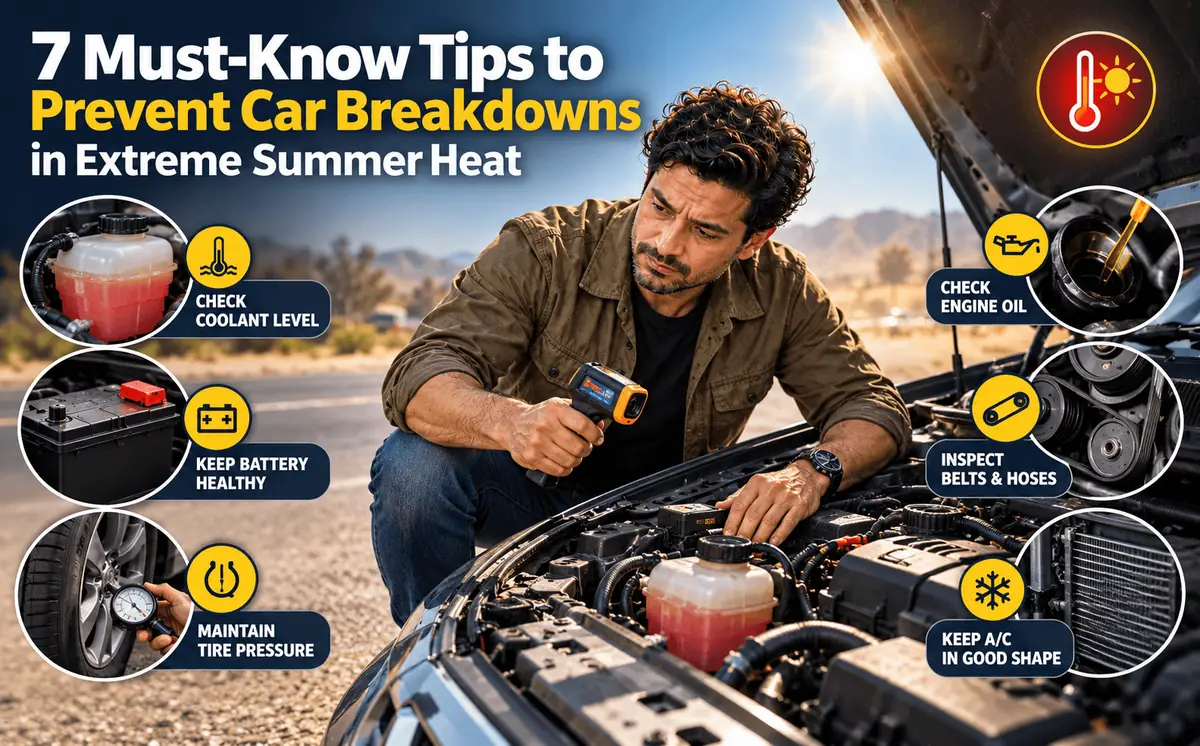
Heat rarely breaks a healthy car on its own. What it does, with remarkable efficiency, is find the weak spot you already had: the coolant that was overdue for a change, the tire running a few pounds low, the battery that limped through spring. A 100-degree afternoon turns those small, ignorable problems into a tow truck and a repair bill.
That makes summer breakdowns unusually preventable. On a hot, sunny day, the temperature inside a parked car can reach 140°F (60°C) or more, and under the hood things get far hotter. Fluids thin, rubber expands and softens, and electrical components work harder than at any other time of year. The seven tips below target the systems that suffer most, in roughly the order they tend to fail, and each one comes down to a check you can do yourself or a quick visit to a shop.
Table of Contents
Tip 1: Keep the Cooling System Ahead of the Heat
Your engine produces an enormous amount of heat, and the cooling system’s whole job is to carry it away before it does damage. When that system falls behind, the consequences escalate fast: a warped cylinder head, a blown head gasket, or in the worst case a seized engine. None of those are cheap, and all of them are far more likely in July than in October.
How the System Works
Coolant, a mix of antifreeze and water, circulates through passages in the engine block and cylinder head, absorbing heat as it goes. The water pump keeps it moving, the thermostat decides when it flows to the radiator, and the radiator releases that heat into the air. At low speeds and idle, when there is not enough natural airflow, the cooling fan pulls air through the radiator to keep the cycle going. A problem with any one of those parts compromises the whole loop.
Check the Coolant Level and Condition
With the engine cold, the coolant in the reservoir should sit between the minimum and maximum marks. A level that keeps dropping means coolant is going somewhere, usually through a leak, and that needs tracking down before a long trip.
Look at the coolant itself, too. Fresh coolant is clean and bright. If it looks rusty or sludgy, or has debris floating in it, it has lost its anti-corrosion properties and much of its ability to transfer heat. That calls for a flush and refill.
Use the Right Mixture
Antifreeze is not only a winter fluid. It also raises the boiling point of the coolant, which is exactly what you need in summer. Pure water boils at 212°F (100°C) at sea level, while a 50/50 mix of antifreeze and water, under the pressure of a sealed cooling system, can stay liquid well above 265°F (129°C). Coolant that boils turns to steam, and steam is far worse at moving heat away from the engine. Always use the coolant type specified in your owner’s manual; different formulations are not interchangeable.
Inspect the Radiator, Hoses, and Belts
Look over the radiator for corrosion, physical damage, or wet spots, particularly where the plastic tanks meet the core. Bent fins restrict airflow and reduce cooling capacity.
Then work through the hoses: the upper and lower radiator hoses and the heater hoses. Squeeze each one gently. A healthy hose feels firm but pliable. Cracks, swelling, or a mushy, overly soft feel all mean the rubber is breaking down. Any drips or discolored crust around the hose clamps deserve attention right away, because a hose that bursts on a hot day can dump the coolant in minutes.
Drive belts deserve a look while you are there. On some engines, a belt drives the water pump, and on older designs it drives the cooling fan as well. Check for cracks, fraying, or a shiny, glazed surface, and make sure the belt is properly tensioned. A slipping belt slows the pump and fan just when you need them most. If your car has electric cooling fans, confirm they switch on as the engine warms up, especially with the A/C running, and listen for grinding or vibration that could point to a failing fan motor.
Watch the Temperature Gauge
The temperature gauge is your early-warning system. Get in the habit of glancing at it, especially in traffic, on long climbs, or on very hot days. If the needle starts to creep toward the red, that is the cooling system telling you it is losing the battle. Pull over somewhere safe, shut the engine off, and let it cool completely before you check anything.
Never open a hot radiator cap or coolant reservoir. The system is pressurized, and scalding coolant can erupt and cause severe burns.
Tip 2: Treat Tire Pressure as a Summer Safety Check
Tires take a beating in the heat. Hot pavement, higher speeds on road trips, and heavier loads all add stress, and the most common way tires fail in summer starts with pressure.
How Heat Changes Your Tire Pressure
Tire pressure rises by roughly 1 PSI for every 10°F increase in temperature. That sounds minor, but the effects show up in both directions:
- Overinflated tires shrink the contact patch, reducing grip, wearing the center of the tread faster, and making the ride harsher.
- Underinflated tires flex more as they roll, and that flexing generates heat. On hot asphalt, the combination of extra internal heat and high ambient temperature is what sets the stage for a blowout. Underinflation also hurts handling and fuel economy.
Cold Pressure Is the Only Accurate Reading
Always set your tire pressure when the tires are cold, which means the car has been parked for at least three hours or driven less than a mile at moderate speed. Use the pressure listed on the sticker inside the driver’s door jamb or in the owner’s manual. The number molded into the sidewall is the tire’s maximum pressure, not the recommended one.
Pressure will rise as you drive, and that is normal. Do not let air out of hot tires to bring them back to the door-placard figure; you will end up underinflated once they cool. Instead, check them cold regularly through the summer and adjust as needed.
Know the Blowout Risk
A blowout is a sudden, violent loss of air that can pull the car sharply to one side. Physical damage from a sharp object or pothole can trigger one, but heat greatly amplifies the stress on a tire that is already weakened or running low. Your best defense is correct pressure, plus a regular look at each tire for cuts, sidewall bulges, or embedded objects.
Don’t Forget Tread Depth and Rotation
Tread does more than evacuate water from summer storms; the tread pattern also helps the tire shed heat. Worn tread manages heat buildup less effectively and performs worse in every condition. The penny test is a quick check: insert a penny headfirst into the deepest groove, and if you can see the top of Lincoln’s head, the tread is too shallow. Our full guide to checking tire tread depth explains more accurate methods.
Regular rotations keep wear even across all four tires. That matters in summer because heat-related pressure swings and uneven loads can accelerate wear on certain positions. Evenly worn tires keep their grip and heat-handling ability longer.
Tip 3: Test the Battery Before the Heat Does
Most drivers think of battery failure as a cold-morning problem, but heat is arguably the more damaging enemy. High temperatures speed up the chemical reactions inside a battery, which wears out its internal components faster, increases internal resistance, and evaporates the water in the electrolyte. The damage builds quietly over the summer, and very often the battery finally gives out on the first cold morning of fall. Either way, a battery that seemed fine in May can leave you stranded in August with little warning.
Clean the Terminals and Tighten the Connections
Look at the battery terminals for white or bluish powdery buildup. That corrosion acts as an insulator and can stop the battery from delivering full power. Clean it off with a wire brush and a mixture of baking soda and water, then make sure the cable clamps are tight. A loose connection can cause intermittent electrical faults or a no-start, and heat tends to make marginal connections worse.
Top Up Conventional Batteries Carefully
Some batteries, mostly in older vehicles, have removable caps that give access to the electrolyte. If yours does, check the level more often in hot weather. Top up with distilled water only, just enough to cover the plates. Overfilling causes electrolyte to spill out as the battery heats up, leading to corrosion. Sealed, maintenance-free batteries do not need this check.
Get a Professional Battery Test
The single most useful battery step is a load test before peak summer. Most auto parts stores and service centers can check voltage, cold-cranking amps, and overall health in a few minutes, often at no charge. If the battery is near the end of its life, replacing it on your schedule is far better than replacing it in a parking lot.
Tip 4: Keep the A/C Working for You, Not Against You
Air conditioning is easy to dismiss as a comfort feature, but in extreme heat it is also a safety system. Heat dulls concentration and slows reaction times, so a cool cabin helps you stay sharp behind the wheel. The A/C also dehumidifies the air, which helps keep windows from fogging during summer storms.
Watch for Weak Cooling
The refrigerant is what makes cold air possible. If the system is low, usually because of a slow leak, it cannot cool properly and has to work harder, which strains the compressor and other components. Most modern A/C systems are sealed and do not need routine top-ups, so a noticeable drop in cooling performance is a reason to have the system checked for leaks rather than simply recharged. If the problem turns out to be more serious, our breakdown of car AC repair costs shows what different fixes typically run.
Reduce the Load on the Engine
The A/C compressor draws power from the engine. When the system is running inefficiently, the compressor cycles more often and works harder, adding drag. Keeping the condenser clean helps a lot. It sits at the front of the car, usually ahead of the radiator, and bugs, leaves, and road debris can cake its fins. A clean condenser sheds heat more easily, which helps both the A/C and the engine’s cooling system.
Replace the Cabin Air Filter
The cabin air filter, sometimes called a pollen filter, traps dust and debris before it reaches the vents. When it clogs, airflow drops, the A/C feels weaker, and the blower motor works harder. Replacing it about once a year, or more often in dusty areas, is one of the cheapest ways to improve A/C performance and cabin air quality.
Tip 5: Check the Fluids That Heat Breaks Down
Coolant gets most of the attention, but several other fluids are just as vulnerable to heat, and each one protects something expensive.
| Fluid | What It Does | How Heat Affects It | What to Do |
|---|---|---|---|
| Engine oil | Lubricates, cools, and cleans the engine | Thins out, weakening the protective film between metal parts | Keep it at the correct level, use the viscosity your manufacturer specifies, and stay on schedule with oil changes |
| Transmission fluid | Lubricates and cools gears; acts as hydraulic fluid in automatics | Breaks down and loses lubricating ability, raising wear and transmission temperature | Check level and condition if your car has a dipstick; follow the service schedule |
| Brake fluid | Transmits pedal force to the brakes | Absorbs moisture over time, lowering its boiling point; boiling fluid creates vapor bubbles that make braking weak | Replace it on the manufacturer’s schedule |
| Washer fluid | Keeps the windshield clear | Not heat-sensitive, but bugs, dust, and glare make it essential in summer | Keep the reservoir full and the wiper blades in good condition |
Brake fluid deserves special mention. Because it is hygroscopic, meaning it absorbs moisture from the air, old brake fluid can boil under heavy braking on a hot day, for example on a long mountain descent. The resulting vapor in the lines causes a soft, sinking pedal and a sharp loss of stopping power. Fresh fluid is cheap insurance against one of the most frightening failures a driver can experience.
Tip 6: Drive Smarter When the Pavement Is Hot
Maintenance prepares the car; driving habits decide how hard it has to work.
- Time your trips. On the hottest days, drive in the early morning or evening where you can. Your cooling system, tires, and battery all have an easier time when the air is cooler, and so do you.
- Go easy on the throttle. Hard acceleration, heavy braking, and sustained high speeds all generate extra heat in the engine and transmission. Smooth inputs and moderate speeds keep everything further from its limits.
- Downshift on long climbs. On a steep grade, a lower gear lets the engine spin a little faster under less load, which typically keeps it cooler than lugging it in a high gear.
- Keep scanning the dash. The temperature gauge and warning lights are how the car tells you something is wrong while there is still time to act.
- Plan road trips around the heat. Get the car checked before you leave, map out shaded rest stops, keep an eye on the forecast along your route, and adjust departure times if a heat wave is coming.
- Look after yourself. Carry plenty of water for everyone in the car, since dehydration causes fatigue, dizziness, and poor judgment. Good sunglasses cut glare from low sun and reflective pavement, which makes hazards easier to spot.
Tip 7: Be Ready for the Breakdown You Didn’t Prevent
Even well-maintained cars break down. In extreme heat, waiting at the roadside is uncomfortable at best and dangerous at worst, so preparation matters more than usual.
Build a Hot-Weather Emergency Kit
- Plenty of bottled water and some non-perishable snacks
- A first aid kit
- Sun protection: sunscreen, SPF lip balm, and a hat
- Basic tools: wrenches, screwdrivers, pliers, duct tape, and zip ties
- A flashlight with spare batteries
- Jumper cables
- Reflective triangles or flares
- A phone charger or power bank
- A tire patch kit and a portable air compressor
- A blanket for shade or comfort while you wait
- Spare washer fluid
Check the Spare Before You Need It
A flat spare is no spare at all. Before any long trip, and a few times through the summer, check the spare’s pressure and look for cracks or bulges. Make sure the jack and lug wrench are in the car, and if you have never changed a tire, practice once in your driveway. Our step-by-step guide to changing a flat tire covers the whole process. Doing it for the first time on the shoulder of a 100-degree highway is a miserable way to learn.
Know What to Do if the Engine Overheats
If the temperature gauge spikes into the red, act quickly:
- Pull over somewhere safe and well away from traffic.
- Turn off the engine to stop it from generating more heat.
- Open the hood to help heat escape, once it is safe to touch the release.
- Leave the radiator cap alone. Wait for the engine to cool completely, which can take 30 minutes to an hour or longer, before checking the coolant level or adding fluid.
- If the coolant is low and you can add it safely once the engine is cool, do so. If the problem returns, have the car towed rather than risk serious engine damage.
Have Roadside Assistance Lined Up
A roadside assistance plan, whether through an auto club such as AAA, your insurer, or your vehicle manufacturer, can cover jump-starts, tire changes, fuel delivery, and towing. That support is especially valuable if you travel alone or drive through remote areas in summer.
Summer Pre-Trip Checklist
| System | Quick Check | Warning Signs |
|---|---|---|
| Cooling | Coolant level and color, hoses, belts, fan operation | Low or rusty coolant, soft or cracked hoses, gauge creeping toward red |
| Tires | Cold pressure, tread depth, sidewalls, spare | Low pressure, bulges, cuts, uneven wear |
| Battery | Terminals, connections, professional load test | Corrosion, slow cranking, age near end of life |
| A/C | Cooling performance, condenser, cabin filter | Weak cold air, clogged filter, debris in condenser fins |
| Fluids | Oil, transmission, brake, washer | Low levels, dark or burnt-smelling fluid, overdue service |
| Emergency gear | Kit, spare, jack, roadside plan | Missing tools, flat spare, no way to call for help |
Frequently Asked Questions
Focus on the systems heat attacks first. Check the coolant level and condition, inspect hoses and belts, set tire pressure cold to the door-placard figure, and have the battery load-tested. Then make sure the A/C is cooling properly, the other fluids are in good shape, and you have an emergency kit in the car.
A well-maintained car usually handles hot-weather road trips without trouble. Heat mostly exposes problems that were already there, so a thorough pre-trip check of the cooling system, fluids, tires, and battery dramatically improves your odds.
High temperatures accelerate the chemical reactions inside the battery, which wears out its internal components faster and evaporates the water in the electrolyte. The damage builds up over the summer, which is why a battery that seemed fine can fail suddenly, sometimes not until the first cold snap of fall.
No. Pressure naturally rises as tires warm up. If you bleed air from hot tires, they will be underinflated once they cool. Set pressure when the tires are cold and leave the normal warm-up increase alone.
Pull over safely, turn off the engine, and let it cool completely before touching anything. Never open the radiator cap on a hot engine. Once it has cooled, check the coolant level, and have the car towed if the overheating comes back.
Coolant comes first, followed by engine oil, transmission fluid, and brake fluid. Heat thins oil, breaks down transmission fluid, and can boil old brake fluid during heavy braking. Keep washer fluid topped up too, because summer bugs and glare make a clean windshield essential.
Yes. A proper antifreeze-and-water mix, typically 50/50, both raises the boiling point for summer and lowers the freezing point for winter. Use the coolant type your owner’s manual specifies.
On a hot, sunny day the inside of a parked car can reach 140°F or more, and it gets far hotter under the hood.
The Bottom Line
Summer breakdowns follow a predictable pattern. Coolant, tires, and batteries account for most of them, and nearly all of those failures give some warning to anyone who looks. An hour spent on the checks above before the first heat wave, plus a habit of watching the temperature gauge and checking tire pressure cold, removes most of the risk.
The rest comes down to preparation. Keep water and a basic kit in the car, make sure the spare is ready, and know what to do if the gauge climbs. Do that, and a scorching summer becomes just another season for your car rather than the one that finally breaks it. When the weather turns, our winter car care guide covers the cold-weather side of the same job.
 Summarize this article with:













Leave a comment