


If your car was built in the last few decades, it almost certainly rolls on radial tires. They are the global standard for safety, efficiency, and everyday performance. So why do bias-ply tires still exist?
Because for a surprising number of drivers, the choice is far from settled. If you tow a boat, restore classic cars, crawl rocks in a dedicated trail rig, or race at the drag strip, radial vs bias-ply is a practical decision with real consequences. Pick the wrong construction for those jobs and you can end up with poor handling, overheated tires, or a vehicle that simply does not do what you built it to do.
How this guide was put together: This guide explains general tire construction; tread life ranges are typical figures, not test results. Checked on October 22, 2026.
To understand why, you have to look beneath the tread at how each tire is put together.
Table of Contents
Inside the Tire: Two Ways to Build a Carcass
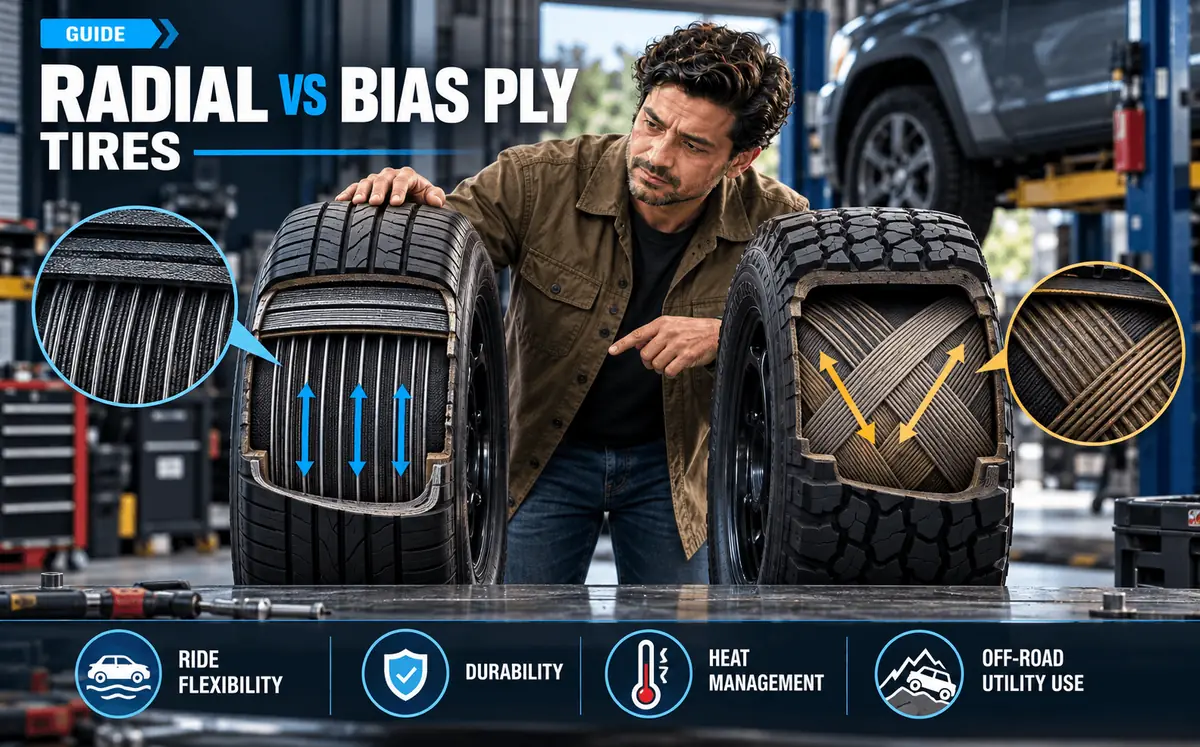
A tire is not just a rubber balloon. It is a composite structure of fabric cords, the plies, coated in rubber and often topped with steel belts. “Radial” and “bias-ply” describe how those body plies are arranged inside the casing.
Bias-Ply Construction
Bias-ply technology dates back to the early days of the automobile. Its internal cords, typically nylon, polyester, or rayon, run diagonally from bead to bead, crisscrossing in an X pattern, usually at angles of 30 to 45 degrees.
Because the plies overlap, the sidewall and tread are mechanically linked into one continuous unit. When the sidewall flexes, the tread flexes with it. Think of a bias-ply tire as a heavy hiking boot: stiff, thick, and moving as one piece.
Radial Construction
Michelin introduced the radial tire in 1946, and it transformed the industry. In a radial, the body cords do not cross. They run straight across the tire from bead to bead at 90 degrees to the direction of travel. Layers of steel belts sit beneath the tread and over the radial casing to give the tread its stability.
The result is a two-part system: a flexible sidewall and a rigid, stable tread. Picture a tank track. The sidewalls act like suspension, absorbing bumps, while the tread stays flat and planted on the ground.
Radial vs Bias-Ply at a Glance
| Factor | Radial | Bias-Ply |
|---|---|---|
| Ply arrangement | Cords at 90 degrees, steel belts under tread | Cords crisscrossed at 30–45 degrees |
| Ride quality | Smooth and compliant | Firm, transmits road imperfections |
| Heat buildup | Runs cooler | Builds heat quickly |
| Sustained highway speed | Excellent | Poor for long high-speed runs |
| Typical tread life | About 40,000–80,000 miles | About 12,000–20,000 miles |
| Cornering grip | Superior, flat footprint | Weaker, tread lifts as sidewall flexes |
| Fuel economy | Better, lower rolling resistance | Worse |
| Sidewall toughness | More vulnerable | Very strong and puncture-resistant |
| Cost | Higher | Lower |
Why Bias-Ply Tires Survive
If radials are better in most respects, why have bias-ply tires not disappeared? Toughness and cost.
Where Bias-Ply Tires Excel
- Sidewall strength: the crisscross plies run through the entire sidewall, giving bias-ply tires much thicker, stronger sidewalls than radials. They resist punctures from rocks, curbs, and agricultural hazards.
- Static load stability: in some slow, heavy-load roles, such as equipment that barely moves, the stiff sidewall resists bulging and swaying.
- Price: simpler construction and fewer materials make them cheaper to buy.
Where Bias-Ply Tires Fall Short
- Heat: this is the big one. As the tire rolls, the crisscrossing plies rub against each other and generate internal friction, which produces heat, and heat destroys tires. That makes bias-ply tires a poor choice for sustained high-speed highway driving.
- Flat-spotting: park a bias-ply tire overnight and it cools with a flat spot where it met the ground. The car may thump and vibrate for the first few miles until the tires warm up and round out.
- Wandering: without steel belts stabilizing the tread, bias-ply tires tend to follow ruts and grooves in the road, so steering needs constant small corrections.
Why Radials Took Over
Radials won because they solved the heat problem and the handling problem at the same time.
Radial Strengths
- Cooler running: because the cords do not cross and rub, radials run much cooler, allowing sustained driving at 75 mph and beyond without the heat-related blowout risk of bias-ply tires.
- A flat footprint: the sidewall flexes independently of the belted tread, so the contact patch stays flat on the road even in corners, for considerably better grip.
- Lower rolling resistance: radials roll more easily, which improves fuel economy.
- Comfort: the flexible sidewall acts like a secondary spring, soaking up small bumps and cracks before they reach the suspension.
Radial Weaknesses
- Vulnerable sidewalls: flexibility requires thinner sidewalls, so a radial is more likely to suffer a sidewall cut on a sharp rock off-road.
- Cost: radials are more complex to design and manufacture.
Head-to-Head on What Drivers Notice
Ride Quality: Radial
There is no contest. Bias-ply tires transmit road imperfections straight into the chassis; radials absorb them. Switching a classic car from bias-ply to radials often makes it feel like a far more modern vehicle.
Tread Life: Radial
As a bias-ply tire rolls, it squirms and distorts, scrubbing rubber against the pavement. Bias-ply tires typically last around 12,000 to 20,000 miles, while a modern radial commonly lasts 40,000 to 80,000 miles.
Load Carrying on Trailers: It Depends
This is the most common debate among RV owners and boaters. Bias-ply trailer tires work well for short trips, farm use, and heavy loads at slow speeds, where the stiff sidewall helps reduce sway. For highway travel, radials are the clear choice. Towing a camper across the country on bias-ply tires risks overheating and blowouts on long, hot highway days.
Handling and Cornering: Radial
When a bias-ply tire corners, the flexing sidewall pulls part of the tread off the road, and traction falls. When a radial corners, the sidewall flexes but the steel belts hold the tread flat.
Where the Choice Gets Interesting
If you are buying tires for a family sedan, buy radials. For these four groups, the answer takes more thought.
Classic Car Restorers
For a vintage muscle car headed to a judged concours show, originality matters. To score top points, the car must look exactly as it did in the showroom, and radials look wrong on many classics: the sidewall bulges differently and the tread pattern is too modern. Purists choose bias-ply.
If you actually plan to drive the car rather than trailer it, radials are the safer choice. By modern standards, bias-ply tires wander, brake poorly, and flat-spot.
There is a middle path. Specialty manufacturers such as Coker Tire build radial tires molded to look like vintage bias-ply tires, combining period appearance with radial safety and ride. Our vintage tire guide covers the options.
Off-Roaders and Rock Crawlers
For overlanding, driving long highway distances to reach a trail, running the trail, and driving home, radials are the better tool. For dedicated, extreme rock crawling, bias-ply tires such as the well-known Super Swamper line remain popular. When aired down to around 8 PSI for maximum grip, a radial sidewall can bulge excessively and become vulnerable, while a stiff bias-ply sidewall supports itself even at very low pressure and wraps around rocks without puncturing. Our guide to the best rock-crawling tires explores both camps.
Drag Racers
At the strip, bias-ply slicks are a staple. They are designed to wrinkle: at launch, the sidewall twists and buckles, storing energy like a spring and cushioning the shock to the drivetrain. That lets a high-horsepower car hook up and launch hard without breaking parts. A stiffer tire is more likely to simply spin.
Trailer Owners
For a utility trailer doing dump runs and mulch hauls, bias-ply is fine. It is cheaper and tolerates curbs and rough use. For a travel trailer or boat trailer that spends time on the highway, choose radials. Heat is the leading cause of trailer tire blowouts, and radials run cooler and track straighter, which helps reduce sway.
How to Tell Which Tire You Have
The size code on the sidewall tells you.
- Radial: look for an R in the size, as in ST205/75R15. The R stands for radial.
- Bias-ply: look for a D (diagonal), a B (belted bias), or a dash, as in ST205/75D15 or 7.00-15. No R means bias construction.
There is also a visual clue. Radials usually show a slight bulge where the tire meets the road, even at correct pressure, while bias-ply tires stand tall and straight with almost no bulge. That same stiffness means a bias-ply tire can look fine when it is dangerously low on air, so always use a pressure gauge.
Never Mix Radial and Bias-Ply Tires
This is the most important rule in this article. Do not mix radial and bias-ply tires on the same vehicle.
The two constructions have very different slip angles, meaning how much the tire twists before it loses grip. Put radials in the rear and bias-ply up front, and the rear grips while the front wanders. Reverse it, with bias-ply in the rear and radials up front, and the rear can swing out in a turn, causing oversteer and possibly a spin.
Trailers are a partial exception. You can technically run radials on the tow vehicle and bias-ply tires on the trailer, but never mix constructions on the same axle, and matching the technology is strongly recommended for better sway control.
Frequently Asked Questions
Generally no. Air retention depends on the inner liner, not ply construction. Bias-ply sidewalls are stiffer, though, so they may not look flat even when pressure is dangerously low.
Vintage bias-ply tires typically had high aspect ratios, such as 80 or 90 series, making them tall and narrow, which suited snow and mud. Modern radials are wider to maximize the contact patch on pavement.
No. Tubes are designed for a specific type of sidewall flex, and a mismatch can cause friction between tube and carcass, leading to failure. Match the tube to the tire construction.
A transitional design from the late 1960s and early 1970s that combined a bias-ply body with fiberglass belts under the tread. It improved on standard bias-ply but fell short of radials, and today it is mostly used in period-correct muscle car restorations.
The most common culprit is bias-ply tires driven faster than their speed rating while under-inflated. Bias-ply tires build heat quickly, and heavy loads, high speeds, and hot days can push internal temperatures past their limits. Switching to radials for highway towing usually solves the problem. Our tire speed rating guide explains the limits.
For nearly all road driving, yes. Bias-ply tires still make sense for show-only classics, extreme rock crawling, drag racing, and slow, heavy farm or utility work.
Because they grip and steer differently. Radials in the rear with bias-ply up front make the front wander, and the reverse can let the rear swing out in a turn and cause a spin, so never mix them on the same vehicle.
The Verdict
Which is better depends entirely on the job.
Choose radial tires if: you drive on the highway; you value comfort and quiet; you want tires that last well beyond 20,000 miles; you tow a camper, boat, or livestock trailer over long distances; or you want the best possible fuel economy.
Choose bias-ply tires if: you are restoring a classic purely for show; you are building an extreme rock crawler that rarely sees pavement; you drag race and need a tire that wrinkles at launch; you run a farm or utility trailer that stays under about 40 mph while carrying heavy loads over rough ground; or you need the lowest possible price for a utility trailer.
For the vast majority of drivers, the radial tire is simply the better engineering: safer, longer-lasting, more efficient, and more comfortable. For the enthusiasts preserving automotive history or pushing the limits of traction, the bias-ply tire remains a legitimate tool.
Sources
Specs, warranty terms and prices were checked on October 22, 2026. Prices change often.
- NHTSA: Tires (tire construction, ratings and safety)
 Summarize this article with:















Leave a comment