
Tire Size Decoder: What Does My Tire Size Mean?
Type the size printed on your tire’s sidewall, such as 245/65R17 107T, to see what every part means: the width, sidewall height and wheel size, how much weight the tire carries in pounds, and how fast it’s rated to go.
Works with passenger, LT, trailer, van and flotation sizes. You can also enter just a load index (107) or speed letter (T).
Your door placard has the final say. The sticker on the driver’s door jamb lists the size, load index and speed rating your vehicle maker specifies. Use this decoder to read a tire, and the placard to check that a tire suits your vehicle.
Is a replacement tire OK for my vehicle?
Enter the size from your door placard or current tires, then the tire you’re thinking of buying. We’ll check the size, load index, speed rating and tire type.
What the numbers and letters in a tire size mean
Every tire size follows the same order. Take 245/65R17 107T, one of the most common SUV and pickup sizes in the US:
Tire type: P, LT, ST or no letter
A P means a P-metric passenger tire; no letter means a Euro-metric passenger tire, which does the same job. LT marks a light truck tire with a tougher casing, ST a trailer-only tire, and T a temporary spare.
Width, aspect ratio and rim: 245/65R17
245 is the width in millimeters. 65 is the aspect ratio: the sidewall is 65% as tall as the tire is wide, or about 159 mm. R means radial construction, and 17 is the wheel diameter in inches. Our tire size calculator compares these dimensions between two sizes.
Load index and speed rating: 107T
Together these are called the service description. 107 is a code for the most weight one tire can carry, 2,149 lb, at its maximum load pressure. T is the speed rating, up to 118 mph. Your replacement tires should meet or exceed both numbers on your door placard.
Extra markings: XL, load range, M+S
XL means extra load. LT tires add a load range letter such as E, and many tires add M+S or the three-peak mountain snowflake for winter use. Our guide to sidewall markings covers the rest, and tire size explained walks through a full sidewall.
Tire speed ratings
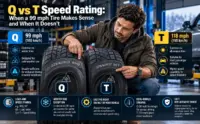
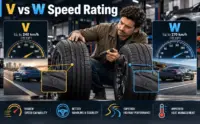
The speed rating is the highest speed a tire can sustain in a standardized lab test, at full pressure and not overloaded. Most cars use T (118 mph), H (130 mph) or V (149 mph) tires. Pickups often run R or S, and winter and mud-terrain tires are commonly Q or S. It’s a measure of a tire’s heat resistance and construction, not a safe speed for the road.
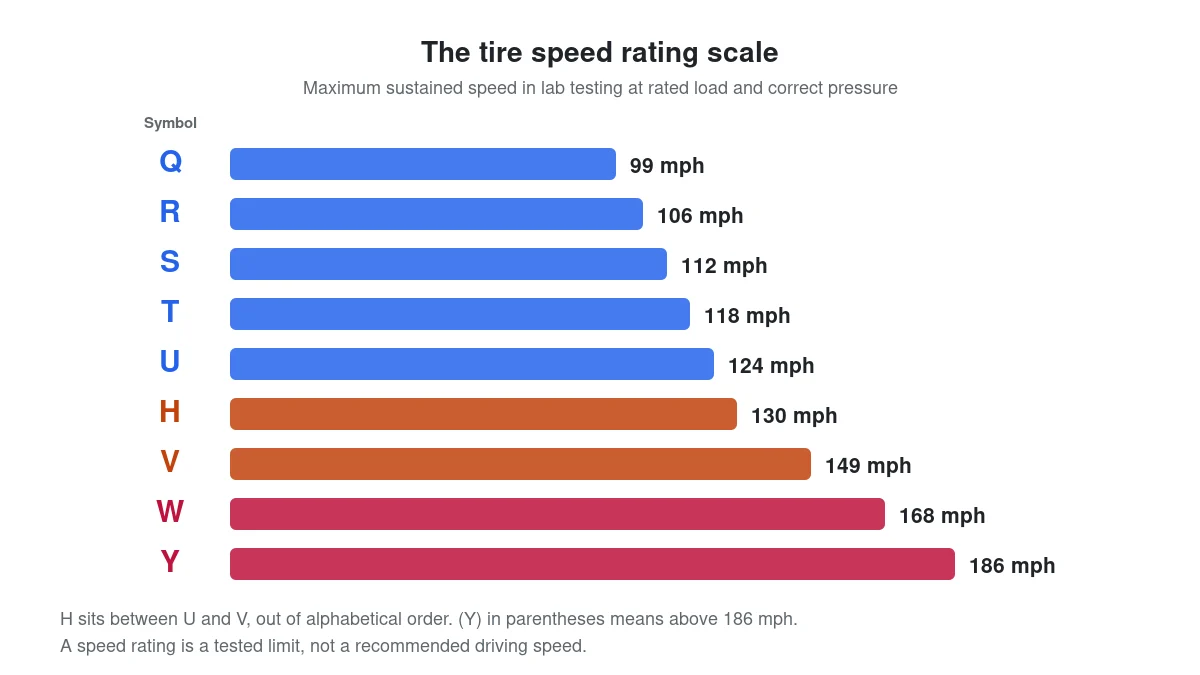
Every symbol from B to (Y), with typical uses, is in our tire speed rating chart.
Load range, XL and ply rating
Passenger tires come in standard load (SL) and extra load (XL). An XL tire carries more weight, but only when inflated to its higher maximum load pressure. Light truck and trailer tires use load range letters instead: each step up is a stronger casing that carries more weight at a higher pressure, from C at 50 psi to E at 80 psi. The ply rating is an old measure of strength, kept as a label; modern tires don’t have that many actual plies.
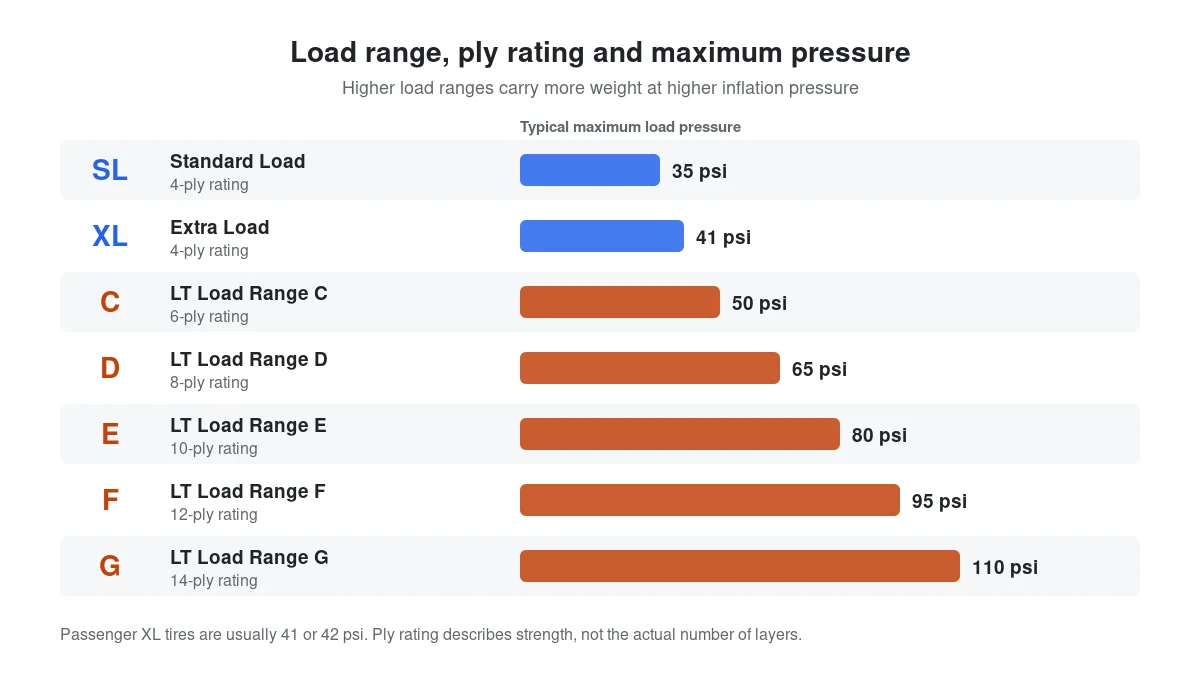
More detail in our tire load range chart and ply rating explainer.
Tire load index chart
The maximum load each tire can carry at its maximum load pressure, from load index 60 to 150. Pounds are converted from the standard kilogram values. Smaller indexes, down to 19, are used on very small tires.
| Load index | Max load (lb) | kg |
|---|---|---|
| 60 | 551 | 250 |
| 61 | 567 | 257 |
| 62 | 584 | 265 |
| 63 | 600 | 272 |
| 64 | 617 | 280 |
| 65 | 639 | 290 |
| 66 | 661 | 300 |
| 67 | 677 | 307 |
| 68 | 694 | 315 |
| 69 | 716 | 325 |
| 70 | 739 | 335 |
| 71 | 761 | 345 |
| 72 | 783 | 355 |
| 73 | 805 | 365 |
| 74 | 827 | 375 |
| 75 | 853 | 387 |
| 76 | 882 | 400 |
| 77 | 908 | 412 |
| 78 | 937 | 425 |
| 79 | 963 | 437 |
| 80 | 992 | 450 |
| 81 | 1,019 | 462 |
| 82 | 1,047 | 475 |
| 83 | 1,074 | 487 |
| 84 | 1,102 | 500 |
| 85 | 1,135 | 515 |
| 86 | 1,168 | 530 |
| 87 | 1,202 | 545 |
| 88 | 1,235 | 560 |
| 89 | 1,279 | 580 |
| Load index | Max load (lb) | kg |
|---|---|---|
| 90 | 1,323 | 600 |
| 91 | 1,356 | 615 |
| 92 | 1,389 | 630 |
| 93 | 1,433 | 650 |
| 94 | 1,477 | 670 |
| 95 | 1,521 | 690 |
| 96 | 1,565 | 710 |
| 97 | 1,609 | 730 |
| 98 | 1,653 | 750 |
| 99 | 1,709 | 775 |
| 100 | 1,764 | 800 |
| 101 | 1,819 | 825 |
| 102 | 1,874 | 850 |
| 103 | 1,929 | 875 |
| 104 | 1,984 | 900 |
| 105 | 2,039 | 925 |
| 106 | 2,094 | 950 |
| 107 | 2,149 | 975 |
| 108 | 2,205 | 1,000 |
| 109 | 2,271 | 1,030 |
| 110 | 2,337 | 1,060 |
| 111 | 2,403 | 1,090 |
| 112 | 2,469 | 1,120 |
| 113 | 2,535 | 1,150 |
| 114 | 2,601 | 1,180 |
| 115 | 2,679 | 1,215 |
| 116 | 2,756 | 1,250 |
| 117 | 2,833 | 1,285 |
| 118 | 2,910 | 1,320 |
| 119 | 2,998 | 1,360 |
| Load index | Max load (lb) | kg |
|---|---|---|
| 120 | 3,086 | 1,400 |
| 121 | 3,197 | 1,450 |
| 122 | 3,307 | 1,500 |
| 123 | 3,417 | 1,550 |
| 124 | 3,527 | 1,600 |
| 125 | 3,638 | 1,650 |
| 126 | 3,748 | 1,700 |
| 127 | 3,858 | 1,750 |
| 128 | 3,968 | 1,800 |
| 129 | 4,079 | 1,850 |
| 130 | 4,189 | 1,900 |
| 131 | 4,299 | 1,950 |
| 132 | 4,409 | 2,000 |
| 133 | 4,541 | 2,060 |
| 134 | 4,674 | 2,120 |
| 135 | 4,806 | 2,180 |
| 136 | 4,938 | 2,240 |
| 137 | 5,071 | 2,300 |
| 138 | 5,203 | 2,360 |
| 139 | 5,357 | 2,430 |
| 140 | 5,512 | 2,500 |
| 141 | 5,677 | 2,575 |
| 142 | 5,842 | 2,650 |
| 143 | 6,008 | 2,725 |
| 144 | 6,173 | 2,800 |
| 145 | 6,393 | 2,900 |
| 146 | 6,614 | 3,000 |
| 147 | 6,779 | 3,075 |
| 148 | 6,944 | 3,150 |
| 149 | 7,165 | 3,250 |
| 150 | 7,385 | 3,350 |
For a full set, multiply by four. For LT tires, the maximum load molded on the sidewall is the figure to follow.
Tire size FAQs
What does 245/65R17 107T mean on a tire?
It’s a tire 245 mm wide with a sidewall 65% as tall as that width (about 159 mm), radial (R) construction, made for 17-inch wheels. 107 is the load index, meaning up to 2,149 lb per tire, and T is the speed rating, meaning up to 118 mph.
Can I use a tire with a higher load index?
Yes. A higher load index than your door placard calls for is fine, as long as the size and tire type suit your vehicle. A lower load index isn’t: the replacement should meet or exceed the original.
Can I use a lower speed rating than my original tires?
Tire and vehicle makers generally advise matching or exceeding the original speed rating. Some vehicle makers allow lower-rated winter tires; check your owner’s manual, and remember the lower rating becomes the top speed for that set.
What’s the difference between P-metric, Euro-metric and LT tires?
P-metric (P prefix) and Euro-metric (no prefix) are both passenger tires, built to slightly different standards. LT tires are built for pickups, vans and SUVs that tow or haul, with stronger casings, higher pressures and a load range letter. Don’t switch between them without checking load and pressure with a tire professional.
What does XL mean on a tire?
XL means extra load. An XL tire can carry more than a standard-load tire of the same size, but only when inflated to its higher maximum load pressure, about 41 to 42 psi instead of 35 to 36 psi.
Why do LT tires have two load numbers?
The first number is the load each tire can carry when fitted on its own; the second, lower number applies when tires are mounted in pairs on a dual-wheel axle. For example, 121/118 means 3,197 lb single and 2,910 lb dual.
What does ZR mean in a tire size?
The Z marks a tire built for speeds above 149 mph (240 km/h). The speed letter after the load index, such as W or Y, gives the exact rating.
Related guides and tools
- Tire size explainedA full walkthrough of the sidewall
- Tire size calculatorCompare two sizes and speedometer error
- Tire speed rating chartEvery speed symbol and its typical use
- Tire load range chartSL, XL and load ranges C to G
- Sidewall max vs. recommended pressureWhich pressure to actually use
- Tire age checkerRead the DOT date code on the same sidewall
- Cold-weather tire pressure calculatorPressure and TPMS warnings for SL, XL and LT tires
- All tire toolsCost per mile, rebates and more
Sources
- Continental: Load index
- Tire Rack: Load range and load pressures
- Yokohama: Sizing information
- Tire Rack: Dual tire fitments on light trucks
Checked November 2026. Dimensions are nominal, calculated from the size; real tires vary by model, rim width and pressure.