


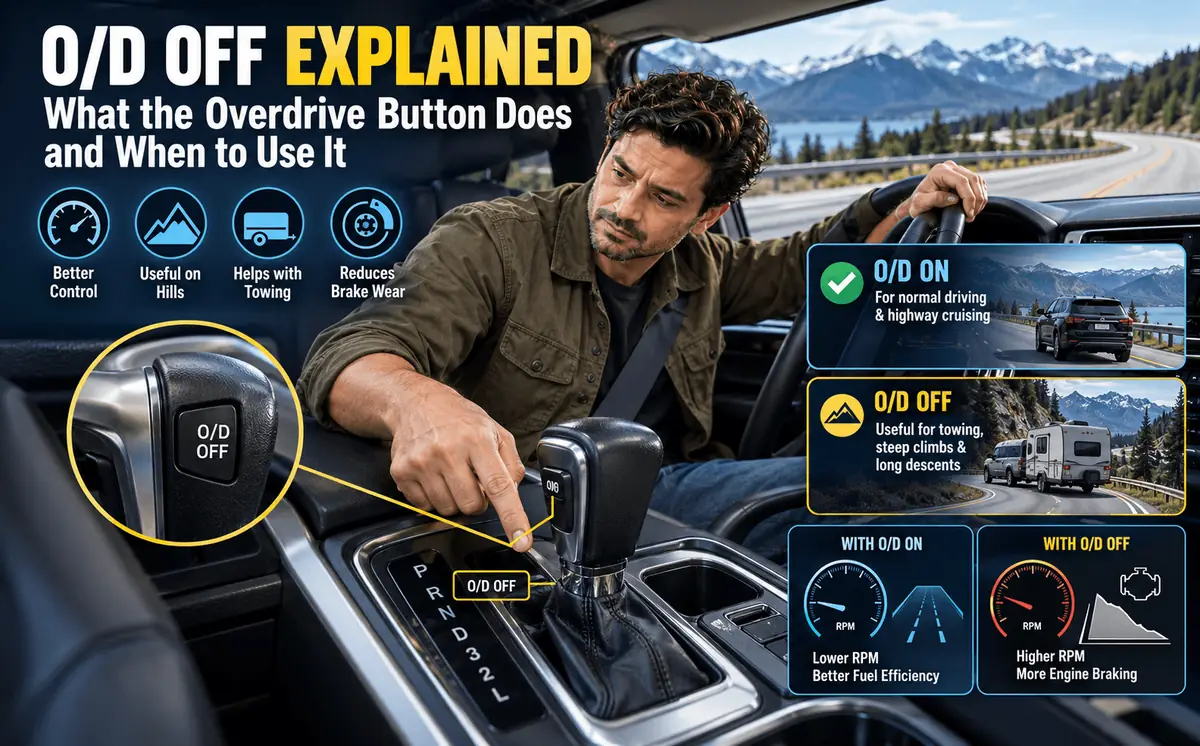
You pressed a small button on the shifter, an amber “O/D OFF” light appeared on the dash, and now the engine sounds busier on the highway. Or maybe that light started blinking on its own and you are wondering whether the transmission is about to fail. Either way, the overdrive button is one of the least understood controls in an automatic-transmission vehicle, and using it wrong can cost fuel, add heat and wear, or hide a problem that needs attention.
The short version: O/D Off tells the transmission not to shift into its top, fuel-saving gear. That is useful in a handful of specific situations, such as towing, long climbs and steep descents, and counterproductive almost everywhere else. This guide explains how overdrive works, when switching it off helps, when it hurts, how the control works on common brands, and what the dashboard light is telling you.
Table of Contents
What Overdrive Actually Is
Every transmission gear has a ratio that compares engine speed with the speed of the transmission’s output shaft. In the lower gears, the engine turns several times for each turn of the output shaft, which multiplies torque for accelerating and climbing. In a direct-drive gear, the two spin at the same speed (a 1:1 ratio).
Overdrive is any gear with a ratio below 1:1, meaning the output shaft spins faster than the engine. At highway speed, that lets the engine loaf along at lower rpm. Lower rpm means less fuel burned, less engine noise and less wear during long, steady cruising. On a classic four-speed automatic, fourth gear is the overdrive gear. Many modern six-, eight- and ten-speed transmissions have two or more overdrive ratios at the top of the range.
The trade-off is torque. A tall overdrive gear delivers little pulling force at the wheels, so the engine has very little in reserve for climbing a grade or accelerating with a heavy load. When it runs out of reserve, the transmission downshifts, and when the load eases, it shifts back up.
What “O/D Off” Changes
Pressing O/D Off locks out the overdrive range. The transmission still shifts automatically through every other gear, but it will not upshift into overdrive. On a four-speed, that means it tops out in third. On transmissions with more gears, the exact behavior varies: some lock out only the highest gear, while others hold back more than one.
The result is higher engine rpm at any given cruising speed, more torque available immediately, and stronger engine braking when you lift off the accelerator. Nothing about this harms a healthy vehicle in the short term. It simply puts the engine and transmission in a range that suits hard work rather than economical cruising.
| Setting | What the transmission does | Engine rpm at highway speed | Best suited to |
|---|---|---|---|
| O/D On (normal Drive) | Uses all forward gears, including overdrive | Lower | Everyday driving, highway cruising, best fuel economy |
| O/D Off | Uses all gears except the overdrive range | Higher | Towing, long climbs, steep descents, preventing gear hunting |
Reading the Dashboard Light
The indicator logic is the reverse of what many drivers expect. On most vehicles, no light means overdrive is working normally. An “O/D OFF” light that stays on simply confirms you have switched overdrive off. Press the button again and the light goes out.
A flashing O/D Off light is different. On many Toyota, Lexus, Ford and other vehicles, a blinking O/D Off light is how the transmission computer reports a fault it has detected, such as a sensor or solenoid problem or an overheating condition. Some transmissions go into a protective “limp” mode at the same time, holding a single gear so you can get the vehicle to safety.
If the O/D Off light flashes without you touching the button, do not ignore it. Drive gently, avoid towing or heavy loads, and have the transmission scanned for trouble codes as soon as possible. Many shops and parts stores can read the codes quickly.
Honda models that use a D3 button or a D3 shifter position show the change differently: the D indicator goes out and a D3 indicator lights up. If the light behavior on your vehicle does not match any of these descriptions, the owner’s manual will explain it.
When Turning Overdrive Off Makes Sense
Towing or Hauling Heavy Loads
This is the classic reason the button exists. With a trailer behind you, the transmission often cannot hold overdrive on anything but flat ground, so it shifts down, then back up, then down again. That repeated “gear hunting” generates heat in the transmission fluid, and heat is the leading enemy of automatic transmissions.
Locking out overdrive keeps the transmission in a gear where the engine has enough torque to pull the load steadily. Shifts drop away, the torque converter can stay locked more consistently on many designs, and fluid temperatures tend to stay lower. Many owner’s manuals specifically recommend turning overdrive off when towing, and some recommend it whenever the transmission begins cycling between gears. If you tow often, a transmission fluid cooler and more frequent fluid service are worth discussing with your dealer or mechanic.
Long Climbs in Hilly or Mountain Country
The same hunting happens on long grades even without a trailer, especially in smaller-engined vehicles or with a full load of passengers and luggage. Switching overdrive off before a sustained climb keeps the engine in a stronger part of its powerband and saves the transmission from cycling every time the grade steepens.
Steep Descents
Going downhill, a lower gear lets engine compression slow the vehicle. That engine braking reduces how often you need the brake pedal, which keeps the brakes cooler and helps prevent brake fade on long mountain descents. Turning off overdrive is a simple way to get that effect, and on very steep grades you may want an even lower gear position (such as 2 or L, or a manual-shift mode) as the owner’s manual recommends.
Passing and Merging
Some drivers turn overdrive off briefly before a pass on a two-lane road so the engine is already in a responsive gear. It works, though in most vehicles pressing the accelerator firmly produces a kickdown that does the same thing. Remember to switch overdrive back on afterward.
Slow, Hilly Stop-and-Go Driving
In heavy traffic at low speeds, the transmission rarely reaches overdrive anyway, so O/D Off changes little. Where it can help is on rolling roads at moderate speeds, where the transmission keeps shifting in and out of top gear. Holding the lower gear smooths things out.
Off-Pavement Driving
On dirt roads and trails, avoiding unexpected upshifts keeps throttle response consistent. For serious off-roading, though, a four-wheel-drive vehicle’s low range and lower gear positions are the right tools; O/D Off is a mild adjustment by comparison.
What O/D Off Does Not Do
It Does Not Improve Fuel Economy
Fuel economy is the main thing overdrive exists to protect. Turning it off raises engine rpm, and higher rpm at a given speed burns more fuel. That holds true in city traffic and on the highway. The one indirect exception is towing or climbing, where preventing constant gear hunting may make a heavily loaded vehicle run more efficiently than it would while cycling, but in normal driving, leaving overdrive on always gives the better mileage.
It Is Not a Traction Aid on Ice or Snow
Holding a lower gear does not make the vehicle more stable on slippery roads. A lower gear sends more torque to the wheels, which can make it easier to spin them when pulling away. On ice, strong engine braking from a sudden downshift can also break the drive wheels loose. On slick surfaces, smooth inputs and good tires matter far more than the overdrive setting. Some vehicles have a dedicated snow or winter mode that starts in a higher gear to reduce wheelspin, and that is the better choice where it exists. Our winter driving guide covers tire choice and technique in more detail.
It Is Not a Daily Driving Mode
Running with overdrive off all the time means higher rpm, more noise, more fuel and more cumulative engine wear for no benefit. Vehicle manufacturers intend O/D Off for temporary, situational use.
| Situation | Overdrive setting | Why |
|---|---|---|
| Highway cruising, light load | On | Lowest rpm and best fuel economy |
| Towing a trailer | Usually off, per owner’s manual | Prevents gear hunting and excess fluid heat |
| Long uphill grade | Off | Keeps torque available and stops repeated shifting |
| Long or steep downhill | Off, or a lower gear | Engine braking saves the brakes |
| Snow or ice | On, or snow mode if equipped | Lower gears add torque and can increase wheelspin |
| City traffic | On | Transmission rarely uses overdrive at low speed anyway |
| O/D Off light flashing | Have it diagnosed | Usually signals a transmission fault code |
Potential Downsides of Overusing O/D Off
- Higher fuel consumption: The penalty grows the longer you cruise at highway speed with overdrive locked out.
- More noise and engine wear: Sustained high rpm means more vibration and noise in the cabin and more revolutions on engine components over time.
- Missed warning signs: If you leave the button pressed and forget about it, a steady O/D Off light becomes background noise, and you may not notice when it starts flashing to report a real fault.
- Higher emissions: More fuel burned means more emissions, a small but real cost of leaving overdrive off unnecessarily.
How to Turn Overdrive Off on Common Vehicles
The control varies by manufacturer, model and year, so always confirm the procedure in your owner’s manual. These are the most common setups:
- Toyota and Lexus: With the shifter in D, press the O/D button on the side of the shift lever. The “O/D OFF” light illuminates. Press again to restore overdrive; the light goes out.
- Ford: Press the transmission control switch, usually on the end or side of the shift lever. The “O/D OFF” light comes on in the cluster. Press again to return to normal Drive.
- Nissan: Press the “O/D OFF” button on the shift lever. The indicator lights while overdrive is off.
- Chrysler, Dodge and Jeep: Older models often have an “O/D Off” button on the shifter or dash. Many later models replaced it with a Tow/Haul button or a gear-limiting feature on the shifter.
- GM (Chevrolet, GMC, Buick): Many GM automatics have no O/D button. Instead, the shifter has a D or circled-D position for overdrive and a separate 3 or lower position that limits the top gear. Trucks often add a Tow/Haul mode.
- Honda and Acura: Older models use a D3 button on the shifter or a D3 position in the gate. The D3 indicator lights when the top gear is locked out.
Newer Vehicles and Tow/Haul Mode
Many current vehicles no longer have an O/D button at all. Their transmissions have more gears and smarter shift logic, and they offer other ways to achieve the same goal: a Tow/Haul mode that delays upshifts and adds engine braking, a manual or sport-shift mode with paddles or a +/- gate, or a gear-limit function that caps the highest gear. If your vehicle has Tow/Haul, use it for towing instead of hunting for an overdrive switch.
Frequently Asked Questions
A steady “O/D OFF” light means the overdrive gear (or gears) has been locked out, usually because someone pressed the overdrive button. The transmission is working normally, just without its top gear. Press the button again to turn overdrive back on and the light should go out.
It will not damage a healthy transmission quickly, but it wastes fuel, makes the engine work harder at highway speed and adds unnecessary wear and noise. Use it for towing, long climbs and descents, then switch back to normal Drive.
On many vehicles, including Toyota, Lexus and Ford models, a flashing O/D Off light means the transmission control module has detected a problem and stored a trouble code. Have the codes read promptly and avoid towing or hard driving until the cause is known.
No. Overdrive exists to lower engine rpm and save fuel, so turning it off increases fuel consumption in normal driving, both in town and on the highway.
Generally no. A lower gear sends more torque to the wheels, which can make wheelspin more likely when pulling away on slippery roads. If your vehicle has a snow or winter mode, use that, and rely on good winter or all-weather tires for real traction.
Yes. On vehicles with an O/D button, it is meant to be used on the move. The transmission downshifts out of overdrive smoothly when you press it, and upshifts again when you turn overdrive back on.
No. Many vehicles use a Tow/Haul mode, a manual-shift mode or a lower shifter position instead. These give the same control over top gear and are often better suited to towing.
Know When to Press It and When to Leave It Alone
O/D Off is a work-mode switch. When you are towing, climbing a long grade or descending a steep one, locking out overdrive keeps the transmission from hunting between gears, holds torque in reserve and lets engine braking save your brakes. Those are meaningful benefits for transmission temperature and driver control.
Outside those situations, leave overdrive on. It gives the best fuel economy, the quietest cruising and the least engine wear, and it does nothing to help on snow or ice. Above all, learn the difference between a steady O/D Off light (you switched it off) and a flashing one (the transmission is reporting a fault). The first is routine. The second deserves a diagnostic scan before it turns into an expensive repair.
 Summarize this article with:












Leave a comment