


Few bills create as much dread as a surprise car repair. Parts prices and shop labor rates have climbed steadily, and a single repair can wipe out a month’s budget. The instinct is to put off maintenance and hope for the best, but that usually makes things more expensive: a neglected $50 job becomes a $1,500 repair a year later.
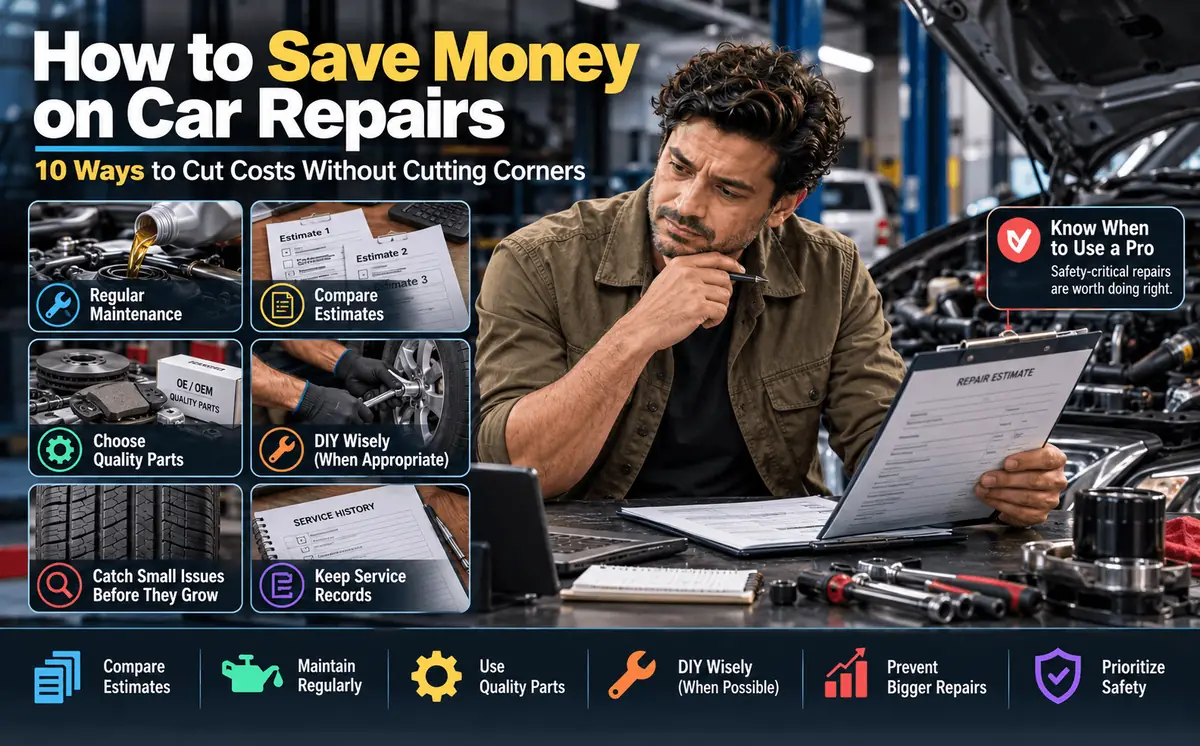
Saving money on car repairs is really about control: preventing problems before they happen, handling the simple jobs yourself, choosing the right shop, and making informed decisions when a repair is needed. The ten strategies below can cut what you spend without compromising safety or quality.
How this guide was put together: This guide summarizes common maintenance intervals and consumer guidance; your owner’s manual is the controlling schedule. Checked on October 22, 2026.
Table of Contents
1. Stay Ahead With Preventive Maintenance
The cheapest repair is the one you never need. Following the maintenance schedule in your owner’s manual catches small problems early and keeps major systems from wearing out prematurely.
| Service | Typical Interval | What It Prevents |
|---|---|---|
| Oil and filter change | Per owner’s manual; many modern cars call for 5,000–10,000 miles with synthetic oil | Engine wear and sludge |
| Tire rotation | Every 5,000–8,000 miles | Premature tire replacement |
| Engine air filter | Commonly 12,000–30,000 miles, depending on conditions | Reduced performance and fuel economy |
| Coolant service | Commonly 30,000–60,000 miles or per manual | Overheating and corrosion |
| Transmission fluid | Per manual, often 30,000–60,000 miles for many automatics | Costly transmission damage |
| Brake inspection | At least once a year | Rotor and caliper damage from worn pads |
| Timing belt (if equipped) | Per manual, often 60,000–100,000 miles | Catastrophic engine damage on many engines |
Replacing wear items such as brake pads, belts, and hoses before they fail costs far less than dealing with the damage they cause when they do. A brake pad replaced on time is an inexpensive job; one that wears down to metal can ruin the rotors and calipers too. Our guide to making your car last longer covers a complete maintenance routine.
2. Do the Simple Jobs Yourself
Many routine tasks require only basic tools and a little patience, and doing them yourself eliminates labor charges:
- Engine and cabin air filters: often a five- to ten-minute job with no tools
- Wiper blades: a two-minute swap
- Battery replacement: manageable on most cars; our guide to replacing a car battery walks through the safe procedure
- Headlight restoration: an inexpensive kit can clear cloudy lenses and save the cost of new headlight assemblies
- Bulb replacement: usually simple on many vehicles
- Oil changes: a bigger commitment, but they can save money each time if you have ramps or jack stands and a way to recycle used oil
- Spark plugs: manageable on many engines with a spark plug socket, though access varies widely
Only take on jobs you can do safely and correctly. Watch a model-specific tutorial first, use proper equipment, and dispose of used fluids responsibly. Our DIY car maintenance guide for beginners explains which jobs are worth doing yourself and which are not.
3. Find a Mechanic You Can Trust
A reliable, honest mechanic is one of the best money-saving assets a car owner can have. A good shop diagnoses problems correctly the first time and recommends only what you need.
- Ask friends, family, and coworkers for shops they have used for years.
- Read recent online reviews, paying attention to patterns and how the shop responds to complaints.
- Look for ASE-certified technicians, who have passed industry certification exams.
- Consider a specialist for your make, especially for European or less common brands.
- Visit the shop. A clean, organized workspace and staff who explain things clearly are good signs.
Independent shops often charge less than dealerships for routine maintenance and out-of-warranty repairs. Dealers can make sense for warranty work, recalls, and complex brand-specific problems.
4. Get More Than One Estimate
For any significant repair, get written estimates from two or three shops before approving the work.
A good estimate should spell out:
- The diagnosis
- The recommended repair
- Parts, with prices, and whether they are OEM, aftermarket, or used
- Labor hours and the hourly rate
- Fees and taxes
- The total, and any warranty on parts and labor
Compare estimates line by line, so you are comparing the same work. Labor rates in particular can vary widely between shops. In many states, shops must provide a written estimate and get your authorization before doing work, and you have the right to approve or decline each repair.
5. Choose Parts Wisely
Parts are a large share of most repair bills, and you often have options:
| Part Type | What It Is | Pros | Cons |
|---|---|---|---|
| OEM | Made by or for the vehicle manufacturer | Exact fit and known quality | Usually the most expensive |
| Aftermarket | Made by other manufacturers | Often much cheaper; many are excellent | Quality varies by brand |
| Remanufactured | Used parts rebuilt to specification | Cheaper than new; often come with warranties | Quality depends on the rebuilder |
| Used or salvage | Parts pulled from other vehicles | Lowest cost, good for body panels and some components | Unknown history; limited or no warranty |
Choose reputable brands, read reviews, and ask about warranties, especially on critical components such as alternators, starters, and water pumps. For safety-critical parts such as brakes, steering, and suspension, quality matters more than the lowest price.
6. Avoid Unnecessary Repairs and Upsells
Not every recommendation is urgent, and some are not needed at all.
- Ask the shop to explain why a repair is needed and what happens if you wait.
- Ask to see the old parts or photos of the problem.
- Check recommendations against your owner’s manual. Some shops push services, such as frequent fluid flushes, well before the manufacturer calls for them.
- Never approve work you do not understand, and do not authorize open-ended repairs. Approve a specific job at a specific price.
7. Get a Second Opinion on Big Repairs
If a shop recommends an expensive repair and you are unsure, take the car elsewhere for a second diagnosis. Paying a modest diagnostic fee at another shop can save hundreds or thousands if the first diagnosis was wrong or inflated. A second opinion also tells you whether the work is truly urgent or can safely wait.
8. Prioritize What Matters Most
When money is tight, rank repairs by urgency:
- Safety-critical: brakes, steering, tires, suspension, and anything affecting control of the car
- Damage-preventing: fluid leaks, overheating, oil changes, and warning lights that could lead to major damage if ignored
- Drivability: problems that affect performance or fuel economy
- Cosmetic: dents, scratches, and worn interior trim, which can usually wait
A flashing check engine light, a brake warning light, or an oil pressure warning should never be ignored. Ask your mechanic to help you sort what needs doing now and what can be scheduled later.
9. Ask About Labor Rates and Discounts
Labor is often the largest part of a repair bill, and there can be room to save.
- Ask about discounts for first-time customers, seniors, students, or members of certain organizations, and look for shop coupons.
- Bundle work where it makes sense. If two repairs share labor, such as replacing a water pump while the timing belt is already off, doing them together can save significant labor time.
- Ask your regular shop whether they can match a competitor’s written estimate. A polite request, backed by a real quote, sometimes works.
- Be fair. Shops have real overhead, and a respectful conversation goes further than hard bargaining.
10. Pay Smart
Some shops offer a small discount for cash payments, because they avoid card processing fees. Others offer financing for large repairs. Compare your options:
- A cash discount can be worthwhile. On a $1,000 repair, an 8% cash discount saves $80, which beats the $20 you would earn from a 2% cash-back credit card.
- A credit card offers purchase protection and the ability to dispute charges if work is done poorly, and rewards can be valuable when there is no cash discount. Pay the balance in full to avoid interest that would erase any savings.
- Shop financing can spread out a large bill, but read the terms carefully; deferred-interest offers can become expensive if not paid off on time.
Whatever you choose, keep every invoice. Records help with warranty claims and resale value.
Quick Money-Saving Checklist
| Strategy | Effort | Potential Savings |
|---|---|---|
| Follow the maintenance schedule | Low | Prevents the most expensive failures |
| DIY simple jobs | Low to moderate | Saves labor on routine tasks |
| Find a trusted independent shop | Moderate, once | Lower rates and honest advice |
| Get two or three estimates | Moderate | Avoids overpaying on big repairs |
| Choose parts wisely | Low | Lower parts costs without sacrificing safety |
| Question upsells | Low | Avoids unnecessary work |
| Get a second opinion | Moderate | Catches wrong or inflated diagnoses |
| Prioritize repairs | Low | Keeps you safe while managing cash flow |
| Ask about discounts and bundled labor | Low | Trims labor costs |
| Pay smart | Low | Small savings and better protection |
Frequently Asked Questions
Preventive maintenance. Following your owner’s manual schedule and fixing small problems early prevents most of the expensive failures that drive repair bills up.
Often, yes, especially for routine maintenance and out-of-warranty repairs. Dealerships make sense for warranty work, recalls, and some complex brand-specific issues.
Many aftermarket parts from reputable brands are excellent and much cheaper than OEM parts. Choose well-reviewed brands with good warranties, and be especially careful with safety-critical parts.
Ask why it is needed, request to see the worn part or photos, compare the recommendation with your owner’s manual, and get a second opinion for expensive work.
Sometimes. Ask about discounts, compare written estimates, and politely ask whether your shop can match a competitor’s quote. Bundling related repairs can also reduce labor costs.
In many states, yes. Rules vary by state, but many states require shops to provide a written estimate and get your authorization before starting work. Ask for one regardless.
The Bottom Line
The biggest car repair savings come from staying ahead of problems: following the maintenance schedule, handling the simple jobs yourself, and fixing small issues before they grow. When a repair is needed, choose a trustworthy shop, compare written estimates, pick quality parts at the right price, and decline work you do not need. Those habits keep your car safe and reliable while keeping more money in your pocket. When AC trouble strikes, our guide to car AC repair costs shows what common fixes typically run.
Sources
Specs, warranty terms and prices were checked on October 22, 2026. Prices change often.
- FTC: Auto warranties and routine maintenance (independent shops and warranty coverage)
 Summarize this article with:














Leave a comment