


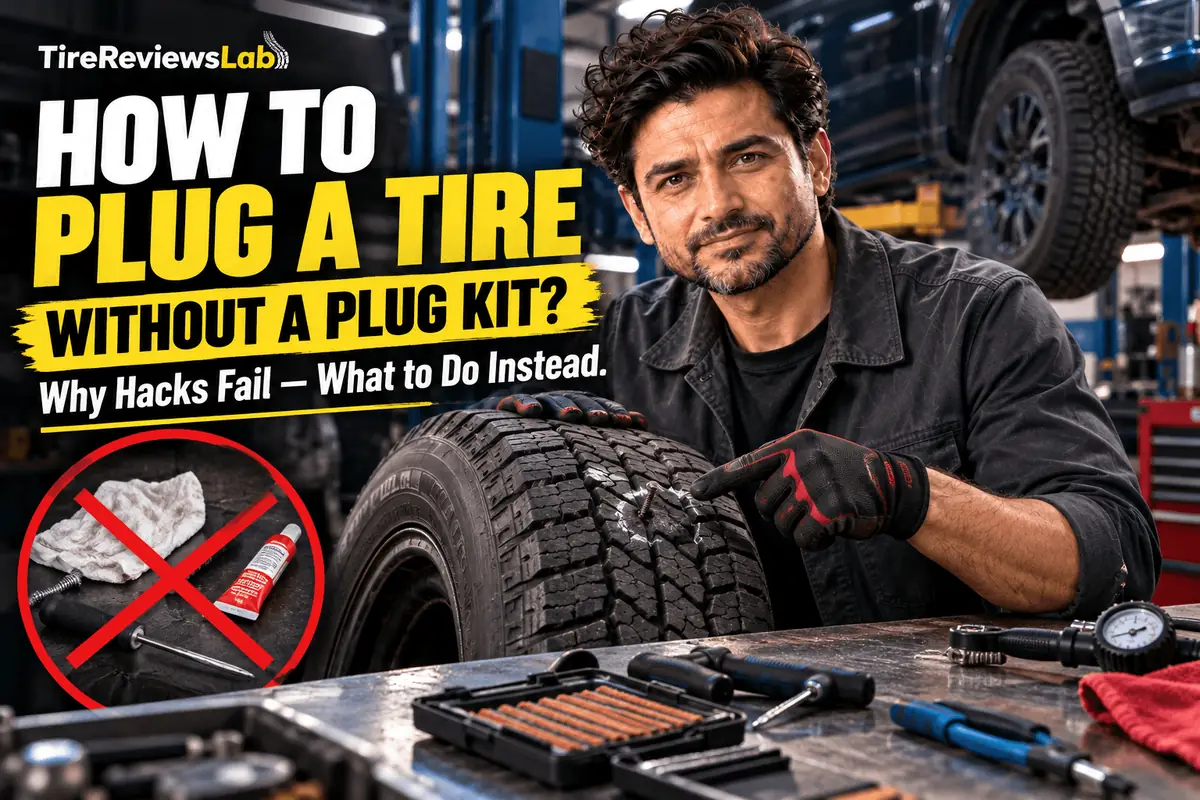
You are on the shoulder with a tire going soft, a nail glinting in the tread, and no plug kit in the trunk. The internet is full of answers: jam a screw in the hole, stuff it with a shoelace, seal it with chewing gum, cinch a bundle of zip ties through it. Every one of those ideas shares the same problem. A tire at highway speed is a hot, flexing, pressurized vessel spinning hundreds of times a minute, and nothing from a junk drawer is built to hold air under those conditions.
The safe answer to “how do I plug a tire without a kit?” is that you don’t. You use one of the options that actually works: the spare, a can of sealant with an inflator, roadside assistance, a mobile tire service, or a real plug kit from the nearest auto parts store. Here is how to choose between them, why the popular hacks are worth skipping, and what a proper repair looks like once you reach a shop.
How this guide was put together: This guide is general information based on common manufacturer and industry guidance; your owner’s manual is the controlling source. Prices are typical ranges, not quotes. Checked on October 22, 2026.
Table of Contents
First, Get Safe and Size Up the Damage
Before you think about fixing anything, get the car out of harm’s way. Pull as far off the road as you can on level ground, switch on the hazard lights, set the parking brake and, if you carry them, place reflective triangles well behind the car. On a busy highway with no safe shoulder, stay in the vehicle with your seatbelt on and call for help rather than working next to traffic.
Then look at the tire. What you see decides which option makes sense.
- A nail or screw in the tread, tire still holding some air: a good candidate for sealant, a careful slow drive to a shop, or a real plug kit.
- A tire that is completely flat or was driven on while flat: the internal structure may already be damaged. Use the spare or call for help.
- Damage in the sidewall or shoulder: not repairable by anyone. The tire needs to be replaced, so use the spare or get a tow.
- A cut, gash or hole larger than about 1/4 inch: beyond what plugs and sealant can handle.
- Bulges, exposed cords or a tire that came off the rim: do not drive on it.
Do not pull a nail or screw out of a tire that is still holding air. The object is partly sealing the hole, and removing it can turn a slow leak into a flat.
Why Improvised Plugs Are Not Safe
The hacks circulate because they sound clever and sometimes appear to hold air in the driveway. The trouble starts when the car moves. As a tire rolls, the tread flexes with every revolution, it heats up, and the air inside pushes outward constantly. A real tire plug is made from sticky, rubber-coated cord that bonds with the tire and vulcanizes in place. Household materials do none of that.
| Improvised “Fix” | Why It Fails | Real Risk |
|---|---|---|
| Driving a screw into the hole | Threads do not seal against flexing rubber and can cut steel belts | Slow leak becomes a sudden one |
| Wood, toothpicks or matchsticks | Rigid and porous, they cannot conform to the hole or hold air | Plug ejects at speed |
| Chewing gum | Softens with heat and has no structural strength | Leak returns within minutes |
| Superglue or household glue | Becomes brittle and cracks as the tread flexes | False sense of security |
| Zip ties, shoelaces, rope or string | Do not bond to rubber and work loose as the tire flexes | Rapid air loss on the road |
| Homemade sealants such as soap or cornstarch | Do not seal under pressure and can foul the wheel and sensors | Imbalance, TPMS damage, no seal |
Some of these hacks also involve enlarging the puncture with a screwdriver or forcing objects through the tread, which can damage the tire’s internal belts and turn a repairable tire into one that has to be replaced. The best case is a leak you have to deal with again in a few miles. The worst case is a sudden loss of air at speed, which can cost you control of the car.
Your Real Options When You Have No Plug Kit
Put On the Spare
If your car has a spare, it is the most dependable fix available. The jack, lug wrench and instructions are usually stored with it, and the owner’s manual walks through the process for your specific vehicle.
Know what kind of spare you have. A full-size spare can generally be driven like any other tire, though it is worth checking its pressure, since spares lose air while they sit for years untouched. A compact temporary spare, often called a donut, is strictly for getting you to a shop. Most carry a speed limit of about 50 mph and a limited driving range, both printed on the spare’s sidewall or in the owner’s manual. Many drivers find their spare is underinflated at exactly the wrong moment, so checking it during routine pressure checks pays off.
Use Tire Sealant and an Inflator
Many newer cars skip the spare entirely and come with a tire mobility kit: a bottle of sealant and a small 12-volt compressor. Aerosol cans of sealant that inflate the tire at the same time are sold at auto parts stores and gas stations, and they are worth keeping in any car without a spare.
Sealant works by coating the inside of the tire and plugging small punctures in the tread from the inside. Used within its limits, it can get you moving again in a few minutes. Those limits matter:
- It is meant for small punctures in the tread, not sidewall damage, cuts or large holes.
- It is a temporary fix. Follow the product’s instructions on maximum speed and distance, and get the tire inspected promptly.
- It may not seal if the tire has been driven flat or the bead has come off the rim.
- Leave the nail or screw in place unless the product instructions say otherwise.
If your car has a tire pressure monitoring system (TPMS), read the sealant label before you use it. Sensors mounted inside the wheel can be fouled or damaged by some sealants, although many products now advertise that they are safe for TPMS sensors. Either way, tell the tire shop you used sealant before they break the tire down. They will need to clean out the tire and wheel, check the sensor, and decide whether the tire can still be repaired.
Call Roadside Assistance
You may already have roadside help and not know it. Common sources include:
- Auto clubs such as AAA, whose memberships typically include flat tire service
- Your auto insurance policy, if it includes roadside or towing coverage, which is often an inexpensive add-on
- Your automaker, since many new vehicles include roadside assistance for a set period, especially while the factory warranty is active
- Some credit cards and cell phone plans, which bundle roadside benefits
A roadside technician will typically install your spare or tow the car to a shop if the spare is missing or unusable. If you are on a busy road, in bad weather or simply not comfortable working on the car, this is the right call.
Book a Mobile Tire Service
In many areas, mobile tire services will come to you, repair a puncture properly or replace the tire on the spot. They charge for the convenience, but the result is a real repair rather than a stopgap, and you avoid driving on a compromised tire.
Buy a Plug Kit at an Auto Parts Store
If the tire is holding enough air to drive a short distance slowly, or you have a spare to get you there, the simplest fix may be the one you were looking for all along: buy a plug kit. Auto parts stores, big-box retailers and many gas stations carry them, and they are inexpensive. Pick up a portable compressor at the same time if you do not already carry one.
Our step-by-step guide to plugging a tire walks through the process with a proper kit, including when a plug is appropriate and when it is not.
Leave the Nail In and Drive Slowly to a Shop
When a nail or screw is stuck in the tread and the tire is losing air slowly, often the best move is to leave the object where it is, inflate the tire to the recommended pressure if you have a way to, and drive directly to the nearest tire shop at reduced speed. Avoid the highway if you can, keep an eye on the TPMS warning or stop to check the tire visually, and pull over if the car starts to pull, vibrate or feel unstable.
This only works when the tire is still holding air. Driving on a flat or badly underinflated tire overheats it and destroys the sidewall, ruining a tire that could have been repaired and possibly damaging the wheel.
Comparing Your Options
| Option | Best For | Main Limitation |
|---|---|---|
| Spare tire | Almost any flat, if you have one | Compact spares limit speed and distance |
| Sealant and inflator | Small tread punctures in cars without a spare | Temporary; may affect TPMS sensors |
| Roadside assistance | Unsafe locations, bad weather, no spare | Wait time; requires coverage |
| Mobile tire service | Getting a real repair without driving | Cost and availability vary |
| Store-bought plug kit | Tread punctures when you can reach a store | Still not a permanent repair |
| Leave the nail and drive slowly | Slow leaks near a tire shop | Only safe while the tire holds air |
What a Permanent Repair Looks Like
Whatever gets you to the shop, the job is not finished until the tire has been properly repaired or replaced. A plug installed from the outside, whether from a kit or a roadside service, and a dose of sealant are both temporary measures.
The permanent fix is a patch-plug installed from the inside. A technician removes the tire from the wheel, inspects the inner liner for damage that cannot be seen from outside, fills the puncture channel with a rubber stem and seals the inside with a patch. This combination seals the hole and keeps moisture out of the steel belts. It is the repair method tire industry guidance supports, and it applies only to punctures in the tread area within size limits, generally up to about 1/4 inch. Sidewall and shoulder damage cannot be repaired.
If you have already plugged the tire, our guide on whether it is safe to drive on a plugged tire covers how long a plug can be trusted and when to have it replaced with a proper repair.
Frequently Asked Questions
No. A screw does not seal against flexing rubber, it can cut the steel belts inside the tread, and it can work loose at speed. If a screw is already stuck in your tire and the tire is holding air, leave it in place and drive slowly to a shop, but never drive a screw in as a fix.
Some sealants can foul or damage sensors mounted inside the wheel, while many newer formulas are labeled as safe for TPMS. Check the label before using it, and tell the tire shop you used sealant so they can clean the wheel and check the sensor.
Sealant is a temporary repair, and limits on speed and distance vary by product, so follow the instructions on the can or kit. Treat it as a way to reach a tire shop, not a fix you can forget about, and have the tire inspected as soon as possible.
No. The nail is partly sealing the hole, and pulling it out can cause the tire to lose air quickly. Leave it in place, keep the tire inflated if you can, and drive slowly to a tire shop where it can be removed and the tire repaired properly.
No. The sidewall and shoulder flex too much to hold a plug or patch, and tire industry repair guidelines do not allow repairs in those areas. A tire with sidewall damage needs to be replaced. Use the spare or call for a tow.
A patch-plug installed from inside the tire after it has been removed from the wheel and inspected. It seals the puncture channel and the inner liner at the same time. It is only appropriate for punctures in the tread area within size limits, generally up to about 1/4 inch.
The Smart Way Out of a Flat Without a Kit
There is no safe way to improvise a tire plug. Screws, wood, gum, glue, zip ties and homemade sealants might look like they work for a minute, but they fail when the tire flexes, heats up and spins at speed, and some of them make a repairable tire unrepairable.
The real options are better and usually faster than any hack: put on the spare, use sealant within its limits, call the roadside coverage you may already have, bring a mobile tire service to you, or pick up a plug kit and a compressor at the nearest store. Then finish the job with a patch-plug from the inside. The best time to deal with this is before it happens, so check your spare’s pressure and keep a plug kit or a can of sealant in the trunk.
Sources
Specs, warranty terms and prices were checked on October 22, 2026. Prices change often.
- Firestone Complete Auto Care: Tire repair (patch vs. plug, repair prices)
- NHTSA: Tires (tire safety, pressure and maintenance)
 Summarize this article with:















Leave a comment