


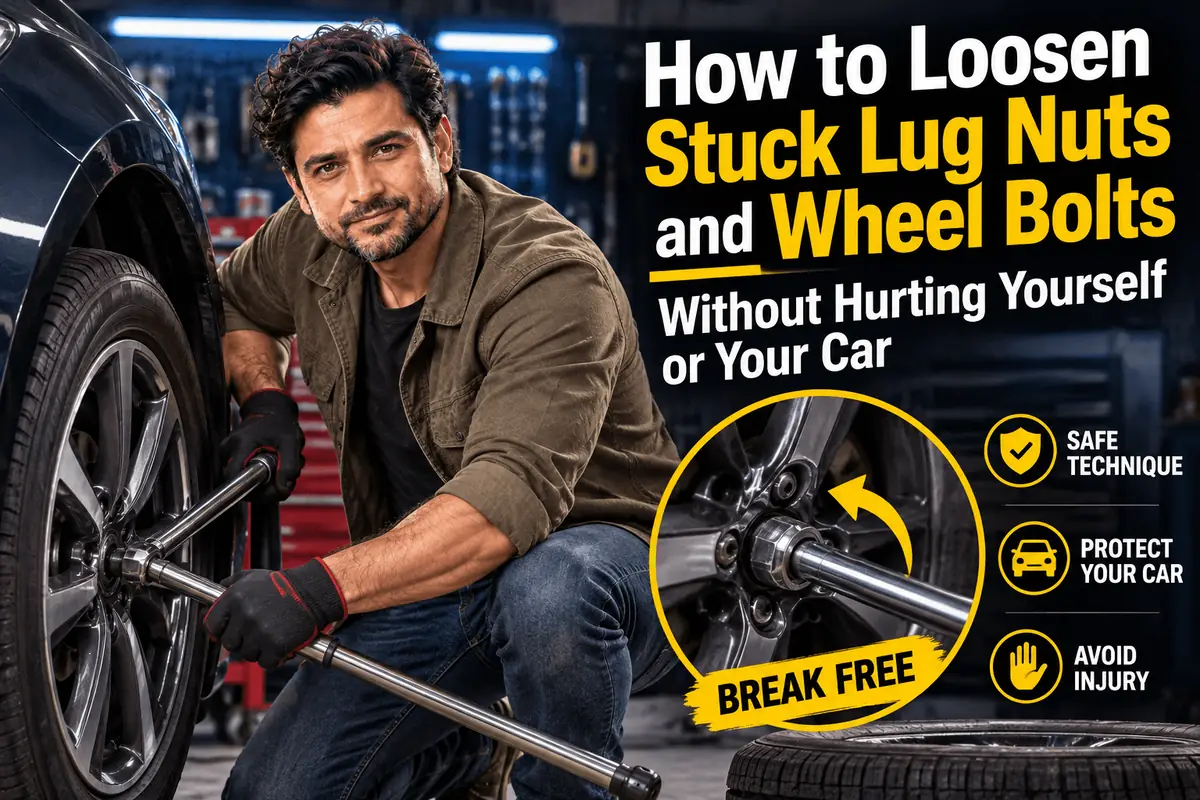
You have the spare out and the lug wrench on the first nut. You pull, then pull harder, and nothing happens. A tire change that should take fifteen minutes has turned into a contest between you and a small piece of rusted steel, and the steel is winning. Stuck lug nuts are one of the most common reasons a simple roadside job ends with a tow truck.
Most stuck fasteners give up with the right mix of leverage, chemistry and patience. The instinctive fixes, like jumping on the wrench or grabbing a torch, are the ones that hurt people and ruin wheels. This guide covers why lug nuts seize, the safe order of attack, what to do about a lost wheel lock key or a wheel stuck to the hub, and the point where a shop is the smarter call.
Table of Contents
Why Lug Nuts and Wheel Bolts Seize
- Rust and corrosion. Moisture and road salt attack the threads and the seat where the nut meets the wheel, effectively gluing the parts together.
- Overtightening. An impact wrench run at full power can drive a nut far past its torque specification, stretching the stud and distorting the threads.
- Time. A wheel that has not come off in years has had years for corrosion to lock everything in place.
- Damaged threads. A nut started at an angle chews up the threads as it tightens and ends up jammed rather than simply tight.
Most domestic and Asian vehicles use lug nuts on studs pressed into the hub. Many European brands, including Audi, BMW, Mercedes-Benz and Volkswagen, use wheel bolts that thread directly into the hub. The techniques are the same, but a damaged wheel bolt can mean repairing threads in the hub itself, which raises the stakes on forcing it. On classic cars, note that Chrysler Corporation vehicles built before 1975 used left-hand threads on one side, so those nuts loosen clockwise. Look for an “L” stamped on the stud or nut.
Set Up Safely First
Stuck nuts call for real force, and real force is where injuries happen.
- Park on flat, firm ground. On the roadside, get as far from traffic as you can and set out warning triangles or flares.
- Put the transmission in Park (or in gear on a manual) and set the parking brake.
- Chock the wheel diagonally opposite the one you are working on, front and back.
- Break the lug nuts loose with the tire still on the ground. The car’s weight keeps the wheel from spinning.
- If you must lift the car, support it on rated jack stands at the frame points in the owner’s manual.
- Wear safety glasses and gloves. Rust flakes fly, and knuckles find sharp edges when a nut suddenly lets go.
Never work under a vehicle supported only by a jack. Jacks are for lifting, and jack stands are for holding.
Step One: More Leverage
The lug wrench that came with your car is built to fit in the trunk, not to break a corroded nut. Torque is force multiplied by distance, so a longer handle puts far more twisting force on the nut for the same effort.
A breaker bar is a long, solid handle with a pivoting drive head and no ratchet mechanism. Pair a half-inch drive bar with a six-point socket of the correct size. Six-point sockets grip the flats of the nut instead of the corners, so they are far less likely to round a stubborn nut than twelve-point sockets. The socket should seat fully with no wobble.
Two tools look similar but must never stand in for a breaker bar. A torque wrench’s measuring mechanism can be ruined in one hard pull, and a ratchet’s internal pawl can fracture under heavy load. If you are rethinking what lives in your trunk, our lug wrench vs tire iron guide compares the options.
A length of pipe over the handle, often called a cheater bar, adds leverage, but only use one on a quality bar made of hardened steel such as chrome vanadium. Cheap bars bend or snap, and too much leverage can break the stud rather than free the nut.
Apply steady, building pressure instead of a jerk. If the nut does not move, try a small push toward tight followed by a firm pull toward loose. That back-and-forth can crack the corrosion bond in the threads.
Step Two: Penetrating Oil and Patience
When leverage alone fails, penetrating oil is next. These thin lubricants creep into rusted threads and start breaking down corrosion.
- Wire brush the area around the nut to remove loose rust and dirt.
- Spray generously where the nut meets the stud and where it seats against the wheel.
- Wait at least 10 minutes, and 15 to 30 minutes on badly rusted hardware, following the product label.
- Reapply during the wait to keep the threads soaked.
- Try the breaker bar again with the same steady technique.
Severely corroded nuts may need several rounds. Spraying the night before and trying again the next day works for a reason: the oil gets hours instead of minutes. A few square taps on the end of a fully seated socket can also help the oil penetrate, as long as the hammer never touches the wheel.
Step Three: Use Your Body Weight, Not Your Momentum
Your legs and body weight are stronger than your arms, and using them properly often decides whether a nut moves.
- Pull toward you when you can. If the bar slips during a pull, you fall back onto your feet. If it slips during a push, you fall forward into the wheel or the road.
- If you press down with your foot, keep both feet stable, hold the car for balance and lower your weight onto the bar in a controlled push.
- Clear the swing path. Picture where the bar and your knuckles will go when the nut breaks free.
Do not jump on the bar. It is one of the most common ways people get hurt doing this job. The socket can pop off, or the nut can suddenly let go, and your full weight drops with no control. Jumping also shock-loads the stud and raises the odds of snapping it. If steady body weight on a proper breaker bar will not move the nut, more violence will not fix it.
Step Four: Impact Wrenches
An impact wrench delivers rapid hammer blows instead of a steady pull, and those sharp impacts shatter corrosion that resists steady force. Cordless models are now strong enough to make them a practical home tool.
Use impact-rated sockets, since standard chrome sockets are brittle and can crack under repeated blows. Start at a moderate setting and work up, and keep the socket square so the energy turns the nut instead of rounding it.
The same tool that removes stuck nuts often creates them. When reinstalling, run the nuts down snug, lower the car and finish with a torque wrench to the vehicle maker’s specification in a star pattern. Our guide to using a torque wrench walks through the process.
Lost Wheel Lock Key
Wheel locks need a matching key adapter, and without it they stop you as well as they stop thieves. Work through the options from least to most invasive:
- Search the car. Check the glovebox, trunk floor, spare tire well and jack kit.
- Order a replacement key. Many lock brands supply an identification code on a card or the original packaging, and the manufacturer can send a matching key from it.
- Try a wheel lock removal kit. These sockets have reverse spiral flutes that bite into the lock. They usually ruin the lock, and some lock designs spin freely to defeat them.
- Visit a tire shop. Shops handle lost keys constantly and often have master sets or removal tools. Expect to replace damaged locks afterward.
Hammering an undersized twelve-point socket onto the lock sometimes works, but it can mar the wheel and leave a socket stuck on the lock. On expensive wheels, the shop is cheaper in the long run.
Nuts Off, Wheel Still Stuck
Corrosion between the wheel’s center bore and the hub, especially where aluminum wheels meet steel hubs, can bond the two together after the nuts are loose.
- Leave the nuts threaded on, backed off about one full turn, so the wheel cannot fall off or fly toward you when it lets go.
- Spray penetrating oil where the wheel meets the hub and let it soak 10 to 15 minutes.
- Rock the wheel by hand, gripping at 3 and 9 o’clock, with the car safely on jack stands.
- Kick the tire sidewall with the flat of your foot, working around the tire.
- Strike the back of the rim with a rubber mallet or dead-blow hammer. Never hit the hub, studs or the face of an alloy wheel with a steel hammer.
Another approach is to lower the car with every nut still threaded on but slightly loose, then roll a few feet at walking speed while gently turning the steering wheel. The car’s weight often breaks the bond. Once the wheel is off, wire brush the hub face and the wheel’s mounting surface, and a thin film of anti-seize on the hub face (not the stud threads) helps keep it from happening again.
Why Heat Belongs at the Shop
Heat works because the nut expands faster than the stud, cracking the corrosion between them. That is why mechanics use torches, and why you should not in a driveway or on a roadside.
The tire sits inches from the nut and is flammable, and so is the penetrating oil you sprayed minutes earlier. Heat can also damage aluminum wheels, bearing seals, brake components and tire pressure sensors. Shops that use heat do it with fire protection on hand and the experience to know how much is too much.
Never use a torch, heat gun or open flame on lug nuts with the tire installed. Leave heat to professionals.
Matching the Method to the Problem
| Problem | Try First | Next Step | Stop and Call a Shop If |
|---|---|---|---|
| Overtightened nut | Breaker bar with steady pull | Longer handle, back-and-forth technique | The stud starts to twist |
| Heavy corrosion | Wire brush and penetrating oil soak | Repeat soak, then impact wrench | Several soaks and an impact wrench fail |
| Rounded nut | Correct six-point socket | Lug nut extractor socket | The extractor slips or the stud is damaged |
| Lost wheel lock key | Search the car, order a key by code | Wheel lock removal kit | The lock spins or the wheel finish is at risk |
| Wheel stuck to hub | Oil at the hub, kick the sidewall | Mallet on rear of rim, roll the car slightly | The wheel still will not separate |
For a rounded nut, extractor sockets with tapered internal spirals grip tighter as you turn. Tap the socket on, then use a breaker bar or impact wrench, and plan to replace the nut. Drilling or cutting a nut off a stud is not a driveway job.
When to Stop and See a Shop
Knowing when to quit saves money. Head to a tire shop or mechanic when:
- The stud twists, stretches or snaps, or a wheel bolt turns without backing out.
- The nut has rounded and an extractor will not grip.
- Penetrating oil, a breaker bar and an impact wrench have all failed.
- Removal tools will not defeat a wheel lock.
- Heat looks like the only remaining option.
- You lack jack stands, chocks or the right sockets, or you are on a busy roadside.
A shop has high-torque impact tools, extractors, safe heat and the parts to replace a broken stud in the same visit. That usually costs far less than repairing a damaged wheel or hub.
Preventing the Next Stuck Nut
- Torque to specification with a torque wrench in a star pattern, and ask shops to do the same.
- Keep threads clean. Follow your vehicle maker’s guidance on lubrication, since many specify clean, dry threads and lubricant changes the clamping force a given torque produces.
- Clean the hub face whenever a wheel is off.
- Rotate on schedule so the nuts come off every few months instead of every few years.
- Keep the wheel lock key with the car, along with a record of its code.
Related Reading
Frequently Asked Questions
On almost every modern vehicle, counterclockwise as you face the wheel. The exception is Chrysler Corporation vehicles built before 1975, which used left-hand threads on one side. Those nuts are often marked “L” and loosen clockwise.
At least 10 minutes, and 15 to 30 minutes for heavy rust, reapplying during the wait. For badly corroded nuts, spraying the night before often beats any amount of extra force.
No. Pressing your weight steadily onto a breaker bar while balancing against the car is reasonable, but jumping can make the socket slip or the nut release suddenly, dropping you into the car or the road. It can also snap the stud.
No. Leave heat to a professional. Tires and penetrating oil are flammable, and heat can damage alloy wheels, bearing seals, brake parts and tire pressure sensors.
Search the car, then look for the key code so you can order a replacement from the lock manufacturer. A removal kit may work but usually destroys the lock, and a tire shop is the safest route for expensive wheels.
Corrosion has bonded the wheel’s center bore to the hub. Leave the nuts loosely threaded on, oil the hub area, kick the sidewall or strike the back of the rim with a rubber mallet, and never put your body under the car while doing it.
The Bottom Line on Stuck Lug Nuts
Most stuck lug nuts and wheel bolts come loose with a predictable sequence: a proper breaker bar and six-point socket, penetrating oil with enough time to work, controlled body weight and, if needed, an impact wrench. Lost wheel lock keys and wheels bonded to the hub have their own fixes, and none of them require heat or heroics.
What turns this job dangerous is a car on a jack alone and force applied without control. Chock the wheels, use jack stands, never jump on the bar and keep flames away from the tire. If the stud starts to twist, the nut rounds or patient attempts have failed, a tire shop will finish the job for less than the cost of a broken stud or a damaged wheel.
 Summarize this article with:


















Leave a comment