


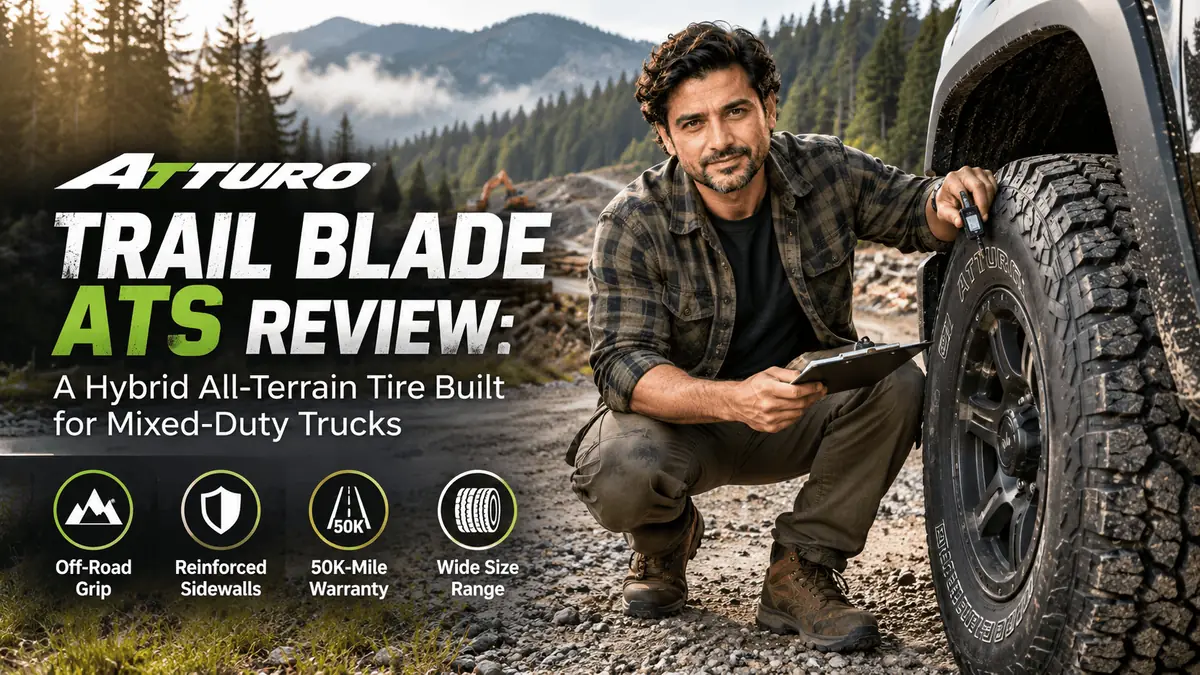
Most all-terrain tires ask a driver to pick a side — comfortable pavement manners or serious off-road bite, but rarely both in equal measure. The Atturo Trail Blade ATS tries to close that gap by borrowing design cues from mud-terrain tires without abandoning the daily-driver comfort that all-terrain buyers actually want. For truck, SUV, and Jeep owners who spend the workweek on pavement and the weekend on a fire road or gravel trail, that hybrid approach is worth a closer look — and worth understanding exactly where it delivers and where it still asks for a compromise.
Atturo Trail Blade ATS at a Glance
| Best for | Truck, SUV, and Jeep owners who split time between daily pavement driving and light-to-moderate off-road use |
| Main strengths | Mud-terrain-inspired shoulder traction, reinforced sidewalls, wide size range |
| Main limitations | Noticeable road noise for the category, firmer ride than a touring tire, not a mud-terrain replacement |
| Price position | Mid-range for hybrid all-terrain tires, roughly $113–$337 per tire depending on size |
Table of Contents
A Hybrid Tread Built Around Mud-Terrain Cues
Atturo built the Trail Blade ATS around a tread pattern that pulls from two different playbooks. The shoulder blocks and sidewall design borrow the aggressive, deep-biting geometry more commonly found on mud-terrain tires, while the center of the tread runs a more conventional all-terrain pattern tuned for everyday pavement manners. Atturo has said the block shapes take design inspiration from Quartermaster Knives, the outdoor gear maker known for rugged, no-nonsense construction — an unusual reference point for a tire tread, but one that lines up with the tire’s intended use.
How this review was put together: We have not road-tested the Trail Blade ATS. This review is based on Atturo design information and retailer listings, with sources listed at the end. Checked on October 22, 2026.
Reinforced sidewalls and a high-ply-rating casing back up that tread design, giving the Trail Blade ATS meaningfully better resistance to punctures and impacts than a typical all-season or standard highway tire. Atturo builds the casing to handle the abuse of regular off-road use while still holding up to daily pavement driving without a jarring, uncomfortable ride — the same balancing act that defines the rest of the tire’s performance.
On-Road Manners: Comfortable for the Category
On pavement, the Trail Blade ATS delivers the kind of predictable, confident traction and handling that most drivers expect from a well-built all-terrain tire — steering feels planted rather than vague, and the tire holds its line through highway lane changes and everyday cornering without drama.
Road noise is where all-terrain tires typically give up the most ground to dedicated highway rubber, and the Trail Blade ATS follows that pattern, though not as severely as some aggressive hybrid designs. Its tread geometry keeps the cabin reasonably quiet for the category, even if it never approaches the hushed cabin of a true highway-terrain tire.
Off-Road Capability: Built for Dirt, Gravel, and Light Mud
Off pavement is where the Trail Blade ATS’s mud-terrain-inspired shoulder design earns its keep. Deep tread blocks and aggressive siping bite into loose surfaces — mud, gravel, and dirt in particular — with traction that a standard all-terrain tire usually can’t match. A wide footprint and sturdy sidewall construction add stability and resistance to punctures and abrasions on rough trails, which matters as much for driver confidence as for outright grip.
Atturo markets the tire as capable across a range of off-road terrain, from rocky trails to sandy conditions, and the shoulder-block design does genuinely extend its usefulness beyond a typical light-duty all-terrain tread. That said, the Trail Blade ATS is not a substitute for a dedicated mud-terrain tire in genuinely extreme conditions — deep mud, technical rock crawling, and similarly demanding terrain still favor a tire built exclusively around that job. For light-to-moderate off-road use — gravel roads, dirt trails, and the occasional muddy stretch — it’s a capable, confidence-inspiring choice.
Sizing and Fitment
The Trail Blade ATS covers an unusually wide range of vehicle applications for a hybrid all-terrain tire. Sizes span wheel diameters from 15 to 22 inches and section widths from 235 to 375 millimeters, with construction options that include 12-ply-rated versions for heavier-duty applications. Discount Tire describes the lineup as including high-flotation sizes alongside those heavier-duty 12-ply constructions, making the tire a fit for ¾-ton and 1-ton trucks as well as Jeeps and SUVs running smaller stock sizes. That range gives the Trail Blade ATS relevance across a genuinely broad swath of the truck and SUV market, from a daily-driven Wrangler to a work truck that occasionally tows.
Tread Life and Warranty
RealTruck advertises a 50,000-mile treadwear warranty for the Trail Blade ATS, but its warranty section doesn’t list the ATS among mileage-warranted tires, so confirm coverage before buying. Regular rotation helps any hybrid tire last. It’s worth keeping in mind that tread wear on any aggressive hybrid tire accelerates with heavy highway use, since the same block design that grips loose dirt also wears faster on abrasive pavement than a smoother highway tread would.
Pricing and Value
The Trail Blade ATS lands in the mid-range of the all-terrain category, with per-tire pricing running from roughly $113 to $337 depending on size, according to TireMart. That places it comfortably below several established all-terrain competitors with similar capability — the Falken Wildpeak A/T Trail, for instance, frequently runs upwards of $200 per tire for comparable sizes. That pricing makes a reasonably strong value case for drivers who want hybrid mud/all-terrain capability without paying a premium-brand price for it.
What Owners Say
Verified owner reviews are thin: RealTruck showed 4.0 out of 5 from just four reviews in October 2026.
Expect more road noise and a firmer ride than a touring tire, as with any tire built for this much off-road capability.
Who the Trail Blade ATS Is Built For
The Trail Blade ATS is aimed squarely at pickup truck, SUV, and crossover owners who split their driving between pavement and light-to-moderate off-road terrain — daily commuting and highway trips during the week, gravel roads and dirt trails on the weekend. Its all-season tread compound handles both dry and wet conditions capably enough for year-round daily use.
It’s a weaker fit for drivers chasing the outermost edge of off-road capability. Rock crawling and genuinely extreme off-road conditions are better served by a dedicated mud-terrain tire, and drivers who never plan to leave pavement at all will find quieter, more efficient options in a standard highway or touring tire.
Atturo Trail Blade ATS vs. Americus Rugged ATR
The closest head-to-head comparison for the Trail Blade ATS is the Americus Rugged ATR, another hybrid tire aimed at SUVs, light trucks, and Jeeps that split time between pavement and trail. Both tires target the same buyer and the same general use case, which makes the differences between them worth calling out.
The Trail Blade ATS’s shoulder-block design, built specifically for digging traction into loose surfaces, gives it steady, confident handling across mixed terrain. We have not tested it against rivals ourselves.
Other Atturo Tires Worth Knowing
Atturo builds the Trail Blade ATS as part of a broader family of off-road-oriented tires. The standard Trail Blade AT covers a similar use case with a more conventional all-terrain tread, the Trail Blade MT and Trail Blade MTS step up to dedicated mud-terrain capability, and the Trail Blade XT and Trail Blade Boss round out the truck and SUV side of the lineup, with the AZ850 and AZ610 covering Atturo’s passenger and performance categories. Buyers who find the Trail Blade ATS’s hybrid approach appealing but want more off-road bite, or less of it, have a reasonable range of alternatives within the same brand.
Pros and Cons
Pros
- Hybrid tread design delivers genuine off-road traction on mud, gravel, and dirt without the harsh ride of a dedicated mud-terrain tire
- Reinforced sidewalls and a high-ply-rating casing resist punctures and impacts on rough trails
- Advertised 50,000-mile treadwear warranty (confirm with your dealer)
- Wide size range, including 12-ply-rated options, covers everything from light SUVs to ¾- and 1-ton trucks
- Priced below several comparable competitors, including the Falken Wildpeak A/T Trail
Cons
- Road noise on pavement is noticeable, even if it’s better controlled than more aggressive hybrid designs
- Off-road performance doesn’t match a dedicated mud-terrain tire in extreme conditions like deep mud or rock crawling
- Aggressive tread design can modestly increase fuel consumption and shorten tread life under heavy on-road driving
- Ride quality is firmer than a comfort-oriented touring or highway tire
Frequently Asked Questions
Yes, particularly for drivers who want more off-road bite than a standard all-terrain tire while still keeping the tire livable for daily highway driving. Its hybrid tread design, borrowed in part from mud-terrain construction, gives it genuine traction advantages on gravel, dirt, and light mud.
RealTruck advertises a 50,000-mile treadwear warranty, but its warranty section is inconsistent, so confirm coverage before buying.
Not particularly. It handles light-to-moderate off-road terrain — gravel roads, dirt trails, and light mud — confidently, but it isn’t built for deep mud or rock crawling the way a dedicated mud-terrain tire is.
Some road noise is noticeable, especially on certain pavement surfaces, which is typical for a tire with this much off-road-oriented tread design. It’s still quieter on the highway than most dedicated mud-terrain tires.
The tire spans wheel diameters from 15 to 22 inches and section widths from 235 to 375 millimeters, with 12-ply-rated options available for heavier-duty truck applications.
It’s competitively priced for the category, typically running from about $113 to $337 per tire depending on size — often less than comparable tires like the Falken Wildpeak A/T Trail.
Pickup trucks, SUVs, crossovers, and Jeeps that split time between highway driving and light-to-moderate off-road use are the best match for this tire.
Atturo Tire Corp., an independent American company founded in 2009 and based in Waukegan, Illinois. It designs the tires in the US and has them built by contract manufacturers overseas.
Final Verdict: Is the Atturo Trail Blade ATS Worth Buying?
The Atturo Trail Blade ATS earns its spot in the crowded hybrid all-terrain category by actually delivering on the trade-off it promises: more off-road bite than a standard all-terrain tire, without the harsh ride and highway noise that usually come with a mud-terrain tread. It handles gravel, dirt, and light mud with real confidence, and undercuts several established rivals on price.
It isn’t the right choice for drivers chasing the outer limits of off-road capability — a dedicated mud-terrain tire will still out-perform it in deep mud or on technical rock — and the tire’s more aggressive tread does trade away some quietness and fuel efficiency compared with a standard highway tire. For the truck, SUV, and Jeep owner who actually needs both sides of that equation — a comfortable daily commute and genuine capability on the weekend trail — the Trail Blade ATS is a well-priced, well-rounded option worth putting on the shortlist.
Sources
Specs, warranty terms and prices were checked on October 22, 2026. Prices change often.
- RealTruck: Atturo Trail Blade ATS (warranty information, price, reviews)
 Summarize this article with:














Leave a comment