


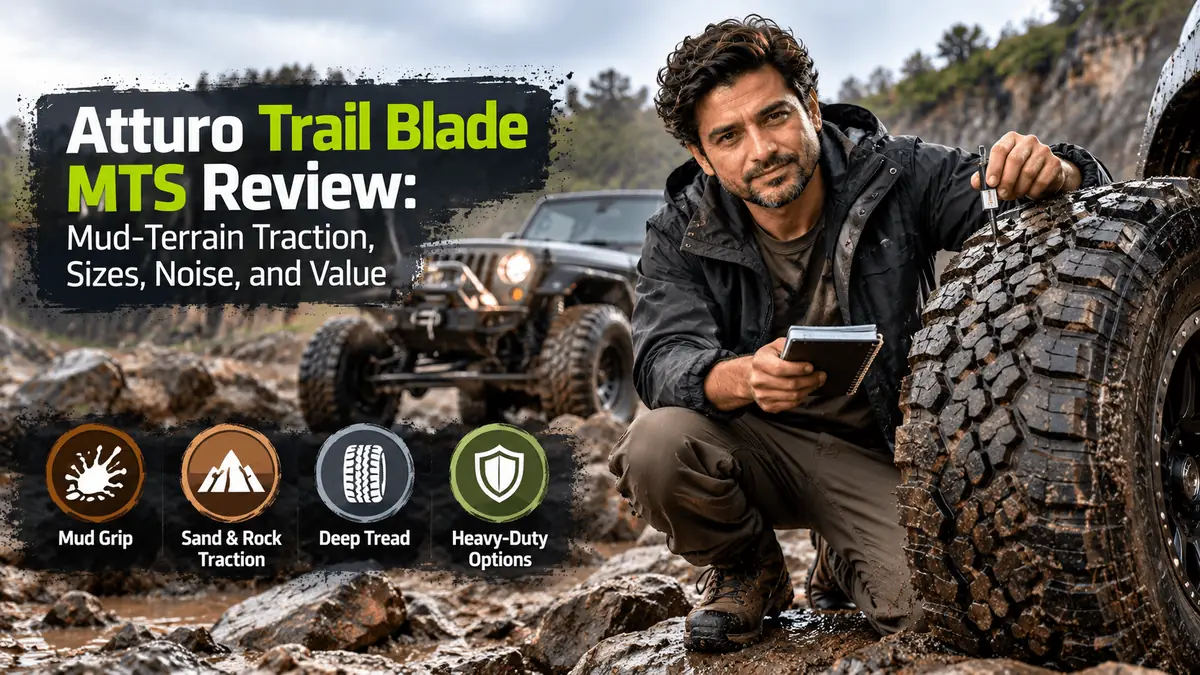
Most mud-terrain tires ask you to choose: dig through deep mud, or stay civil on the highway. The Atturo Trail Blade MTS leans hard toward the mud. It pairs a four-lug center pattern with serrated shoulder edges and tread that wraps into the sidewall, and Atturo itself rates the tire 9 out of 10 for mud traction and 5 out of 10 for a quiet ride. That split tells you most of what you need to know. The MTS is a truck and SUV tire for people who spend real time off pavement and are willing to trade some hum on the road for grip.
This review covers how the tread works, how the MTS should behave in mud, sand, rock, and snow, what to expect on pavement, which of its 19 sizes suit which vehicles, and where it sits among the other Trail Blade models. It closes with a buyer’s guide, a verdict, and a full size chart.
How this review was put together: We have not road-tested the Trail Blade MTS. This review is based on Atturo’s published specifications and warranty terms plus retailer listings, with sources listed at the end. Checked on October 22, 2026.
Atturo Trail Blade MTS at a Glance
| Category | Details |
|---|---|
| Tire type | Mud-terrain tire for light trucks, SUVs, and Jeeps |
| Best for | Drivers who want maximum grip in mud, sand, and rock and run large-diameter tires on lifted or leveled trucks |
| Sizes | 19 sizes for 16- to 26-inch wheels, from 32.1 to 36.5 inches in overall diameter |
| Construction | 8-, 10-, and 12-ply ratings on LT sizes (nine sizes are 12-ply), plus one passenger-metric XL size |
| Tread depth | 17/32 to 22/32 inch, with most sizes at 20/32 or deeper |
| Atturo’s own ratings | Mud 9, sand 8, rock 8, wet traction 7, snow 7, street performance 6, quiet ride 5 (each out of 10) |
| Warranty | Atturo’s 3-year manufacturer defect warranty; confirm any treadwear mileage terms before buying |
| Main trade-off | Road noise and pavement manners take a back seat to off-road traction |
Table of Contents
What Makes the MTS Tread Different
The MTS is a true mud-terrain, not a hybrid. Its headline feature is a four-lug center pattern that Atturo modeled on the curved blade of a karambit knife. According to Atturo, that layout gives twice the biting-edge count of the original Trail Blade M/T, and the extra edges carry over the shoulders as well. Those edges matter because a mud tire has to keep clawing forward once the surface stops offering easy purchase.
Four other details fill out the design:
- Serrated edges on the tread blocks cut into mud, sand, and loose ground rather than skating across it.
- Shoulder blocks that flow into the sidewall add lateral bite when the tire is sunk in ruts or climbing at an angle.
- A combination of shoulder sipes and conventional siping adds edges for wet surfaces, on the road and off it.
- Stone ejectors, segmented arches in the grooves, help keep channels clear of dirt and debris so the tread can keep biting.
Retailers also point to center lugs that are joined at the base, which stiffens the blocks and helps the tread wear more evenly over its life while adding straight-line stability. Atturo describes the sidewalls as reinforced, which is what you want from a tire that will spend time around rocks and ruts.
Off-Road Performance: Mud, Sand, Rock, and Snow
Atturo’s ratings put the MTS’s strengths in a clear order: mud first at 9 out of 10, then sand and rock at 8 each. Those are manufacturer scores rather than independent measurements, but they match what the pattern suggests. Large, widely spaced lugs, an open tread with plenty of void space, and deep rubber are the ingredients that let a tire shed mud and keep moving.
Tread depth helps here, too. Most MTS sizes carry 20/32 to 22/32 inch of rubber, which gives the lugs height to reach through soft surfaces and leaves a lot of tread to wear through before the tire loses its bite. Only the low-profile 285/45R22 is shallower, at 17/32.
Snow earns a 7 from Atturo. That is a reasonable score for a mud-terrain, and the deep, siped blocks give the tire something to grab in fresh snow. The score is not a winter-tire promise, though, and Atturo’s product page lists no mountain-snowflake winter certification for the MTS. Drivers who see regular ice or packed snow should weigh that before choosing an aggressive mud pattern as a year-round tire.
On Pavement: Wet Grip, Ride, and Noise
Off-road capability always costs something on the highway, and the MTS pays in noise. Atturo scores the quiet ride at 5 out of 10, the lowest of its seven published ratings, and street performance at 6. Wet traction fares better at 7, helped by the sipe combination in the shoulders.
Owner comments on Atturo’s own site are mixed in a useful way. One buyer calls the tire fairly quiet on the road, another reports little to no road noise, and a third, who tows, says the tire is a little noisy but adds that this is expected with 13.50-inch-wide tires. Reviews hosted by a manufacturer skew favorable, so treat them as anecdotes, but the pattern is consistent with the ratings: the MTS is tolerable rather than quiet. Wider sizes, heavier load ranges, and more aggressive lugs all raise the volume, so a 35×13.50 will sound different from an LT275/60R20.
If most of your miles are highway commuting, the noise is the number to think about. If you drive to the trailhead and spend the weekend in the dirt, it is a fair price for the traction.
Sizes and Fitment
The MTS comes in 19 sizes across 16-, 17-, 18-, 20-, 22-, 24-, and 26-inch wheels. The range skews large: overall diameters run from 32.1 to 36.5 inches, and most of the lineup is in the 33-, 35-, and 37-inch flotation sizes that lifted trucks and Jeeps favor. Here is how the range breaks down:
- 16 to 18 inches (5 sizes): LT315/75R16, 37×12.50R17, LT325/65R18, 33×12.50R18, and 35×12.50R18. This is a practical group for off-road builds because the taller sidewall gives room to air down.
- 20 inches (4 sizes): LT275/60R20, LT295/55R20, 33×13.50R20, and 35×13.50R20. The LT275/60R20 is a familiar full-size-truck dimension and the closest thing here to a mild upgrade over factory tires.
- 22 inches (4 sizes): 285/45R22, LT285/55R22, 33×13.50R22, and 35×13.50R22.
- 24 and 26 inches (6 sizes): 33×13.50R24, 35×13.50R24, 37×13.50R24, LT385/30R26, 35×13.50R26, and 37×13.50R26, aimed at big-wheel builds.
Load capacity varies more than most buyers expect. Maximum single load ranges from 2,150 pounds (33×13.50R24) up to 3,970 pounds (35×12.50R18), and maximum inflation pressure runs from 50 to 80 psi. Nine sizes are 12-ply, which retailers recommend for three-quarter-ton and one-ton trucks, while the 37×12.50R17 is an 8-ply tire with a 3,525-pound rating. Speed ratings are Q (up to 99 mph) on most sizes, with S or T on a handful of the metric-style sizes. Weights run from about 45 to 85.5 pounds, so the biggest sizes add real rotating mass.
Check the load index against your vehicle’s requirement, not only the ply rating. Atturo’s warranty terms call for a load index equal to or greater than the vehicle maker specifies, and a heavy truck that tows regularly should skip the lower-capacity sizes. The full chart is in the appendix.
How the MTS Compares Within the Trail Blade Family
Atturo’s Trail Blade line covers a wide spread of off-road priorities, and the manufacturer’s own 10-point scores make it easy to see where the MTS falls. The X/T is a hybrid with an all-terrain center and mud-terrain shoulders, while the Boss is Atturo’s most aggressive off-road tire.
| Atturo rating (out of 10) | Trail Blade X/T | Trail Blade MTS | Trail Blade Boss |
|---|---|---|---|
| Mud | 8 | 9 | 10.5 |
| Sand | 7 | 8 | 10.5 |
| Rock | 7 | 8 | 10.5 |
| Wet traction | 8 | 7 | 6 |
| Snow | 7 | 7 | 6 |
| Street performance | 7 | 6 | 5 |
| Quiet ride | 6 | 5 | 4 |
The pattern is a clean trade-off. Each step toward more off-road grip costs street manners: the X/T is the quietest and best on wet roads, the Boss is the most capable in the dirt and the loudest, and the MTS sits in the middle with a mud-first personality. If you want a single tire that handles daily commuting with occasional trail days, look at the X/T or one of the all-terrain models and read our Trail Blade X/T review. If you want the most extreme traction and can live with the noise, the Boss is worth a look. The MTS suits drivers who want serious mud grip without going to the most aggressive tire in the lineup.
Against the older Trail Blade M/T, Atturo says the MTS doubles the biting edges and adds larger sizes and stronger construction, including 12-ply options.
Tread Life, Warranty, and Price
Atturo backs every tire with a 3-year manufacturer defect warranty. It applies to the original purchaser, is not transferable, and covers tires bought new and mounted on the vehicle they were first installed on. That protects against manufacturing flaws but is not a treadwear guarantee. Atturo’s MTS product page does not list a mileage figure, and the only size with a published UTQG rating is the 285/45R22, at 500 A B. Some retailers cite tread life of up to 50,000 miles, so ask the seller to confirm in writing what, if anything, is covered on the size you want.
Atturo does not publish a price for the MTS and directs buyers to local dealers for quotes. Retailers commonly discount from list, and prices swing widely between a 33-inch and a 37-inch size, so compare quotes on the exact size. One owner on Atturo’s site summed up the appeal in four words: great tire for the price. That is the reason most people shop this tire. It is an aggressive mud-terrain from a relatively young brand, and shoppers tend to weigh it on value.
Installation and Ownership Tips
Heavy, stiff mud-terrain tires are harder to mount than passenger tires, so a professional installer with the right equipment is worth the fee. Proper bead seating and inflation matter, and the rim needs to fall within the approved range for the size. That range is narrow on some sizes, for example 8.5 to 11 inches for the 33×12.50R18.
Plan on rotating and balancing every 5,000 to 8,000 miles, or on the schedule in your owner’s manual. Aggressive shoulder blocks are where uneven wear tends to appear first on mud-terrains, and regular rotation keeps it in check. Check pressure often, too. Lower pressures help off-road traction, but the highway needs the pressures your load calls for.
Pros and Cons
Pros
- Atturo rates mud 9 and sand and rock 8, strong marks for an off-road-focused tire
- Deep tread, 20/32 to 22/32 inch in most sizes, leaves plenty of rubber to wear
- 19 sizes, including 33-, 35-, and 37-inch options for lifted trucks and Jeeps
- 8-, 10-, and 12-ply options, with maximum loads up to 3,970 lb per tire
- Wet traction and snow both score 7 out of 10, a reasonable showing for a mud-terrain
- An owner on Atturo’s site singles out value for the money
Cons
- Quiet ride rates 5 out of 10 and street performance 6, so it is not a daily-comfort tire
- No treadwear mileage on Atturo’s product page; the warranty covers defects for 3 years
- Only one size has a UTQG rating, and it is the low-profile passenger-metric 285/45R22
- Large sizes weigh up to 85.5 lb, which adds rotating mass
- No mountain-snowflake winter certification listed by Atturo
- Feedback on noise varies, so results depend on size and vehicle
Who Should Buy the MTS?
- Weekend off-roaders and trail drivers: Mud, sand, and rock are exactly what this tire was built for, and the range of 33- to 37-inch sizes fits most popular lift setups.
- Lifted-truck owners who tow or haul: The 12-ply sizes and loads up to 3,970 lb per tire give heavy trucks headroom. Match the load index to your vehicle’s requirement first.
- Budget-conscious mud-terrain shoppers: If price matters and you accept a newer brand’s track record, the MTS is a strong candidate. Ask for treadwear terms in writing.
- Daily commuters: Look at an all-terrain or the hybrid X/T instead. The MTS’s noise and street manners will wear on a long highway commute.
- Drivers in ice and packed snow: A dedicated winter tire, or an all-terrain with a mountain-snowflake rating, is a better answer than any mud-terrain.
Final Verdict
The Atturo Trail Blade MTS does one thing well and doesn’t pretend otherwise. Its four-lug center, serrated edges, and deep tread give it a mud, sand, and rock profile that ranks among the strongest in Atturo’s own lineup short of the Boss, and its size range covers just about any lifted-truck build from 16 to 26 inches. On the road it is a mud-terrain: louder and less refined than an all-terrain, though not out of bounds for a truck that also spends time on pavement.
The compromises are clear. You get no published treadwear mileage, a defect-only warranty, and noise that will depend on the size you choose. The reward is a lot of off-road tire for the money. For drivers who care most about traction in soft terrain, and who value price over refinement, the MTS is worth a place on the shortlist. If your truck lives on the highway, choose something quieter.
Frequently Asked Questions
It is a mud-terrain. The MTS uses a four-lug center pattern with serrated blocks and sidewall-wrapping shoulders. Atturo’s hybrid model, with an all-terrain center and mud-terrain shoulders, is the Trail Blade X/T.
Atturo rates snow traction 7 out of 10, which is decent for a mud-terrain thanks to the deep, siped tread. It is not a winter tire, and Atturo lists no mountain-snowflake certification for it, so expect compromises on ice and packed snow.
Louder than an all-terrain. Atturo rates the quiet ride 5 out of 10. Owners on Atturo’s website describe it variously as fairly quiet and a little noisy, with wide 13.50-inch sizes drawing the most comment.
Nineteen sizes for wheels from 16 to 26 inches, with overall diameters from 32.1 to 36.5 inches. The full chart appears at the end of this article.
Atturo covers all of its tires with a 3-year manufacturer defect warranty for the original purchaser. Atturo’s product page does not list a treadwear mileage, so confirm with the seller before purchase if tread-life coverage matters to you.
Atturo says the MTS offers double the biting-edge power of the original M/T thanks to its four-lug center, and it adds larger sizes and 12-ply construction for heavier trucks.
The heavier sizes are built for it. Nine sizes are 12-ply, and the highest load rating is 3,970 lb per tire on the 35×12.50R18. Always match the load index to your vehicle’s requirements, since ply rating alone doesn’t set capacity.
Appendix: Full Atturo Trail Blade MTS Size Chart
For reference, here is the complete Trail Blade MTS lineup with Atturo’s published specifications.
| Size | Load / Speed | Ply | Diameter (in) | Width (in) | Tread (/32) | Max Load (lb) | Max PSI |
|---|---|---|---|---|---|---|---|
| LT315/75R16 | 127/124S | 10 | 34.6 | 12.3 | 21 | 3,860 | 80 |
| 37×12.50R17LT | 124Q | 8 | 36.5 | 12.5 | 21 | 3,525 | 50 |
| LT325/65R18 | 127/124T | 10 | 34.6 | 13.0 | 21 | 3,860 | 65 |
| 33×12.50R18LT | 122Q | 12 | 32.5 | 12.5 | 22 | 3,305 | 80 |
| 35×12.50R18LT | 128Q | 12 | 34.5 | 12.5 | 22 | 3,970 | 80 |
| LT275/60R20 | 123/120S | 10 | 33.0 | 11.0 | 20 | 3,415 | 80 |
| LT295/55R20 | 123/120Q | 10 | 32.8 | 12.2 | 20 | 3,415 | 80 |
| 33×13.50R20LT | 121Q | 12 | 32.5 | 13.6 | 22 | 3,195 | 80 |
| 35×13.50R20LT | 126Q | 12 | 34.5 | 13.6 | 21 | 3,750 | 80 |
| 285/45R22 | 114S XL | N/A | 32.1 | 11.2 | 17 | 2,600 | 50 |
| LT285/55R22 | 124/121Q | 10 | 34.4 | 11.7 | 20 | 3,525 | 80 |
| 33×13.50R22LT | 114Q | 10 | 32.5 | 13.6 | 22 | 2,600 | 65 |
| 35×13.50R22LT | 123Q | 12 | 34.5 | 13.6 | 22 | 3,415 | 80 |
| 33×13.50R24LT | 107Q | 10 | 32.5 | 13.6 | 22 | 2,150 | 65 |
| 35×13.50R24LT | 116Q | 10 | 34.5 | 13.4 | 21 | 2,755 | 65 |
| 37×13.50R24LT | 124Q | 12 | 36.5 | 13.6 | 22 | 3,525 | 80 |
| LT385/30R26 | 125Q | 12 | 35.1 | 15.2 | 21 | 3,640 | 80 |
| 35×13.50R26LT | 123Q | 12 | 34.5 | 13.6 | 21 | 3,415 | 80 |
| 37×13.50R26LT | 125Q | 12 | 36.5 | 13.6 | 21 | 3,640 | 80 |
Sources
Specs, warranty terms and prices were checked on October 22, 2026. Prices change often.
- RealTruck: Atturo Trail Blade MTS (sizes and specifications)
 Summarize this article with:














Leave a comment