


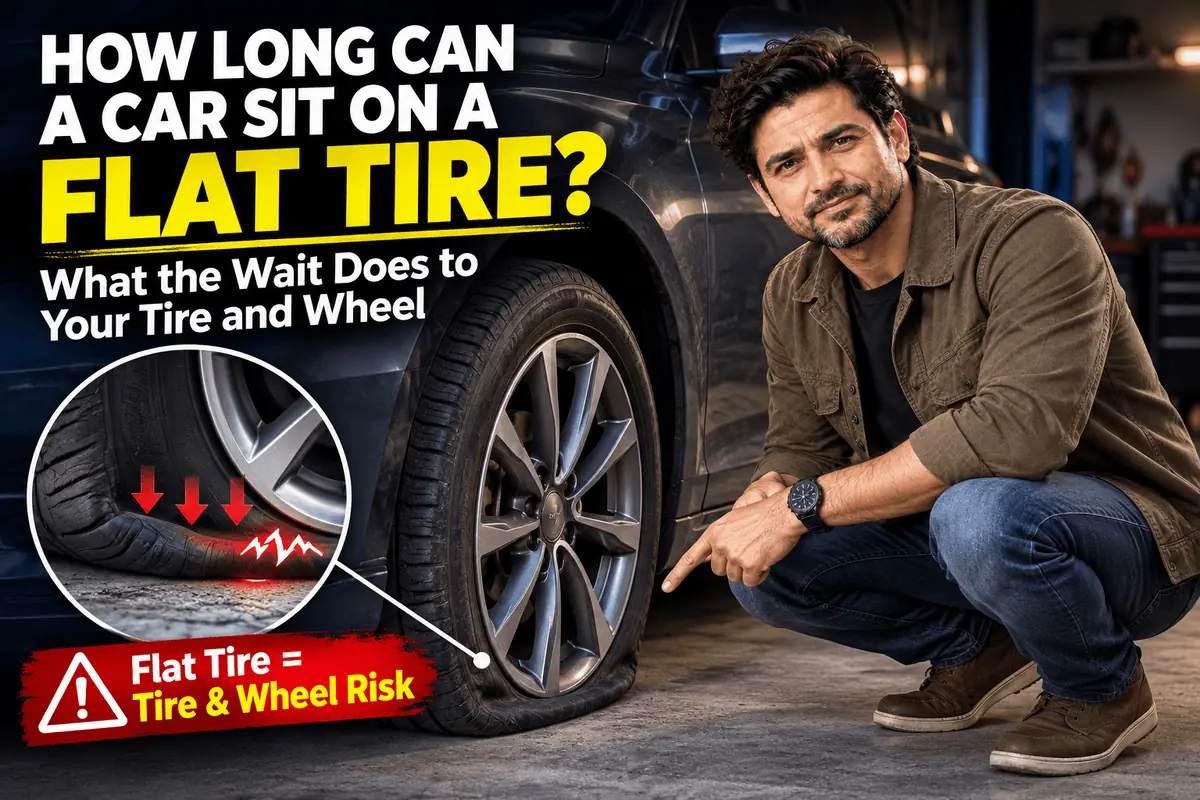
You walk out to the driveway and one corner of the car is sitting on its rim. Maybe you are traveling, maybe the car is a weekend vehicle or maybe there is simply no time to deal with it today. The natural question is whether it can wait, and for how long.
There is no clean number of hours or days that applies to every car. What is clear is that a flat tire is not resting while it waits. The full weight of that corner of the car is pressing the deflated sidewall into the ground and the wheel rim toward the pavement, and the risk grows with time, temperature and vehicle weight. This guide explains what actually gets damaged, how fast it can happen, what to do right away and how to protect a car that will sit for months.
Table of Contents
The Short Answer
Deal with it as soon as you reasonably can. A few hours on a flat is unlikely to change much for most cars, and an overnight wait is often survivable, but every additional day adds risk to the tire, and in some cases to the wheel. Over weeks, the odds that a repairable tire turns into a replacement rise sharply, especially on a heavy vehicle or in temperature extremes.
The cheapest outcome is almost always the fastest one. If the tire can be reinflated and moved, or swapped for the spare, the problem stops getting worse immediately.
If you can’t fix it today, at least get weight off that tire or add air to it. Either step stops most of the damage a flat tire suffers while parked.
What Happens When a Car Sits on a Flat
A properly inflated tire carries the car on a cushion of air. When that air is gone, the tire’s structure takes the load instead, and it was never built to do that while parked.
Sidewall Creasing and Cord Damage
With no pressure inside, the sidewall folds under the weight of the car. The longer it stays folded, the more the rubber and the cords inside it take a set along that crease. Cracking can start at the fold, and internal cords can be stressed or broken where they bend sharply. That kind of damage is not always visible, and it can show up later as a bulge or a weak spot. Once the sidewall is compromised, the tire is not repairable, even if the original puncture was a small nail in the tread.
Bead Problems
The bead is the reinforced edge of the tire that seals against the wheel. A tire that sits flat can shift on the rim, and the bead area can be crushed between the wheel and the ground. That can make the tire hard to seal again when you try to reinflate it, and a damaged bead is another reason a shop will refuse to reuse the tire.
Wheel Damage
When the tire flattens completely, the wheel can end up resting very close to the ground through only a thin layer of folded rubber. On a hard surface, under a heavy vehicle, the rim lip can be pressed against that rubber and the pavement for a long period. Sitting still is far less damaging than rolling, but the risk is not zero, and alloy wheels are more vulnerable to bends and cracks than steel ones. A bent rim can cause a slow leak or vibration later, and a cracked wheel needs replacement.
Flat Spots
Even an inflated tire develops a flat spot where it meets the ground if the car sits long enough, because the casing takes a set to the shape of the contact patch. Michelin notes that the most common type is temporary and that driving at normal highway speeds for more than 20 minutes relaxes most of it. A tire left sitting underinflated, under load, in heat for a long period can develop a more stubborn semi-permanent flat spot that takes much longer to go away. A tire that sat completely flat is in a worse position still, because the deformation is far deeper.
Suspension and Body
A car sitting low on one corner puts that corner’s suspension at an unusual angle, but while parked, the strain is modest. The real risk to suspension, steering and alignment comes from driving on the flat, which is covered below.
What Speeds Up the Damage
The same flat tire can survive a long wait in one situation and be ruined quickly in another.
| Factor | Why It Matters | Higher-Risk Situation |
|---|---|---|
| Vehicle weight | More load folds the sidewall harder and presses the rim closer to the ground | Full-size trucks, large SUVs, loaded vehicles, heavy EVs |
| Temperature | Heat softens rubber and speeds aging, while cold makes it stiffer and more prone to cracking | Summer sun on dark pavement, deep winter cold |
| Surface | Hard, uneven surfaces concentrate pressure on the rim and sidewall | Gravel, broken concrete, curbs |
| Tire construction | Low-profile tires leave less sidewall between the rim and the ground | Performance tires on large-diameter wheels |
| Time | Rubber and cords take a deeper set the longer they stay deformed | Weeks or months without action |
| Partial vs total flat | A tire with some pressure still supports part of the load | Zero pressure with the rim resting near the ground |
Low-profile tires deserve a special note. With very little sidewall, the wheel has almost no cushion when the tire goes flat, so rim damage becomes more likely and happens sooner.
What to Do Right Away
You do not need to fix the flat permanently today, but you should stop it from doing more damage.
Option 1: Reinflate It
If the leak is slow, adding air may hold for hours or days. A portable 12-volt compressor or a trip to an air pump gets the tire back into shape and the load back onto air. Check the pressure again later the same day to gauge how fast it is leaking. A tire that holds air for a while can usually be driven a short distance to a shop at moderate speed. Our guide to whether you can use Fix-a-Flat for a slow leak explains when a sealant makes sense as a stopgap and what to tell the shop if you use one.
Option 2: Put the Spare On
If the tire will not hold air, change it. A full-size spare can stay on until the flat is repaired or replaced. A compact temporary spare comes with limits printed on its sidewall, commonly 50 mph and a limited distance often quoted around 50 to 70 miles. Follow the label for your spare. It is a bridge to the tire shop, not a replacement.
Option 3: Take the Weight Off
If you cannot do either of those right now, raising that corner with a jack and supporting it on a jack stand takes the load off the tire and wheel. Never rely on a jack alone to hold the car for any length of time, and never get under a car supported only by a jack.
Option 4: Call for Help
Roadside assistance can change the tire, bring air or tow the car to a shop. Many vehicles include it for a period under the new-car warranty, and it is also offered through auto clubs and some insurance policies. If you lack a spare, tools or a safe place to work, this is the sensible route.
Why You Shouldn’t Drive on a Flat
Sitting on a flat is slow damage. Driving on one is fast damage.
When a tire rolls without air, the sidewall flexes far past its normal range with every revolution. That generates a great deal of heat, which can break down the inner liner and the cords in a short distance. A tire that had a small, perfectly repairable puncture can be ruined before you reach the next exit. The rim can be bent or cracked by contact with the road, and the tire can come off the wheel entirely.
There is also the safety side. A flat tire reduces steering control, braking ability and stability, particularly at speed or in an emergency maneuver. If the tire goes flat while driving, slow down gradually, signal and get off the road as soon as it is safe. If you must move the car to escape a dangerous spot, keep it short and slow, and accept that the tire may be finished.
Run-flat tires are the exception, but only within their limits. Their reinforced sidewalls let them keep going after losing pressure, typically for around 50 miles at up to 50 mph, though the exact figures depend on the tire and vehicle. Check the owner’s manual and tire maker’s guidance, and plan on having the tire inspected and possibly replaced afterward.
Storing a Car for Weeks or Months
A car that sits for a season faces many of the same forces on all four tires, even when they start out fully inflated. A few precautions prevent flat spots and slow leaks from turning into new tires.
- Inflate to the placard pressure before storage. Use the figure on the driver’s door jamb. Avoid running tires well above it, since overinflation combined with load and heat contributes to stubborn flat spots.
- Check pressure periodically. Tires lose air slowly even without a puncture. A monthly check catches a tire before it goes flat.
- Move the car now and then. Rolling it a few feet changes the contact point. Driving long enough to warm the tires is even better.
- Consider jack stands or tire cradles for long storage. Taking the weight off the tires prevents flat spotting. Support the car at the manufacturer’s lift points.
- Store out of heat and sun. A cool, dry, shaded spot slows rubber aging. Keep tires away from chemicals, solvents and equipment that produces ozone, such as electric motors.
- Clean and inspect before driving. Look for cracking, bulges and low pressure, and expect some vibration for the first few miles while temporary flat spots work out.
If you have a vehicle that sits more than it drives, also keep an eye on tire age. Many tire retailers and vehicle makers suggest replacing tires around 6 years of age regardless of tread, and 10 years from the date of manufacture is widely treated as the outside limit. Rubber that has aged in storage is more likely to crack when a tire goes flat.
Preventing the Next Flat
Most flats are punctures, but some are preventable. Check pressure monthly, including the spare, and keep it at the placard level. Underinflated tires flex more, run hotter and are more prone to damage. Rotate tires on the schedule in your owner’s manual, commonly every 5,000 to 8,000 miles. Look for cuts, bulges and uneven wear, which can signal alignment or suspension problems, and replace tires before the tread reaches 2/32 inch. A leaking valve stem or a corroded bead seat can also cause slow leaks, so have a tire that keeps losing air checked rather than just refilled.
Frequently Asked Questions
For most passenger cars, one night on a flat is unlikely to cause serious harm, especially on a smooth surface in mild weather. It is still worth adding air or putting on the spare as soon as you can, because the risk of sidewall and bead damage builds with time.
It can. When the tire is fully deflated, the rim can rest very close to the ground through a thin layer of folded rubber. Heavy vehicles, low-profile tires and hard or uneven surfaces raise the risk of a bent or cracked rim, particularly with alloy wheels.
Sometimes, but a technician needs to inspect it from the inside. If the sidewall has creased, the bead is damaged or the inner liner shows wear, the tire should be replaced even if the original puncture was small and in the tread.
Ideally not at all. Driving on a flat quickly overheats and destroys the sidewall and can damage the wheel. Only move the car if staying put is unsafe, and keep it as short and slow as possible. Run-flat tires are the exception, within the distance and speed limits set for them.
Most do. Temporary flat spots usually disappear once the tires warm up on the road, and Michelin notes that more than 20 minutes at normal highway speeds relaxes most of them. Flat spots from long storage under load, overinflation and heat can take much longer. If vibration persists, have the tires and wheels inspected.
For several months, yes. For storage lasting several months, taking the weight off the tires with jack stands or tire cradles is an effective way to prevent flat spots. Place the stands at the manufacturer’s recommended support points.
Final Word: Don’t Let a Flat Wait
A car can sit on a flat tire for a short time without much consequence, but the clock is running from the moment the air is gone. Weight, heat, cold, low-profile tires and hard ground all shorten the safe window, and the damage that builds up in the sidewall, bead and rim can turn a cheap repair into a new tire or a new wheel.
The fix does not have to be complete to be effective. Adding air, mounting the spare or getting that corner on a jack stand stops most of the harm while you arrange a proper repair. And whatever you do, avoid driving on the flat. A few minutes of patience on the shoulder costs far less than a ruined tire and wheel.
 Summarize this article with:















Leave a comment