


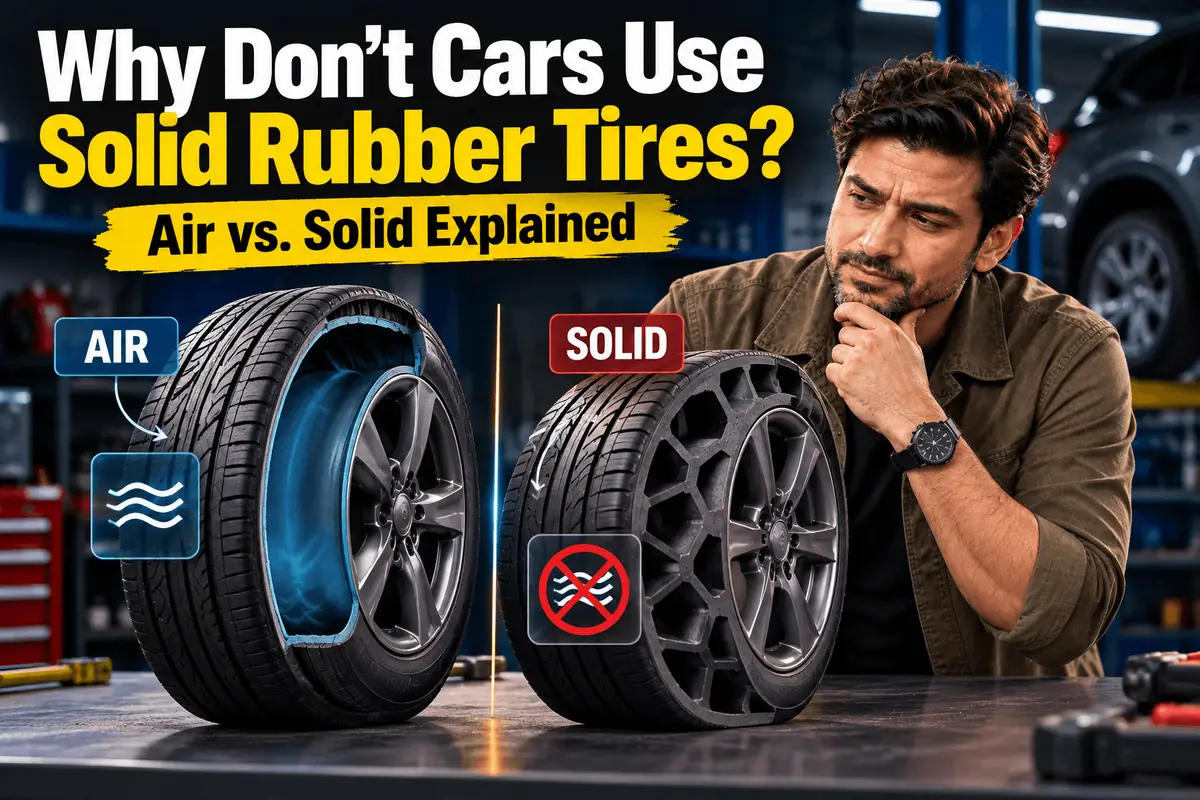
Every flat tire raises the same question. If air is the thing that leaks out and leaves you stranded, why not just make tires out of solid rubber and be done with punctures forever? Forklifts run on solid tires. So do plenty of lawn tractors and warehouse carts. It seems like an obvious fix that the tire industry has somehow overlooked.
It has not been overlooked. Solid tires were common on early motor vehicles, and the switch to air happened for very good reasons that still apply today. Air does far more than fill space inside the rubber: it carries the load, cushions the ride, helps manage heat and keeps the tread pressed into the road. This guide explains what air actually does, why solid rubber fails at highway speed, where solid tires still make sense and how close airless designs from Michelin and Bridgestone are to replacing the inflated tire.
Table of Contents
What the Air Inside a Tire Actually Does
Air carries the load
The air in your tires, not the rubber, holds up the car. Pressurized air pushes outward against the inside of the casing, and that tension gives the tire the stiffness to support the vehicle. The rubber, cords and steel belts act as a container that shapes and contains the pressure. This is why a tire’s load capacity is tied directly to its inflation pressure, and why an underinflated tire sags and overheats.
The result is a remarkable strength-to-weight ratio. A tire weighing a couple dozen pounds can support well over a thousand pounds per corner because most of the work is done by air, which weighs almost nothing.
Air is the first spring in your suspension
When a tire hits a bump, the air compresses for an instant and then rebounds. That makes the tire the first layer of your suspension, absorbing small, sharp impacts before they ever reach the shocks, springs and body. Seams in concrete, coarse asphalt and small potholes are smoothed out largely by the tire. Without that cushion, every tiny imperfection would travel straight into the chassis.
Air helps the tread stay on the road
A properly inflated tire flexes to form a flat, consistent contact patch, and it conforms to the texture of the road surface. On uneven pavement, that flexibility keeps the tread in contact with the ground instead of skipping over high spots. Consistent contact is what gives you steering response, braking grip and stability in a corner.
Air helps manage heat
All tires generate heat as they flex. In an inflated tire, the flexing is concentrated in relatively thin sidewalls and a thin layer of tread, so the amount of rubber being worked and heated is limited. The air inside also circulates and moves heat away from hot spots. Heat is the enemy of rubber, so this matters enormously at highway speed.
Air pressure can be adjusted
Inflation pressure gives engineers and drivers a tuning tool. Automakers specify pressures that balance comfort, handling, load and efficiency for each vehicle. Off-road drivers air down for sand and rocks to lengthen the footprint, and some military and off-road vehicles use central tire inflation systems that change pressure from the cab. A solid tire offers none of that flexibility.
Why Solid Rubber Fails on Cars
Solid tires solve one problem, punctures, and create several worse ones. At walking pace those trade-offs are tolerable. At 70 mph they are not.
Weight
A solid tire replaces air with rubber, and rubber is heavy. A solid tire in a passenger car size would weigh several times as much as an inflated tire, and all of that mass is unsprung weight that the suspension has to control. Heavy wheels make the car slower to accelerate and stop, harder for the suspension to keep planted and less efficient to drive. Rotating mass is especially costly because the car must spin it up as well as move it forward.
Heat buildup at speed
This is the decisive problem. A thick block of solid rubber deforms with every revolution, and rubber is a poor conductor of heat. The core of the tire gets hotter and hotter with nowhere for the heat to escape. Solid industrial tires are rated for low speeds precisely for this reason. Run one at highway speed for long enough and the internal heat can break down the rubber, leading to chunking, separation or outright failure.
A harsh ride that damages the vehicle
Solid rubber does compress slightly, but nowhere near as much as an air chamber. Bumps that an inflated tire swallows are passed straight into the suspension, body and occupants. Beyond comfort, that constant pounding accelerates wear on bushings, ball joints, wheel bearings, shocks and even body mounts and interior trim. Passenger car suspensions are tuned on the assumption that the tires will absorb a meaningful share of impacts.
Poor grip
A solid tire cannot flex and conform the way an inflated one can, so its contact patch is smaller and less consistent. On rough or wet pavement it is more likely to skip and lose contact. Braking distances suffer, cornering grip drops and the car feels nervous over mid-corner bumps. Solid tires also handle water poorly because the tread cannot deform to maintain pressure on the road.
Cost and rolling resistance
Solid tires use far more rubber per tire, which raises material costs. Solid rubber also tends to waste more energy as heat with each revolution, increasing rolling resistance and fuel consumption. When a solid tire wears out, the whole unit is replaced, while a punctured pneumatic tire can often be repaired for a small fraction of its cost.
| Factor | Air-Filled Tire | Solid Rubber Tire |
|---|---|---|
| Ride comfort | Absorbs small impacts and road texture | Harsh, transmits most impacts |
| Weight | Light for its load capacity | Several times heavier |
| Heat at highway speed | Manages heat well when properly inflated | Builds internal heat, limited to low speeds |
| Grip | Flexes to form a consistent contact patch | Smaller, less consistent contact |
| Adjustability | Pressure can be tuned for load and terrain | None |
| Puncture risk | Vulnerable to nails and cuts | Effectively puncture-proof |
| Maintenance | Regular pressure checks needed | Almost none |
Where Solid Tires Make Sense
Solid tires thrive where speeds are low, loads are heavy and a flat tire would be expensive or dangerous. Those conditions describe a lot of industrial work.
- Forklifts. Most indoor forklifts run on solid tires, either press-on bands or solid pneumatic-shaped tires. They move slowly, carry heavy loads and work in warehouses where a sudden flat with a raised load is a serious safety hazard.
- Industrial and construction equipment. Skid steers, scissor lifts, pallet jacks, airport ground support equipment and machines working in demolition, recycling or waste handling often use solid or foam-filled tires because sharp debris is everywhere.
- Lawn and garden equipment. Many push mowers, wheelbarrows, hand trucks and some riding mowers use solid or flat-free tires. Low speeds make the harsher ride acceptable, and never having to inflate a wheelbarrow tire is a real convenience.
What these uses share is speed. At a few miles per hour, heat buildup is minimal and the harsh ride is a minor annoyance. The trade-off only becomes unworkable as speed and distance rise.
Solid tires are not a failed idea. They are the right answer for slow, heavy, puncture-prone work, and the wrong answer for highway driving.
Airless Tires: The Middle Ground
The real future alternative to the inflated tire is not solid rubber but airless, or non-pneumatic, designs. These replace air with a flexible structure, usually spokes or a web made from polymers, that bends under load the way an air chamber compresses. The goal is to keep most of the comfort and grip of air while eliminating flats.
Michelin X Tweel
The Tweel, a combination of tire and wheel, is the best-known airless design on sale today. It uses flexible polyurethane spokes attached to a shear band and tread, all mounted on a rigid hub. Michelin sells X Tweel versions for UTVs and for zero-turn mowers and other turf equipment, along with skid steers and other construction machines. These are low-to-moderate-speed uses where flat-free operation is a big advantage and the ride is acceptable.
Michelin Uptis
The Uptis, short for Unique Puncture-proof Tire System, is Michelin’s attempt to bring airless technology to passenger cars. Michelin and General Motors showed the prototype in 2019 and have tested it on vehicles including the Chevrolet Bolt EV. Michelin has also run a pilot with DHL Express delivery vans in Singapore. Early announcements targeted a passenger car launch around 2024, but that date has passed, and Michelin has indicated there are no immediate plans to sell Uptis to consumers while testing continues. It remains a promising development rather than something you can buy.
Bridgestone’s air-free concept
Bridgestone has been developing its own air-free tire for more than a decade, using a web of resin spokes that supports the load. The company has shown versions for bicycles and small vehicles and continues to test passenger-size designs. Engineering hurdles remain, including keeping debris and snow from packing into the spokes and achieving consistent ride and handling.
What still holds airless tires back
Airless designs still face trade-offs. They can generate more heat and noise than inflated tires at highway speed, they are more expensive to manufacture, and the industry has yet to settle the standards and testing requirements that would govern them on public roads. Many in the industry expect wider adoption to take years rather than months. For now, the inflated radial tire remains the best all-round answer for cars, trucks and SUVs.
Making Your Air-Filled Tires More Puncture Resistant
If your real goal is fewer flats, you do not need to give up air. Self-sealing tires, which carry a sealant layer inside the tread, can close many nail punctures before they lose pressure. Run-flat tires use stiffened sidewalls to carry the car for a limited distance after losing air. Keeping tires properly inflated and replacing them before the tread wears thin also helps. Our bulletproof tires guide covers the more extreme end of this spectrum, from run-flat inserts to military-grade designs.
Frequently Asked Questions
Solid rubber tires are far heavier than inflated tires, build up dangerous internal heat at highway speed, deliver a harsh ride that damages the vehicle and provide less grip. The air in a pneumatic tire carries the load, cushions impacts and keeps the tread in consistent contact with the road, which solid rubber cannot match.
Yes, a solid tire cannot go flat because there is no air to lose. It can still be cut, chunked or worn out, and once it is worn the entire tire has to be replaced. That puncture resistance is why solid tires are popular on forklifts and industrial equipment.
Forklifts move slowly, carry heavy loads and often work around debris. At those low speeds, heat buildup and ride harshness are not serious problems, and eliminating flats prevents dangerous situations with a raised load and costly downtime.
Not yet. Michelin’s Uptis passenger car tire has been tested with General Motors and in a delivery van pilot, but it is not available to consumers. Airless tires are sold for UTVs, mowers and construction equipment, such as the Michelin X Tweel.
No. Solid tires are much heavier and tend to waste more energy as heat with each revolution, which increases rolling resistance. Both effects make the vehicle less efficient, not more.
No. Solid tires are a block of rubber, while airless tires use a flexible structure of spokes or webbing to support the load. That structure flexes like an air chamber, giving a much better ride and less heat buildup than solid rubber.
Without air they lose the cushioning, load support and heat management that air provides, so solid tires ride harshly, build up heat and fail at highway speed. That is why they are limited to slow vehicles such as forklifts.
The Bottom Line on Air vs Solid
Air wins on almost every measure that matters for road vehicles. It carries heavy loads with very little weight, smooths out the road, keeps heat in check at speed and lets the tread grip consistently. Solid rubber eliminates flats but pays for it with weight, heat, harshness and poor grip, which is why it belongs on forklifts, industrial machines and lawn equipment rather than passenger cars.
Airless designs such as the Michelin Tweel and the Uptis prototype point to a future where puncture-proof tires might reach the highway, but that future is not here yet. Until it is, the best defense against flats is a well-maintained inflated tire, perhaps with self-sealing or run-flat technology if punctures are a recurring headache.
 Summarize this article with:














Leave a comment