


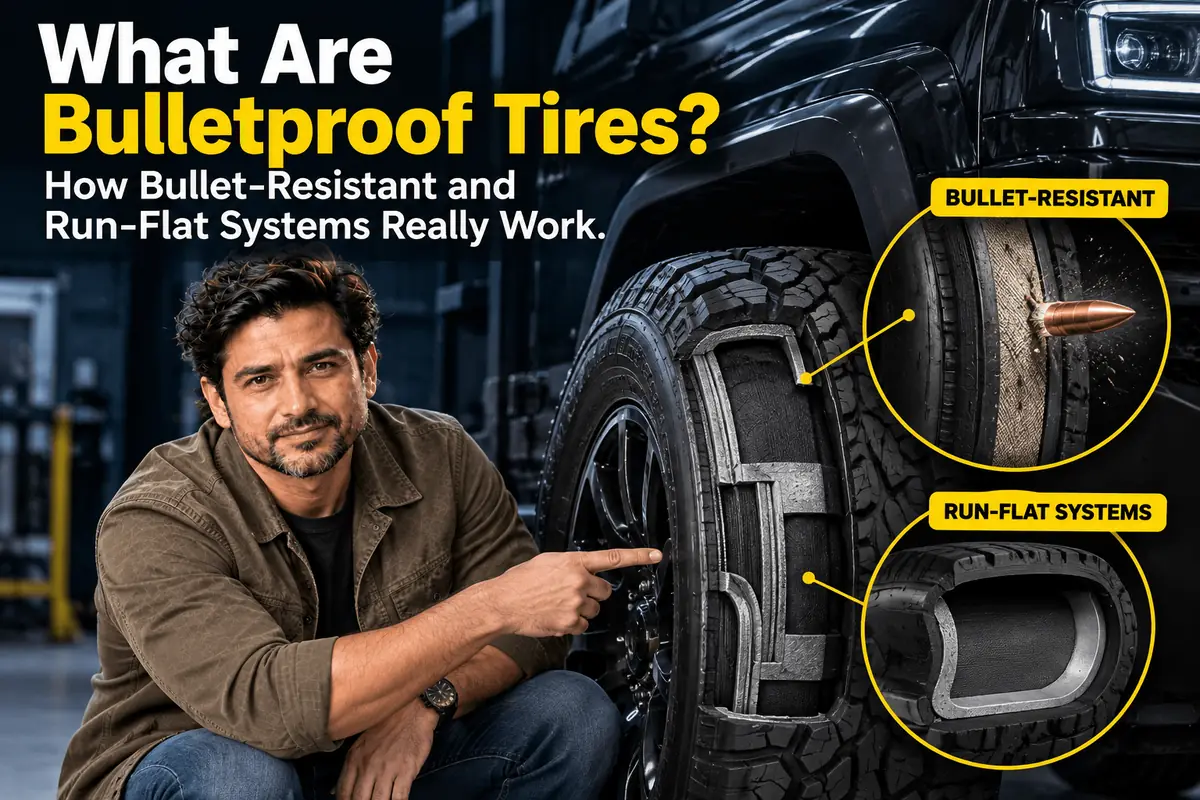
Movies have taught a lot of people that some vehicles roll on tires a bullet simply bounces off. Armored SUVs, presidential motorcades and military trucks all seem to shrug off gunfire and keep driving. That image raises a reasonable question for anyone shopping for security, or just curious: can you buy a tire that cannot be shot flat, and what does it take to put one on your own vehicle?
The short answer is that “bulletproof tire” is a misnomer. No practical road tire stops bullets the way armor plate does. What exists instead is a family of bullet-resistant and run-flat technologies built around one goal: keeping a damaged vehicle moving long enough to get its occupants out of danger. Understanding how those systems work, who uses them and what they cost tells you far more than the marketing label ever will.
Table of Contents
Why “Bulletproof” Is the Wrong Word
A conventional tire is a flexible rubber casing held in shape by compressed air. Puncture it with a bullet, a nail or a shard of metal, and the air escapes. Once the pressure is gone, the sidewalls fold under the vehicle’s weight, the tire can come off the bead and the wheel ends up grinding on the pavement.
So-called bulletproof tires attack that chain of failure at the point where it matters. Most of them still lose air when shot. The difference is that something other than air takes over the job of carrying the load. That might be a rigid ring inside the tire, a sidewall stiff enough to hold the vehicle up on its own, or a structure that never relied on air in the first place.
The real measure of these systems is mobility after damage, not immunity to it. A security vehicle with a shot tire that can still drive away from an ambush at reduced speed has done exactly what it needs to do.
The Main Types of Bullet-Resistant Tire Systems
Run-Flat Inserts
Run-flat inserts are the backbone of armored-vehicle tire protection. An insert is a rigid ring, usually made of hard rubber, composite or a polymer, that mounts on the wheel inside the tire. Under normal driving it sits clear of the tread and does nothing. When the tire loses pressure, the casing collapses onto the insert, which then carries the vehicle’s weight and keeps the tire seated on the rim.
Hutchinson, a French company, is one of the best-known makers of these systems and supplies run-flat inserts for military and security vehicles around the world. Other suppliers build similar inserts for armored SUVs, sedans and cash-in-transit trucks. Because the insert lives inside an ordinary-looking tire, an armored vehicle fitted this way does not look different from the outside.
Inserts typically require specific wheels, often multi-piece or specially designed rims, and fitting them takes specialized equipment and training. That is a large part of why they show up on purpose-built armored vehicles rather than on everyday cars.
Self-Supporting Reinforced Sidewalls
A self-supporting design builds the run-flat capability into the tire itself. Thick, stiff sidewalls made with heat-resistant rubber and reinforcing layers can hold up the vehicle even with no air pressure. The bead area is also reinforced so the tire stays locked to the wheel when deflated.
This is the same basic principle used in consumer run-flat tires sold on many passenger cars. Security versions push it further, with heavier construction and more robust sidewalls rated to support armored weight. Some designs also add tough fiber layers such as aramid (the family of fibers that includes Kevlar) to improve cut and puncture resistance, though those layers make the tire harder to penetrate rather than impenetrable.
Solid and Airless Tires
The most literal answer to the “can’t be shot flat” question is a tire with no air to lose. Solid rubber tires, foam-filled tires and non-pneumatic designs that use spokes or a honeycomb-like structure all fall into this group. A bullet can gouge them, but there is no pressure to escape, so the tire keeps its shape.
The catch is ride quality and heat. Solid and foam-filled tires are heavy, ride harshly and generate a lot of heat at sustained speed, which limits them mainly to industrial, construction and specialized military uses. Airless designs are improving, but they remain uncommon on road vehicles that need to cruise at highway speed.
Central Tire Inflation Systems
Many military trucks and tactical vehicles carry a central tire inflation system, often shortened to CTIS. It connects each tire to an onboard air supply so the crew can raise or lower pressures from the cab. Its everyday job is to let drivers drop pressure for sand, mud or snow and restore it for pavement.
CTIS also adds damage tolerance. If a tire takes a hit that causes a slow leak, the system can keep pumping air in to offset the loss and hold usable pressure. It cannot save a tire with a massive hole, which is why military vehicles frequently combine CTIS with run-flat inserts.
Other Approaches
A few other designs appear in specialized applications. Multi-chamber tires split the air volume into separate compartments, so a single puncture does not deflate the entire tire. Sealant liners can close small punctures from nails and screws, though a bullet wound is usually beyond what a sealant can handle. These technologies tend to supplement inserts or reinforced sidewalls rather than replace them.
| System | How It Works | Strengths | Limitations |
|---|---|---|---|
| Run-flat insert | Rigid ring on the wheel carries the load after air loss | Proven on armored and military vehicles, invisible from outside | Needs special wheels and fitting equipment, adds weight |
| Reinforced sidewall | Stiff sidewalls support the vehicle with no pressure | No special wheel needed, familiar consumer technology | Limited capability under very heavy armored weight |
| Solid or airless | No air to lose | Cannot go flat | Heavy, harsh ride, heat buildup at speed |
| Central tire inflation | Onboard air keeps refilling a leaking tire | Offsets slow leaks, adjusts pressure for terrain | Cannot keep up with large holes |
What They Can Actually Do After Damage
The capability every one of these systems shares is limited distance at reduced speed. A damaged tire riding on an insert or a reinforced sidewall is working under stress it was never meant to sustain indefinitely. Heat builds quickly, and the structure degrades the longer and faster the vehicle travels.
Exact figures depend heavily on the system, the vehicle’s weight, the extent of the damage and the road surface. As a general picture, security run-flat systems are built to carry a vehicle somewhere in the range of tens of miles at moderate speeds rather than hundreds of miles at highway pace. That is enough to escape an attack, clear a dangerous area or reach a secure location. It is not a license to keep driving normally until the next scheduled service.
Think of a bullet-resistant tire as an escape tool. Its job is to buy distance and time after an attack, not to let the vehicle carry on as though nothing happened.
After any run-flat event, the damaged tire and, in many cases, the insert need professional inspection and usually replacement.
Who Uses Bulletproof Tires
Military Forces
Military vehicles are the largest and most demanding users. Tactical trucks, armored personnel carriers and patrol vehicles operate where gunfire, shrapnel and debris are real threats, so most rely on a combination of run-flat inserts, CTIS and rugged off-road tread patterns.
Armored and VIP Vehicles
Government officials, diplomats, executives and other high-profile individuals often travel in armored SUVs and sedans. Run-flat protection is a core part of those builds, alongside armored body panels and bullet-resistant glass. Protecting the cabin means little if a single shot to a tire can stop the vehicle in the middle of an ambush.
Security, Law Enforcement and Cash Transport
Cash-in-transit trucks, some law enforcement and tactical units, and organizations working in unstable regions also use run-flat systems. For these fleets, the ability to keep moving after a tire is deliberately targeted is as much a security requirement as locks and armor.
Trade-Offs That Come With Bullet Resistance
Protection is never free. The extra structure that keeps a tire usable after damage brings a set of compromises that matter in daily driving.
- Weight: Inserts and reinforced construction add significant unsprung weight, which can dull acceleration, braking and handling and increase fuel consumption.
- Ride comfort and noise: Stiffer sidewalls and heavier assemblies transmit more impact harshness and road noise into the cabin.
- Suspension wear: Heavier wheel and tire assemblies put extra load on suspension and steering components.
- Speed limits: Many security tire assemblies carry lower speed ratings than the high-performance tires found on luxury vehicles.
- Servicing: Mounting and removing inserts requires trained technicians and specialized equipment, so a regular tire shop may not be able to help.
None of these drawbacks matter much to an armored-vehicle operator weighing them against the risk of being stranded under fire. They matter a great deal to anyone considering the technology for an ordinary car.
Can Civilians Buy Bulletproof Tires?
Yes, in most cases. In the United States, run-flat inserts and security tire systems are generally legal for civilian purchase and use. No federal law prohibits them, and they are sold through armoring companies, security vehicle outfitters and specialist suppliers. Laws can differ in other countries, where some systems may be treated as security or defense equipment, so anyone planning to export a vehicle or drive it across borders should check local rules first.
Availability is a different question from legality. Most suppliers sell run-flat systems as part of a professional armoring package or through installers who can match the insert, wheel and tire to the vehicle’s weight. Buying an insert and bolting it onto any car is rarely an option.
What They Cost
Costs vary widely with the vehicle, system and supplier, so treat any figure as a rough guide. A set of run-flat inserts with compatible wheels and professional installation for an SUV can easily run into several thousand dollars, and heavy armored or military-grade systems cost considerably more. Replacement after a run-flat event adds to the bill, since the damaged tire and often the insert must be replaced. Compared with even premium conventional tires, the total cost is many times higher.
How They Compare With Consumer Run-Flat Tires
Consumer run-flat tires sold on many BMW, Mini and other passenger models use the self-supporting reinforced sidewall approach. They let a driver continue after a puncture, usually for a limited distance at reduced speed set by the tire or vehicle maker, so the car can reach a shop instead of stopping on the shoulder. Our run-flat tires guide explains how those tires work and what owners should expect.
The core idea is the same, but the purpose is different. Consumer run-flats exist to handle nails, screws and road debris and to eliminate the need for a roadside spare tire change. Security systems are built for heavier vehicles, deliberate attacks and worse damage, and they are engineered for escape rather than convenience. A consumer run-flat that takes a bullet may keep going for a short distance, but it was never rated for that scenario, and it should not be treated as a substitute for a true security system.
For most drivers, a quality consumer run-flat tire or a good conventional tire paired with a spare or repair kit is the sensible choice. Security-grade systems only make sense when the threat itself justifies the cost and compromises.
Caring for Run-Flat and Security Tires
Security tire systems need the same basics as any tire, with a few added priorities.
- Check pressures regularly with a gauge. Reinforced sidewalls can hide low pressure, so a tire may look normal while running underinflated.
- Rely on a working tire pressure monitoring system, since it is often the only warning that a run-flat tire has lost air.
- Inspect tread and sidewalls for cuts, bulges and embedded objects.
- Keep up with rotation and alignment to avoid uneven wear on heavy assemblies.
- Respect the load and speed ratings, which matter even more on heavy armored vehicles.
- Use installers trained on run-flat inserts for mounting, removal and post-damage inspection.
- Replace tires by age as well as tread depth, following the manufacturer’s recommendation.
Frequently Asked Questions
Not in the way the name suggests. Most still lose air when shot. What they do is keep the vehicle moving afterward, using an internal insert, reinforced sidewalls or an airless structure to carry the load for a limited distance.
It depends on the system, the vehicle’s weight, the damage and the road. As a general rule, security run-flat systems allow tens of miles at reduced speed, enough to escape a threat or reach safety, rather than normal driving over long distances.
Generally, yes. Civilians can legally buy and use run-flat inserts and security tire systems in the US. Rules can differ abroad, so check local laws before exporting a vehicle or driving it across borders.
Expect several thousand dollars or more for a set of inserts with compatible wheels and professional installation on an SUV, with heavier armored and military systems costing considerably more. Costs vary widely by vehicle and supplier.
Consumer run-flat tires use stiff sidewalls to get a car to a shop after an everyday puncture. Security systems, often built around rigid inserts, are made for heavier armored vehicles and deliberate attacks, with the goal of escape rather than convenience.
Yes. The added weight and stiffness usually mean a firmer, noisier ride, slower acceleration and braking, more suspension wear and higher fuel consumption. Many assemblies also carry lower speed ratings than performance tires.
Military forces, armored VIP and diplomatic vehicles, cash-in-transit trucks, some law enforcement units and organizations working in high-risk regions are the main users.
The Bottom Line on Bullet-Resistant Tires
Bulletproof tires are real in function, if not in name. Run-flat inserts from companies such as Hutchinson, self-supporting reinforced sidewalls, airless designs and central tire inflation systems all serve the same purpose: keeping a damaged vehicle mobile long enough to get people out of harm’s way. They do it at reduced speed over a limited distance, and they ask for a lot in return in weight, comfort, servicing and cost.
For military, armored and security fleets, that bargain makes sense. For everyday drivers, it rarely does. A consumer run-flat or a quality conventional tire handles the punctures most people actually face, at a fraction of the cost and with a far better ride.
 Summarize this article with:













Leave a comment