


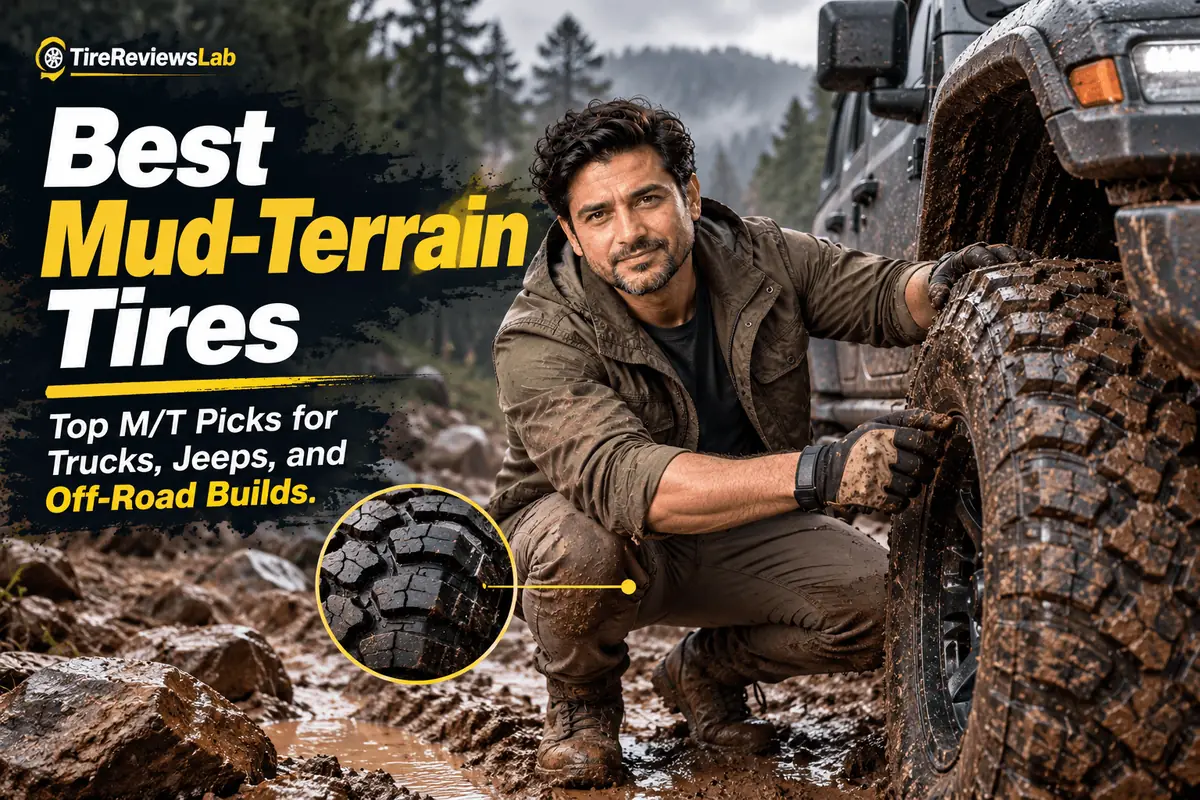
A mud-terrain tire is a specialist, and buying one is an admission that the pavement isn’t where the truck does its most important work. Big tread blocks, wide voids, and armored sidewalls let an M/T claw through clay that would turn an all-terrain into a slick, rubber donut, and crawl over rock that would slice a highway tire open. The price is paid on the commute home: more noise, more weight, a firmer ride, and tread that wears faster on asphalt.
That trade-off is why the best mud-terrain tire depends so much on the build. A rock-crawling Jeep, a three-quarter-ton diesel that tows all week, and a budget weekend rig each want something different. This guide compares ten of the strongest M/T tires, explains where each one fits, and covers the sizing, pressure, and maintenance habits that keep an expensive set alive.
How this guide was put together: We have not road-tested these tires. Picks are based on manufacturer specifications, warranty terms and retailer listings, with sources listed at the end. Tread-life and price figures are typical ranges. An earlier version listed a 50,000-mile warranty on the Baja Boss M/T, which carries none; that has been corrected. Checked on October 22, 2026.
Table of Contents
Mud-Terrain Tires at a Glance
| Tire | Best For | Strongest Terrain | Treadwear Warranty |
|---|---|---|---|
| BFGoodrich Mud-Terrain T/A KM3 | Best overall | Mud, rock, dirt | None (workmanship only) |
| Mickey Thompson Baja Boss M/T | Premium build, Jeeps | Mud, rock, wet road | None (defect coverage only) |
| Nitto Trail Grappler M/T | Heavy trucks, daily-driven rigs | Mud, rock, street | None (workmanship only) |
| Toyo Open Country M/T | Heavy-duty trucks and towing | Mud, dirt, deep snow | None (workmanship only) |
| Cooper Discoverer STT Pro | Mixed mud and rock | Mud, rock, gravel | None (workmanship only) |
| Falken Wildpeak M/T | Off-camber rock and dirt | Rock, mud, dirt | None (workmanship only) |
| Yokohama Geolandar M/T G003 | Tread life and looks | Mud, dirt, street | None (workmanship only) |
| General Grabber X3 | Balanced off-roading | Mud, dirt, rock | None (workmanship only) |
| Milestar Patagonia M/T | Budget builds | Rock, dirt, sand | None (workmanship only) |
| Dick Cepek Extreme Country | Lighter vehicles | Mud, dirt, street | None (workmanship only) |
What Makes a Mud Tire Work
The entire design of a mud-terrain tire revolves around one problem: mud sticks. A tire that can’t clear its tread packs full and loses grip almost instantly. M/T tires solve that with high void ratios, meaning lots of open space between big, independent tread blocks, so each rotation flings out the mud it just picked up and presents a clean, biting edge to the ground.
Three other features separate a serious mud tire from an aggressive-looking one:
- Sidewall armor. Rocky trails and aired-down pressures put the sidewall in harm’s way. Three-ply construction and branded protection systems such as BFGoodrich’s CoreGard or Cooper’s Armor-Tek3 make the difference between a scratch and a trail-ending slice.
- Shoulder and sidewall lugs. Lugs that wrap onto the sidewall, often called sidebiters, grab the walls of deep ruts and add grip on rocks when the tire is aired down.
- Stone ejectors. Small rubber bumps at the base of the grooves keep pebbles from lodging in the tread and slowly grinding into the casing, a process known as stone drilling.
Mud Terrain vs. All Terrain
| Factor | Mud Terrain (M/T) | All Terrain (A/T) |
|---|---|---|
| Mud and rock traction | Excellent | Moderate to good |
| Road noise | High; a noticeable hum | Low to moderate |
| Puncture resistance | Exceptional, usually 3-ply | Good, usually 2-ply or light 3-ply |
| Highway comfort | Stiff, rougher ride | Smooth and comfortable |
| Typical tread life | 30,000 – 45,000 miles | 50,000 – 65,000+ miles |
| Best use | Deep mud, rock crawling, extreme trails | Daily driving, dirt roads, sand, snow |
The large voids that help an M/T clear mud also put less rubber on the pavement, which costs wet-road grip and adds noise. An all-terrain’s tighter tread rides quieter and lasts longer but clogs quickly in thick mud. If the truck spends most of its life on asphalt, TireReviewsLab’s guide to the quietest all-terrain tires is the better starting point.
The Best Mud Terrain Tires
BFGoodrich Mud-Terrain T/A KM3: Best Overall
The KM3 is the reference point for the category. BFGoodrich’s Krawl-Tek compound gives it a sticky grip on slick rock and resists cutting and chipping, while massive independent tread blocks and Mud-Phobic bars in the shoulders break suction and release packed mud so the tire keeps digging. CoreGard Max Technology protects the sidewalls, and BFGoodrich says they’re 27 percent tougher than on the previous KM2.
It airs down into a huge footprint, which is a big part of why rock crawlers favor it. The drawbacks are predictable for a flagship: premium pricing and noticeable highway noise. TireReviewsLab’s BFGoodrich review covers the KM3’s on-road trade-offs in more detail.
Best for: serious off-roaders and rock crawlers who want the most complete mud tire available.
Mickey Thompson Baja Boss M/T: Best Premium Pick
Asymmetrical tread patterns are rare among mud tires, and that’s what makes the Baja Boss M/T stand out. The asymmetric layout sharpens on-road handling, trims noise, and improves grip on wet and dry pavement, which gives Jeeps in particular some welcome highway stability. Off-road, Mickey Thompson’s PowerPly XD 3-ply sidewall resists cuts, aggressive Sidebiters pull the truck forward in deep ruts and off-camber sections, and a silica-reinforced compound resists tearing.
Like most mud-terrains it carries no treadwear warranty, only defect coverage, and SimpleTire lists sizes from about $328 to $939 per tire (October 2026). It’s one of the most expensive options here, and it’s heavy.
Best for: premium builds and Jeep owners who want maximum traction and a premium build.
Nitto Trail Grappler M/T: The Mud Tire You Can Commute On
The Trail Grappler slots between Nitto’s ultra-aggressive Mud Grappler and its milder Terra Grappler, and that middle position suits trucks that work during the week and wheel on weekends. Nitto used 3D computer simulation to shape a tread that’s surprisingly quiet for a mud tire, while Z-groove center blocks add lateral stability. A thick 3-ply, high turn-up sidewall handles boulders and the weight of three-quarter- and one-ton trucks, and two sidewall designs let owners choose their look.
Wet and dry traction are both strong. It’s a very heavy tire, though, which hurts fuel economy, and the ride is stiff.
Best for: lifted trucks, heavy diesels, and Jeeps that need an aggressive tire without constant highway roar.
Toyo Open Country M/T: Built for Heavy Trucks
The Open Country M/T has been a lifted-truck staple for years, and its reputation rests on toughness. A high turn-up, 3-ply polyester casing gives it very high load capacity, so it handles the weight of three-quarter- and one-ton trucks that tow during the week. Hook-shaped tread blocks bite hard going forward, and an over-the-shoulder tread design helps pull it through deep snow and mud. It also wears well for a mud tire.
The weight costs fuel economy and acceleration, and road noise rises noticeably as the tread wears.
Best for: heavy-duty trucks that tow and still head into deep mud.
Cooper Discoverer STT Pro: The Most Puncture-Resistant Design
Cooper‘s Armor-Tek3 construction is the STT Pro’s headline feature. Rather than stacking three plies, Cooper angles the third ply to close gaps, which makes it much harder for a sharp branch or rock to pierce the sidewall. A flex groove in the buttress lets the tread and sidewall wrap around rocks and logs when aired down, a 3-2 inner rib layout reduces noise and adds stability, and asymmetrical scallops with mud-release dimples prevent packing. A silica compound improves wet traction and chip resistance.
The slightly softer compound may wear faster on heavy trucks, and pricing sits toward the high end.
Best for: drivers who move from deep mud to jagged rock on the same trail.
Falken Wildpeak M/T: Off-Camber Specialist
Proven in Ultra4 racing, the Wildpeak M/T is built for steep, uneven terrain. Offset shoulder blocks give it strong grip off-camber, Falken’s DURASPEC 3-ply sidewall stands up to punishment, and heat diffuser technology in the lower sidewall helps dissipate heat at low pressures or when towing heavy loads. Road manners are better than expected.
Sizing options are more limited than older rivals, and the compound runs a little hard, giving up some grip in cold weather. TireReviewsLab’s Falken review covers the rest of the Wildpeak family.
Best for: overlanders and trail drivers who see lots of off-camber rock and dirt.
Yokohama Geolandar M/T G003: Best for Tread Life
The G003 is one of the most striking tires available, but its real advantage is longevity. A high-density triple-polymer compound and a wider, flatter profile spread the vehicle’s weight evenly, so it lasts noticeably longer than typical mud tires. Yokohama‘s GEO-SHIELD construction combines multiple sidewall plies, steel belts, and a full nylon cap, and pitch-varied tread blocks help hold down noise.
It can struggle on solid ice, and the stiff sidewalls ride harshly on lighter vehicles.
Best for: daily-driven off-road rigs where long tread life and an aggressive look both matter.
General Grabber X3: Balanced and Good Value
General says “X3” stands for extreme mud, extreme dirt, and extreme rock, and the tire covers all three well. Multi-angle tread blocks find traction in any direction, an open pattern with evacuation channels clears mud quickly, and stone bumpers at the base of the grooves protect the casing. DURAGEN 3-ply construction resists punctures yet flexes enough for a big aired-down footprint, and optional red sidewall lettering gives it a distinctive look.
It can be louder than newer competitors, and wet pavement traction is only average.
Best for: Jeeps and weekend off-roaders who want balanced capability at a fair price.
Milestar Patagonia M/T: Best Budget Mud Tire
The Patagonia M/T has become a favorite of budget builders because it performs well above its price. Its tread is a hybrid: tightly packed center blocks behave like an all-terrain on the highway, while widely spaced shoulder blocks dig like a mud tire. That combination brings surprisingly good road manners and excellent rock grip when aired down. A 3-ply sidewall and integrated stone ejectors add durability.
Treadwear can be quicker than premium brands, and deep snow and ice aren’t its strengths.
Best for: budget-conscious builds and weekend Jeeps focused on rock crawling.
Dick Cepek Extreme Country: For Lighter Vehicles
Mud-terrain weight can overwhelm a lighter vehicle, and the Extreme Country tackles that directly. A two-ply high-tensile body cord and tighter inner tread voids save significant weight, which helps acceleration, fuel economy, and on-road handling on vehicles like older Jeep Wranglers and the Toyota Tacoma, where heavy unsprung weight can hurt performance and stress axles. Scalloped shoulder lugs still pull well through deep ruts.
The two-ply sidewall isn’t as tough as three-ply rivals on sharp rock, and availability can be limited.
Best for: mid-size trucks and lightweight Jeeps that need mud traction without the weight penalty.
Best Picks by Use
- Best overall: BFGoodrich Mud-Terrain T/A KM3
- Best budget: Milestar Patagonia M/T
- Best for Jeep Wranglers: Mickey Thompson Baja Boss M/T, for on-road stability
- Best for heavy-duty trucks: Toyo Open Country M/T
- Best for daily-driven trucks: Nitto Trail Grappler M/T
- Best for tread life: Yokohama Geolandar M/T G003
Who Actually Needs a Mud Tire
Mud tires make sense for off-road enthusiasts who regularly drive far from pavement, rock crawlers who air down to single-digit pressures, drivers in swampy or heavy-clay regions, and overlanders who need puncture resistance in remote country. They’re also the classic look for a heavily lifted truck. For drivers who spend most of their miles on the highway, a mud tire usually means paying in noise, fuel, and tread life for capability that rarely gets used.
How to Choose
Void ratio. Bigger voids clear mud better but are louder on pavement. Hybrid designs like the Milestar Patagonia tighten the center blocks to split the difference.
Sidewall strength. For rocky terrain, three-ply construction is essential. Two-ply tires are lighter and ride better but are far easier to slice on sharp rock or branches.
Size and weight. Mud tires are heavy. Fitting 35- or 37-inch M/Ts to a stock vehicle hurts fuel economy and acceleration and loads up brakes, axles, and the transmission, so make sure the vehicle is geared and built for the extra mass. TireReviewsLab’s guide to the best tires for lifted trucks covers sizing by lift height.
Noise. Every mud tire hums, but pitch-tuned designs like the Nitto Trail Grappler and Mickey Thompson Baja Boss M/T keep it down.
Budget. Premium tires from BFGoodrich, Toyo, and Mickey Thompson can cost $400 to $500 or more per tire in large sizes and deliver the best balance of traction, durability, and road manners. Budget options from Milestar and General grip well off-road but may wear faster or ride rougher.
Making Mud Tires Last
- Air down on the trail, air up for the road. Dropping to roughly 12 to 18 PSI lengthens the footprint for traction and a smoother ride over rock. On the street, use the door-jamb pressure or a chalk test, and always re-inflate before highway driving.
- Rotate every 3,000 to 5,000 miles. Big tread blocks are prone to cupping. A five-tire rotation with a matching full-size spare stretches the life of the set.
- Wash out the mud. Dried mud inside the wheel barrel throws off balance and causes violent shaking at highway speed.
- Watch alignment and shocks. Off-roading knocks alignment out quickly, and a bad alignment or worn shocks can destroy a $400 tire in months.
Frequently Asked Questions
Yes, but they aren’t optimized for it. Expect more noise, a stiffer ride, and weaker handling, especially on wet pavement, than an all-terrain or highway tire.
Yes. Their weight and rolling resistance typically cost 1 to 3 mpg, depending on size.
In deep powder, yes; on ice, no. In deep, unplowed powder, they dig and paddle through well. On packed snow and ice, they struggle because their large blocks lack the sipes needed to grip slick surfaces.
Usually 30,000 to 45,000 miles with rotation every 3,000 to 5,000 miles. Skip rotations or ignore alignment, and a set can be finished in under 20,000 miles.
Yes, if the size fits without rubbing the fenders or control arms. Most owners want a larger size for the look, though, which usually means a leveling or lift kit.
It’s when small rocks wedge into the tread voids and gradually grind into the casing until they cause a puncture. Stone ejectors in the grooves prevent it.
The Verdict
A good mud-terrain tire unlocks more off-road capability than almost any other upgrade, as long as its highway compromises fit the way the truck is used. The BFGoodrich Mud-Terrain T/A KM3 remains the best overall choice, with superb rock grip, efficient mud clearing, and tough sidewalls. The Mickey Thompson Baja Boss M/T is the premium alternative, adding better pavement manners and a rare 50,000-mile warranty.
Heavy trucks are best served by the Toyo Open Country M/T or the quieter Nitto Trail Grappler M/T, while the Cooper Discoverer STT Pro offers the strongest puncture protection and the Yokohama G003 lasts longest. On a tight budget, the Milestar Patagonia M/T delivers remarkable capability for the money, and lighter vehicles benefit from the Dick Cepek Extreme Country’s reduced weight. Pick the tire for the terrain the truck actually sees, and keep up with rotation and alignment to make the investment last.
Sources
Specs, warranty terms and prices were checked on October 22, 2026. Prices change often.
- SimpleTire: Mickey Thompson Baja Boss M/T (no tread life warranty, prices)
 Summarize this article with:















Leave a comment