


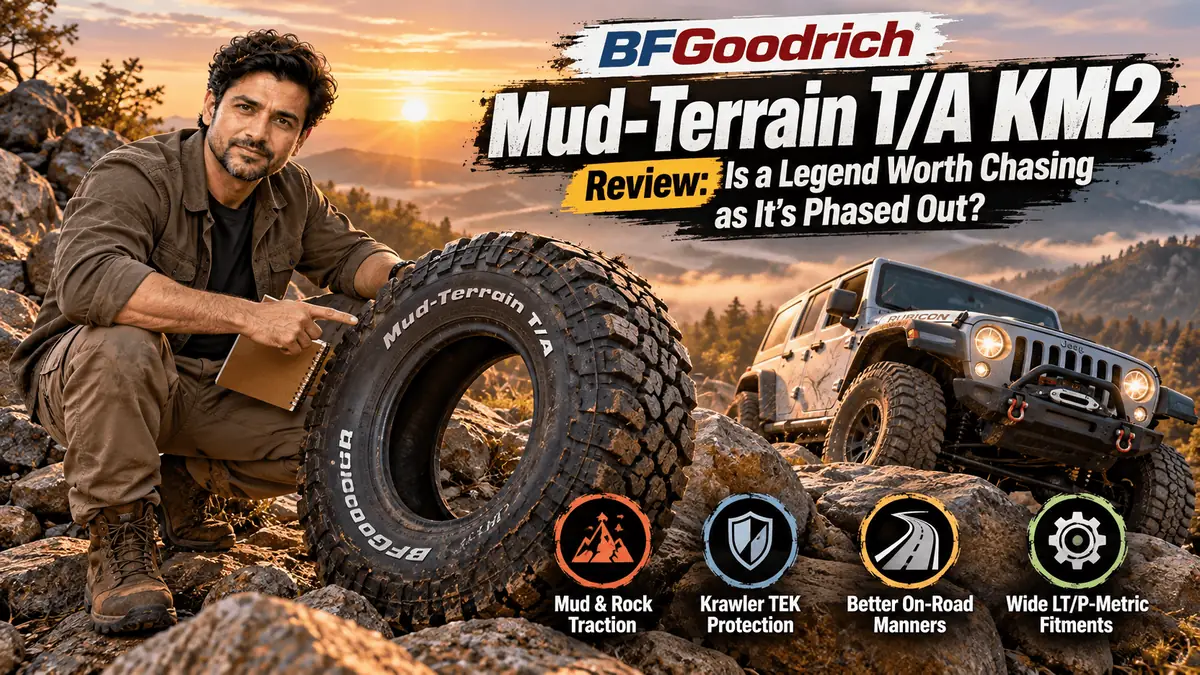
For nearly two decades, the BFGoodrich Mud-Terrain T/A KM2 has been the tire that off-road forums, overland builds, and rock-crawling Jeeps kept coming back to. It earned that reputation the hard way: real traction in real mud, sidewalls that shrug off rocks, and enough on-road civility that owners could actually drive it to the trailhead instead of trailering a set of highway tires behind them. That legacy is exactly why the KM2 still shows up on buyers’ shortlists today, even though BFGoodrich has already moved most of the lineup over to its successor, the Mud-Terrain T/A KM3.
That transition is the real story for anyone shopping the KM2 right now. Several major retailers list it as discontinued in specific sizes, while BFGoodrich still sells it directly in others, which means buyers may find themselves choosing between remaining KM2 stock and the newer KM3. This review breaks down what the KM2 actually delivers — off-road, on the highway, and over the life of the tread — so you can decide whether it’s still worth seeking out, and who it still makes sense for.
How this review was put together: We have not road-tested the KM2. This review is based on BFGoodrich specs and warranty terms and the owner ratings on BFGoodrich’s site, with sources listed at the end. Checked on October 22, 2026; prices are approximate.
At a Glance
| Category | BFGoodrich Mud-Terrain T/A KM2 |
|---|---|
| Tire type | Dedicated mud-terrain (Maximum Traction) tire, M+S rated |
| Best for | Trucks, SUVs, and Jeeps used for serious off-roading, rock crawling, and overlanding |
| Sizes | 15– to 20-inch rim diameters, LT-metric and P-metric fitments |
| Load ranges | C through D/E depending on size |
| Warranty | Standard BFGoodrich Limited Warranty — defects for life of usable tread or 6 years; no published treadwear-mileage guarantee |
| Typical price | Roughly $200–$400 per tire, depending on size |
| Owner rating | 4.3/5 average across 600+ verified reviews (94% would recommend) |
| Main strengths | Off-road traction, sidewall toughness, better on-road manners than most mud tires |
| Main limitations | Road noise, firmer ride, increasingly hard to find as retailers shift to the KM3 |
Table of Contents
What Is the BFGoodrich Mud-Terrain T/A KM2?
The KM2 sits in BFGoodrich’s Maximum Traction category — the aggressive end of the off-road spectrum, one step beyond the brand’s more familiar All-Terrain T/A KO2 and KO3. It was developed for full-sized, lifted trucks and SUVs that spend real time on rock and in mud rather than tires that merely look the part. BFGoodrich built the tread around its Krawler T/A KX, a tire with a long track record in competitive rock crawling, and carried that DNA into a design meant for everyday trucks.
The tread itself uses a symmetric layout with deep, self-cleaning tread blocks and linear flex zones that let the tire’s face conform around obstacles when aired down at low speed — a trait serious wheelers rely on for extra bite on rock ledges and boulders. BFGoodrich calls the sidewall system Krawler TEK, which combines three elements: aggressive sidewall lugs that add bite in soft terrain, a cut- and chip-resistant sidewall compound, and BFGoodrich’s TriGard casing, a three-ply polyester construction with sidewall cords the company says are up to 33% stronger than those on the original Mud-Terrain T/A KM. Twin steel belts, spirally wrapped in nylon, sit under the tread to add stability and puncture resistance, and a single continuous bead strand improves uniformity and ride quality.
Tread, Compound, and Construction
Underneath the marketing names, the engineering choices are straightforward and purposeful. The deep, high-void tread pattern with chunky lugs is what gives the KM2 its mud performance — those wide gaps let the tire eject packed mud and debris rather than clogging up and losing grip, a self-cleaning trait that matters as much in a muddy Midwestern field as it does on a Western trail.
The rubber compound is formulated to resist cutting, chipping, and tearing when the tread rolls over sharp rocks and roots, and it stays pliable enough that the tire doesn’t turn rock-hard and skittish on pavement the way some ultra-aggressive mud tires do. Combined with the TriGard casing and Krawler TEK sidewall protection, the result is a tire that’s built to survive abuse most street tires would never see — punctures, sidewall bruising, and the kind of impacts that come from crawling over sharp-edged rock.
Off-Road Capability
This is where the KM2 has built its reputation, and it’s earned. The deep, siped lugs bite into mud and loose soil, while the shoulder blocks wrap around onto the sidewall to add extra traction when the tire is aired down and flexing around an obstacle. In sand and soft soil, the tread digs in rather than floating on top, and the reinforced casing helps the tire hold its footprint instead of deflecting under load — something that matters when you’re trying to keep consistent contact patch on loose ground.
On rock, the thick sidewall lugs and TriGard casing do the heavy lifting, shielding the tire from the punctures and cuts that end a trail day early. Owners who run the KM2 on Jeep Wranglers, Gladiators, and similarly built rigs consistently point to this combination — mud traction plus sidewall durability — as the reason they keep buying it, even as newer designs have entered the market.
On-Road Manners
For a dedicated mud tire, the KM2 is more livable day-to-day than its aggressive tread would suggest. Dry-pavement grip and cornering are respectable, and the compound is tuned to wear more evenly on paved roads than the most extreme mud tires. Wet traction is adequate for daily use — the deep grooves and biting edges move water reasonably well — but it doesn’t match a dedicated all-terrain or highway tire, and hydroplaning resistance drops off at higher speeds compared with tires designed primarily for the street.
Road noise is the biggest on-road compromise. The large tread voids and mud-scooping lug design that make the KM2 effective off-road also generate a noticeable hum and drone at highway speeds — louder than an all-terrain tire. Ride quality lands in the middle of the mud-terrain pack: the reinforced casing and thick sidewalls needed for off-road durability make the ride somewhat firm, but not harsh, a reasonable trade for the off-road payoff.
Tread Life and Warranty: What BFGoodrich Actually Guarantees
This is one area where it pays to look past the marketing copy. BFGoodrich backs the KM2 with its Standard Manufacturer’s Limited Warranty, which covers defects in materials and workmanship for the life of the original usable tread or six years from the purchase date, whichever comes first. What BFGoodrich does not publish for the KM2 is a specific treadwear-mileage guarantee of the kind attached to some of its other lines, such as the All-Terrain T/A KO2’s 50,000-mile coverage. Buyers shouldn’t expect a mileage figure printed on the invoice.
BFGoodrich does not publish a mileage figure for the KM2, and we have not found reliable owner mileage data, so we don’t quote one. Rotation discipline and inflation pressure matter more for this tire’s longevity than for most all-season tires, and heavy loads or mostly-pavement use will shorten tread life.
What Owners Say
On BFGoodrich’s own review page, the KM2 held a 4.3-out-of-5 average from 602 reviews in October 2026. Manufacturer review pages tend to skew positive, so treat that as a ceiling. The usual mud-terrain drawbacks apply: road noise at highway speed, and faster or uneven wear on heavier trucks that skip rotations.
That trade-off is typical for the mud-terrain category. Buyers who accept the noise and keep up with rotation are the best fit; anyone expecting all-terrain-level quiet and all-season-tire mileage will likely be disappointed.
Sizes, Fitments, and Load Ratings
The KM2 has historically covered a wide swath of the truck and SUV market, spanning 15- through 20-inch rim diameters in both LT-metric and P-metric sizes, with popular options including 265/70R17, 285/70R17, and 33- and 35-inch flotation sizes. It’s a common fitment on the Jeep Wrangler and Gladiator, where it’s frequently specified as original equipment, and it’s a popular aftermarket choice on trucks like the Ford F-150, Chevrolet Silverado 1500, Ram 1500, and Toyota Tundra and 4Runner.
Load ranges run from C up through D and E depending on size, with larger LT-metric fitments supporting roughly 3,000 to 3,500 pounds per tire — plenty for most lifted trucks and SUVs running mild to moderate plus-sizing. Because the KM2 is offered almost entirely in light-truck sizing, it doesn’t carry a government UTQG rating; that grading system doesn’t apply to LT-metric tires, so shoppers won’t find a treadwear or traction number on the sidewall to compare directly against passenger-car tires.
Pricing and Value
Expect to pay somewhere between $200 and $400 per tire depending on size, which puts the KM2 in the premium tier of the mud-terrain category rather than the budget end. For drivers who genuinely use the off-road capability — trail running, mud, rock crawling — that price buys real sidewall protection and a tread compound built to survive it, and the value case holds up. For someone who wants the aggressive look but drives almost exclusively on pavement, a less expensive all-terrain tire will likely deliver better day-to-day value: less noise, better fuel economy, and a smoother ride, without giving up much that they’d actually use.
KM2 vs. KM3 and the Rest of the Mud-Terrain Field
The most immediate comparison for KM2 shoppers isn’t a rival brand — it’s BFGoodrich’s own KM3, which has replaced the KM2 in most of the lineup and in many retailers’ catalogs. BFGoodrich positions the KM3 as an improvement in traction and climbing ability in mud and on hard rock. That said, newer isn’t automatically better for every use case — it’s worth cross-shopping both if you can still find KM2 sizing for your vehicle.
Against outside competitors, the trade-offs are the usual mud-terrain balancing act. The Nitto Trail Grappler is regarded as extremely capable off-road but tends to run louder on pavement, where the KM2 has an edge in everyday civility. The Goodyear Wrangler DuraTrac leans further toward on-road comfort and all-around balance, which can mean a quieter commute at the cost of some outright mud and rock performance compared with the KM2. The General Grabber X3 is frequently cross-shopped as well, with owners generally rating it competitive on-road and on treadwear while the KM2 holds an edge in sidewall protection and outright traction in the deepest mud and rock. None of these is a universal winner — the right pick depends on how much weight you put on quiet commuting versus outright off-road bite.
Who Should Consider the KM2?
- Off-road enthusiasts and rock crawlers who want proven sidewall protection and mud traction from a tire with a long track record
- Overlanders who need a tire that can handle multi-day trail use but still needs to drive reasonably well on the highway between destinations
- Work truck and ranch owners who regularly deal with mud, gravel, and unimproved roads and value the KM2’s cut- and chip-resistant compound
- Jeep Wrangler and Gladiator owners replacing factory-fitted KM2s who want to stick with a known quantity
Drivers who mostly stay on pavement, want a quiet commute, or are chasing maximum tread life and fuel economy are better served by an all-terrain tire like the KO2/KO3 or a highway-terrain option — the KM2’s strengths only pay off when the tire actually sees dirt, mud, or rock on a regular basis.
BFGoodrich Brand Overview
BFGoodrich traces its roots to 1870, when Benjamin Franklin Goodrich founded a rubber manufacturing operation in Akron, Ohio — one of the earliest tire and rubber companies in the United States. Over the following century, the company built a reputation around durability, off-road capability, and motorsport, later becoming a fixture in desert racing and rock-crawling competition through models like the Krawler T/A KX. Today, BFGoodrich operates as part of the Michelin Group, which has owned the brand since acquiring Uniroyal Goodrich Tire Company in 1990. That backing gives BFGoodrich access to Michelin‘s manufacturing scale and research resources while the brand itself continues to focus on truck, SUV, and off-road tires, including the KO-series all-terrains, the Baja T/A desert-racing tire, and the Mud-Terrain lineup the KM2 and KM3 represent.
Pros and Cons
Pros
- Excellent mud, rock, and loose-terrain traction
- Durable TriGard casing and Krawler TEK sidewall protection
- Better on-road manners than most dedicated mud tires
- Strong owner ratings on BFGoodrich’s site (4.3/5 from 602 reviews)
- Wide range of LT and P-metric sizes for common trucks, SUVs, and Jeeps
Cons
- Noticeable road noise at highway speed
- No published treadwear-mileage warranty
- Tread life varies widely and depends heavily on rotation habits
- Increasingly hard to find as retailers shift to the KM3
- Premium pricing relative to all-terrain alternatives
BFGoodrich Mud-Terrain T/A KM2 FAQs
Partly. It’s in the process of being phased out in favor of the Mud-Terrain T/A KM3. Some retailers already list specific KM2 sizes as discontinued, while others — including BFGoodrich directly — still sell it in select sizes. Availability varies by size and retailer, so it’s worth checking stock for your specific fitment before assuming it’s still on the shelf.
There’s no official mileage figure from BFGoodrich, and we have not found reliable owner mileage data. Regular rotation and correct inflation pressure matter most. Off-road use, load, and maintenance habits all move that number more than they would on a highway tire.
It’s usable as a daily driver, but expect more road noise and a firmer ride than an all-terrain or highway tire. Dry traction and stability are solid for commuting; if a quiet ride is the priority, an all-terrain tire like the KO2 or KO3 is a better everyday fit.
All three are capable mud-terrain tires with different emphases. The Nitto Trail Grappler is built for heavy off-road use, the General Grabber X3 is usually the lower-priced option, and the KM2’s standout is its sidewall protection. We have not tested them side by side.
Reasonably well for a mud-terrain tire — the aggressive tread and siping bite into snow better than most all-terrain designs — but it isn’t a substitute for a dedicated winter tire in sustained ice or deep snow conditions.
The KM2 spans 15- to 20-inch rim diameters in both LT-metric and P-metric sizes. Common fitments include 265/70R17, 285/70R17, and 33- and 35-inch flotation sizes on trucks like the F-150, Silverado 1500, Ram 1500, and Tundra, as well as the Jeep Wrangler and Gladiator. Check your owner’s manual or a fitment guide before buying, since availability now depends on which sizes remain in production.
Pricing generally runs from about $200 to $400 per tire depending on size, placing the KM2 toward the premium end of the mud-terrain category.
The KM3 is the KM2’s successor and is replacing it in most sizes. It is designed to be more comfortable and quieter than most mud-terrains while keeping strong off-road traction, puncture resistance and long tread life.
Final Verdict
The BFGoodrich Mud-Terrain T/A KM2 built its reputation honestly: strong mud and rock traction, a sidewall system that holds up to real abuse, and on-road behavior that’s genuinely better than most tires in its class. Owner ratings on BFGoodrich’s site back that up, with a 4.3-out-of-5 average from 602 reviews. The trade-offs are equally real — more road noise than an all-terrain tire, a firmer ride, no published mileage warranty, and tread life that depends heavily on how well it’s maintained.
The wrinkle for 2026 buyers is availability. With BFGoodrich shifting much of its mud-terrain lineup to the KM3, the KM2 is disappearing from some retailers’ shelves in specific sizes even as it remains available in others. For drivers who can still find their size, it remains a proven, well-regarded choice — particularly for Jeep and off-road-focused truck owners who value its blend of trail capability and everyday usability. Buyers who can’t source their size, or who want the latest compound and tread updates, should cross-shop the KM3 directly rather than assume the KM2 is the only option. Either way, this is a tire worth chasing down while a formerly OE size is still available for anyone whose driving genuinely calls for mud-terrain capability.
Sources
Specs, warranty terms and prices were checked on October 22, 2026. Prices change often.
- BFGoodrich: Mud-Terrain T/A KM2 reviews (4.3/5 from 602 reviews)
- BFGoodrich: Mud-Terrain T/A KM2 (specs and warranty)
 Summarize this article with:














Leave a comment