


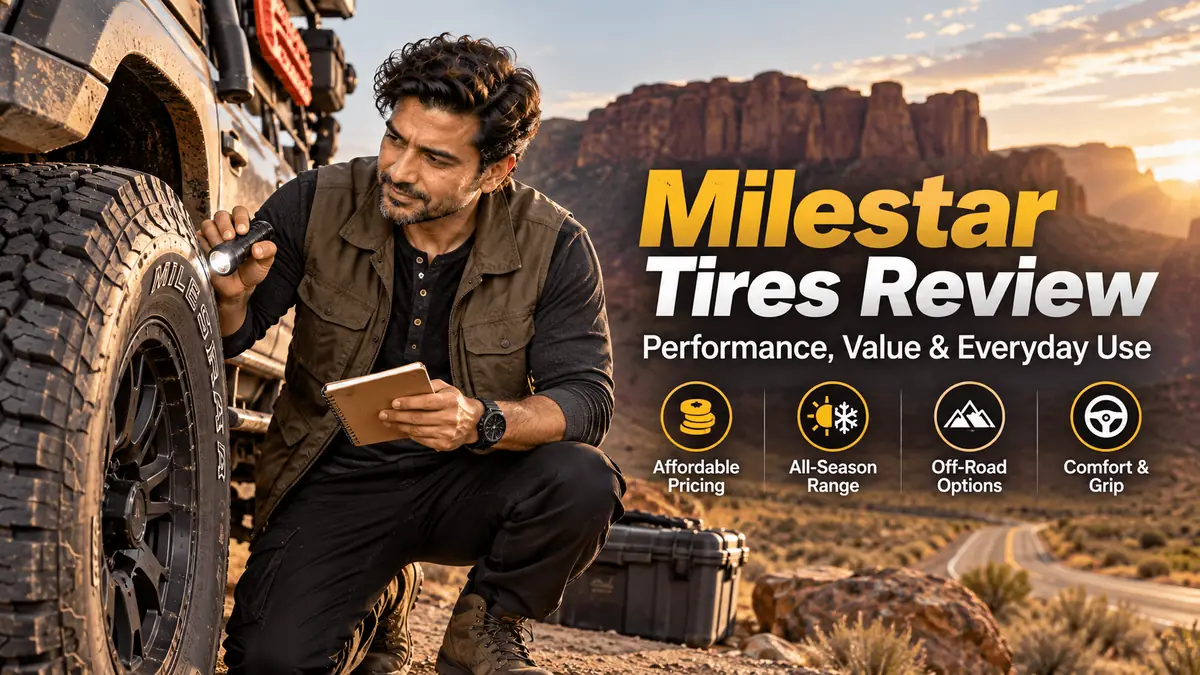
Milestar built its business on a simple pitch: tires that cost noticeably less than the big names on the wall, without asking drivers to accept a dramatically worse tire in return. Since emerging in the early 2000s, the brand has expanded from a handful of all-season models into a catalog that covers passenger cars, performance sedans, light trucks, SUVs, and dedicated off-road duty. That range makes Milestar worth a closer look for budget-conscious shoppers, but it also raises the question every value brand eventually has to answer: where does the savings actually come from, and what does a driver give up to get it?
This review walks through Milestar’s lineup by use case, what the brand’s core technologies are meant to deliver, how the tires are priced and warrantied, what retailer ratings show, and how Milestar stacks up against premium names like Michelin, Bridgestone, and Goodyear.
How this review was put together: We have not road-tested Milestar tires. This review is based on manufacturer information, published warranty terms and retailer ratings, with sources listed at the end. Checked on October 22, 2026.
Table of Contents
Who Makes Milestar Tires?
Milestar is owned and marketed by Tireco, Inc., a California-based tire distributor and private-brand marketer. The brand entered the replacement tire market in the early 2000s and has since built out a lineup spanning passenger cars, light trucks, SUVs, and commercial vehicles. Rather than manufacturing tires the way a vertically integrated giant like Michelin or Bridgestone does, Milestar operates as a brand built around sourcing, quality control, and distribution — a common structure among value-oriented tire brands, and one that lets a smaller company compete on price without carrying the overhead of owning every factory in its supply chain.
Milestar says its tires go through multiple stages of inspection during production, including visual checks, X-ray analysis, and laboratory testing for uniformity, balance, and structural integrity, with tires that fail those checks rejected before reaching a dealer. The company also describes subjecting finished tires to real-world evaluation — high-speed endurance runs, wet and dry braking tests, and exposure to temperature extremes — as part of validating a design before it goes on sale. As with any manufacturer’s account of its own quality process, that’s Milestar’s description of its own standards rather than results verified by an outside lab, but it does reflect the kind of testing regimen a modern tire brand is expected to run.
The Milestar Lineup at a Glance
Milestar organizes its catalog around five broad categories, and understanding that structure is the fastest way to navigate the brand: all-season tires for everyday passenger cars and crossovers, performance tires for drivers who want sharper handling, truck and SUV tires built for load capacity and rough terrain, dedicated winter tires for snow and ice, and specialty tires for trailers, RVs, and other niche applications.
| Category | Best For | Key Traits |
|---|---|---|
| All-Season | Sedans and crossovers | Balanced dry, wet, and light-snow traction; long tread life |
| Performance | Enthusiast and sporty-sedan drivers | Sharper cornering, braking, and steering response |
| Truck & SUV / Off-Road | Light trucks, SUVs, off-road use | Load capacity, durability, on- and off-pavement traction |
| Winter | Snow-belt drivers | Cold-weather compounds and tread built for ice and snow |
| Specialty | Trailers, RVs, niche applications | Purpose-built construction for non-passenger use cases |
Milestar’s All-Season Tires: Where the Brand Does Most of Its Business
The bulk of Milestar’s catalog — and the tires most everyday drivers will actually cross-shop — sits in the all-season category, aimed at sedans and crossovers that need dependable traction across a full year of driving rather than the outer edges of grip or off-road capability.
MS932 Sport — The Flagship
The MS932 Sport is Milestar’s best-known all-season tire and functions as the brand’s flagship passenger model. It uses a symmetric tread pattern paired with an advanced tread compound aimed at grip and handling on both dry and wet pavement, while wide circumferential grooves and lateral notches are built to improve hydroplaning resistance and move water out from under the tread during rain. SimpleTire lists a 60,000-mile treadwear warranty on T-, H- and V-rated sizes (50,000 miles on W-rated sizes) and a 4.4 out of 5 rating across about 2,150 reviews, most of them from Google Shopping (October 2026). It is made by Nankang in Taiwan.
MS932 XP+ — Built for Tread Life and Efficiency
The MS932 XP+ shifts the emphasis toward longevity and fuel economy. A computer-optimized tread design promotes even wear across the tread face, while a silica-enhanced compound is aimed at improving wet-surface traction without giving up the tire’s efficiency focus. It’s the more sensible pick for a driver whose priority is minimizing how often the tires need replacing rather than sharpening the car’s handling.
MS932 Sport N/T+ — A Sportier All-Season
For drivers who want a bit more responsiveness without leaving the all-season category, the MS932 Sport N/T+ uses a directional tread pattern with additional siping aimed at improving braking and traction in both wet and light-snow conditions, alongside sharper dry-road handling than the standard MS932 Sport.
Grantland AP and Weatherguard AWT — Comfort-Focused Touring
Milestar’s Grantland AP and Weatherguard AWT lean toward comfort rather than sportiness, targeting drivers who want a quiet, smooth ride for commuting and highway trips. As touring tires tuned for comfort, they are not the strongest choice for heavy rain or snow.
MS775 — A Mixed Bag
The MS775 rounds out Milestar’s standard all-season lineup as its most basic option. We have not found enough verified reviews to judge its tread life, so check current reviews for your size before buying.
Performance Tires: Grip for Drivers Who Want More Than Basic Transportation
Milestar’s performance-oriented tires are built for drivers who want sharper cornering and braking response than a standard all-season tire delivers, without stepping up to flagship pricing from Michelin or Continental.
Patagonia SXT
The Patagonia SXT is Milestar’s performance-tuned option for drivers who want a more engaging feel behind the wheel. An aggressive tread pattern combined with a silica-based compound targets strong grip on both dry and wet pavement, and the tire is built around precise cornering and shorter braking distances rather than maximum comfort or tread life.
Granturer HP+
The Granturer HP+ pushes further into ultra-high-performance territory, aimed at sports cars and higher-powered vehicles that need stability at speed. An asymmetric tread pattern and Milestar’s performance compound work together to prioritize dry handling while still delivering usable wet-weather grip — the same trade-off most ultra-high-performance tires make, regardless of brand.
Truck, SUV, and Off-Road Tires
Milestar’s truck and SUV lineup follows the same logic used by most brands in this segment: separate tires for drivers who want light off-road capability without sacrificing highway comfort, and separate tires for drivers who genuinely need to get through mud, rock, and loose terrain.
Patagonia A/T — On-Road Comfort, Off-Road Capability
The Patagonia A/T is built for owners who split time between pavement and unpaved surfaces without wanting to give up a comfortable daily commute. It’s positioned as an all-terrain tire that holds up on the highway while still delivering useful traction and handling once the pavement ends — a fit for gravel roads, dirt trails, and light off-road excursions rather than serious rock crawling.
Patagonia M/T and M/T+ — Built for Harder Terrain
The Patagonia M/T is Milestar’s dedicated mud-terrain tire, with an aggressive tread pattern and reinforced construction built for genuinely tough terrain. The Patagonia M/T+ steps that up further, adding a more aggressive tread design and stronger sidewall protection aimed at rock crawling and other extreme off-road use. Expect a rougher ride on paved roads — the typical compromise that comes with a tread pattern built primarily for dirt, mud, and rock rather than highway comfort.
Winter and Specialty Tires
Milestar also maintains a dedicated winter lineup engineered around cold-weather compounds and tread patterns intended for traction, handling, and braking on snow and ice, giving drivers in colder climates an alternative to relying on all-season tires through a full winter. Beyond passenger and light-truck applications, Milestar’s specialty category covers trailer tires, RV tires, and other niche uses where standard passenger or truck tires aren’t the right fit.
Warranty Coverage
Milestar backs most of its lineup with a Limited Treadwear Warranty, and coverage varies by model: the MS932 Sport carries 60,000 miles on T-, H- and V-rated sizes, according to SimpleTire. Milestar also lists road hazard and workmanship-and-materials coverage, so check the current terms for the model you buy.
Pricing and Value
Price is where Milestar makes its clearest case. Compared with mainstream premium brands like Michelin, Bridgestone, and Goodyear, Milestar’s tires typically run 30 to 40 percent cheaper in comparable categories and sizes — a meaningful gap that grows quickly once a full set of four is on the table, and one that matters most for drivers replacing tires on more than one vehicle or working with a tight budget.
That upfront savings comes with a trade-off worth weighing honestly: Milestar’s overall lifespan and durability don’t consistently match the longevity of premium-brand tires, which means some drivers may find themselves replacing a set sooner than they would with a longer-lived competitor. For drivers who don’t rack up unusually high annual mileage or push their tires in extreme conditions, that trade-off tends to work out in Milestar’s favor — the upfront savings outweigh the modest risk of an earlier replacement cycle. For high-mileage drivers or anyone who wants to stretch a single set of tires as far as possible, the calculation is closer, and it’s worth weighing the treadwear warranty on a specific model against what a comparable premium tire would cost over the same span.
Where to Buy Milestar Tires
Milestar tires are sold directly through the brand’s own website, where buyers can browse the full lineup and select a model and size for their vehicle. They’re also carried by major retailers including Tire Rack, Discount Tire, and SimpleTire, along with a network of independent tire shops and automotive service centers that can provide personalized fitment advice and installation. Availability varies by location and specific model, so it’s worth checking more than one retailer before settling on a price.
What Owners Say About Milestar Tires
Retailer ratings are the most useful public signal. The MS932 Sport, Milestar’s best-reviewed model, averaged 4.4 out of 5 across about 2,150 reviews on SimpleTire in October 2026. We have not found enough verified reviews of the other models to summarize them reliably, and we don’t quote owner mileage figures we can’t check.
Milestar vs. Michelin, Goodyear, and Bridgestone
Milestar isn’t positioned to out-engineer Michelin, Goodyear, or Bridgestone, and the brand doesn’t need to in order to make sense for the driver it’s actually built for. Where Milestar consistently wins is price — tires that run 30 to 40 percent below comparable premium models while still delivering a smooth, reasonably comfortable ride and dependable traction across most everyday conditions. Where the premium brands maintain an edge is at the performance ceiling and in long-term durability: the very best handling, the longest treadwear ratings, and the most consistent performance as a tire ages generally still belong to the established leaders.
For a driver cross-shopping Milestar against those brands, the decision comes down to priorities rather than a clear overall winner. Choose Michelin, Goodyear, or Bridgestone if maximum performance, the longest possible tread life, or brand-name resale considerations matter most. Choose Milestar if the priority is minimizing cost per set while still getting a tire that performs competently across daily driving, occasional rain, and light winter weather.
Who Should Consider Milestar Tires
- Budget-conscious drivers who want to lower the cost of a tire purchase without stepping down to the least reliable option on the shelf.
- Commuters and daily drivers whose main priorities are dry and wet traction, tread life, and a reasonably comfortable ride.
- Truck and SUV owners who want an all-terrain or mud-terrain option at a lower price than BFGoodrich, Falken, or similar competitors.
- Drivers replacing tires on more than one vehicle, where the savings compound across multiple sets.
Drivers who should look elsewhere include those chasing the outright performance ceiling, anyone who drives high annual mileage and wants to stretch a single set of tires as far as mechanically possible, and buyers who place a premium on brand recognition or resale considerations tied to a well-known name.
Milestar Tires: Pros and Cons
Pros
- Pricing that consistently runs 30 to 40 percent below Michelin, Bridgestone, and Goodyear for comparable models.
- A broad lineup covering all-season, performance, truck/SUV, off-road, winter, and specialty applications.
- Strong retailer ratings for the flagship MS932 Sport (4.4/5 across about 2,150 reviews).
- Warranty coverage — treadwear, road hazard, and workmanship — comparable in structure to larger competitors.
Cons
- Overall lifespan and durability don’t consistently match premium-brand longevity, which can mean earlier replacement for some drivers.
- Some models, including the MS775, draw mixed feedback on tread life and wear consistency.
- Certain models generate more road noise or ride firmness than comparable premium-brand tires.
- Brand recognition is well behind established leaders like Michelin and Goodyear, which matters to buyers who value that reputation.
Frequently Asked Questions
Milestar is owned and marketed by Tireco, Inc., a California-based tire distributor and private-brand marketer. The brand has been selling tires in the US replacement market since the early 2000s.
For budget-conscious drivers, yes. Milestar’s tires deliver competent everyday performance and solid retailer ratings on the MS932 Sport at prices well below premium brands, though they generally don’t match the performance ceiling or long-term durability of the top-tier competition.
Treadwear warranties vary by model; the MS932 Sport carries 60,000 miles on T-, H- and V-rated sizes. Actual tread life depends on the specific model, driving habits, and maintenance.
The MS932 Sport is Milestar’s flagship all-season tire and its best-reviewed model, with a 4.4 out of 5 average on SimpleTire. The MS932 XP+ is worth considering for drivers who want to prioritize even wear and efficiency.
Yes. The Patagonia A/T covers light off-road use while staying comfortable on the highway, while the Patagonia M/T and more aggressive M/T+ are built for serious mud, rock, and off-road terrain, at the cost of a firmer ride on pavement.
Milestar tires typically cost 30 to 40 percent less than comparable models from those brands. In exchange, buyers generally give up some long-term durability and outright performance, though Milestar’s better-regarded models close that gap more than others in the lineup.
Most Milestar tires include a Limited Treadwear Warranty (60,000 miles on most MS932 Sport sizes, for example), a Limited Road Hazard Warranty covering damage from hazards like nails and potholes, and a Limited Workmanship and Materials Warranty covering manufacturing defects.
Milestar tires are sold directly through the brand’s website and through retailers including Tire Rack, Discount Tire, and SimpleTire, as well as independent tire shops and service centers nationwide.
Milestar is a value brand rather than a premium one. It typically costs 30 to 40 percent less than Michelin, Bridgestone or Goodyear and handles everyday driving competently, but it doesn’t match the top brands’ performance ceiling or long-term durability.
No. Milestar is owned and marketed by Tireco, Inc., a California-based tire distributor and private-brand marketer, not by Michelin.
Final Verdict: Are Milestar Tires Worth Buying?
Milestar delivers on the promise at the core of its brand: tires that cost meaningfully less than Michelin, Bridgestone, or Goodyear while still handling everyday driving competently. The MS932 Sport stands out as the strongest all-around value in the lineup, and the Patagonia A/T and M/T give truck and SUV owners a genuinely capable, lower-priced alternative to pricier all-terrain and mud-terrain tires from bigger names.
The trade-offs are real but narrow. Overall durability and tread life don’t consistently match the top of the market, a handful of models — the MS775 in particular — draw more mixed feedback than the rest of the catalog, and drivers chasing maximum grip or the longest possible tread life will still find better options from premium brands, at a correspondingly higher price. For everyday commuters, budget-conscious shoppers, and truck or SUV owners who want capable tires without paying a premium-brand markup, Milestar earns a spot on the shortlist — as long as the specific model is matched carefully to how the tire will actually be used.
Sources
Specs, warranty terms and prices were checked on October 22, 2026. Prices change often.
- SimpleTire: Milestar MS932 Sport (warranty, price, ratings, manufacturer)
- SimpleTire: MS932 Sport reviews (owner reviews)
 Summarize this article with:













Leave a comment