


You need four tires, the quote from the local shop made you wince, and an online listing offers a set from a brand you have never heard of for less than half the price. The question running through your head is simple: is this a smart way to save money, or one of the worst tire brands you could put on the car? Plenty of websites will hand you a confident list of names to avoid. Very few of those lists explain how anyone reached their conclusions, and many recycle the same complaints from one brand to the next.
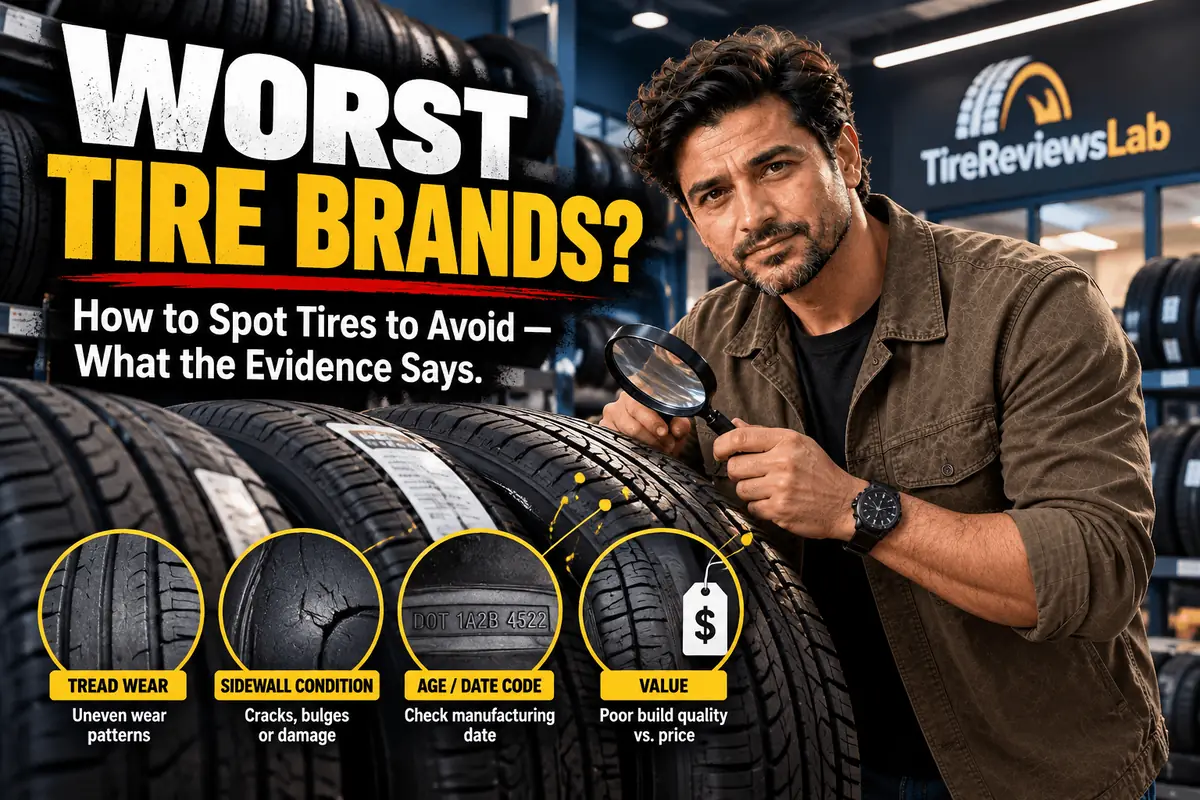
A better approach is to learn the warning signs that separate a poor tire purchase from a sensible budget one. Recall records, federal grading, date codes, warranty terms and independent test results are all public, and every one of them can be checked before you hand over a card. This guide walks through those signals, looks at what the recall evidence really shows, and explains how to buy inexpensive tires without gambling on safety.
Table of Contents
Why a List of Names Is the Wrong Starting Point
Brand-level rankings feel useful, but they flatten a messy reality. Most large manufacturers sell several tire lines at very different price points, and a single brand can produce an excellent touring tire alongside a mediocre one. Factories change, compounds get revised, and a model that drew complaints a decade ago may share little with today’s version beyond the name.
What tends to separate a bad buy from a good one is not the logo on the sidewall but the evidence behind it. A tire that comes with a clear warranty, solid federal grades, a recent date code, a reachable US distributor and a presence in independent testing is a known quantity. A tire missing most of those things is a question mark, whatever it costs.
Seven Warning Signs a Tire Is a Poor Buy
No Real US Distribution, Dealer Support or Warranty
Before anything else, find out who stands behind the tire in the United States. Established brands, including budget ones, have a US distributor, a network of dealers that can mount and service the tires, and a warranty process with a phone number and an address. That infrastructure matters the day something goes wrong. If a tire develops a defect, you need someone to inspect it, process a claim and, if a recall is issued, actually reach you.
Be wary when a seller cannot tell you who imports the tire or when the only point of contact is a marketplace storefront. A tire with nobody behind it might perform fine, but you carry all of the risk if it does not.
A Short or Missing Treadwear Warranty
Many passenger all-season and touring tires carry a mileage warranty, with the figure varying widely by category and price point. Performance and winter tires frequently carry shorter mileage coverage or none at all, which is normal for those segments. The red flag is an ordinary all-season tire with no treadwear warranty, a vague promise with no written terms, or a manufacturer that will only honor claims through the original online seller.
Read the terms rather than the headline number. Most mileage warranties are prorated and require proof of regular rotations and correct inflation. A believable warranty with clear conditions tells you more than an eye-catching figure that comes with a dozen exclusions.
Weak UTQG Traction or Temperature Grades
The Uniform Tire Quality Grading system, administered by the National Highway Traffic Safety Administration (NHTSA), puts three grades on the sidewall of most passenger car tires. Manufacturers assign the grades using federal test procedures.
- Treadwear is a comparative number measured against a reference tire on a roughly 400-mile government test course in Texas. A tire graded 400 wore twice as well on that course as one graded 200. It is a relative figure, not a mileage promise.
- Traction is graded AA, A, B or C, from highest to lowest. It reflects the tire’s ability to stop on wet asphalt and concrete in straight-line braking tests. It does not measure cornering grip, dry braking or hydroplaning resistance.
- Temperature is graded A, B or C. It reflects how well the tire resists building heat and sheds it on a laboratory test wheel. Grade C is the federal minimum, while A and B represent higher performance.
For a typical passenger car, a traction grade of A or AA and a temperature grade of A or B are reasonable baselines. A C in either category is a sign to look harder at alternatives. Keep in mind that UTQG grades do not apply to deep-tread winter tires, temporary spares or light truck tires, so an LT-rated tire without them is not hiding anything.
| UTQG Grade | What It Measures | What to Look For |
|---|---|---|
| Treadwear (number) | Wear rate relative to a reference tire on a government course | Compare within a brand and category, not across brands |
| Traction (AA, A, B, C) | Straight-line wet braking on asphalt and concrete | A or AA for most daily drivers |
| Temperature (A, B, C) | Resistance to heat buildup on a lab test wheel | A or B, with C as the legal minimum |
Recall History You Can Check Yourself
NHTSA maintains a public recall database on its website, and tires are one of the categories you can search. Look up the brand and model before you buy, and if you already own the tires, check the Tire Identification Number on the sidewall against open recalls. A recall years ago is not, by itself, a reason to write off a company. What deserves attention is a recall that covers the exact tire you are considering, or a pattern of recalls involving the same failure.
An Old DOT Date Code
Every tire sold in the US carries a DOT Tire Identification Number, and the last four digits give the week and year it was built. A code ending in 1424 means the 14th week of 2024. NHTSA notes that some vehicle and tire manufacturers recommend replacing tires that are six to 10 years old regardless of tread depth, because rubber ages even in storage.
A “new” tire that has spent several years in a warehouse has used up part of its service life before it touches the road, and deep discounts sometimes reflect exactly that. Ask for the date code before you pay.
A Missing DOT Code
Federal rules require every new tire manufacturer to permanently mold a Tire Identification Number into one sidewall, and tires certified for US highway use carry the DOT symbol showing compliance with federal safety standards. A tire with neither has not been certified for road use in the United States and cannot legally be sold for that purpose. If you cannot find a DOT marking anywhere on a tire, do not buy it for a road vehicle.
Little or No Presence in Independent Testing
Independent tire testing is expensive, and testers tend to focus on tires that sell in meaningful volume. Consumer organizations, automotive magazines and large tire retailers all run test programs that compare braking, handling, noise and tread life under controlled conditions. A brand that never appears in any of them is not automatically poor, but you are buying it with less information than you would have for almost anything else on the shelf.
When a tire does appear in testing, read beyond the final ranking. A budget tire that trails premium models slightly in wet braking may still suit a low-mileage commuter, while one with a long wet stopping distance is a poor match for anyone who drives in heavy rain.
No single warning sign proves a tire is unsafe. Three or four of them together, on a tire you know nothing else about, is a strong reason to keep shopping.
What the Recall Record Shows
Recalls are where evidence replaces opinion, and the record makes one thing clear: serious tire defects are not limited to obscure brands.
The best-known example is the Firestone recall announced on August 9, 2000. It covered Radial ATX and Radial ATX II tires in size P235/75R15, along with Wilderness AT tires of the same size built at the company’s Decatur, Illinois plant, after reports of tread separating from the steel belts at high speed in hot climates. Roughly 6.5 million tires still in service were affected, and the problem came from one of the largest tire makers in the world.
A smaller but instructive case followed in 2007, when New Jersey importer Foreign Tire Sales recalled about 255,000 light truck tires made in China by Hangzhou Zhongce Rubber Company and sold under the Westlake, Compass and YKS names. The recall notice stated that the tires, produced from 2004 to 2006, lacked a gum strip or had an insufficient one between the steel belts, which could allow the tread or belts to separate. The importer said the manufacturer had changed the tire’s construction without notifying it, and the case raised broad questions about how imported tires were tracked and recalled.
The lesson from both cases is practical. What matters is whether the specific tire in front of you is under an open recall, and whether the company behind it has the US presence to reach you if one is issued.
Where the Real Risk Tends to Sit
Rather than fixating on brand names, it pays to recognize the categories of tire where the warning signs above cluster.
Unknown ultra-budget imports. Some tires arrive in the US market with no established distributor, no English-language warranty documentation and no test history. They can be extremely cheap, and a few may perform acceptably, but you have almost nothing to judge them by and little recourse if one fails early.
Off-brand tires sold only online. Marketplace listings sometimes feature brand names that appear nowhere else, with product photos borrowed from other tires and specifications that do not match the sidewall. Confirm the DOT code, the UTQG grades and the warranty holder before buying anything you cannot find through a conventional tire retailer.
Old stock sold as new. Any brand can end up here. A tire that has sat in a warehouse for years may carry a perfectly respectable name and still be a poor buy because of its age.
Cheap Does Not Automatically Mean Bad
It would be easy to conclude that the safe move is to buy the most expensive tire you can afford. That is not necessary for most drivers. Many major manufacturers sell budget and mid-range lines that share engineering and quality systems with their premium tires, and several Asian manufacturers have built strong reputations for value in the US market. A driver who covers modest annual mileage in a mild climate, rarely pushes the car hard and keeps the tires properly inflated can be well served by an inexpensive, properly graded tire from a company with a real US presence.
Premium tires earn their price in the margins, such as shorter wet braking distances, better winter grip and longer tread life. Those margins matter most to high-mileage drivers, people in wet or snowy regions and performance car owners. Our Blackhawk tires review is one example of a budget brand TireReviewsLab has evaluated, and similar brand reviews can help you weigh a specific inexpensive option against better-known names.
How to Buy Budget Tires Safely
- Start with the correct size, load index and speed rating from your vehicle’s door jamb placard or owner’s manual, and never go below those figures to save money.
- Choose a brand with a US distributor, a working website and a written warranty that names who handles claims.
- Compare UTQG grades within the category you need, aiming for a traction grade of A or better and a temperature grade of A or B on a passenger car.
- Search the brand and model in NHTSA’s recall database, and check the TIN against open recalls once the tires arrive.
- Ask for the DOT date code before purchase and refuse tires that are already several years old.
- Look for the tire, or a close sibling from the same manufacturer, in at least one independent test or detailed review.
- Buy from a retailer or installer that will mount, balance and register the tires so you receive recall notices.
- Match the tire to your climate. If you see regular snow, a budget all-season is no substitute for a dedicated winter tire or an all-weather tire carrying the three-peak mountain snowflake symbol.
Frequently Asked Questions
The most useful answer is a set of warning signs rather than a list of names. Tires with no US distributor or warranty, poor UTQG traction or temperature grades, old or missing DOT codes, open recalls and no presence in independent testing are the ones to avoid. Those signals apply regardless of brand and can be checked before you buy.
Find the DOT Tire Identification Number on the sidewall and use the tire recall search on NHTSA’s website. You can also search by brand and model. Registering your tires with the manufacturer at purchase helps make sure you receive any future recall notice directly.
For most passenger cars, a traction grade of A or AA and a temperature grade of A or B are sensible minimums. Treadwear numbers are comparative and work best for comparing tires from the same manufacturer. Winter tires and light truck tires are not graded, so the absence of UTQG markings on those is normal.
There is no single federal cutoff, but NHTSA notes that some vehicle and tire manufacturers recommend replacement at six to 10 years regardless of tread. Since that clock starts at the factory, a tire that has already spent several years in storage is a weaker value. Check the last four digits of the DOT code and favor recent production.
No. Tires sold for highway use in the US must carry the DOT symbol and a molded Tire Identification Number showing they were certified to federal safety standards. A tire without them has not been certified for road use, cannot legally be sold for that purpose and cannot be traced in a recall. Do not install one on a road vehicle.
Rather than a single brand, choose an established budget line with a US distributor, a dealer network that can service the tires, a real warranty and some independent test results. Unknown ultra-budget imports without those are the ones to avoid.
The Bottom Line on Tires to Avoid
Lists of the worst tire brands that circulate online rarely show their work, and naming names is far less useful than knowing how to read the evidence yourself. The tires most worth avoiding share a recognizable profile: nobody in the US stands behind them, the warranty is thin or missing, the federal grades are weak, the date code is old or absent, and no independent tester has ever measured them. Recalls can hit any company, so check the specific tire against NHTSA’s database.
None of that means you must buy premium tires. A budget tire with solid grades, a fresh date code, a real warranty and a traceable distributor can be a smart purchase for the right driver. Spend your effort on verification rather than brand loyalty, and match the tire to your climate and mileage.
 Summarize this article with:












Leave a comment