


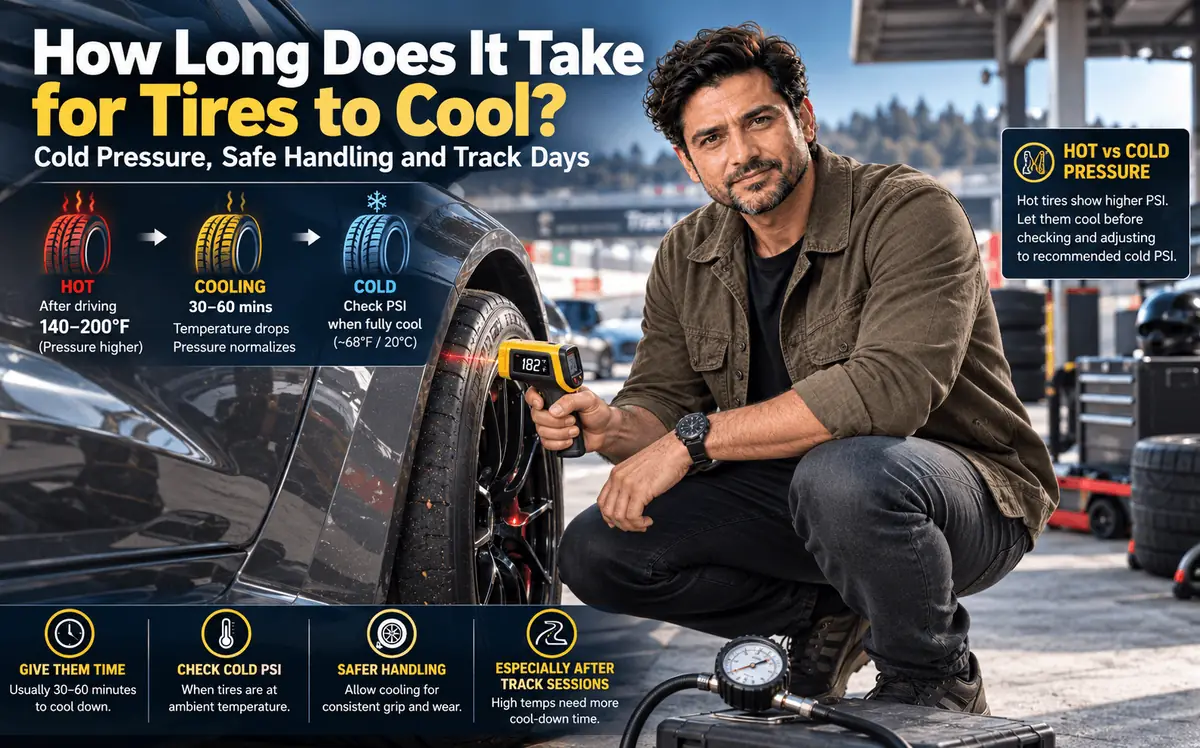
You pull into a gas station after an hour on the interstate, clip a gauge onto the valve stem and see a number well above what the door placard says. The instinct is to let some air out. That instinct is wrong, and it is the most common way drivers end up running underinflated tires without realizing it. The reading was high because the tire was hot, and it will settle back down on its own once the tire cools.
So how long is long enough? The short answer is that tires shed most of their heat within the first hour after parking, but the industry standard for a true “cold” pressure reading is longer: about three hours parked, or less than a mile of driving. Below, we break down why that gap exists, what speeds up or slows down cooling, and how the answer changes for tire changes, towing, hot climates and track days.
Table of Contents
The Short Answer: Cooling Times at a Glance
Tires do not cool at a steady rate. Heat leaves fastest right after you park, when the gap between tire temperature and the surrounding air is widest, and then the rate tapers off as the tire approaches ambient temperature. That curve explains why a tire can feel merely warm after 20 minutes yet still carry a little extra pressure an hour later.
The figures below are practical estimates, not lab measurements. Real-world times depend on how hard the tire worked, the weather and where the car is parked.
| Situation | Typical Wait (Estimate) | What It Is Good For |
|---|---|---|
| Parked about 3 hours, or driven less than a mile | 3 hours | Accurate cold pressure check against the door placard |
| Normal commuting, mild weather | 30 to 60 minutes | Safe to touch, most of the heat gone; pressure still slightly elevated |
| Long highway run or hot afternoon | 1 hour or more to feel cool | Handling the tire; still not a true cold reading |
| Heavy towing or hauling | Longer than normal driving | Inspection after a stop; save pressure adjustments for a cold check |
| Track session | Varies widely | Hot pressures are read immediately and managed separately |
The safest rule for everyday drivers is simple: check and set pressure first thing in the morning, before the car has moved, or after it has sat for at least three hours.
What “Cold Tire Pressure” Really Means
Every pressure figure printed on your door jamb placard and in your owner’s manual is a cold inflation pressure. Tire and vehicle makers define cold as a vehicle that has been parked for about three hours, or one that has been driven less than a mile at moderate speed. That is the baseline the recommended pressure assumes.
Driving changes the picture fast. As the tire rolls, its rubber and cords flex thousands of times per mile, and that constant flexing generates heat. The air inside warms and expands, pushing pressure up. A common rule of thumb holds that tire pressure changes by roughly 1 PSI for every 10°F change in temperature, and after a stretch of highway driving, readings commonly run a few PSI above the cold figure. Sustained high speeds, a hot afternoon and direct sun can push that gap wider.
That rise is normal. Tires are engineered to handle it, and the recommended cold pressure already accounts for the increase that comes with driving.
Never bleed air from hot tires to bring them down to the placard number. Once they cool, they will be underinflated, and underinflation builds even more heat on the next drive.
Why the Wait Matters
Cooling time affects more than a pressure reading. There are four practical reasons to respect it.
Accurate Pressure Checks
A hot reading tells you very little about whether the tire is correctly inflated. If you top up a tire to the placard figure while it is hot, it will drop below spec once it cools. If you let air out of a hot tire, the shortfall is even bigger. Either way, you end up driving on an underinflated tire, which flexes more, runs hotter, wears the shoulders faster and costs fuel economy.
If you must check pressure on the road, treat the hot reading as information only. A tire reading a few PSI over its cold spec after a long drive is behaving normally. A tire reading below the cold spec while hot is seriously low and needs air now.
Safe Handling
Tires and wheels get hot enough after hard driving to burn skin, and the wheel itself can be hotter than the rubber. Brakes convert motion into heat, and that heat flows straight into the wheel and the tire bead area. After a long downhill, a spirited mountain drive or repeated hard stops, give everything time before you grab the tire or wheel bare-handed. Heavy work gloves are a smart addition to any roadside kit.
Tire Changes and Repairs
Changing a flat on the shoulder sometimes cannot wait, and that is fine with gloves and care. For planned work, though, cooler is better. Hot lug nuts and wheels are harder to handle, and a tire shop working on a repair will want the tire at a normal temperature so a patch can bond properly. If you are swapping wheels in the driveway, let the car sit first.
Track Days and Performance Driving
On track, heat is part of the plan rather than a problem to wait out. Performance drivers read pressures hot, right after coming off track, and manage them differently than street drivers do. More on that below.
What Affects How Fast Tires Cool
Two things set the cooling time: how much heat the tire built up, and how quickly its surroundings can carry that heat away.
Ambient Temperature
Outside air is the floor your tires cool toward. On a cold day, the large temperature gap pulls heat out quickly. On a 95°F afternoon, the gap is narrow, the tire cools more slowly, and it may never get far below the temperature of the air around it. That is also why a morning reading and an afternoon reading on the same untouched tire can differ by a PSI or two.
Sun and Parking Surface
Direct sunlight keeps adding heat to a parked tire, particularly the side facing the sun. Dark asphalt that has baked all day radiates heat back into the lower part of the tire. A shaded spot, or a garage that is cooler than the outdoor air, helps the tire settle faster. Moving air helps as well; a breeze carries heat away more effectively than still air in an enclosed space.
Speed and Distance
The faster and farther you drive, the more the tire flexes and the hotter it gets. A short trip across town adds modest heat. Hours at highway speed build much more, and the tire takes longer to come back down.
Load
Weight makes a tire deflect more under the car, which means more flexing and more heat. A fully loaded minivan on a family road trip, a pickup with a bed full of gear or a vehicle pulling a trailer all run hotter tires than the same vehicle running light.
Braking Heat From the Wheels
Brake heat is easy to overlook. Rotors and drums get extremely hot during hard or repeated braking, and that heat soaks into the wheel and from there into the tire’s bead and lower sidewall. A long mountain descent can leave the tires warm even if the speeds were low. A brake that is dragging will do the same thing on a single wheel, and one tire that is noticeably hotter than the others after a drive is worth having checked.
Tire Inflation and Construction
An underinflated tire flexes more and builds heat faster, which creates a cycle: low pressure leads to more heat, which masks the low pressure with an inflated hot reading. Larger, heavier tires with thick tread and stiffer construction, such as light truck and all-terrain tires, also hold heat longer simply because there is more rubber to cool.
Hot Weather, Towing and Hauling
Summer heat, heavy loads and long distances tend to arrive together, especially on vacation road trips, and each one compounds the others.
Hot Climates
In hot weather, set pressure in the morning before driving, when the tires are at their coolest point of the day. Check more often during summer, because heat accelerates air loss through the rubber and makes any underinflation more damaging. Park in the shade when possible, both for the tires and for the accuracy of any check you make later.
Towing and Heavy Loads
Many vehicles list a higher recommended pressure for full loads or towing, either on the door placard or in the owner’s manual. Set that pressure cold, before the trip. During fuel stops, a quick walk-around is still worthwhile: look for obvious damage, and compare how the tires feel. Hot tires are normal under load, but one tire that is much hotter than its partner on the same axle can point to low pressure, a dragging brake or a bearing problem.
Trailer tires follow the same rules. Check them cold, using the pressure listed on the trailer’s placard or the tire sidewall as the trailer maker specifies, and inspect them at each stop.
Track Days: Hot Pressures Are Managed Differently
Track driving flips the usual advice. Drivers arrive with a cold starting pressure, run a session, then pull into the pits and immediately read the hot pressures. The goal is to hit a target hot pressure that gives the tire the best grip and wear, and the cold starting pressure is adjusted between sessions to get there.
Because the tires are hot when measured, any adjustment in the pits is made with the full understanding that the tire will cool afterward. That is very different from bleeding a hot tire on the street, where the target is the cold placard figure. Track targets come from the tire maker, the car’s setup and experienced instructors, and they do not translate to daily driving. Before driving home, reset the tires to the street cold pressure once they have cooled.
Some drivers also use a probe or infrared thermometer to read temperatures across the inner, middle and outer tread. Comparing those zones offers clues about camber and inflation, which is part of why serious track drivers take temperatures immediately rather than waiting.
Can You Cool Tires Faster?
Patience is the only method that never causes a problem. If you want to help things along, park in the shade, on a cooler surface, somewhere with airflow, and leave the car alone.
Skip the shortcuts. Spraying cold water on hot wheels and tires does not get you an accurate pressure reading any sooner, and hitting hot brake components with cold water is a bad idea. Letting air out to “relieve” hot tires is the worst option of all, for the reasons covered above. If you are stuck without time to wait, read the hot pressure, make sure no tire is low, and do the proper cold check the next morning. If you do not have a gauge with you, our guide to checking tire pressure without a gauge covers some stopgap methods until you can get an accurate reading.
Monthly Pressure Check Routine
A few habits make cooling time a non-issue.
- Keep a quality pressure gauge in the glove box.
- Check all four tires, and the spare if it is a full-size or compact inflatable one, at least once a month and before long trips.
- Check in the morning before driving, or after the car has been parked for about three hours.
- Set pressure to the cold figure on the door placard, not the maximum pressure molded into the sidewall.
- Adjust for full loads or towing if your vehicle lists a separate pressure for that.
- Recheck after big seasonal temperature swings, since pressure drops as the weather cools.
Frequently Asked Questions
For an accurate cold reading, wait about three hours after driving. If you only drove less than a mile at moderate speed, the tires still count as cold. Checking 30 to 60 minutes after a drive gets you closer, but the reading will usually still be slightly high.
It is common for pressure to rise a few PSI after highway driving. A rough rule of thumb is about 1 PSI for every 10°F change in temperature, and the increase can be larger after long, fast drives in hot weather or with heavy loads.
No. A high reading on hot tires is expected, and the recommended pressure already accounts for it. If you let air out while the tires are hot, they will be underinflated once they cool.
Warm tires after driving are normal. What deserves attention is one tire that feels much hotter than the others, a tire that reads below its cold spec even while hot, or a burning smell from a wheel. Those can signal low pressure, a dragging brake or another problem worth checking.
Generally, yes. Cold air pulls heat out of a tire faster than warm air. Keep in mind that cold weather also lowers the baseline pressure, so tires checked on a cold morning often need air after a big temperature drop.
They read pressures hot, right after a session, and adjust the cold starting pressure to reach a target hot pressure. That approach is specific to track use. On the street, always set pressure cold to the figure on the door placard.
The Takeaway on Tire Cooling Time
Most of a tire’s heat is gone within the first hour after parking, so it is usually safe to handle by then. Accurate pressure is a different matter. For a reading you can trust, check after the car has sat for about three hours or has rolled less than a mile, and set the tires to the cold figure on the door placard.
Expect longer waits after highway runs, towing, hard braking or a summer afternoon in the sun, and treat any number read on hot tires as a rough guide rather than a target. Above all, leave hot tires alone: do not bleed them down, and do the real check the next morning. That one habit prevents more underinflation than any gadget.
 Summarize this article with:














Leave a comment