


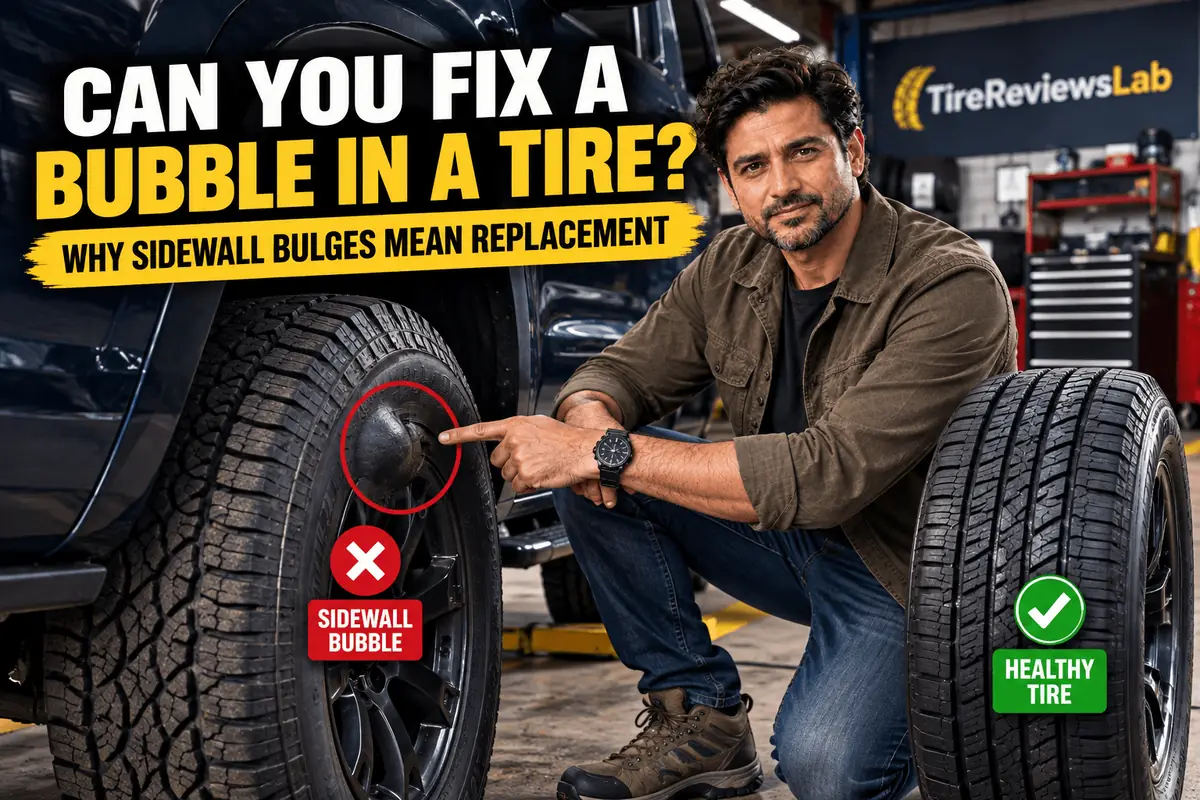
You walk past your car and notice a lump on the side of one tire, a rounded swelling that was not there last week. The tire holds air, the car drives normally, and the obvious question follows: can this be patched, or are you buying a new tire? The short answer is the one nobody wants to hear. A bubble in a tire cannot be repaired, and the tire needs to be replaced.
That bulge is not cosmetic. It is a sign that the internal structure has failed and that the only thing holding air back at that spot is a thin layer of outer rubber. This guide explains what creates a tire bubble, how to tell a real bulge from a harmless indentation, what to do the moment you find one, how warranty and road hazard coverage usually treat it, and how to lower the odds of seeing another.
Table of Contents
What a Tire Bubble Actually Is
A modern radial tire is built in layers. Beneath the outer rubber sit body plies made of fabric cords, steel belts under the tread, and an airtight inner liner that keeps the pressurized air where it belongs. The cords give the tire its strength and shape. Rubber alone cannot contain 30-plus psi of air at highway speed.
A bubble forms when some of those cords break or separate. Air then works its way past the damaged area and pushes outward against the sidewall rubber, which has no cord reinforcement left behind it at that point. The result is a visible blister, sometimes small and firm, sometimes the size of a golf ball. Shops also call it a bulge, a sidewall bubble or a tire aneurysm.
The key fact is that the damage is internal. What you see on the outside is only the symptom. The broken cords that caused it are hidden inside the casing, and they do not heal, stabilize or bond back together.
What Causes Bubbles in Tires
Impact Damage
Most bubbles start with a single hard hit. A pothole with a sharp edge, a curb taken too fast or at a bad angle, a chunk of debris or a raised expansion joint can pinch the sidewall between the object and the wheel rim. That squeeze can snap cords inside the tire without cutting the outer rubber at all. The bulge may show up immediately or appear over the following days as air gradually finds its way into the damaged area.
Low-profile tires are especially vulnerable. With less sidewall height between the rim and the road, there is less cushion to absorb an impact before the rubber gets pinched.
Underinflation and Overloading
A tire running low on air flexes more with every revolution, and the sidewall bears the brunt of that flexing. Extra flex builds heat, and heat weakens the bond between the rubber and the cords inside. An underinflated tire also bottoms out more easily over a pothole, which makes the pinch damage described above far more likely. Carrying more weight than the tire’s load rating allows has a similar effect.
Manufacturing Defects
Occasionally a bubble traces back to the factory rather than the road. Poor bonding between layers during production can leave a weak area that eventually lets go. Defects of this kind are rare with modern quality control, but they do happen, and they matter a great deal when it comes to warranty coverage.
Age and Chemical Exposure
Rubber loses flexibility as it ages, and harsh chemicals can speed that process along. An old, hardened tire is more likely to suffer internal damage from an impact it might have shrugged off when it was new. Age rarely creates a bubble by itself, but it lowers the margin for error.
Bubble or Normal Sidewall? How to Tell the Difference
Not every irregularity on a sidewall is a problem. Many drivers panic over a feature that is completely normal, while others dismiss a real bulge as a molding mark. Here is how to sort them out.
Sidewall Indentations and Undulations
Radial tires are made by wrapping the body ply around the tire and overlapping the ends where they meet. That overlap, called a splice, contains a double layer of cord material, so it stretches slightly less than the rest of the sidewall when the tire is inflated. The result is a shallow dip or vertical crease on the sidewall, sometimes more than one, that tire makers commonly call an indentation or an undulation.
These marks point inward, not outward. They tend to be more visible on tires with tall, smooth sidewalls and on brand-new tires, and they are not a structural defect. A tire with an indentation is perfectly safe to drive.
Signs You Are Looking at a Real Bubble
- The area bulges outward from the normal contour of the sidewall.
- The shape is a rounded blister or lump rather than a narrow crease.
- It sits on one spot of the tire and does not repeat in a regular pattern.
- It often appears after a pothole, curb strike or other impact.
- The rubber over the bulge may feel firm and stretched when pressed.
Clean the tire and look at it in good light from more than one angle. Running a hand gently around the sidewall helps too, since a bulge you cannot easily see is often easy to feel. Check the inner sidewall as well, because impact damage on that side is easy to miss.
| Feature | Normal Indentation | Tire Bubble |
|---|---|---|
| Direction | Dips inward | Pushes outward |
| Shape | Narrow vertical crease | Rounded blister or lump |
| Cause | Ply splice from manufacturing | Broken or separated internal cords |
| Typical timing | Visible from new | Appears after an impact |
| Safe to drive? | Yes | No, replace the tire |
Bubbles in the Tread Area
Although the sidewall is the most common location, a bulge can also appear in the shoulder or the tread. A bump in the tread usually signals belt or tread separation, which is just as serious. You may feel it before you see it, as a rhythmic thump or a vibration that gets worse with speed.
Can a Tire Bubble Be Repaired?
No. Tire repair standards in the US allow puncture repairs only within the tread area, using a combination patch and plug installed from inside the tire after it has been removed from the wheel. The sidewall falls outside the repairable zone, and a bubble is not a puncture in the first place. It is structural damage to the cords that carry the load.
That rules out every shortcut you may see online:
- Plugs and patches seal holes. They cannot reconnect broken cords.
- Tire sealant coats the inside of the tire to stop small leaks. It does nothing for a separation.
- Glues, rubber compounds and external patches may cover the bulge, but the damaged cords underneath stay broken.
- Letting air out can make the bubble look smaller, yet running a tire underinflated adds heat and flex to an already weakened area.
- Puncturing the bubble to release air simply creates a hole in the only thing holding the air in.
A reputable shop will not attempt to repair a sidewall bubble on a passenger car or light truck tire. If someone offers to, find a different shop.
A bubble means the cords inside the tire are already broken. Any fix that covers the bulge leaves the actual damage in place.
What to Do as Soon as You Find a Bubble
Treat the tire as a blowout waiting to happen, because that is what it is. The bulge can grow with heat and speed, and when the outer rubber finally gives way, the tire loses air all at once. At highway speed, that can mean a sudden pull, a loss of steering control and a very bad day.
- Stop driving on the tire as soon as you can do so safely.
- Fit the spare, or call roadside assistance if you are not comfortable changing a wheel yourself.
- If you have a compact temporary spare, respect its speed and distance limits, usually printed on the spare or listed in the owner’s manual.
- Drive as little as possible until the damaged tire is replaced, and avoid highways if you can.
- Get the tire to a shop promptly and have the wheel checked too, since a hit hard enough to break cords can also bend a rim.
If you have no spare and no way to get help, driving slowly and gently over the shortest possible route to a tire shop is the only reasonable option. Do not leave the bubbled tire on the car for days while you shop around.
Replacing One Tire or More
Once you are at the shop, the question becomes whether you need one tire or several. If the other tires are fairly new, replacing just the damaged one is often fine, ideally with the same model and size. If they are well worn, the new tire will have noticeably more tread than its partner on the same axle, which can affect handling, so many shops recommend replacing tires in pairs.
All-wheel-drive vehicles add a wrinkle. Many AWD systems are sensitive to differences in tire diameter, and a new tire next to worn ones can strain the drivetrain. Your owner’s manual will list any tread-depth matching requirement. Some tire shops can shave a new tire down to match the others, which can save you from buying a full set.
Will Warranty or Road Hazard Coverage Pay for It?
Coverage depends on what caused the bubble, and that distinction drives almost every claim decision.
Manufacturer Warranty
The manufacturer’s limited warranty covers defects in materials and workmanship. If an inspection finds that the bubble came from a production flaw, the tire may be replaced free early in its life or with a prorated credit later on. These warranties commonly run around six years from purchase, but terms differ by brand and tire line, so check the booklet for your specific tires.
Impact damage is a different story. Bubbles caused by potholes, curbs and road debris are classified as road hazard damage, and standard manufacturer warranties almost always exclude them. Since most bubbles come from impacts, most bubble claims under a manufacturer warranty are denied. A shop inspecting the tire will look for evidence such as a pinch mark, a scuff on the sidewall or a matching dent in the rim.
Road Hazard Protection
Road hazard plans are the coverage that actually fits a typical bubble. These plans are usually sold by the retailer at the time of purchase, and some tire lines include limited road hazard coverage. They often cover impact damage that the manufacturer will not, although many prorate the replacement after the early part of the tire’s life, and some require you to return to the selling retailer. If you drive on rough roads, a plan can pay for itself with a single pothole.
Auto Insurance
Standard auto policies generally do not pay for tire damage from road hazards on its own. Tire damage can be covered when it is part of a larger insured event, such as vandalism or a collision. Check your policy before assuming either way.
| Cause of Bubble | Manufacturer Warranty | Road Hazard Plan |
|---|---|---|
| Manufacturing defect | Usually covered, often prorated | Varies by plan |
| Pothole or curb impact | Usually excluded | Often covered |
| Road debris | Usually excluded | Often covered |
| Running underinflated or overloaded | Usually excluded | Usually excluded |
Keep your receipt, installation invoice and service records. Without them, any claim gets harder, whatever the cause.
How to Prevent Tire Bubbles
You cannot dodge every pothole, but a few habits make a bubble much less likely.
- Check tire pressure monthly with a quality gauge, using the figure on the driver’s door jamb placard. Check when the tires are cold, and remember that pressure drops about 1 psi for every 10°F fall in temperature.
- Slow down for rough pavement. Speed multiplies the force of an impact. Easing off before a pothole, railroad crossing or broken patch of road gives the tire a far better chance of surviving it.
- Approach curbs carefully. Parallel parking and tight turns are classic sources of pinch damage. Avoid scraping or climbing curbs.
- Respect load ratings. Stay within your vehicle’s payload limit and your tires’ load capacity, and adjust pressure when carrying heavy loads or towing if the vehicle manufacturer calls for it.
- Inspect after impacts. Any time you hit something hard, look at the tire within the next day or two, since a bubble can take a little time to develop.
- Rotate and inspect regularly. A rotation every 5,000 to 7,000 miles, or on your vehicle’s schedule, is a good moment for a technician to look over every sidewall.
- Consider sidewall height when buying. A tire with a taller sidewall offers more cushion than an ultra-low-profile tire, which is worth weighing if your local roads are rough.
Frequently Asked Questions
No. A bubble means the internal cords are broken or separated, and no plug, patch, sealant or glue can restore them. Sidewalls fall outside the area where tire repairs are permitted. The only safe fix is to replace the tire.
You should not drive on it any longer than it takes to get somewhere safe and fit the spare. There is no reliable mileage figure, because a bulge can fail at any time, and heat, speed and load all speed up that failure. Highway driving on a bubbled tire is especially risky.
Usually not. A shallow inward dip or vertical crease is normally a sidewall indentation caused by the overlapping ply splice inside the tire, and it is harmless. A bubble pushes outward from the sidewall and typically appears after an impact. If you cannot tell which you have, a tire shop can confirm it in a few minutes.
Only if the bubble comes from a manufacturing defect. Most bubbles result from potholes, curbs or debris, which manufacturer warranties typically exclude. A road hazard protection plan, if you bought one with the tires, is the coverage more likely to pay for impact damage.
The impact can break cords inside the tire without any immediate visible sign. Air then gradually works into the damaged area, and the outer rubber stretches until the bulge becomes noticeable. That delay is why it is worth inspecting your tires a day or two after any hard hit.
Not always. If the other tire on that axle is fairly new, replacing only the damaged one is often acceptable. If it is well worn, replacing both keeps handling balanced. All-wheel-drive owners should check the owner’s manual for tread-depth matching requirements.
Yes, they tend to be more vulnerable. A shorter sidewall leaves less rubber and air between the wheel rim and the road, so a pothole or curb is more likely to pinch the sidewall hard enough to break internal cords.
The Verdict on Tire Bubbles
A bubble in a tire is one of the few tire problems with no gray area. It means the cords inside the casing are broken, it cannot be repaired by any shop or product, and it puts the tire at real risk of a sudden blowout. The right response is to get the tire off the car, fit the spare, drive as little as possible and replace it promptly.
What you can influence is the paperwork and the prevention. Check whether a manufacturing defect or a road hazard plan might cover the replacement, keep your records handy, and make pressure checks and careful pothole driving a habit. Before panicking over a mark on a brand-new tire, though, make sure it is not a harmless inward indentation. If it pushes out, it has to go.
 Summarize this article with:














Leave a comment