


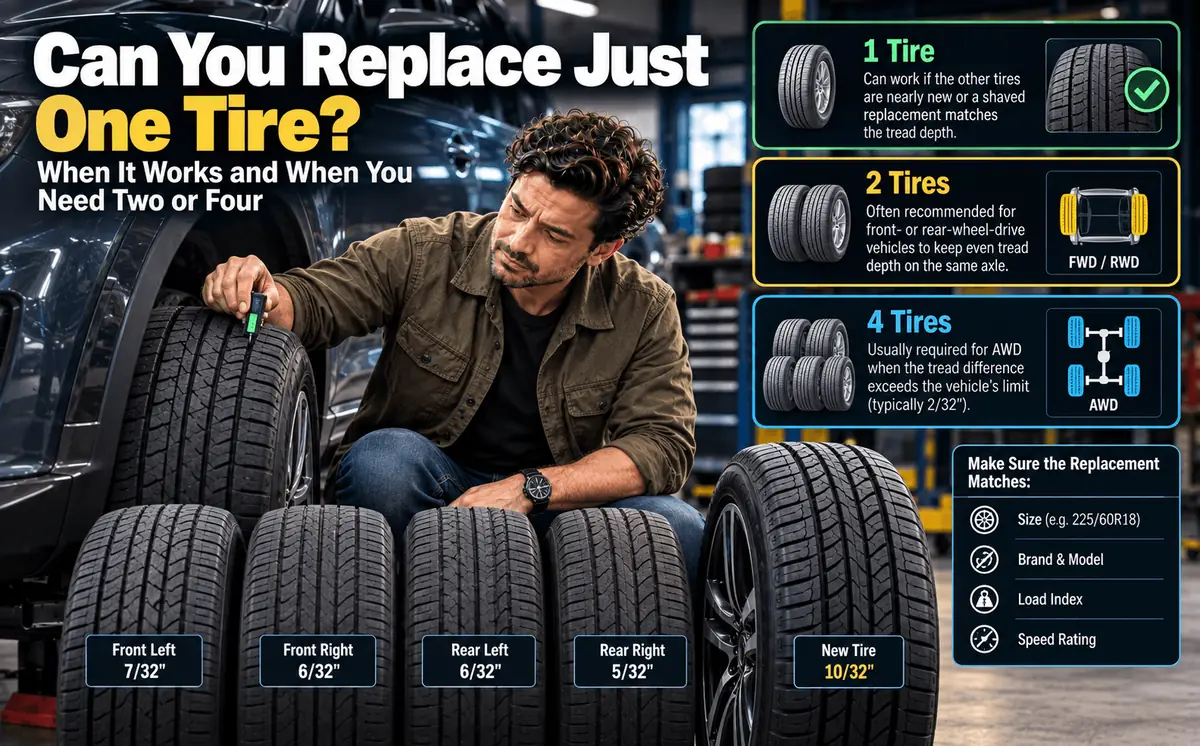
A nail in the sidewall or a pothole that slices the tread leaves you with one ruined tire and three that still look fine. Then the shop tells you it wants to sell you two, or even four. It is easy to read that as an upsell, and sometimes it is. Just as often, though, the advice is sound, because a single new tire can upset the way your car brakes, corners, and puts power to the ground.
The answer depends on three things: how worn the remaining tires are, which wheels drive the car, and whether you can find an exact match for what is already on it. This guide walks through when one tire is perfectly acceptable, when replacing a pair is the smarter move, why all-wheel-drive vehicles are the strictest case, and how tire shaving can save you from buying a full set.
Table of Contents
The Quick Answer
You can replace just one tire when the other three are close to new, or when the replacement can be shaved down to match their tread depth. In most other cases, the safer approach is to replace tires in pairs on the same axle, and on many all-wheel-drive vehicles you may need all four unless the tread depths are close enough to stay within the automaker’s limit.
| Situation | Usual Recommendation |
|---|---|
| Other three tires are nearly new | One matching tire is fine |
| Front- or rear-wheel drive, other tires partly worn | Replace two on the same axle, new tires on the rear |
| AWD, tread difference within the owner’s manual limit | One matching tire is fine |
| AWD, tread difference beyond the limit | Replace all four, or buy one shaved tire |
| Exact model is no longer available | Replace at least the pair on that axle |
Why Tread Depth Changes Tire Size
Tread depth is not only about grip. It also changes the outside diameter of the tire. Most new passenger tires start with roughly 10/32 to 12/32 inch of tread. A tire worn to 4/32 inch has lost a meaningful amount of rubber all the way around, so its circumference is smaller than a fresh tire of the same size.
A smaller tire has to turn more times to cover the same distance. Put one new tire on a car with three worn ones and that new tire turns at a slightly different speed from the others, even on a perfectly straight road. On a two-wheel-drive car, the main consequences show up as uneven grip and handling. On an all-wheel-drive car, that constant speed difference reaches the drivetrain itself.
All-Wheel Drive: The Strictest Case
AWD systems split power between the front and rear axles through a center differential, a clutch pack, or a coupling. Those parts expect the front and rear wheels to turn at the same speed most of the time. They handle the brief differences that come from turning a corner or a moment of wheelspin, but a permanent mismatch is a different matter.
When one tire is noticeably larger than the rest, the system sees continuous slip that never goes away. The coupling or differential keeps working to reconcile the difference mile after mile, which builds heat and wears internal parts. Over time, that can lead to repairs that cost far more than the tires you were trying to avoid buying.
How Much Difference Is Allowed
Each automaker sets its own tolerance. Many AWD manufacturers limit the difference between tires to about 2/32 to 4/32 inch of tread depth, while others express the limit as a maximum difference in tire circumference. Your owner’s manual is the authority for your vehicle, and it is worth reading that section before you buy anything.
On an AWD vehicle, measure the tread on the three remaining tires before you shop. If they are worn beyond your manual’s limit compared with a new tire, a single unshaved replacement is the wrong purchase.
A tread depth gauge costs only a few dollars and gives you a real number. Measure each tire in several grooves and use the figures to compare against a new tire’s starting depth.
Front- and Rear-Wheel Drive: Think in Pairs
Two-wheel-drive cars are more forgiving because the front and rear axles are not linked through a center differential. That does not mean a single new tire is free of consequences.
Put one new tire next to a worn one on the same axle and the two tires have different diameters and different levels of grip. On the drive axle, the car can tug to one side under hard acceleration. Under heavy braking, the tire with more tread bites differently than the worn one, which can make the car twitch or pull. Both effects get worse on wet pavement.
That is why the usual advice is to replace both tires on the same axle. If the right front is ruined, replace the left front with it. If the tire you remove still has plenty of life, it can serve as a full-size spare, which is a real upgrade over a compact temporary spare.
Why New Tires Go on the Rear
Most drivers assume new tires belong on the front, especially on a front-wheel-drive car where the front tires steer, brake, and do the driving. Tire-industry guidance says otherwise: when you install only two new tires, they go on the rear axle.
The reasoning comes down to what happens when grip runs out. Worn tires hydroplane sooner and lose traction earlier in a hard corner.
- Worn tires on the rear: The back of the car loses grip first and swings outward. This is oversteer, and it can turn into a spin that few drivers can catch, especially in the rain.
- Worn tires on the front: The front loses grip first and the car pushes wide. This is understeer, and most drivers recover from it naturally by easing off the accelerator and letting the front tires regain traction.
Understeer is the more predictable and more recoverable of the two, so the deeper tread belongs at the back. If you are forced to buy a single tire for a two-wheel-drive car, the same logic applies: mount it on the rear, ideally paired with whichever remaining tire has the most tread, and move the more worn tires forward.
Moving tires between positions is also a good moment to look at rotation and alignment, since uneven wear on the other tires often points to an alignment issue that will chew up the new tire too. Our guide to tire rotation and alignment covers both in detail.
Tire Shaving: Matching a New Tire to Worn Ones
Throwing away three healthy tires because one was damaged feels wasteful, and on an AWD car it may not be necessary. Tire shaving uses a specialized machine, similar to a lathe, to remove rubber from a new tire until its tread depth matches the rest of the set.
The trade-offs are simple to weigh:
- Advantages: You buy one tire instead of four, and the AWD system sees four tires of essentially the same circumference.
- Disadvantages: You pay full price for a tire and then pay a fee to remove part of its tread life. Fewer local shops offer the service than in the past, although some online tire retailers will shave a tire before shipping it.
Shaving makes the most sense when the remaining tires still have substantial tread left. If they are already close to replacement, the money is better spent on a new set.
What Must Match on a Single Replacement
Even when tread depth is close, a replacement tire needs to match the others in several ways.
Size
The size on the sidewall, such as 225/65R17, must be identical. A tire from a different size can have a different outside diameter even when new, which brings back the same circumference problem you were trying to avoid.
Brand and Model
Different tire models use different rubber compounds, tread patterns, and internal construction. One may channel water more effectively than another, and one may have a stiffer sidewall. Mixing models on the same axle creates uneven grip from side to side, which is most noticeable in emergency braking and wet cornering. The ideal replacement is the same brand and model as the tire it replaces. If that model has been discontinued, replacing the pair on that axle is the better route.
Load Index and Speed Rating
The load index and speed rating appear together after the size, as in 98H. A replacement should carry the same load index and speed rating as the originals, or at least meet what your vehicle’s placard specifies. Never mix speed ratings on the same axle. Tires with different speed ratings often differ in construction and steering response, so mixing them can make the car feel unsettled.
Age
Rubber ages even when a tire sits unused. If a shop offers a tire that has been on the shelf for years, or you are considering a used tire to match the remaining tread, check the DOT code on the sidewall. The last four digits give the week and year of manufacture, so 2423 means the 24th week of 2023. A used tire also brings an unknown history of repairs, impacts, and underinflation, so have it inspected before it goes on your car.
When One Tire Is Perfectly Fine
Replacing a single tire is a reasonable choice in several situations:
- The set is nearly new. If the other three tires have only a few thousand miles on them and have lost very little tread, a new matching tire will sit within any sensible tolerance.
- The replacement is shaved to match. Once the new tire’s tread depth equals the others, the size difference disappears.
- The tread difference is within your owner’s manual limit. On an AWD vehicle, measure first and compare against the automaker’s figure.
- The exact same model and size is available. A matching tire avoids the handling inconsistencies that come from mixing models.
If none of those apply and money is tight, a single new tire on the rear of a two-wheel-drive car is a stopgap rather than a fix. Drive more cautiously in the wet, keep an eye on the remaining tires, and plan to replace the pair when you can.
Other Things to Check at the Shop
A tire that failed from impact or uneven wear often leaves clues about the car. A hard pothole hit can knock the suspension out of alignment, and a tire that wore bald on one edge almost always points to an alignment problem. Ask the shop to check the alignment when the new tire goes on so the replacement does not wear out the same way.
Warranties are another reason to be careful. Many vehicle warranties exclude drivetrain damage caused by mismatched tires, and tire mileage warranties typically require regular rotation and even wear across the set. Mixing one new tire into a worn set can complicate either kind of claim, so read the terms before you buy.
Frequently Asked Questions
Yes, if the tread depth of the remaining tires is within the limit your owner’s manual specifies, or if the new tire is shaved to match them. Many automakers set that limit at roughly 2/32 to 4/32 inch, while some use a circumference figure. If the difference exceeds the limit, the safe choice is either a shaved tire or a full set of four.
The rear. Tire-industry guidance calls for the tires with the deepest tread to go on the rear axle, regardless of whether the car is front-, rear-, or all-wheel drive. Worn rear tires lose grip first on wet roads and can send the car into a spin, while worn front tires produce understeer that is easier to control.
It is best avoided. Different brands and models use different compounds, tread designs, and construction, so they grip and respond differently. If you must mix in an emergency, keep matching tires together on the same axle and replace the odd tire with the correct one as soon as possible.
Most new passenger car tires start with about 10/32 to 12/32 inch of tread depth. Light truck and off-road tires often start deeper. Comparing that starting figure with the depth of your current tires tells you how far apart a new tire would be from the rest of the set.
It is worth considering on an AWD vehicle when the other three tires still have plenty of tread left. Shaving costs a fee on top of the tire price and removes some of the tread you paid for, but it can save you from buying three tires you do not yet need. When the remaining tires are close to worn out, a new set is the better investment.
Not always, but it is often a good idea. If the old tire failed after a hard impact, or if any of your tires show wear on one edge, the alignment may be off. Checking it protects the new tire from wearing unevenly.
The Bottom Line on Single-Tire Replacement
Replacing just one tire is not a scam to avoid at all costs, and it is not always safe either. It works well when the rest of the set is nearly new, when the replacement is an exact match in size, model, load index, and speed rating, and, on an AWD vehicle, when the tread difference stays inside the automaker’s limit or the new tire is shaved to fit. Outside those conditions, replace tires in pairs with the new ones on the rear axle, and on AWD vehicles plan for four. Spending a little more at the counter costs far less than a damaged drivetrain or a car that loses its rear end on a wet highway.
 Summarize this article with:
















Leave a comment