


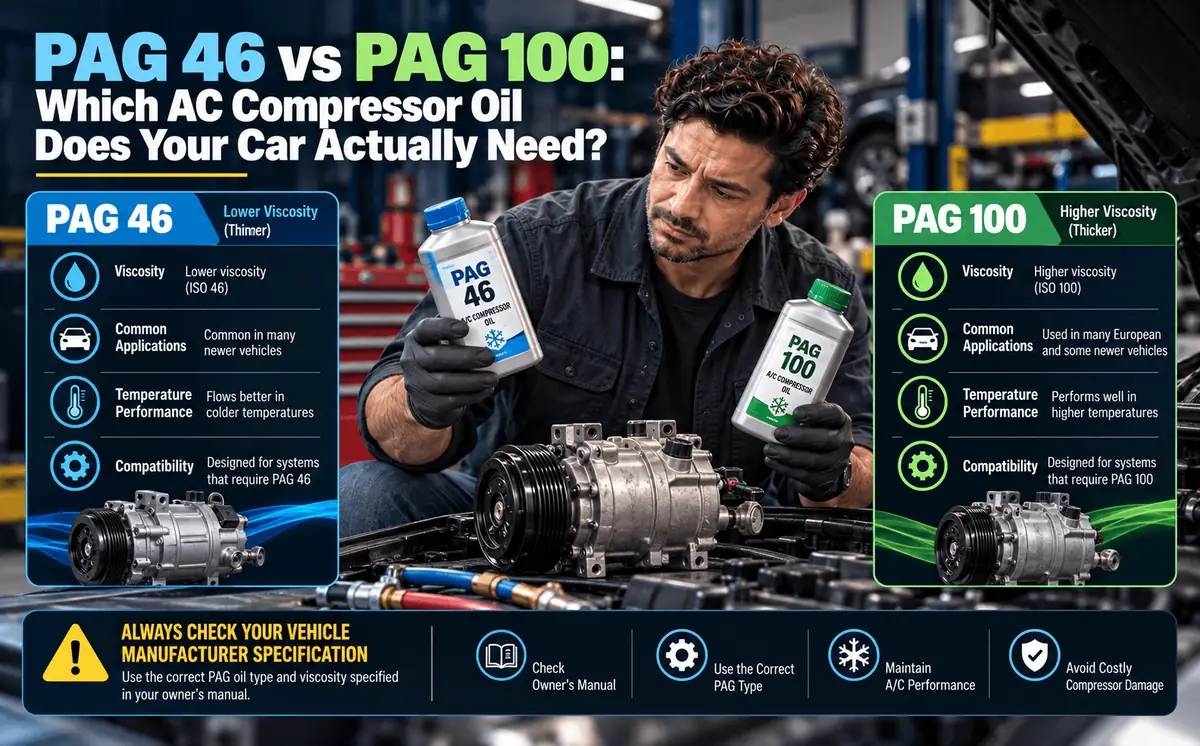
Stand in the AC section of any auto parts store and you will see two bottles that look nearly identical: PAG 46 and PAG 100. If you are replacing a compressor, the choice between them matters far more than the small price difference suggests. The wrong oil can quietly starve a brand-new compressor of lubrication or clog the system with oil that will not circulate, and either mistake can mean buying the compressor twice.
The short version: most modern passenger cars call for PAG 46, while many Chrysler, Dodge, Jeep, and Ram vehicles, along with some older trucks and high-capacity systems, call for PAG 100. But the real answer for your car is printed on your compressor’s label and in your vehicle’s service information, not in a general rule. This guide explains the difference, why it matters, and how to get it right.
How this guide was put together: This guide is general information based on common manufacturer and industry guidance; your owner’s manual is the controlling source. Prices are typical ranges, not quotes. Checked on October 22, 2026.
Table of Contents
PAG 46 vs. PAG 100 at a Glance
| Factor | PAG 46 | PAG 100 |
|---|---|---|
| Viscosity | Lower (thinner) | Higher (thicker) |
| Typical vehicles | Most modern cars, including many Honda, Toyota, GM, and Ford models | Many Chrysler/Dodge/Jeep/Ram vehicles, some trucks and SUVs, older and high-capacity systems |
| Common refrigerant pairing | R-134a; YF-specific versions for R-1234yf | Mostly R-134a |
| Typical compressor types | Scroll, rotary vane, many swash-plate designs | Many variable-displacement and some piston-type designs |
| Main strength | Circulates easily through tight modern systems | Thicker protective film for larger, harder-working compressors |
| Mixing with other grades | Not recommended | Not recommended |
| Price | Slightly lower | Slightly higher |
What PAG Oil Is and Why It Matters
PAG stands for polyalkylene glycol, a fully synthetic lubricant made for automotive AC compressors in R-134a and R-1234yf systems. It replaced the mineral oil used with R-12, the older refrigerant phased out in the 1990s.
The key thing to understand about AC oil is that it does not stay in the compressor. There is no separate oil reservoir. The oil travels with the refrigerant through the entire system, including the condenser, the expansion valve or orifice tube, and the evaporator, and back to the compressor. Every time the refrigerant circulates, it carries the oil that lubricates and seals the compressor’s precision internal parts.
That means the oil you choose affects the whole system:
- Compressor life, through the thickness of the protective film between moving parts
- Cooling performance, because oil that does not circulate well restricts refrigerant flow
- Seal health, since PAG oil also conditions the system’s rubber seals and O-rings
- System pressures, because viscosity changes how the oil-refrigerant mix moves through the components
PAG oil is also hygroscopic, meaning it absorbs moisture from the air. Moisture inside an AC system causes acid formation and corrosion, so how you store and handle the oil matters as much as which grade you buy.
The Core Difference: Viscosity
The number after “PAG” is its ISO viscosity grade. The higher the number, the thicker the oil. PAG 100 is more than twice as viscous as PAG 46, and a heavier PAG 150 grade also exists for some older applications.
Everything else follows from that:
- PAG 46 flows freely, moving easily with the refrigerant through narrow passages in the evaporator and condenser. That makes it a natural fit for modern, tight-tolerance systems built around efficiency.
- PAG 100 builds a thicker protective film on compressor internals. Compressors with heavier internal loads, particularly some piston-type and variable-displacement designs, are engineered around that extra film strength.
Neither oil is better in general. Each is correct for the compressor it was specified for.
Compressor Design Decides the Oil
A common mistake is choosing oil based on the size or age of the vehicle. What actually determines the requirement is the compressor’s design.
| Compressor Type | Typical PAG Grade |
|---|---|
| Scroll (common in modern cars) | PAG 46 |
| Rotary vane | PAG 46 |
| Swash plate / axial piston | PAG 46 or PAG 100, depending on the application |
| Variable displacement | Often PAG 100 |
| Older fixed-displacement piston | PAG 100 or PAG 150 |
Most new and remanufactured compressors have the correct oil grade printed or stamped on the unit. Check before you start. If yours is not labeled, look it up in the service information for your exact vehicle.
Which Vehicles Typically Use Each Oil
Where PAG 46 Is Common
PAG 46 is the most widely specified AC oil in modern U.S.-market passenger vehicles. It is typically found in:
- Honda and Acura vehicles, almost across the board
- Toyota and Lexus vehicles
- Many modern GM vehicles with scroll-type compressors
- Many Ford and Lincoln vehicles
- Recent Hyundai and Kia platforms
- Most Nissan, Infiniti, and Subaru models
- Many R-1234yf systems, which often call for a YF-specific PAG 46 formulation
Where PAG 100 Is Common
PAG 100 appears most often in:
- Chrysler, Dodge, Jeep, and Ram vehicles, where it is common across many platforms
- Some Ford F-Series and E-Series trucks with larger compressors
- Older GM trucks with reciprocating piston compressors
- Some Mercedes-Benz and other European models
- Commercial vans and fleet vehicles with high-capacity AC systems
- Systems with variable-displacement compressors designed for a heavier oil film
Brand Tendencies
| Brand | Commonly Specified Oil | Notes |
|---|---|---|
| Honda / Acura | PAG 46 | Nearly universal across the lineup |
| Toyota / Lexus | PAG 46 | Hybrid models may differ |
| Ford / Lincoln | PAG 46 | Most models; heavy-duty trucks may vary |
| Chevrolet / GMC | PAG 46 | Modern platforms; some older trucks use PAG 150 |
| Chrysler / Dodge / Jeep / Ram | PAG 100 | Very common across these brands |
| Hyundai / Kia | PAG 46 | Recent platforms |
| Nissan / Infiniti | PAG 46 | Most models |
| Subaru | PAG 46 | Most platforms |
| BMW | PAG 46 or a brand-specific oil | Check carefully |
| Mercedes-Benz | Varies | Some use PAG 100; others require brand-specific oils |
Treat this table as a starting point, not a substitute for your vehicle’s specification. Exceptions exist within every brand. Hybrids and EVs deserve special caution: many use electrically driven compressors that require a specific oil with electrical insulating properties, and using standard PAG in those systems can cause serious problems.
Pros and Cons of Each Oil
PAG 46
Strengths:
- Circulates efficiently through the whole system, including the evaporator
- Ideal for scroll and rotary compressors, the most common designs in modern cars
- Widely available at major parts stores and online
- Used with R-134a, with YF-specific versions for R-1234yf
- Slightly cheaper than heavier grades
Limitations:
- Too thin for compressors designed around PAG 100 or PAG 150
- Absorbs moisture quickly once opened
PAG 100
Strengths:
- Stronger film for larger, harder-working compressors
- Holds up well under sustained high heat and load
- Reduces metal-to-metal contact in heavy piston-type designs
- Well suited to trucks, SUVs, and commercial vehicles running the AC hard for long periods
Limitations:
- Too thick for most modern scroll compressors
- Generally not the right choice for R-1234yf systems
- Slightly more expensive and less widely stocked
- Can pool in the evaporator of a system designed for thinner oil, reducing cooling
Climate Doesn’t Override the Spec
It is tempting to think a car in Phoenix or Dallas needs heavier oil than the same car in Seattle. In extreme heat, larger vehicles working their AC hard do benefit from PAG 100’s film strength, but only when PAG 100 is what the compressor was designed for. If your car calls for PAG 46, that is what goes in, regardless of where you live.
Humidity does matter in one respect. Both oils absorb moisture, so in humid regions it is especially important to replace the receiver/drier or accumulator during any major AC service, since the desiccant inside traps moisture that would otherwise attack the system.
What Happens If You Use the Wrong PAG Oil
Getting it wrong does not usually cause instant failure. It causes slow damage that shows up months later.
PAG 100 in a system that calls for PAG 46:
- The thicker oil does not circulate properly
- Oil can pool in the evaporator, starving the compressor of the oil and refrigerant it needs
- The compressor runs hotter with less lubrication than designed
- Failure can follow within a season or two
PAG 46 in a system that calls for PAG 100:
- The film between metal parts is too thin
- Pistons, cylinder walls, and bearings wear faster
- The compressor may rattle or knock
- The compressor can fail prematurely, often after showing signs of oil starvation
Warning signs of the wrong oil, or the wrong amount, include:
- Whining, grinding, or rattling from the compressor
- Weak cooling despite a correct refrigerant charge
- Excessive compressor cycling
- Metal particles in the oil, which means the system is contaminated and needs a full flush and component replacement
The economics are lopsided. A bottle of the correct PAG oil typically costs about $10 to $20. A remanufactured compressor commonly runs $200 to $600, and labor can push the total past $1,000. For a broader look at what different AC repairs cost, see our guide to car AC repair costs.
Can You Mix PAG 46 and PAG 100?
No. Different PAG grades will not react violently with each other, but mixing them produces an oil with a viscosity somewhere in between, which is correct for neither design. The compressor was engineered for a specific viscosity, and anything else compromises its lubrication.
If you need to switch a system from one grade to another, for example after installing a compressor that specifies a different oil, the correct procedure is a full system flush.
How to Choose the Right PAG Oil
- Check the compressor label. New and remanufactured compressors usually list the required oil on the unit. This is your first source of truth.
- Confirm it in the service information for your exact year, make, model, and engine, using a factory service manual or a professional repair database rather than a general web search.
- Confirm the refrigerant type. R-134a systems may use PAG 46, 100, or 150 depending on the compressor. R-1234yf systems typically require a YF-specific PAG formulation, which is not necessarily interchangeable with standard PAG 46. The refrigerant type is usually on a label under the hood.
- Verify the quantity. The amount matters as much as the grade. Too little oil causes wear; too much reduces refrigerant capacity and cooling. Many systems specify somewhere between 3 and 8 ounces in total, but use your vehicle’s exact figure, and account for oil already in a new compressor or remaining in components you did not replace.
- Be wary of “universal” PAG oil for compressor replacements. Products claiming to replace multiple grades may be acceptable for topping off a working system, but a fresh compressor deserves the exact specified oil.
Common Mistakes to Avoid
- Choosing oil by vehicle size. “Big truck, so PAG 100” sounds logical but is not reliable. Check the spec.
- Reusing old oil. After a compressor failure, especially one that left metal debris, all the old oil must come out. Contaminated oil can destroy a new compressor quickly.
- Leaving bottles open. PAG oil absorbs moisture fast. Keep caps tight, and do not use oil from a bottle that has been sitting open.
- Overfilling. Excess oil displaces refrigerant and cuts cooling efficiency. Measure with a graduated cylinder instead of eyeballing it.
- Skipping the vacuum. After major AC work, pull a deep vacuum, commonly 500 microns or lower held for 30 minutes or more, to remove moisture and air before recharging. Skipping it invites acid formation and corrosion.
- Using PAG in an R-12 system. Vintage R-12 systems use mineral oil, and PAG is not compatible. Converting an R-12 system to R-134a requires a full flush.
- Buying the cheapest no-name oil for a compressor replacement. Quality varies, and established AC brands are worth the small premium on a job this expensive.
Final Verdict: PAG 46 or PAG 100?
Choose PAG 46 if:
- You drive a modern passenger car from Honda, Toyota, Hyundai, Kia, Nissan, Subaru, or most GM and Ford platforms
- Your compressor label or service information specifies PAG 46
- You have an R-1234yf system that calls for a YF-specific PAG 46
Choose PAG 100 if:
- You drive a Chrysler, Dodge, Jeep, or Ram vehicle and the spec confirms it
- You have an older truck or SUV with a piston-type or variable-displacement compressor that calls for it
- Your compressor label or service information explicitly says PAG 100
- You are servicing a high-capacity commercial AC system that specifies it
In every case, the compressor label and the vehicle’s service information are the only sources that settle the question. Forums, rules of thumb, and parts-counter advice are useful starting points, nothing more.
If you are replacing a compressor, take your time: flush the system, add the correct oil in the correct amount, replace the receiver/drier or accumulator, pull a proper vacuum, and recharge to spec. Done right, it is a job you will not have to repeat for a long time.
Frequently Asked Questions
Viscosity. PAG 46 is thinner and circulates easily through modern, tight-tolerance AC systems. PAG 100 is more than twice as viscous, providing a thicker protective film for compressors designed around it, such as many larger piston-type and variable-displacement units.
Check the label on your compressor and the service information for your exact vehicle. As a general pattern, most modern passenger cars use PAG 46, while many Chrysler, Dodge, Jeep, and Ram vehicles use PAG 100, but exceptions exist within every brand.
No. Mixing creates an in-between viscosity that is wrong for both compressor designs. If you need to change grades, flush the system completely.
Not always. Many R-1234yf systems call for a YF-specific PAG formulation, which is not necessarily interchangeable with standard PAG 46. Confirm the exact oil your system requires before adding anything.
Oil that is too thick can pool in the evaporator and starve the compressor, while oil that is too thin leaves inadequate protection between moving parts. Either way, the likely result is noise, weak cooling, and premature compressor failure.
Only if your compressor is designed for it. Climate never overrides the manufacturer’s specification; a car that calls for PAG 46 should get PAG 46 even in extreme heat.
It varies by vehicle, commonly somewhere between 3 and 8 ounces in total. Use the exact figure for your system, because too much oil reduces cooling and too little causes wear.
Often not. Many hybrids and EVs use electrically driven compressors that require a specific oil with electrical insulating properties. Using standard PAG in those systems can cause damage, so always follow the manufacturer’s specification.
Sources
Specs, warranty terms and prices were checked on October 22, 2026. Prices change often.
- FTC: Auto warranties and routine maintenance (service records and warranty coverage)
 Summarize this article with:
















Leave a comment